
Reviewed · ATHENS MYTHOLOGY TOURS
Mythology, Philosophy and Democracy Tour
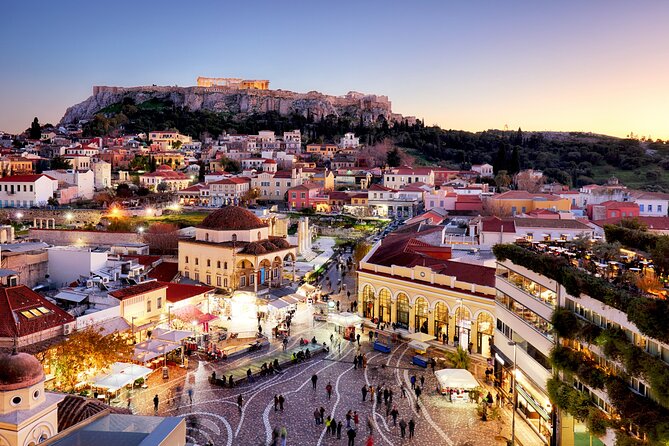
The most useful thing about this Athens walk is its clear idea: it links mythology, philosophy, and democracy instead of treating ancient sites as isolated ruins. You move from the cemetery at Kerameikos to the political ground of the Pnyx, then finish on Philopappos Hill with wide views toward the Acropolis.
I like the small maximum of 12 people, which gives Panos room to adjust the conversation and answer questions. I also like the route itself: it includes famous places such as the Ancient Agora, but also quieter stops many first-time visitors might miss. The main drawback is the heat and walking. This is an outdoor tour with hills, and the final 45 minutes on Philopappos Hill may feel demanding in strong sun.
Key points to know before booking
- Panos is the central attraction: His storytelling connects ancient events to questions about politics, mathematics, religion, and modern life.
- The route covers more than ruins: You see Kerameikos, the Agora, Monastiraki, the Roman Agora, Plaka, the Pnyx, and Philopappos Hill.
- The Pnyx gives the tour its political focus: This is where citizens gathered for the early democratic assembly.
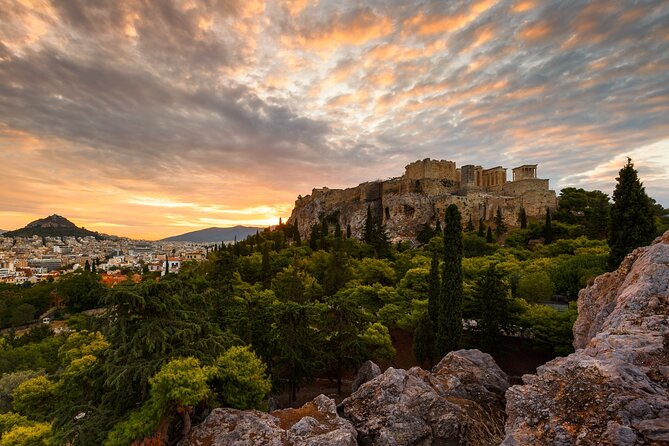
- You finish with some of Athens’s finest views: Philopappos Hill looks toward the Acropolis and the city, especially appealing near sunset or after dark.
- The group is limited to 12 people: That is a useful size for discussion without the feel of a private tour price.
- Plan for outdoor conditions: Wear practical shoes, carry water, and take the weather seriously.
An Athens tour built around ideas, not just monuments
Many Athens walks move from one famous ruin to the next. This one takes a different route. Its subject is the development of human thought, beginning with mythology and religious belief, then moving toward philosophy, observation, science, and democracy.
That theme gives each stop a job. Kerameikos introduces the city and the people who lived and died here. The Agora becomes the setting for argument and public life. The Pnyx shows where political participation took physical form. By the time you reach Philopappos Hill, the Acropolis below you feels connected to a much larger story.
Panos is the guide for Athens Classic Tour. His strength is not simply naming dates or identifying stones. He explains how history, literature, political power, and philosophical questions influenced each other. The best parts of the experience appear to come when he asks you to think, not just listen.
You should not book this expecting a fast overview with a few amusing facts. The tour is more reflective. Panos may connect ancient problems with modern political and social questions, and he encourages critical thinking. That makes the walk especially suitable if you enjoy history, philosophy, or discussions that continue after the tour ends.
More Greek mythology tours in Athens:
- Athens: Mythology of Delphi, Museum and Arachova Guided Tour
★ 4.6 · 4,008 reviews - Athens & Acropolis Highlights: Greek Mythology Small-Group Tour
★ 5.0 · 2,370 reviews - Athens: Acropolis and Mythology Highlights Small Group Tour
★ 4.8 · 2,275 reviews
Kerameikos: a cemetery at the edge of ancient Athens
The walk begins at the Statue of Theseus, with Kerameikos as the first major stop. This area is easy to overlook when you are focused on the Acropolis, but it once played two important roles.
Kerameikos was the center of Athens’s pottery production, which explains its name. It was also the city’s cemetery for many centuries. That combination gives the site a useful human scale. You are not only looking at public buildings and grand political figures. You are also considering how ordinary Athenians made a living, marked death, and remembered important citizens.
This is also the place associated with Pericles’ famous funeral speech, known as the Epitaphios. He delivered it for the first Athenian casualties of the Peloponnesian War and praised the city’s political system and way of life.
The stop is planned for about 25 minutes. That is enough time for Panos to set up the central question of the tour: what did democracy mean to the Athenians, and how did their ideas about citizenship differ from modern assumptions?
Kerameikos is a strong opening because it combines archaeology, civic memory, war, and political speech. It also sets expectations for the rest of the walk. You will be asked to picture Athens as a working city, not just a collection of monuments.
The Ancient Agora: where public life became an argument
The Ancient Agora was the heart of Athens. Citizens came here to shop, meet, conduct public business, and discuss matters affecting the city. It was also associated with figures such as Socrates, Plato, Solon, Themistocles, Pericles, Thucydides, Sophocles, and Aristophanes.
The value of this stop lies in the setting. Philosophy in Athens was not always a private study conducted behind closed doors. Ideas were tested through conversation, disagreement, persuasion, and public debate.
You may find that the Agora means more after hearing how the city worked politically. It was a place where people encountered one another and where public decisions were shaped by speech. Panos uses the site to connect the practical business of the city with the larger development of philosophy and democracy.
The listed stop is about 10 minutes, so expect a focused explanation rather than a long archaeological tour. If you want a detailed examination of every surviving structure, you may need a separate visit. Here, the Agora functions as part of a larger story.
Monastiraki and the Roman Agora: ancient and modern Athens side by side
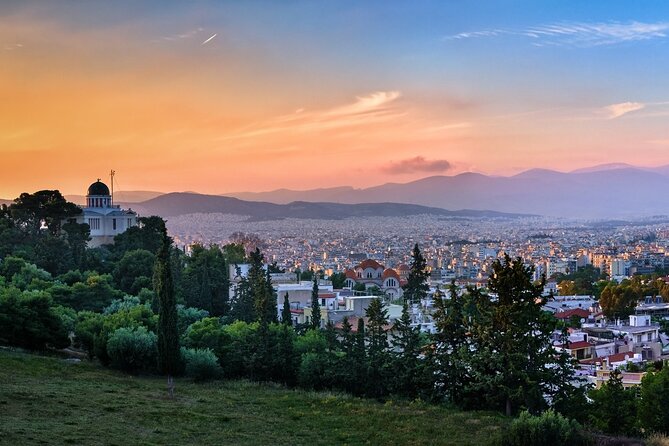
From the Ancient Agora, the route moves through Monastiraki Square and its flea market. This short walk adds a welcome change of pace. You see antique shops, tourist stores, and the everyday city around you rather than only archaeological remains.
I like this part because it reminds you that Athens is not an open-air museum. Ancient stones, modern commerce, food, traffic, and local movement all share the same streets. The contrast helps keep the tour grounded.
The Roman Agora is next, north of the Acropolis and east of the Ancient Agora. This stop shows another layer of the city’s past, when Roman influence shaped Athens. The tour does not present Greece as a single frozen period. Instead, you move through different eras and see how the city changed while retaining its older identity.
Both stops are planned for about 10 minutes. That brevity is useful if you want variety, but it also means you should not expect a long site interpretation at either location. The point is connection: public life, trade, imperial power, and the modern street all form part of Athens’s story.
More philosophy walks in Athens:
- Philosophy and Democracy tour of Athens
★ 5.0 · 285 reviews - Athens Highlights: Myths & Philosophers Walking Tour
★ 5.0 · 125 reviews - Athens: Philosophy and Democracy Walking Tour
★ 5.0 · 91 reviews - Athens: the Great Greek Philosophers Guided Tour in Spanish
★ 4.9 · 59 reviews
The Tower of the Winds: an early weather station and clock
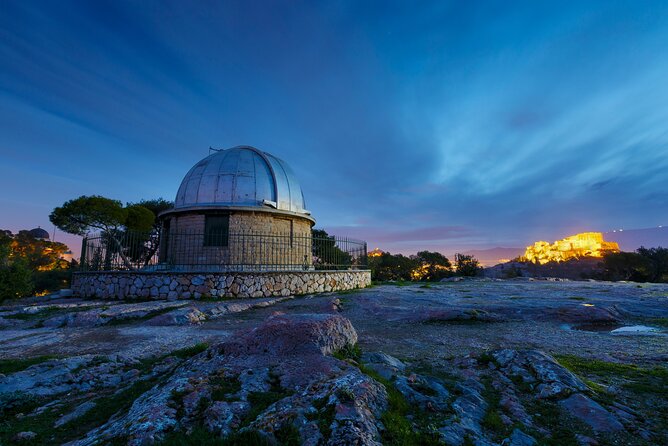
The Tower of the Winds is one of the most memorable stops for anyone interested in science and practical invention. This octagonal structure was designed by the astronomer Andronicus of Kyrristos in the first century BC.
It served as a wind indicator and a clock. Its solar clock marked time in clear weather, while a hydraulic mechanism operated when the sky was cloudy. The description of it as Athens’s version of a clock tower and weather station helps explain why the building mattered to the city.
This is where the tour’s movement from mythology toward science becomes especially clear. The ancient world did not abandon religious belief overnight, but it increasingly developed ways to observe, measure, and explain natural events.
The planned visit lasts about 10 minutes. Panos’s interpretation matters here because the building itself is compact. Without context, you might simply see a small ancient tower. With the larger explanation, it becomes evidence of practical astronomy and early meteorological thinking.
Hadrian’s Library and Plaka: Roman power and a lived-in neighborhood

Hadrian’s Library was built by the Roman Emperor Hadrian in AD 132 on the northern side of the Acropolis. At the time, it was one of the largest libraries in the world.
Its place in the route helps you see Athens under Roman rule. Greek intellectual traditions continued, but the city also existed within a wider imperial system. The library represents the value placed on learning and written material, while its Roman construction shows who held power.
After the library, the walk enters Plaka. This neighborhood is known for narrow streets and small, scenic houses. The change from ancient remains to a lived-in district is refreshing, particularly after several archaeological stops in a row.
Plaka is not presented as a major lecture stop. Instead, it gives you a chance to walk through one of central Athens’s most atmospheric areas while Panos continues the conversation. The short visit also helps break up the more concentrated history.
The Pnyx: standing where democracy took shape

The Pnyx is the intellectual and political center of the route. It is described as the first parliament in the world, and this is where the tour’s discussion of democracy becomes physical.
At the Pnyx, citizens gathered to hear speeches and take part in political decisions. The important point is not that ancient democracy was identical to modern democracy. It was limited and excluded many people. Yet it created a lasting model of public participation, argument, and civic responsibility.
This stop is planned for about 25 minutes. That gives Panos time to explain how the assembly functioned and why the setting mattered. You can look across the area while considering the practical question at the heart of democracy: who gets to speak, who gets to decide, and who is left out?
The Pnyx also offers broad views across Athens. The site is free, like the other listed stops, and works well near sunset. If the weather is hot, the open hill can be exposed, so bring water and a hat.
Philopappos Hill: a fitting finish above the Acropolis
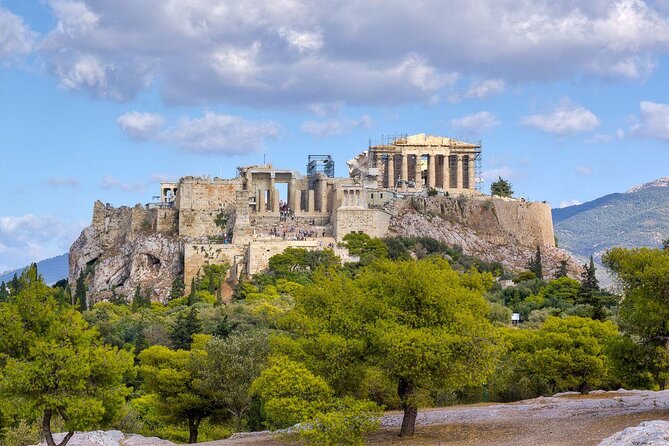
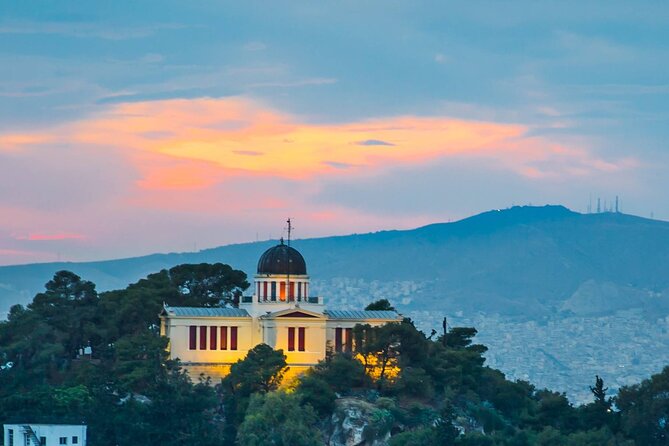
The final stop is Philopappos Hill, also called the Hill of the Muses. The tour allows about 45 minutes here, making it the longest single stop.
That extra time matters. This is not just a quick photo stop. The hill offers views toward the Acropolis and Athens, including appealing evening and nighttime vistas. It gives you space to review the themes of the walk while looking at the city from above.
The end point also gives the tour an informal symposium feel. In ancient Greek culture, a symposium was a setting for conversation and thought. Here, the idea is used as a closing opportunity to discuss philosophy and the connections among mythology, reason, politics, and human society.
The hill is one reason to consider the tour’s timing carefully. A cooler evening can make the walk much more pleasant than a hot midday departure. The tour requires good weather, and poor conditions may lead to a new date or a refund.
What $50.69 means for the value
At $50.69 per person, this is not the cheapest way to walk around central Athens. You could visit many of these outdoor places independently, and the listed stops have no admission charge.
The value comes from the interpretation and the route. You are paying for a guide who can connect a cemetery, an ancient marketplace, a Roman monument, a scientific instrument, a library, and two hills into one argument about Western thought. That is different from paying for access to a single monument.
The group maximum of 12 improves the value. You are not part of a huge crowd, and there is a better chance to ask questions or follow a thread that interests you. For a family, university-age visitors, or anyone curious about philosophy, the price can make sense.
I would not choose this tour only to collect photographs. I would choose it if you want to understand the city and are willing to listen, walk, and think. The experience is particularly useful early in an Athens visit because it can give later visits to the Acropolis and Agora more context.
Who will get the most from this walk
This is a good match for you if you enjoy:
- Ancient Greek history and mythology
- The origins of democracy and political thought
- Philosophy, mathematics, and the development of science
- Storytelling that connects old events with present-day questions
- Small-group walking tours rather than large bus excursions
- Scenic views at the end of an active afternoon or evening
It can also work well for families with older children and teenagers. The subject matter is serious, but Panos uses wit and conversation to keep it accessible. The tour may be especially useful for students or anyone studying philosophy, politics, history, or classical culture.
You should think twice if you dislike extended discussion or want a tour focused mainly on architecture. You will also need to be comfortable walking between sites and spending time outdoors. The exact duration is advertised at about three hours, though the route includes enough stops and walking that you should keep your schedule flexible.
The tour is offered in English. Service animals are allowed, public transportation is nearby, and most people can participate. Still, the hills and summer heat deserve attention. Practical shoes, water, and a weather check are sensible choices.
Booking, timing, and cancellation details
The meeting point is at the Statue of Theseus in Athens. The walk ends at Philopappos Hill, so you do not return to the starting point. That matters when planning dinner, a hotel visit, or another timed attraction.
The experience is often booked well ahead, with an average booking time of about 37 days before the date. If you already know your Athens schedule, reserving early is sensible, especially if you want a particular day.
You can cancel for a full refund up to 24 hours before the start time. Changes or cancellations inside that window are not refunded. If poor weather or an insufficient number of participants causes the tour to be canceled, you are offered another date or a full refund.
Should you book the Mythology, Philosophy and Democracy Tour?
Book it if you want meaning and context, not just a checklist of ruins. Panos brings together the ideas behind Athens’s monuments and explains how mythology, debate, science, and civic life influenced one another.
The best reason to go is the combination of places and conversation. Kerameikos and the Pnyx are easy to miss on a standard Athens plan, yet they give the tour its strongest sense of place. The final view from Philopappos Hill adds a memorable finish.
Skip it if you want a short, low-effort sightseeing loop or a detailed architectural tour of each monument. For everyone else, especially curious first-time visitors, families with older children, and students of history or philosophy, this is a thoughtful use of three hours and a strong way to begin understanding Athens.
FAQ
How much does the Mythology, Philosophy and Democracy Tour cost?
The tour costs $50.69 per person.
How long does the tour last?
The advertised duration is approximately three hours.
Where does the tour begin?
The meeting point is at the Statue of Theseus in Athens, Greece.
Where does the tour end?
The tour ends at Philopappos Hill.
What language is the tour offered in?
The tour is offered in English.
How many people can join the tour?
The maximum group size is 12 travelers.
Which places are included?
The route includes Kerameikos, the Ancient Agora of Athens, Monastiraki Square, the Roman Agora, the Tower of the Winds, Hadrian’s Library, Plaka, the Pnyx, and Philopappos Hill.
Are admission tickets included?
The listed stops show no admission charge.
Is the tour suitable for most people?
Most travelers can participate, and service animals are allowed. The experience includes outdoor walking and hills, so weather and personal comfort should be considered.
Can I cancel for a refund?
Yes. You can cancel up to 24 hours before the start time for a full refund. Cancellations or changes made less than 24 hours before the start time are not refunded.
Newly reviewed around Athens
- Feel Ancient thermal Spa Visit Delphi, Leonidas ℨoo Spaʀtan★ 5.0 · 4 reviews
- Food Tour★ 5.0 · 3 reviews
- Explore the Hidden Food Gems of Athens★ 5.0 · 57 reviews
- Food Experience in Athens including Unlimited Lunch★ 5.0 · 3 reviews
- Eat Your Way Through Athens: A Local Food Walk★ 4.9 · 97 reviews
- From Athens: Delphi Private Tour with Lunch Time★ 4.0 · 3 reviews
- Delphi: Spanish guided one day tour★ 4.6 · 55 reviews
- Early Entry Acropolis & Museum. Beat the Crowds & the heat★ 5.0 · 3 reviews
Athens Mythology Tours, compared.
Mythology of Delphi, Museum and Arachova Guided Tour
Read our review →
Athens & Acropolis Highlights: Greek Mythology Small-Group Tour
Read our review →
Acropolis and Mythology Highlights Small Group Tour
Read our review →
Athens Highlights: Myths & Philosophers Walking Tour
Read our review →
Greek Mythology Treasure Hunt for Kids – Athens Private Tour
Read our review →
Browse the lists this tour appears in