
Reviewed · ATHENS MYTHOLOGY TOURS
Athens Highlights: Myths & Philosophers Private Walking Tour
Athens becomes much more interesting when its streets turn into a classroom. This four-hour private walk links the Academy of Athens, Parliament, National Garden, Ermou Street, Monastiraki, Plaka, and the Areopagus with Socrates, Plato, Epicurus, and Aristotle. You are not just looking at old stones. You are asking what these thinkers were trying to solve.
I like the personal format, which lets guides such as Bianca and John adjust the conversation to your interests. I also like the coffee break in Thissio, where philosophy becomes less formal and more like a chat with a well-read local. The main drawback is the amount of walking, including uneven streets and the climb to Areopagus Hill, so this is not a good choice for anyone with limited mobility.
Key points to know before booking

- A private four-hour walk: You get an English-speaking guide and a conversation shaped around your questions, rather than a fixed speech for a large group.
- Philosophy tied to real places: Socrates, Plato, Epicurus, Aristotle, the Stoics, and the Cynics are discussed near locations connected with ancient Athenian life.
- Mythology runs alongside history: Apollo, Athena, Hermes, Aiolos, and the Olympian gods give the walk a lively second thread.
- A useful central Athens route: The walk begins at Panepistimio and ends at Areopagus Hill, passing major sights on the way.
- Coffee is included: You receive one Greek coffee or another traditional refreshment during the Thissio stop.
- Best for curious walkers: The tour suits people who enjoy discussion, questions, and ideas as much as photographs.
Why this Athens philosophy walk feels different
Many city tours move from monument to monument. This one uses the monuments as prompts for larger questions. Why did philosophical thinking take root in Athens? How did myth shape public life? What did Socrates mean by questioning everything? The guide connects those subjects while you move through the modern city.
That approach works especially well in a private group. If you have studied philosophy, you can spend more time on Plato, rhetoric, or the practical side of Stoicism. If the subject is new to you, the guide can explain the ideas without turning the morning into a school lecture.
The strongest part is the conversation. John has guided visitors with a particular interest in philosophy and has also translated books on the subject. Bianca has a warm, clear storytelling style and has led discussions on how ancient ideas apply to modern life. Effie has also guided the walk. The exact guide depends on the date and booking, but the format gives you room to ask questions.
You should still know what this is not. It is not an archaeological tour with entrance tickets, and it does not take you inside the Acropolis or the other sites along the way. The value comes from interpretation, local perspective, and the way the route joins Athens landmarks into one story.
More Greek mythology tours in Athens:
- Athens: Mythology of Delphi, Museum and Arachova Guided Tour
★ 4.6 · 4,008 reviews - Athens & Acropolis Highlights: Greek Mythology Small-Group Tour
★ 5.0 · 2,370 reviews - Athens: Acropolis and Mythology Highlights Small Group Tour
★ 4.8 · 2,275 reviews
Starting at Panepistimio and the Athenian Trilogy
The meeting point is outside Panepistimio Metro Station, also called University. This is a practical place to begin because it puts you close to the Academy of Athens and the grand buildings of central Athens.
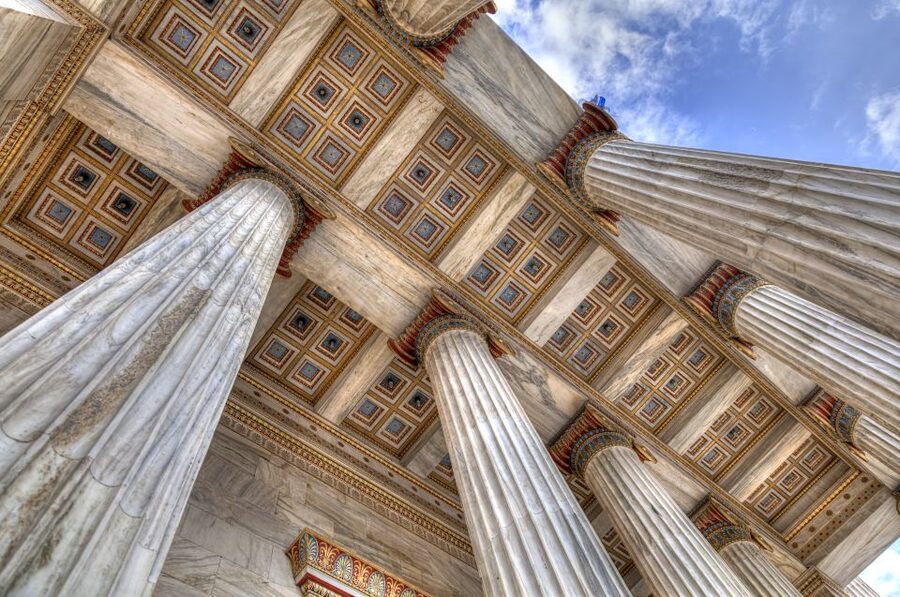
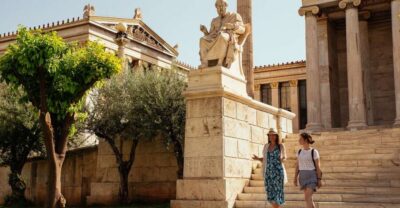
The first major stop is the Athens Trilogy, designed by the Danish architect Theofilus Hansen. The group includes the Academy of Athens, the National and Kapodistrian University of Athens, and the National Library. The architecture gives the opening part of the walk a formal, 19th-century setting, with statues by well-known sculptors and a style meant to recall classical Greece.
Here, the guide introduces Socrates and Plato. You will hear about the roots of philosophical thought and how Plato’s ideas grew from the questions associated with Socrates. This is a good early stop because the grand buildings make the city’s later effort to connect itself with ancient Athens easy to see.
I would pay close attention here if you are interested in how public spaces use the past. The Trilogy is not an ancient ruin, but it presents a modern version of Greece’s classical identity. That contrast gives the discussion more depth than a simple list of dates.
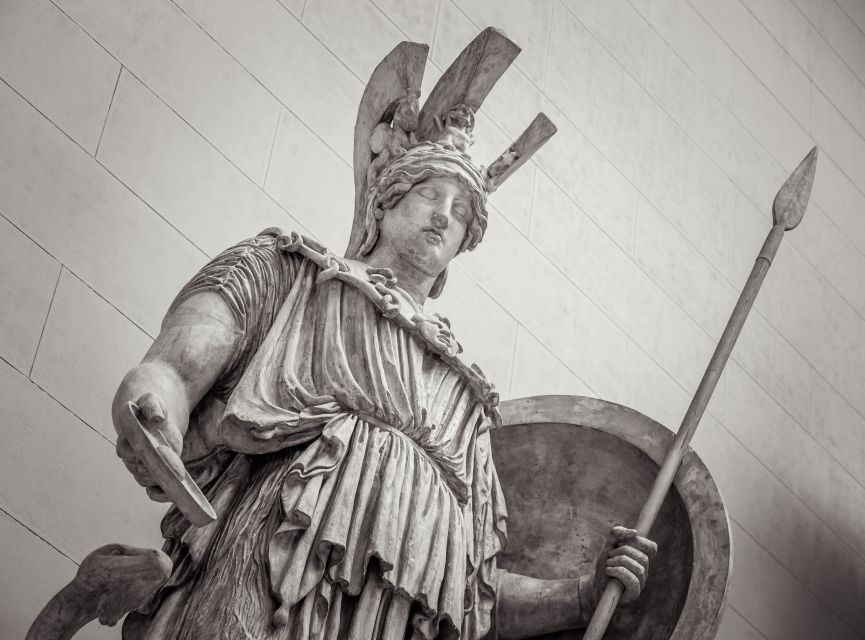
Apollo and Athena also enter the conversation. Apollo represents a different set of qualities from Athena, yet the guide points out the links between them. The mythology is not treated as a separate bedtime story. It helps explain how the people of Athens imagined wisdom, order, art, war, and civic life.
The Numismatic Museum and the route toward Parliament
The route continues through central Athens toward the Numismatic Museum. The stop is part of a longer walk through the city rather than a museum visit with an included entrance ticket, so you should not expect entry to be covered.
This section helps you get your bearings. You are moving from the academic quarter toward Syntagma and the Greek Parliament, with busy city streets replacing the quiet formality of the Trilogy. The shift matters because ancient philosophy was not created in isolation. It grew in a city filled with trade, politics, public debate, religion, and daily errands.
The walk is listed in roughly 30-minute sections between major points. The exact pace depends on questions, photographs, and the guide’s route on the day. If you want a brisk sightseeing circuit, say so at the start. If you prefer discussion, the private format makes it easier to pause.
Epicurus in the National Garden
At the Greek Parliament and the National Garden, the focus turns to Epicurus and his philosophical school, known as the Garden. This is one of the more useful stops for anyone who thinks philosophy is only about grand theories.
Epicurus is often reduced to pleasure, but the guide can put that idea into better context. His school asked how people could live with less fear and more peace of mind. Talking about those ideas in or near a garden gives the subject a fitting setting, even though the modern National Garden is not the original ancient Garden.
I like this part because it brings philosophy down to ordinary life. The discussion can touch on friendship, simple pleasures, anxiety, and the habits that make daily life calmer. It also gives you a change of pace after the formal buildings and political center.
The National Garden offers shade compared with some open parts of the route, but Athens can still be hot. Bring water, sunglasses, and sunscreen. Comfortable shoes matter from the first step, not only at the final hill.
More philosophy walks in Athens:
- Philosophy and Democracy tour of Athens
★ 5.0 · 285 reviews - Athens Highlights: Myths & Philosophers Walking Tour
★ 5.0 · 125 reviews - Athens: Philosophy and Democracy Walking Tour
★ 5.0 · 91 reviews - Mythology, Philosophy and Democracy Tour
★ 5.0 · 64 reviews
Ermou Street and the tiny Kapnikarea church
From the National Garden, the walk heads along Ermou Street, one of the city’s main commercial roads. The street is named after Hermes, the Greek god associated with commerce and travel.
This is a clever part of the route because it places mythology in modern Athens. You are walking through a shopping street while discussing a god whose role connects directly with trade and movement. The city’s old names are still woven into its everyday life.
Look for Kapnikarea, an 11th-century Byzantine church set among the shops. Its small scale and older stonework make it easy to miss if you are walking quickly. The guide uses it as a doorway into the world of Aristotle and his Lyceum.
Aristotle’s school adds another angle to the walk. Compared with Socratic questioning or Epicurean calm, Aristotle’s work reaches across many fields of thought. The stop is not a visit to the ancient Lyceum itself, and no entrance fees are included, but the discussion helps you understand how schools of philosophy were tied to places and communities.
Ermou can be crowded and noisy, especially during shopping hours. That is part of the point, but it can make conversation harder for a moment. Stay close to your guide and do not expect every section to feel peaceful.
Monastiraki, coffee, and the first philosophers
The route continues through Monastiraki toward Thissio. This is where the walking tour gets a welcome pause. One Greek coffee or another traditional refreshment is included for each person.
The exact cafe setting can vary, and one past route included a rooftop terrace with a view. The important thing is the break itself. After several hours of walking, sitting down gives you time to ask the questions that often come only after the guide has introduced several ideas.
The conversation here turns to the Pre-Socratic philosophers. These early thinkers looked for explanations of the world beyond the old mythic stories. Their questions about nature, matter, change, and the origins of things helped prepare the ground for later philosophy.
You do not need a background in the subject. A good guide can explain the basic shift: instead of relying only on stories about gods, these thinkers began asking what the world was made of and how it worked. That makes this section useful for first-time learners as well as anyone preparing to teach philosophy.
The coffee is a small inclusion, but it improves the pacing. You are paying for a private four-hour experience, not merely a route between landmarks, and the refreshment gives the tour a human rhythm. If you do not drink Greek coffee, another traditional refreshment is available.
The Ancient Agora and the Poikile Stoa
Near the Ancient Agora, the guide discusses the Poikile Stoa, associated with the beginning of Stoic philosophy. The Agora was a place of public life, and that setting helps explain why Stoicism is linked with ideas about conduct, responsibility, and how to respond to events.
You will not receive an entrance ticket to the Ancient Agora, so plan a separate visit if you want to explore the archaeological site itself. The walking route takes place around the major areas rather than providing access to every attraction.
This stop is valuable because Stoicism remains easy to connect with modern concerns. The guide can help you consider the difference between what you can control and what you cannot, without turning the subject into a list of slogans. In a private conversation, you can ask how these ideas might apply to work, family life, or travel itself.
The route now has a clear pattern. You see a place, hear about a school or thinker connected with it, then test the idea against ordinary life. That is the main reason the tour works better for curious people than for anyone who only wants a quick roll call of monuments.
Plaka, Anafiotika, and the Cynic philosophers
The next section takes you into Plaka and Anafiotika, at the foot of the Acropolis. These areas bring a different feel from Ermou and Monastiraki, with smaller lanes and a more intimate setting.
The guide discusses Cynic philosophers here. The name can be misleading in modern English, where cynical usually means distrustful or negative. The ancient Cynics questioned social conventions and material status, often presenting a deliberately plain way of life.
This is another place where the private format helps. You can ask how Cynicism differed from Stoicism, or why a philosopher might reject comfort and public approval. The subject can become funny as well as serious, especially when it is tied to the streets around you rather than delivered as an abstract definition.
Anafiotika includes narrow passages and uneven surfaces. The route is not suitable for people with mobility impairments, and you should take that warning seriously. Even fit walkers may want supportive shoes, especially in warm weather.
The Tower of Winds and Aiolos
The Tower of Winds is one of the most distinctive points on the route. The guide uses it to tell the story of Aiolos, keeper of the winds.
This stop blends observation with myth. You look at a surviving ancient structure, then hear about the figure linked with the winds and the way the Greeks gave human form to forces they could not control. It is a strong example of how architecture, weather, religion, and storytelling once met in one place.
The Tower of Winds also gives the mythology thread a physical anchor. Apollo and Athena appeared earlier, Hermes was tied to Ermou Street, and Aiolos now adds the power of nature. By this point, the gods are no longer a random collection of names. They form part of the way ancient people explained the world around them.
Finishing above Athens on Areopagus Hill
The tour ends on Areopagus Hill, also called the Hill of Ares. The final view looks toward the Acropolis, giving you a memorable finish after the long walk.
The hill is not a polished viewing platform. The surface can be uneven, and you need to watch your footing. Still, the setting is worth the care. The guide closes with more stories about the Olympian gods while the Acropolis rises in front of you.
This ending brings the tour’s two subjects together. You have discussed rational inquiry, schools of philosophy, public life, and practical ethics. You have also heard stories about gods, winds, wisdom, and commerce. From the hill, Athens feels like one place where all those strands have been layered over one another.
The drop-off point is Areopagus Hill, so you can continue into the Acropolis area or Plaka afterward. The experience does not include a return transfer. That is useful if you want to keep sightseeing, but you should plan your next stop rather than assuming the guide will take you back to Panepistimio.
What $100 per person gets you
At $100 per person, this is not the cheapest way to see central Athens. You are not paying for monument admission, transport, or a large set of physical inclusions. You are paying mainly for four hours of private guiding, conversation, route planning, and the ability to shape the subject around your own interests.
For a group of two or more people, that can be fair value if you want an intellectual tour rather than a standard highlights walk. The Greek coffee is a pleasant extra, but it is not the reason to book. The reason is the guide’s time and the personal exchange.
I would compare it with the cost of a private city walk, not with a self-guided visit to the Agora or a museum ticket. If you already know Athens well and only want access to archaeological sites, this may not suit you. If you want to understand why Athens matters beyond the Acropolis, the price makes more sense.
The tour has a five out of five rating from 34 reviews, and the repeated strengths are clear: guides who explain ideas well, flexible conversations, strong knowledge of philosophy and mythology, and a route that keeps the material active. Bianca and John receive especially strong praise for adapting the tour to a person’s interests. One participant used the walk while preparing a high school class, while another had studied philosophy and rhetoric and wanted new angles.
Who should book this four-hour walk?
I would recommend it to:
- People who want Athens sightseeing with more substance than a monument checklist
- Students, teachers, and readers of philosophy
- Couples or small private groups who enjoy talking as they walk
- First-time visitors who want a useful introduction to central Athens
- Anyone curious about how mythology and philosophy shaped Greek culture
I would think twice if you want a relaxed, mostly seated experience. Four hours on foot is a real commitment, and the final climb and uneven surfaces make the route unsuitable for people with mobility impairments.
English is the tour language. Bring comfortable shoes, sunscreen, and sunglasses. Since the route crosses busy shopping areas, historic lanes, and exposed viewpoints, dress for a full morning or afternoon outdoors.
Free cancellation is available up to 24 hours before the start, and you can reserve now and pay later. Starting times depend on availability, and the meeting point can vary by the option booked, so confirm those details before setting out.
Should you book Athens Highlights: Myths & Philosophers?
Book this tour if you want to talk, question, and connect ideas to the places around you. The best moments are not simply the statues or the Acropolis view. They are the links between a modern shopping street and Hermes, a garden and Epicurus, a public square and the Stoics, or a hilltop view and the old stories of the Olympian gods.
Skip it if your main goal is entry to archaeological sites or a fast tour of Athens landmarks. For everyone else, especially anyone who enjoys philosophy but does not want a formal lecture, this private walk offers a thoughtful and active way to meet the city.
FAQ
Where does the tour begin?
The usual starting point is outside Panepistimio Metro Station, also called University. The meeting point may vary depending on the option booked.
Where does the tour end?
The tour ends at Areopagus Hill, also called the Hill of Ares.
How long does the experience last?
The walking tour lasts four hours.
Is the tour private?
Yes. The experience is offered as a private group tour.
What language is the tour conducted in?
The live tour guide speaks English.
Are entrance fees included?
No. Entrance fees to points of interest are not included.
Is Greek coffee included?
Yes. Each person receives one Greek coffee or another traditional refreshment.
Is the tour suitable for people with mobility impairments?
No. The experience is not suitable for people with mobility impairments. The route includes considerable walking and ends on Areopagus Hill.
What should I bring?
Bring comfortable shoes, sunglasses, and sunscreen.
More city tours in Athens
- Best of Athens Half Day Private Tour
★ 5.0 · 3,714 reviews - Athens Half-Day Sightseeing Tour with Tickets of Acropolis
★ 4.0 · 1,402 reviews - Highlights of Athens biketour
★ 5.0 · 840 reviews - Essential Athens Highlights Plus Cape Sounion Skip-The-Line Tour
★ 5.0 · 705 reviews
More walking tours in Athens
- Athens: Acropolis and Parthenon Guided Walking Tour
★ 4.6 · 5,882 reviews - Greek Food Walking Tour in Athens
★ 5.0 · 4,740 reviews - Acropolis: Acropolis and Parthenon Guided Walking Tour
★ 4.7 · 3,442 reviews - Acropolis monuments & Parthenon Walking Tour with Optional Acropolis Museum
★ 5.0 · 2,678 reviews
Newly reviewed around Athens
- Feel Ancient thermal Spa Visit Delphi, Leonidas ℨoo Spaʀtan★ 5.0 · 4 reviews
- Food Tour★ 5.0 · 3 reviews
- Explore the Hidden Food Gems of Athens★ 5.0 · 57 reviews
- Food Experience in Athens including Unlimited Lunch★ 5.0 · 3 reviews
- Eat Your Way Through Athens: A Local Food Walk★ 4.9 · 97 reviews
- From Athens: Delphi Private Tour with Lunch Time★ 4.0 · 3 reviews
- Delphi: Spanish guided one day tour★ 4.6 · 55 reviews
- Early Entry Acropolis & Museum. Beat the Crowds & the heat★ 5.0 · 3 reviews
Athens Mythology Tours, compared.
Mythology of Delphi, Museum and Arachova Guided Tour
Read our review →
Athens & Acropolis Highlights: Greek Mythology Small-Group Tour
Read our review →
Acropolis and Mythology Highlights Small Group Tour
Read our review →
Athens Highlights: Myths & Philosophers Walking Tour
Read our review →
Greek Mythology Treasure Hunt for Kids – Athens Private Tour
Read our review →
Browse the lists this tour appears in