
Reviewed · ATHENS MYTHOLOGY TOURS
Greek Mythology Storytelling Walk
The gods of Greece come alive on this two-hour walking tour through Plaka, the Acropolis area, and Pnyx. Instead of treating mythology as a list of names, the storytellers turn Zeus, Dionysus, Athena, and Poseidon into dramatic characters with jealousies, schemes, contests, and surprising family problems.
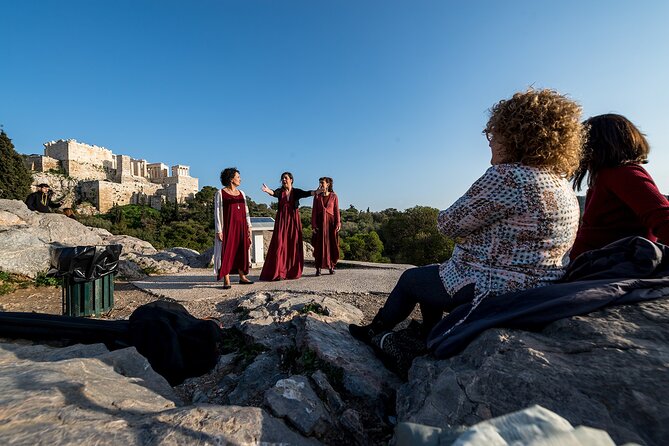
I like the route for two clear reasons: the stories are tied to the places where ancient Athenian life unfolded, and the walk finishes at Pnyx with a close view of the Propylaea. The professional storytelling is the real draw, and one booking at the 9:30 time slot even became a private experience when no one else signed up.
The main caution is practical: this is a walking tour over historic city streets, and it is not suitable for people with mobility impairments or hearing impairments. You also do not enter the Acropolis on this experience, so book it for mythology, atmosphere, and views rather than for archaeological-site access.
Key points to know before you book
- Zeus begins the story in Plaka, where you hear about his birth, his battle with his father, and Europa.
- Dionysus gets a fitting setting, the pedestrian street beside the Acropolis and two ancient theaters.
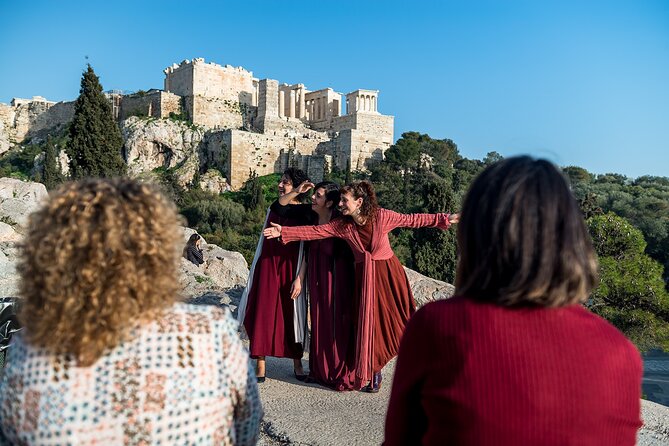
- Athena’s final scene takes place at Pnyx, with a strong view of the Propylaea.
- Professional storytellers carry the experience, making this more theatrical than a standard history walk.
- The walk suits families with older children, though children under three cannot join.
- The $53 price pays for interpretation and performance, not admission to the Acropolis or food and drinks.
Why this Athens walk feels different
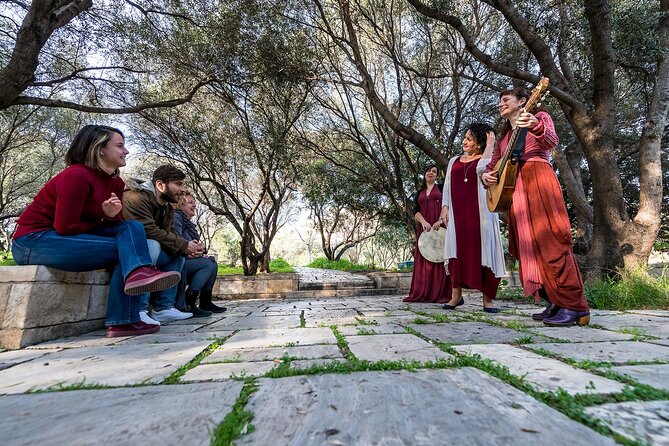
Athens offers plenty of tours that point toward a monument, name a date, and move on. This experience takes another route. It uses the streets and viewpoints of central Athens as a stage for some of the most familiar tales in Western culture.
You meet at the corner of Nikis and Kidathineon streets in Plaka. Your guide carries an Alternative Athens sign, so finding the group should be straightforward. From there, the route moves through the oldest part of the city before reaching the pedestrian path around the Acropolis and then Pnyx.
The tour is conducted in English and led by a professional storyteller and tour leader. That distinction matters. You are not simply hearing background information about statues or ruins. You are listening to performed stories, with the gods treated as characters who want power, love, status, revenge, or a place in the city’s identity.
The strongest praise for this experience focuses on the storyteller’s ability to hold attention. One booking described the storyteller as wonderful and entertaining, while another highlighted how fully the performer brought the tale to life. The walk itself was also described as easy, though you should still wear proper shoes for uneven historic streets and a route that ends at Pnyx.
More Greek mythology tours in Athens:
- Athens: Mythology of Delphi, Museum and Arachova Guided Tour
★ 4.6 · 4,008 reviews - Athens & Acropolis Highlights: Greek Mythology Small-Group Tour
★ 5.0 · 2,370 reviews - Athens: Acropolis and Mythology Highlights Small Group Tour
★ 4.8 · 2,275 reviews
Zeus and Europa in the lanes of Plaka
The first story belongs to Zeus, as seems proper for the ruler of the gods. Plaka is a good place to begin because it lets you see Athens as both a modern tourist district and an old residential quarter.
Plaka is now packed with souvenir shops, cafés, and restaurants. Yet just away from the main streets, you can find corners that still matter to local residents. The tour uses this contrast well. You are not placed in a museum room or a modern theater. You hear about Zeus while walking through the living city.
The story covers Zeus’s birth and his rise against his father, a gruesome family struggle that sets the tone for Greek mythology. You also hear about his romance with Europa, whose name became attached to an entire continent.
That connection gives the first section more weight than a simple tale of a powerful god. Europa is not only a figure in a love story. Her name links a myth told in Athens with a word used across the modern map. A good storyteller can make that connection easy to remember without turning it into a lecture.
Plaka is also the most commercial part of the route. If you are hoping for a quiet walk through untouched ancient streets, adjust your expectations. You will be in a busy central neighborhood with shops and people around you. The benefit is that the story is set against a real part of Athens rather than a carefully preserved display.
This first section lasts about 40 minutes as you walk through Plaka. It gives you time to settle into the format and learn how the tour works. Expect storytelling first, with the streets providing atmosphere and context.
Dionysus beside the ancient theaters
The route then moves toward Dionysiou Areopagitou, the pedestrian street that curves around the Acropolis. This is one of the most pleasant walking routes in central Athens, and it leads you past the area of two ancient theaters, including the Odeon of Herodes Atticus.
Here, the subject is Dionysus, god of wine and theatrical arts. The setting is especially well chosen. A god connected with performance and celebration is introduced beside theaters that still shape the cultural identity of Athens.
Dionysus is not just a cheerful party figure. His worship could involve excess, loss of control, and behavior that made Roman authorities uneasy. The tour explains how popular he was in Greece and early Rome, and how Roman opinion later turned against the excesses linked with his rites.
I like this part because it shows how mythology connects with ancient public life. Theater in Greece was not merely entertainment in the modern sense. It was tied to religion, civic identity, and large public gatherings. You do not need specialist knowledge to follow the story, but the setting helps you see why Dionysus mattered.
The walk along Dionysiou Areopagitou is also a welcome change from Plaka’s shop-lined lanes. It is pedestrian-friendly and gives you more room to look toward the Acropolis. Your attention will still be divided between the storyteller and the surroundings, so this is not the moment to expect a detailed architectural explanation of every monument.
The second section is listed as another 40-minute walk. That makes the whole experience feel active without becoming an all-day commitment. You get mythology, city views, and an outdoor performance in one compact outing.
Athena, Poseidon, and the view from Pnyx
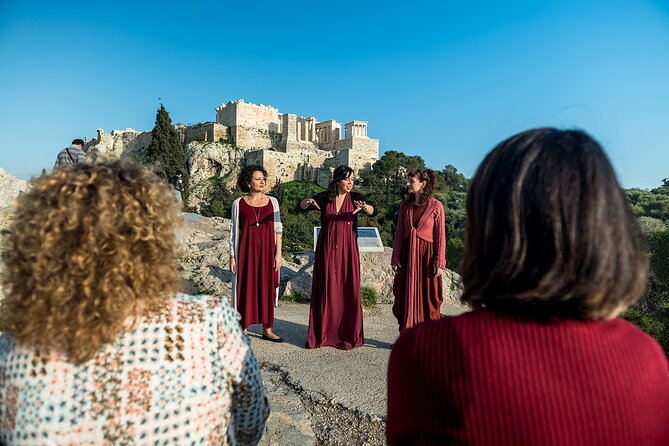
The final stop is Pnyx, an important hill with a close view of the Propylaea, the gateway to the Acropolis. This is the strongest visual finish of the route.
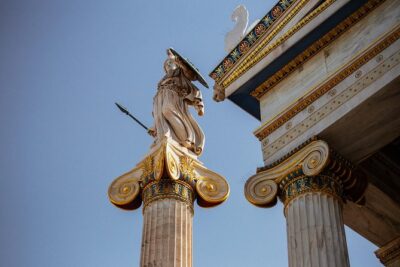
Here, the story turns to Athena. You hear about her birth and the contest between Athena and her uncle Poseidon for the patronage of the city. Athena’s victory explains why the city took her name and became Athens.
Pnyx is a fitting place for this story because the stop gives you a direct view toward the Sacred Rock and its entrance. The setting helps the myth feel connected to the city rather than floating free as a piece of folklore.
The rivalry between Athena and Poseidon also gives the final section a clear shape. Two powerful gods compete for the allegiance of a city, and the result becomes part of Athens’s identity. Athena represents wisdom and the city’s name, while Poseidon brings the force and unpredictability associated with the sea.
The visit at Pnyx lasts about 40 minutes. Since this is the finishing point, you can linger over the view after the storytelling ends, but the tour itself finishes there. You should plan any next activity from Pnyx rather than assuming you will return to Plaka.
The hilltop setting is rewarding, but it is also where footwear and mobility matter most. The experience is not suitable for people with mobility impairments. Comfortable clothes and shoes are specifically recommended, and I would take that advice seriously.
More walking tours in Athens:
- Athens: Acropolis and Parthenon Guided Walking Tour
★ 4.6 · 5,882 reviews - Greek Food Walking Tour in Athens
★ 5.0 · 4,740 reviews - Acropolis: Acropolis and Parthenon Guided Walking Tour
★ 4.7 · 3,442 reviews - Acropolis monuments & Parthenon Walking Tour with Optional Acropolis Museum
★ 5.0 · 2,678 reviews
What the professional storytelling adds
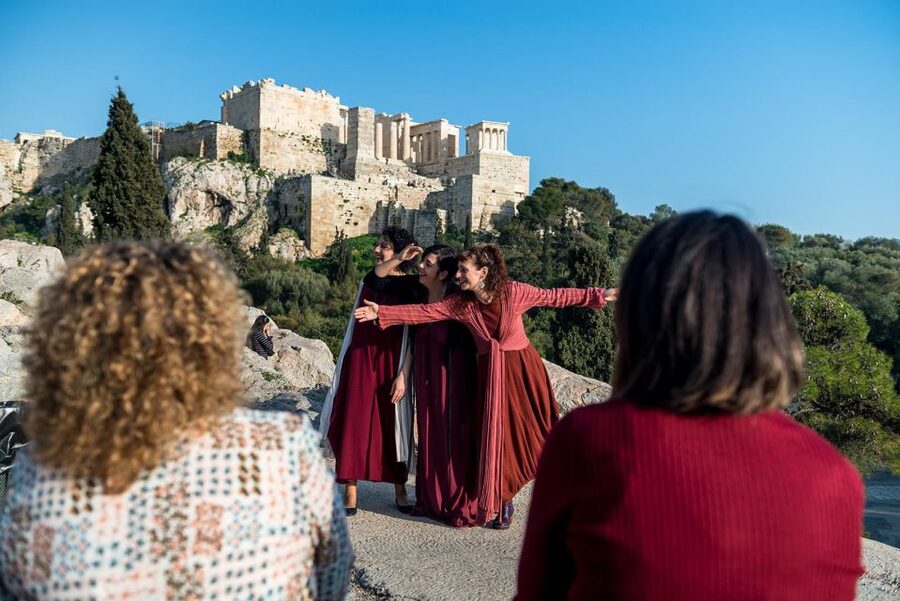
The price of this experience is not mainly paying for transportation or entry tickets. It is paying for a live performance shaped around a walking route.
That can be good value if you enjoy stories and want help making sense of Greek mythology. Zeus’s family tree, Dionysus’s changing reputation, and the rivalry between Athena and Poseidon can become confusing when you meet them in scattered museum labels. A skilled storyteller gives those characters voices, motives, and memorable conflicts.
The experience also works well for families. A child may not remember a list of temple dates, but may remember that Zeus defeated his father, that Dionysus was linked with theater, or that Athena and Poseidon competed to become the city’s patron. The activity is suitable for all ages in general, but children under three are not allowed.
The performance style will not suit everyone. If you prefer quiet time with an audio guide or a detailed archaeological explanation, the dramatic approach may feel less precise than you want. This is built around the myths and the delivery, not around a full survey of ancient Athens.
No guide name is provided in the booking details, so you cannot request a particular storyteller based on the information available. The quality of the experience will depend heavily on the individual performer, but the strongest published feedback points to engaging delivery and an easy walk.
Is $53 a fair price?
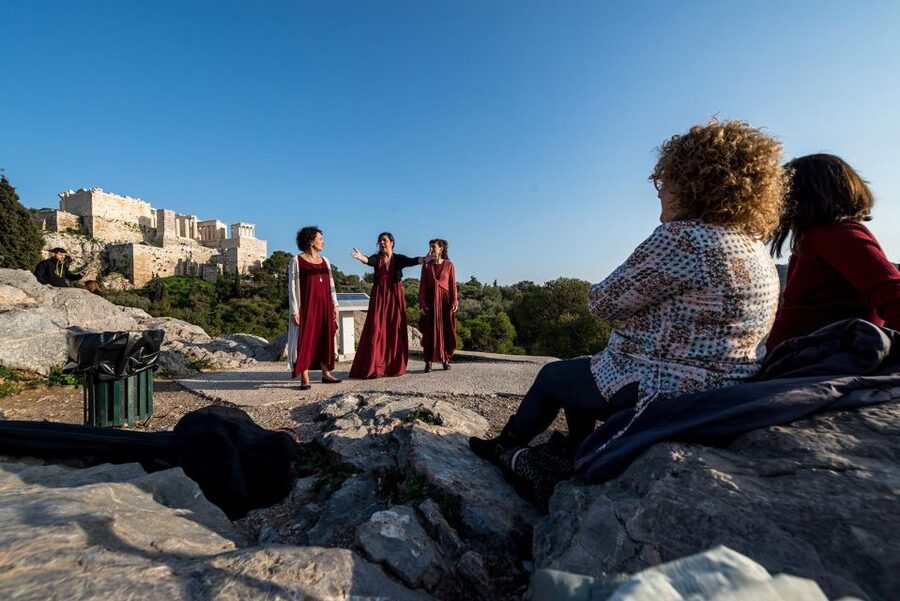
At $53 per person, this is not the cheapest way to hear Greek myths in Athens. You can read the stories for free or listen to an inexpensive audio guide. The question is what you value.
For the price, you receive a two-hour live experience, an English-speaking professional storyteller, a tour leader, and a route through three meaningful areas of central Athens. You also get the benefit of having each myth connected to a specific place: Zeus in Plaka, Dionysus near the theaters, and Athena at Pnyx.
You do not receive food, drinks, or entry to the Acropolis. The tour circles the Acropolis area and offers views of the Propylaea, but it is not an Acropolis admission ticket. If you want to explore the Parthenon and the archaeological site itself, you need a separate plan and ticket.
I see the best value here for someone who wants a memorable introduction to mythology during a short stay. It is also useful early in an Athens visit because it gives you stories to carry into later visits to museums and ruins.
The value is weaker for a visitor who already knows the major myths well and wants detailed ancient architecture. In that case, you may prefer a conventional archaeological tour or a ticketed visit inside the Acropolis.
Timing, comfort, and group expectations
The full activity lasts two hours, with three roughly 40-minute sections. Starting times vary, so check availability when you book. The 9:30 time slot can sometimes produce a very small group. One booking at that time became a private tour because it was the only reservation, but that is a possibility rather than a promise.
A small group can make it easier to hear the storyteller and ask questions. A larger group may feel less personal, though the performance format should still work if the guide projects well.
Wear comfortable shoes and light, comfortable clothes. You will walk through Plaka, along a pedestrian street, and up to Pnyx. Athens can be tiring in warm weather, and the route includes historic surfaces rather than a smooth indoor floor.
The experience is offered in English only. It is not suitable for people with hearing impairments, which is important to know before booking because the spoken performance is the center of the activity.
Free cancellation is available up to 24 hours before the start time, and you can reserve now and pay later. Those terms are useful if your Athens schedule is still changing, but the main decision should remain the format: choose this for live myth-telling on foot.
Who will enjoy this most?
I would recommend this walk to:
- First-time visitors who want a simple introduction to Greek mythology
- Families with children old enough to walk for two hours
- Adults who enjoy theater, oral storytelling, and dramatic legends
- Visitors who want Acropolis-area views without spending the whole day inside an archaeological site
- Anyone looking for a short activity that fits around meals or other Athens plans
I would think twice if you have limited mobility, hearing loss, or little interest in mythology. The tour does not focus on food, shopping, or a detailed tour of the Acropolis buildings.
The experience can also work well for people who have already visited the Acropolis. The viewpoint from Pnyx offers a different way to look toward the Propylaea, and the myth of Athena gives the city’s name a memorable story.
Should you book the Greek Mythology Storytelling Walk?
Book it if you want Greek mythology delivered as live theater while you walk through central Athens. The strongest parts are the professional storytelling, the well-chosen sequence of locations, and the final view from Pnyx.
Do not book it expecting entry to the Acropolis, a formal archaeological lecture, or a fully accessible route. At $53, the value depends on enjoying performance as much as information.
For most families, first-time visitors, and mythology fans, this is a smart two-hour addition to an Athens itinerary. Bring good shoes, arrive at Nikis and Kidathineon with time to find the Alternative Athens sign, and let the gods handle the family drama.
FAQ
Where does the Greek Mythology Storytelling Walk begin?
The meeting point is at the corner of Nikis and Kidathineon streets in Plaka. The guide will be holding an Alternative Athens sign.
Where does the tour finish?
The tour finishes at Pnyx, after the final storytelling session about Athena and the contest with Poseidon.
How long does the activity last?
The experience lasts two hours. The route includes about 40 minutes in Plaka, 40 minutes walking toward the Acropolis area, and a 40-minute visit at Pnyx.
Is the Acropolis entrance included?
No. The tour walks around the Acropolis area and offers a view of the Propylaea, but admission to the Acropolis is not included.
Is the tour suitable for children?
The activity is for all ages, but children under three are not permitted. Comfortable shoes and clothes are recommended.
What language is the storytelling in?
The tour is conducted in English by a live professional storyteller and tour leader.
Newly reviewed around Athens
- Athens: workshop for painting landscape with local artist★ 4.6 · 3 reviews
- Athens: Greek Wine & Olive Oil Tasting at Brettos Plaka★ 4.5 · 3 reviews
- Outdoor Yoga and Pilates with Akropolis view★ 4.0 · 5 reviews
- Acropolis of Athens: 60′ Tour in a Vintage Motorcycle★ 5.0 · 4 reviews
- Ultimate Tasting of the Volcanic Wines of Greece★ 5.0 · 3 reviews
- workshop for painting acropolis/landscape with local artist★ 5.0 · 3 reviews
- Athens at Twilight Night Tour with Drinks and Meze Dishes★ 4.8 · 4 reviews
- Breakfast in the markets with olive oil and honey tasting★ 4.8 · 8 reviews
Athens Mythology Tours, compared.
Mythology of Delphi, Museum and Arachova Guided Tour
Read our review →
Athens & Acropolis Highlights: Greek Mythology Small-Group Tour
Read our review →
Acropolis and Mythology Highlights Small Group Tour
Read our review →
The History of Athens: Greek Mythology Private Tour
Read our review →
Athens Highlights: Myths & Philosophers Walking Tour
Read our review →
Greek Mythology Treasure Hunt for Kids – Athens Private Tour
Read our review →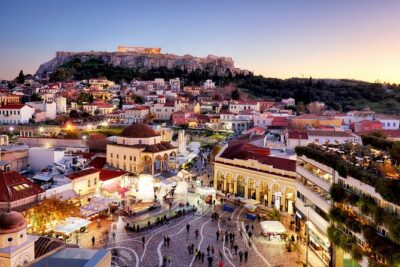
Browse the lists this tour appears in