
Reviewed · ATHENS MYTHOLOGY TOURS
Greek Mythology for Kids: Private Tour
Greek mythology becomes much easier for children when it is tied to real places, movement, riddles, and a little theater. This private Athens tour turns stories about Athena, Hercules, Icarus, Pandora, and the Minotaur into a four-hour city adventure led by a professional children’s educator.
I like the private format, since the guide can keep pace with your own children rather than a large mixed-age group. I also like the use of games, maps, challenges, and role-play, which helped children as young as 7 and as old as 13 stay involved for several hours. The main drawback is the amount of walking, with about 45 minutes allowed at each stage, so children and adults need comfortable sports shoes and reasonable stamina.
Key points for families

- A real Athens route: Walk from the Acropolis area to the Choragic Monument of Lysicrates, Hadrian’s Arch, Zappeion, the Panathenaic Stadium, the National Garden, and Syntagma Square.
- Activities children can keep: The mythology booklet, game materials, completed work, board game, and medal become souvenirs of the day.
- Private attention: Your group has its own English-speaking guide and can focus on the myths that interest your children most.
- Good use of storytelling: Greek gods, heroic quests, epic battles, natural events, and famous monsters are explained through play rather than a long lecture.
- A useful age range: The activities have kept both 7 and 9 year olds and 10 and 13 year olds interested, though every child’s energy level is different.
- Price to consider: At $170 per person, this is a premium family activity, but it includes four hours of guiding, materials, refreshments, and a private group.
Greek myths with a city route attached

Many children meet Greek mythology as a list of difficult names. Athena, Apollo, Hercules, Icarus, Pandora, and the Minotaur can blur together after a few pages in a book. This tour gives those stories a setting and a job to do.
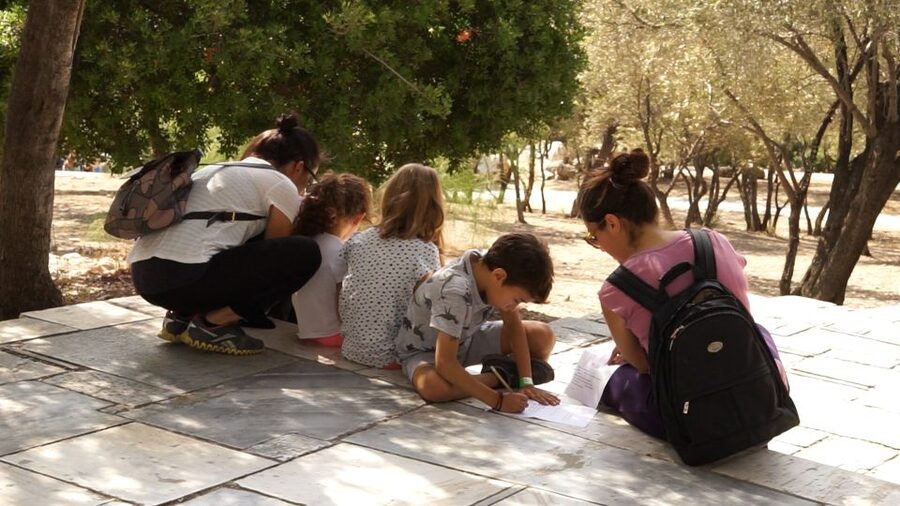
Your guide uses interactive games and role-play to explain the twelve gods of Mount Olympus, heroic quests, rivalries, battles, natural phenomena, and the myths connected with Athens. Children are not simply asked to listen while an adult talks. They answer riddles, follow clues, use maps, and complete challenges.
That matters in Athens. The city is full of ancient remains, but children need help connecting a stone monument to a story. A question about Athena may lead to a discussion of Athens itself. A story about Theseus and the Minotaur can turn a simple walk into a search for clues. Pandora’s Box and the idea of Hope provide a thoughtful ending, giving the tour a point beyond monsters and superpowers.
The guides named in past bookings include Niki, Antonia, Effie, Bianca, and Martina. The strongest praise centers on their ability to keep children involved for three and a half to four and a half hours. One family especially appreciated that the games arrived at the right time, helping break up the walking and storytelling.
The advertised tour language is English. One booking notes that Martina spoke Spanish, but you should confirm language availability if Spanish instruction is important for your family.
More Greek mythology tours in Athens:
- Athens: Mythology of Delphi, Museum and Arachova Guided Tour
★ 4.6 · 4,008 reviews - Athens & Acropolis Highlights: Greek Mythology Small-Group Tour
★ 5.0 · 2,370 reviews - Athens: Acropolis and Mythology Highlights Small Group Tour
★ 4.8 · 2,275 reviews
Starting outside the Acropolis Metro Station
The meeting point is outside Acropolis Metro Station on Makrigianni Street. The itinerary identifies Acropoli as the starting area, while the route ends at Syntagma Square. Since one part of the information also refers to meeting at Syntagma, confirm the exact meeting instructions before setting out. The specific meeting-point details place the start outside the Acropolis station.
This is a practical location for a family day in Athens. It is easy to identify, close to the Acropolis area, and puts you near the first ancient sights. Arrive with water, comfortable clothing, and sports shoes. The tour is not designed for people with mobility impairments, and the long walk includes several stops rather than one short museum visit.
The guide sets the tone early. Children are introduced to the gods and goddesses, heroes and heroines, and the larger question of how ancient Greeks explained the world around them. The stories cover the heavens, seas, cities, and natural events, so the tour gives children more than a collection of monster tales.
The Choragic Monument of Lysicrates and the first challenges

The first named stop is the Choragic Monument of Lysicrates. This small, elegant ancient monument sits in the Plaka area and gives the guide a good place to connect Greek stories with public life, performance, and competition.
The tour allows about 45 minutes for this section. That does not mean you will spend every minute staring at the monument. Expect the guide to use the area for explanation, questions, and activities. A child may be asked to solve a riddle, identify a character, or take part in a short role-play.
This is where the private format helps. If your children are fascinated by gods, the guide can give that interest more room. If they respond better to puzzles and physical tasks, the activity can carry more of the lesson. Past family accounts describe maps, riddles, treasure-hunt tasks, and challenges rather than a fixed lecture.
Hadrian’s Arch and the meeting of two Athens
The next stop is Hadrian’s Arch, reached on foot in another section listed at about 45 minutes. The arch is a useful place to show that Athens was not frozen in the age of Greek mythology. Roman rule added new buildings and new layers to the city.
For adults, this is one of the better history links in the route. For children, the value comes from seeing how a large stone gateway can mark a change in time. The guide can place the mythic age beside the later Roman period and explain that the city continued to change long after the stories of Athena and Hercules were first told.
Do not expect admission to a major site here. Entrance fees to points of interest are not included, and this activity is built mainly around an outdoor route. That keeps the tour moving, but it also means you should not book it expecting a full interior visit to every monument.
A few more Athens tours worth putting side by side
- Best of Athens Half Day Private Tour
★ 5.0 · 3,714 reviews - Athens Full Day Private Tour
★ 5.0 · 2,903 reviews - Athens Airport Private Arrival Transfer with Meet & Greet
★ 4.5 · 1,495 reviews - Athens Airport to Athens Hotels Private Arrival Transfer
★ 5.0 · 947 reviews
Zappeion, gardens, and stories of the gods
The walk continues to Zappeion, a grand neoclassical building beside the National Garden. The itinerary allows around 45 minutes for this stop. Its open surroundings give children space to move, listen, and complete activities without being confined to a gallery.
This is a good setting for the wider stories of the Greek gods. The guide can explain the power struggles and intrigues among the twelve Olympians, then connect those tales to the human questions behind them: pride, jealousy, courage, punishment, and hope.
The activity materials are part of the appeal. Your children can keep what they produce during the day, along with a mythology booklet and board game. Those items may seem modest, but they help the tour continue after you leave Athens. A child who takes home a medal or booklet is more likely to remember that Athena was not simply a name on a worksheet.
The route is also a chance to manage energy. If your children are active, the outdoor format may suit them better than a quiet museum tour. If they tire easily, the guide will need to balance the 45-minute sections with short pauses. The published information does not promise a stroller-friendly or low-walking version, so families should plan on a full walking experience.
The Panathenaic Stadium and heroic competition
The Panathenaic Stadium is one of the route’s most recognizable sights. Its white marble seating and long track make ancient competition easy for children to picture. The tour allows another 45-minute segment here.
This is a natural place to discuss heroes, contests, courage, and the ideals linked to athletic competition. Stories of Hercules fit especially well with the idea of trials and impossible tasks. The guide can also use the stadium to show how ancient public events were connected to identity and civic pride.
No entrance fee is included. If you want to go inside the stadium, you will need to handle that separately, and the schedule may need to allow for it. The tour itself can still use the stadium as a memorable outdoor teaching point.
The stadium is also one of the places where the adult may get as much from the explanation as the child. You learn how the city’s ancient stories and public spaces overlap, while your children have a clear visual setting for the tales.
The National Garden as a play space for myths
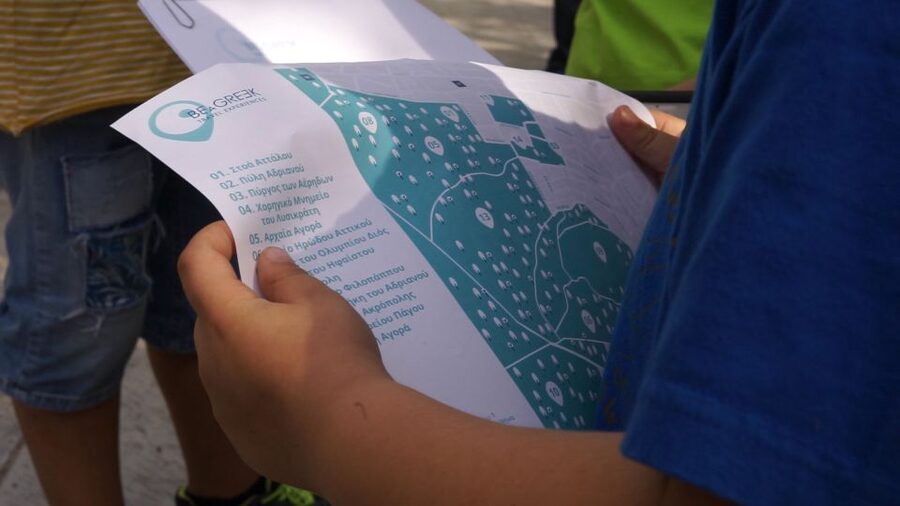
The route then continues through the National Garden. Another 45-minute section is listed here, making it one of the better places for games and movement.
The garden offers a change from stone monuments and busy city streets. Children can work through clues, answer riddles, or take part in a treasure hunt while the guide continues the story of ancient Greece. Past bookings specifically describe treasure-hunt challenges and map work, which may help children who need an active task to remain focused.
This is also where the route’s practical weakness becomes clearer. Four hours on foot is a long stretch for younger children, especially in warm weather. Bring water and dress for movement. The activity includes a coffee or another traditional refreshment for each person, but that is not a substitute for planning snacks if your family needs them.
The outdoor stops create variety, but the tour is still a city walk. Parents should not expect a playground visit or a free-running break built into the schedule. The guide’s games help, yet children will still need to walk between the sights.
Syntagma Square and the story of Hope
The final stop is Syntagma Square, where the tour ends. The route gives this last section about 45 minutes, and the ending centers on Pandora’s Box and Hope.
That is a smart choice for a children’s program. The myths include frightening monsters, dangerous quests, divine arguments, and serious punishments. Ending with Hope gives the day a gentler message: courage can remain even when a situation looks bleak.
The square also gives you an easy place to continue your day after the tour. The exact end point is listed as Syntagma, while the meeting point is outside Acropolis Metro Station, so the route crosses a useful section of central Athens without requiring private transport.
At the end, children receive a medal, and the materials made during the activities can be taken home. The medal is a small touch, but it gives the experience a clear finish. Children leave with something physical to show family members, not just a few unfamiliar names to remember.
What the $170 price means for a family
The price is $170 per person. That is expensive compared with a standard group walking tour, especially if you are booking for several family members. The value depends on what you need.
You are paying for four hours of private guiding, a children-focused approach, activity materials, a mythology booklet, a board game, a medal, and a coffee or traditional refreshment for each person. You also avoid being placed with strangers and can ask the guide to adjust the pace or focus within the private format.
For a family that would struggle through a conventional adult history tour, this can be money well spent. The activities give children a reason to keep walking, and the guide’s attention is directed at your own group. The value is weaker if your children already enjoy long museum talks, if you mainly want monument interiors, or if you plan to visit only one or two sights.
The tour is also best judged as a family teaching activity rather than a sightseeing checklist. You do not get admission to the monuments, and personal expenses are extra. If your priority is entering major archaeological sites, budget separately and compare this experience with a standard guided visit.
Who will enjoy this four-hour adventure
I would consider this tour for families with children who enjoy stories, puzzles, acting, treasure hunts, or physical challenges. It has proved suitable for a wide age span, with one family keeping 10 and 13 year old boys involved for more than three and a half hours and another using it successfully with children aged 7 and 9.
The private setting is especially useful when siblings have different interests. One child can focus on Athena and the gods, while another may prefer Hercules, Icarus, or the Minotaur. A guide can also explain why Icarus flew too close to the sun, how the Minotaur came to live in a labyrinth, and why Pandora’s story ends with Hope.
I would be more cautious if anyone in your group has mobility limitations or dislikes walking. The activity is specifically not suitable for people with mobility impairments. It is also not the right choice for a family seeking a quiet, short introduction to Athens. The four-hour length is part of its strength, but also its main demand.
Book up to 24 hours ahead for a full refund if plans change, and the reserve-now, pay-later option lets you hold a place without paying immediately. Those terms are useful for families arranging a busy Athens schedule, but the walking route and meeting point still deserve attention before booking.
Should you book this mythology tour?
Book it if you want your children to remember Athens as a place of stories, puzzles, and heroic challenges rather than a string of ancient stones. The best parts are the private guide, the well-timed activities, the take-home materials, and the route through several central sights.
Skip it if you want included monument admissions, minimal walking, or a conventional adult history lecture. At $170 per person, it is not a bargain sightseeing loop. It is a specialized family experience, and its value comes from getting children involved.
For families who want a focused introduction to Greek mythology, especially on a first Athens visit, I would put this high on the list. Wear sports shoes, confirm the meeting point and language needs, bring water, and be ready to solve a few riddles along the way.
FAQ
Where does the Greek Mythology for Kids tour begin?
The meeting point is outside Acropolis Metro Station on Makrigianni Street. The itinerary identifies Acropoli as the starting area.
Where does the tour finish?
The tour ends at Syntagma Square.
How long does the activity last?
The activity lasts four hours. Availability should be checked for the specific starting time.
What language is the tour conducted in?
The listed tour language is English. One past booking notes that Martina spoke Spanish, but Spanish availability should be confirmed before booking.
Are entrance fees included?
No. Entrance fees to points of interest and personal expenses are not included.
What should children wear and bring?
Wear comfortable clothing and sports shoes or other comfortable walking shoes. The activity materials, mythology booklet, board game, and medal can be kept by the children.
Newly reviewed around Athens
- Athens: workshop for painting landscape with local artist★ 4.6 · 3 reviews
- Athens: Greek Wine & Olive Oil Tasting at Brettos Plaka★ 4.5 · 3 reviews
- Outdoor Yoga and Pilates with Akropolis view★ 4.0 · 5 reviews
- Acropolis of Athens: 60′ Tour in a Vintage Motorcycle★ 5.0 · 4 reviews
- Ultimate Tasting of the Volcanic Wines of Greece★ 5.0 · 3 reviews
- workshop for painting acropolis/landscape with local artist★ 5.0 · 3 reviews
- Athens at Twilight Night Tour with Drinks and Meze Dishes★ 4.8 · 4 reviews
- Breakfast in the markets with olive oil and honey tasting★ 4.8 · 8 reviews
Athens Mythology Tours, compared.
Mythology of Delphi, Museum and Arachova Guided Tour
Read our review →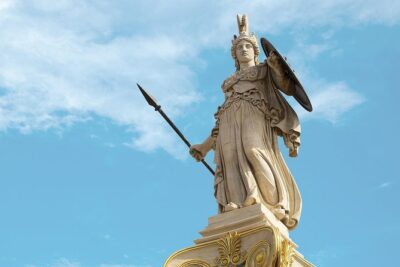
Athens & Acropolis Highlights: Greek Mythology Small-Group Tour
Read our review →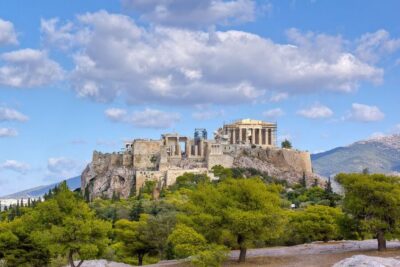
Acropolis and Mythology Highlights Small Group Tour
Read our review →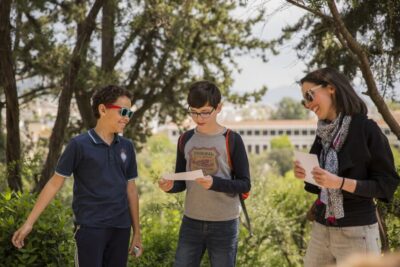
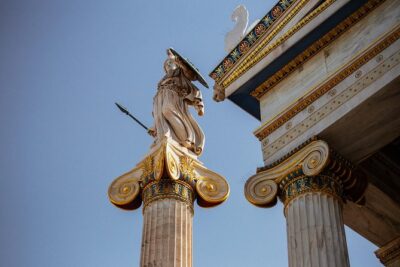
The History of Athens: Greek Mythology Private Tour
Read our review →
Athens Highlights: Myths & Philosophers Walking Tour
Read our review →
Greek Mythology Treasure Hunt for Kids – Athens Private Tour
Read our review →
Browse the lists this tour appears in