
Reviewed · ATHENS PHILOSOPHY TOURS
Athens: Philosophy and Democracy Walking Tour
Athens becomes much easier to understand when you connect its ruins to the ideas born among them. This walking tour links the Ancient Agora, Pnyx, and Philopappos Hill with the rise of democracy, philosophy, science, and public life. Panos is the named guide, and his storytelling is the main reason this tour feels more like a guided seminar outdoors than a standard ruin-by-ruin walk.
I like two things here: first, the route reaches important places you could easily pass without grasping their meaning; second, the guide keeps asking what ancient ideas mean for life today. The price is fair at $49, especially for a small group of up to 15 people, but remember that admissions to the archaeological sites are not included.
Key points before you book
- Panos connects places to ideas: Expect stories about Socrates, Plato, Aristotle, politics, science, law, and the birth of democracy.
- The route covers more than the Acropolis: You see the Agora, Roman Agora, Hadrian’s Library, Pnyx, Kerameikos area, and Philopappos Hill, while passing the Acropolis rather than entering it.
- Philopappos Hill provides the finale: The walk ends with broad views of Athens from a historic hilltop.
- The walking is manageable but not effortless: The tour lasts 3.5 hours, includes hills and steps, and can feel strenuous in hot weather.
- Children 14 and under join free: Older children may enjoy the stories, though younger ones may find the philosophical discussion demanding.
- Admissions are extra: Budget separately for the Ancient Agora, Roman Agora, Tower of the Winds, and Hadrian’s Library if you want to go inside.
Why this Athens walk feels different
Many Athens tours give you a fast list of dates, temples, and famous names. This one takes a more thoughtful route. You walk through the places where public debate, trade, law, religion, and civic life once met, then use those settings to discuss how democracy and philosophy developed.
That approach works because ancient Athens was not simply a collection of grand buildings. It was a city where citizens argued over laws, merchants sold goods, leaders addressed the public, and thinkers questioned accepted ideas. The stones matter, but the human activity around them matters just as much.
Panos is repeatedly praised for making difficult subjects clear and entertaining. His style appears to include history, political systems, philosophical theories, and modern examples, with time for questions along the way. You should expect a guide who wants you to think, not just take photographs.
The tour is in English and lasts about three and a half hours. A maximum group size of 15 keeps it smaller than a large coach excursion, which matters when you are standing beside ruins or trying to follow a long explanation. It also gives you a better chance to ask about a philosopher, building, or political idea that catches your attention.
More philosophy walks in Athens:
- Philosophy and Democracy tour of Athens
★ 5.0 · 285 reviews - Athens Highlights: Myths & Philosophers Walking Tour
★ 5.0 · 125 reviews - Mythology, Philosophy and Democracy Tour
★ 5.0 · 64 reviews
Starting near the Statue of Theseus
The official meeting point is in front of the Statue of Theseus, opposite the train station and across the road. Take care here, since a busy central Athens meeting point can be easy to miss if you are looking only for a sign or a large tour bus.
The route information also places the opening discussion around Kerameikos Archaeological Site. Kerameikos was an important cemetery and area of ancient Athens, associated with the burial of prominent citizens for centuries. It is also linked with Pericles and the famous speech he gave in Athens.
That opening subject sets the tone. Instead of treating democracy as an abstract modern word, the guide places it within the lives, deaths, speeches, and civic duties of actual Athenians. If you arrive a few minutes early, you can settle in before the historical discussion begins.
The Ancient Agora and the public life of Athens
The Ancient Agora is the heart of the tour. The site was the center of political, commercial, administrative, and social activity in ancient Athens. It was not simply a marketplace, despite the common translation of agora as market. It was a place where public life happened.
This is where the tour’s central theme makes the most sense. Democracy needs places where citizens gather, discuss, vote, conduct business, and hear leaders speak. Walking through the Agora while hearing about those functions gives the ruins a clear purpose.
The route information allows for roughly 20 minutes of walking in this part of the outing. Some sections are viewed from outside or passed during the walk, while admissions to the Ancient Agora are separate. That means you should confirm with the guide which sites the group enters on your date and decide if you want to return later with an entry ticket.
The Agora can also be a useful second visit after your Acropolis day. The Acropolis shows the religious and symbolic power of Athens. The Agora helps explain how ordinary civic life worked below the hill.
Monastiraki, where old Athens meets modern Athens
From the Agora, the walk continues toward Monastiraki. This is one of the liveliest parts of central Athens, known for antique stores and the flea market. You will see a more modern street scene here, but the guide uses it to keep the connection with the past alive.
Monastiraki is not just a pause between ruins. Its shops and market stalls offer a useful contrast with the ancient marketplace. The goods have changed, yet buying, selling, bargaining, and browsing remain familiar urban habits.
The walk from the Agora is listed at about 20 minutes in one part of the route and about 15 minutes in another. Exact timing may depend on the group and the guide’s chosen order. Wear shoes with good grip, since this is a walking tour rather than a series of short transfers.
More walking tours in Athens:
- Athens: Acropolis and Parthenon Guided Walking Tour
★ 4.6 · 5,882 reviews - Greek Food Walking Tour in Athens
★ 5.0 · 4,740 reviews - Acropolis: Acropolis and Parthenon Guided Walking Tour
★ 4.7 · 3,442 reviews - Acropolis monuments & Parthenon Walking Tour with Optional Acropolis Museum
★ 5.0 · 2,678 reviews
Hadrian’s Library and the Roman Agora
Hadrian’s Library is one of the main ancient landmarks on the route. Built by the Roman emperor Hadrian, it reflects the way Athens continued to matter long after the city’s classical age. The site also fits the tour’s focus on education, writing, and the preservation of ideas.
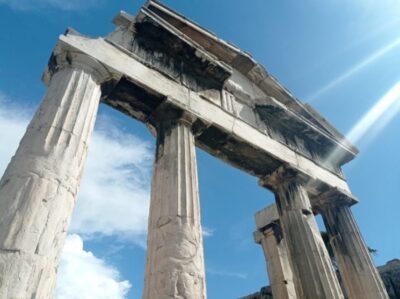
A short distance away is the Roman Agora, including the Tower of the Winds. These places help show how Athens changed under Roman rule while keeping its reputation as a center of learning and culture.
Admissions to Hadrian’s Library, the Roman Agora, and the Tower of the Winds are not included in the $49 tour price. This is an important cost detail. The walking and guiding are covered, but entering every archaeological site can raise your total.
The Tower of the Winds is especially memorable. This octagonal marble tower served as a wind indicator and a clock. It is often described as an early meteorological station, and the guide explains how its design helped people track weather and time.
That small building makes a good teaching stop because it moves the discussion beyond philosophy and politics. Ancient Athens also produced practical work in mathematics, astronomy, engineering, and science. You see how broad the city’s intellectual life was.
Plaka and the edge of the Ancient Agora
The route passes through Plaka, the historic neighborhood below the Acropolis. Its narrow streets and small houses offer a softer, more intimate view of Athens than the open archaeological areas.
You may find Plaka crowded, especially at busy times, so the guide’s explanation is useful when the streets become more about movement than quiet reflection. The neighborhood also works as a visual bridge between modern Athens and the ancient city.
The tour then returns to the story of the Ancient Agora and the public institutions around it. This is where the guide’s political discussion becomes especially useful. Ancient Athenian democracy was not the same as modern representative government. Understanding who could participate, how decisions were made, and who was excluded gives you a more honest picture than simply calling Athens the birthplace of democracy.
The best part of this discussion is its balance. You can admire the innovation of citizen government while still recognizing its limits. The tour aims to show both the achievement and the problems of the system.
Pnyx Hill and the meaning of democracy
Pnyx Hill is one of the most important stops for the tour’s main subject. It is tied directly to Athenian democratic practice and public speaking. This is the place where the guide can explain how citizens gathered, listened, debated, and took part in decisions affecting the city.
You will walk for about 30 minutes toward this part of the route. That time gives the guide room to build the story before you reach the hill. The subject also gains force from the setting. You are no longer hearing about democracy in a classroom. You are standing in the area associated with the public life that helped shape the idea.
The hill requires some effort, and the tour information describes the outing as easy with a few steps at the end. That is a fair warning, but do not read easy as completely flat. A summer walk in Athens can be tiring, and one review specifically noted that the heat made the route harder for children and older people.
The tour is not recommended for people over 70. That limit may feel strict, since fitness varies widely, but it reflects the length, heat, uneven ground, and hill walking. If you have mobility concerns, contact the provider before booking.
Philopappos Hill and the best views of the walk
The final section leads to Philopappos Hill, also called Filopappou Hill, and the Philopappos Monument. The route description allows up to an hour and a half for this portion, so do not expect a quick photo stop.
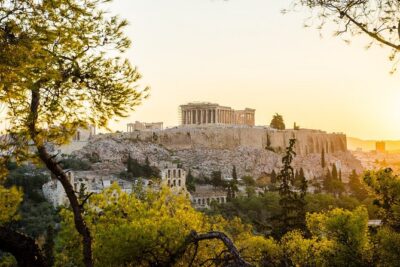
The hill gives you views across Athens and toward the Acropolis. This is one of the strongest practical reasons to take the tour. You see the city from above, then recognize the relationship between the Acropolis, Agora, old neighborhoods, and surrounding hills.
The Philopappos Monument is an ancient Greek mausoleum. Its presence adds another layer to the tour’s interest in memory and public identity. Athens honored people through speeches, monuments, graves, and civic spaces. The guide can tie those customs to the wider question of how societies remember their leaders.
The tour finishes on the hill. That means you should be ready to find your own way onward rather than expecting to return to the starting point. The ending location is rewarding, but it may not be the most convenient place if you have a fixed lunch booking or another activity immediately afterward.
The Acropolis is part of the story, not the ticket
The Acropolis is passed during the route, but this is not an Acropolis entry tour. You will see the ancient citadel on its rocky outcrop above Athens, and the guide uses it as part of the wider story, but you should book a separate visit if you want to enter the Parthenon complex.
This separation is actually useful. You can give the Acropolis the time it deserves on another day, then use this walk to understand the political, social, and intellectual world around it. One visitor who had already visited the Acropolis found this tour filled in the surrounding story well.
Do not book this experience expecting a full tour of every famous monument. Book it for the context between those monuments.
How philosophy fits into the walk
The philosophy section is a major reason to choose this tour. Panos explains the development of rational thought, science, ethics, and political ideas, with attention to Socrates, Plato, and Aristotle. The discussion is aimed at people who may know the names but have not studied philosophy in detail.
The strongest feature is accessibility. You do not need a university background to follow the main ideas. Panos is praised for using humor, examples, and modern comparisons to make the material understandable.
You should still know what you are signing up for. This is not a light sightseeing stroll with occasional facts. The guide may discuss political systems, moral questions, and the meaning of wisdom, common sense, and expertise. Several people found the discussion stimulating enough to want book and video recommendations afterward.
For adults and older teenagers, that is a real strength. For a 10-year-old, three and a half hours of philosophy may be too much, even though children up to age 14 join free. Children aged 12 to 14 may follow more of the political and historical material, but family interest matters as much as age.
Price, pace, and practical value
At $49 per person, the tour offers good value if you want a guide to connect several sites into one clear story. You are paying for three and a half hours of live English instruction, a small group capped at 15, and access to places that can feel confusing when visited alone.
The value is lower if you mainly want to enter ruins. Site admissions are extra, and the tour does not replace an Acropolis ticket. Think of the $49 as the cost of the guide and walking route, not an all-inclusive archaeological pass.
The pace appears moderate, with time for questions and explanation rather than a rushed march. Still, the route is long enough to demand comfortable shoes, water, sun protection, and sensible planning. It runs rain or shine, so bring a rain layer if the forecast looks uncertain.
The booking terms are flexible: you can cancel up to 24 hours before the start for a full refund, and you can reserve now and pay later. Check the current start time when booking, since several departure times may be available.
Who should take this tour?
You should consider it if you:
- Want Athens explained through democracy, philosophy, and public life
- Have already seen the Acropolis and want the surrounding context
- Enjoy a guide who tells stories and welcomes questions
- Prefer walking and discussion to a bus tour
- Are visiting Athens early in your trip and want a useful introduction
- Are traveling with teenagers who enjoy history, politics, or big ideas
You may want another option if you need a flat route, dislike long explanations, or want a tour focused mainly on entering monuments. Older visitors and anyone sensitive to heat should take the age and walking guidance seriously.
Should you book it?
Book this tour if you want to understand why Athens matters, not simply photograph its ruins. The strongest feature is Panos’s ability to connect the Agora, Pnyx, Roman-era buildings, and hilltop views with the larger story of democracy and philosophy.
Skip it if your priority is a fully ticketed Acropolis visit or a short, low-effort sightseeing loop. For curious adults, older teenagers, and families willing to think while they walk, this is a smart use of half a day and a strong companion to an Acropolis visit.
FAQ
How long does the Philosophy and Democracy Walking Tour last?
The tour lasts about 3.5 hours. The route includes walking between several ancient sites and finishes on Philopappos Hill.
Where does the tour meet?
The meeting point is in front of the Statue of Theseus, opposite the train station and across the road.
Is the Acropolis included?
The route passes by the Acropolis, but entry is not included. This experience does not replace a separate Acropolis visit.
Are archaeological site admissions included in the price?
No. Admissions to the Ancient Agora, Hadrian’s Library, Roman Agora, and Tower of the Winds are not included in the $49 price.
Is the tour suitable for children?
Children up to age 14 join free. The subject includes philosophy, politics, and ancient history, so younger children may find the discussion demanding. The tour information also says it is not suitable for people over 70.
What language is the tour in?
The live guided tour is in English. Comfortable shoes are recommended, and the tour operates rain or shine.
Newly reviewed around Athens
- Feel Ancient thermal Spa Visit Delphi, Leonidas ℨoo Spaʀtan★ 5.0 · 4 reviews
- Food Tour★ 5.0 · 3 reviews
- Explore the Hidden Food Gems of Athens★ 5.0 · 57 reviews
- Food Experience in Athens including Unlimited Lunch★ 5.0 · 3 reviews
- Eat Your Way Through Athens: A Local Food Walk★ 4.9 · 97 reviews
- From Athens: Delphi Private Tour with Lunch Time★ 4.0 · 3 reviews
- Delphi: Spanish guided one day tour★ 4.6 · 55 reviews
- Early Entry Acropolis & Museum. Beat the Crowds & the heat★ 5.0 · 3 reviews
Athens Philosophy Tours, compared.

Athens Highlights: Myths & Philosophers Walking Tour
Read our review →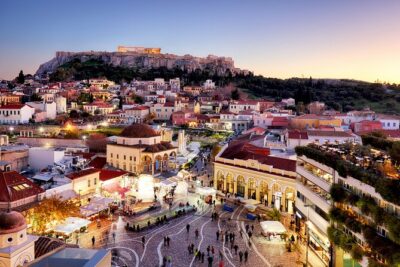
the Great Greek Philosophers Guided Tour in Spanish
Read our review →
Athens Highlights: Myths & Philosophers Private Walking Tour
Read our review →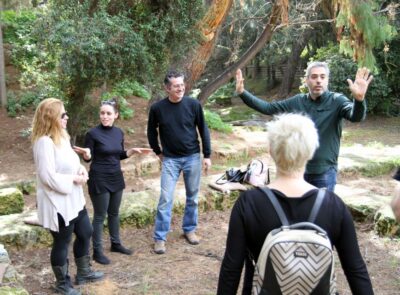
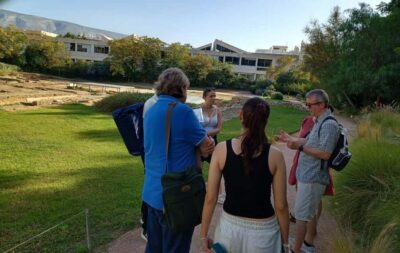
Aristotle’s Philosophy Experiential Workshop, Lyceum, Athens
Read our review →
Browse the lists this tour appears in