
Reviewed · ATHENS MYTHOLOGY TOURS
Athens Riverside: A Journey in Mythical Athens
Athens has two rivers you can barely see today, yet their paths lead straight through the city’s oldest stories. This three-hour walk follows the buried Eridanos and the underground Ilissos, linking ancient watercourses with sanctuaries, caves, Roman ruins, the Agora, and the Acropolis hills.
I like the way this tour takes you beyond the standard photo stops, and I like the views from Pnyx and Philopappos Hills, especially late in the day. The main caution is the heat: three hours on Athens’ hills can feel rough in summer, and the price of $83.77 per person is easier to justify if your guide is strong and your group is small.
Key points to know before you book
- The rivers are the hook: See part of the Eridanos beneath Monastiraki and follow the old course of the Ilissos through modern Athens.
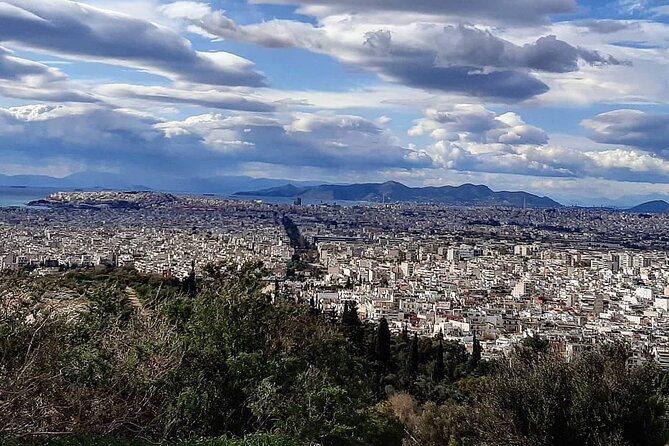
- The route reaches the hills: Pnyx, the Hill of the Muses, and Philopappos Hill bring broad views over the city and the Acropolis.
- You get more than mythology: Expect ancient sanctuaries, Christian remains, caves, Roman baths, the Ancient Agora, and the Roman Conservatory.
- It is a private experience: Only your own group takes part, which allows more questions and a flexible feel.
- Guides add much of the value: Helena, Eleni, Dionysus, and Arthur have all led this walk, with particular praise for clear history and links between ancient and modern Athens.
- Plan for weather: The tour runs in all conditions, so wear practical shoes and bring protection from sun or rain.
Why Athens’ buried rivers make a good walking theme
At first, a river walk in central Athens may sound odd. Modern Athens is dry, paved, and crowded in places. The Eridanos is mostly hidden, while the Ilissos runs underground through much of the city. But that is exactly what gives the route its character. You are not simply looking at one preserved monument after another. You are tracing the natural lines that helped shape old Athens.
The Eridanos begins at a spring on Mount Lycabettus and once flowed toward Kerameikos. Near Monastiraki Square, construction for the metro exposed part of the old channel. It is a small but telling sight. Beneath the modern transport system is a watercourse connected with the city’s earliest life.
The river was named for Eridanos, a river god in Greek mythology. Your guide uses this detail to connect physical places with the stories attached to them. That works well here because the tour is not just about dates and building styles. It asks you to picture how water, hills, religious sites, assemblies, and roads fitted together in ancient Athens.
The Ilissos offers a different kind of clue. Its old banks were linked with ancient writing and with Socrates, who is said to have taught in the area. Much of the river now lies below the modern city, but the route follows its former course and uses it to explain how Athenians understood their surroundings.
I like this approach for repeat visitors. If you have already seen the Parthenon and walked the main central streets, the rivers give familiar Athens a new shape. You begin to notice that the city’s famous sites did not exist in isolation. They sat within a network of water, slopes, sacred places, and civic spaces.
More Greek mythology tours in Athens:
- Athens: Mythology of Delphi, Museum and Arachova Guided Tour
★ 4.6 · 4,008 reviews - Athens & Acropolis Highlights: Greek Mythology Small-Group Tour
★ 5.0 · 2,370 reviews - Athens: Acropolis and Mythology Highlights Small Group Tour
★ 4.8 · 2,275 reviews
Starting at Monastiraki and finding the Eridanos
The stated meeting point is Ermou 111, close to Monastiraki Square. The tour information also directs you to the uncovered section of the Eridanos near the metro area. Confirm the exact spot and guide contact when you book, since central Athens has several busy meeting areas and the published start details describe both the street address and the square.
Monastiraki is a practical starting point because it puts you at the center of old and new Athens. Modern shops and transport surround remains that reach back thousands of years. Your guide begins by explaining the river’s route, its source, its destination, and why it disappeared beneath the growing city.
Do not expect a large, open river scene. The Eridanos is valuable because it is a fragment. You see how much of ancient Athens is still present below the pavement, even when the city above it looks entirely modern.
This first stop also sets the tone for the rest of the walk. You will be asked to look at Athens in layers. A classical site may sit beside a Christian remnant. A Roman structure may appear near a modern neighborhood. A myth may explain the name of a hill or rock. The guide’s storytelling matters here, since the physical remains alone can be modest.
Ancient Agora, sacred slopes, and the route toward the Acropolis
The walk continues through archaeological areas that include the Ancient Agora and the Acropolis area. The Agora was the civic heart of ancient Athens, so it helps explain the city as a working community rather than only a collection of temples.
The experience is not described as a full, ticketed museum visit with a long stop inside every major site. Instead, you should think of it as a connected walking route through important archaeological ground. Ask your guide exactly which areas you will enter and whether any admission fees apply, because the included service is the local guide and food and drinks are not included.
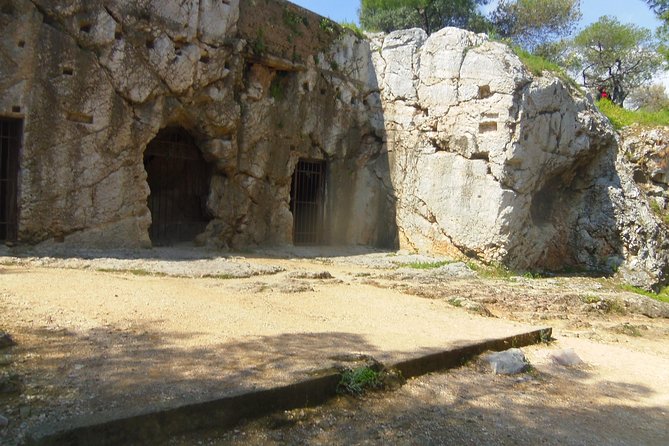
As you move toward the Acropolis, the route passes ancient sanctuaries dedicated to Greek gods, remains of Christian churches, mystical caves, and Roman baths. These details give the walk its strongest sense of time. Athens was not rebuilt from scratch every few centuries. Later communities used, altered, buried, and sometimes ignored what came before.
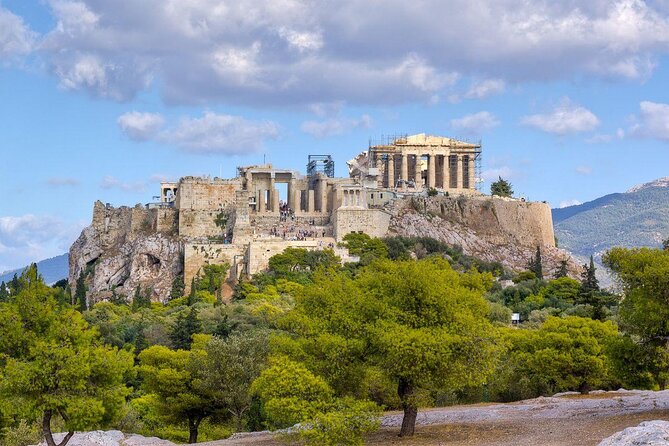
The Acropolis itself is the obvious star, but this walk looks at the sacred hill and its lower slopes from several angles. That makes the experience useful for orientation. You gain a better sense of how the hill relates to the surrounding neighborhoods and why its position mattered so much.
The end point is in front of the Acropolis Museum on Makryianni Street. That is a useful place to finish. You can continue into the museum if you have a separate ticket and enough time, or use the nearby central area for your next stop. The tour itself does not promise museum entry, so treat the museum as a possible follow-on rather than part of the package.
Ares’ Rock and the small naked outcrop
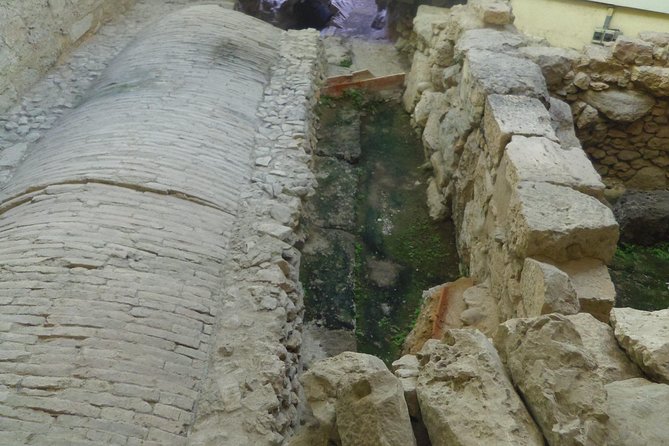
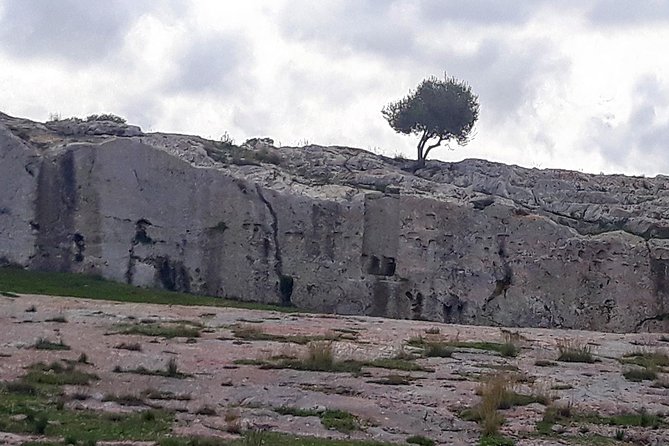
One itinerary stop focuses on the small bare rock associated with Ares. Known as the Areopagus, it has strong links with ancient civic and religious life. The point is not its size. The exposed rock shows how a modest natural feature could carry great importance in the old city.
Your guide explains the myths and traditions tied to the place, along with its role in the ancient Athenian setting. This is one of the route’s useful habits: it gives meaning to features you might otherwise pass without a second look.
There is also a practical issue. Bare rock and hill paths can be uneven, and the walk includes several slopes. The tour is described as suitable for most people, but casual clothing should include sturdy footwear. If you have trouble with hills, ask about the route before booking rather than assuming a flat city stroll.
A different kind of day out from Athens:
- Athens: Acropolis & up to 5 Archaeological Sites Combo Pass
★ 4.4 · 12,619 reviews - Athens: Acropolis Ticket with Optional Audio or Live Guide
★ 4.2 · 11,055 reviews - Athens: Acropolis, Parthenon & Acropolis Museum Guided Tour
★ 4.8 · 9,316 reviews - Athens: Cape Sounion & Poseidon Temple Sunset Half-Day Trip
★ 4.8 · 8,241 reviews
The Hill of the Nymphs and the Athenian Assembly
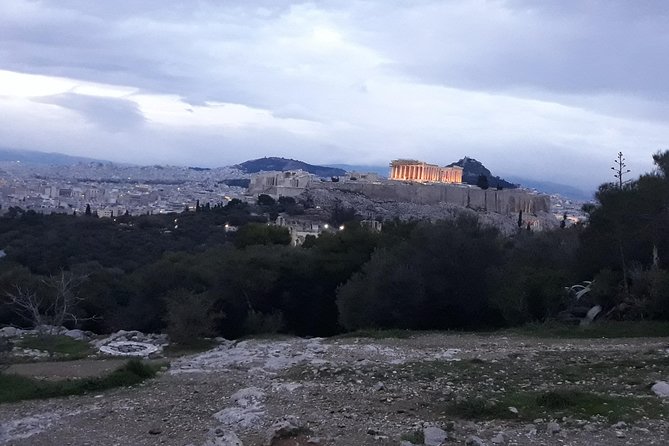
The path then heads through the mythical Hill of the Nymphs toward the place connected with the Athenian Assembly. This section shifts the focus from gods and burial channels to democracy and public decision-making.
The Assembly was not an abstract idea in ancient Athens. It was a physical gathering of citizens, held in a setting shaped by the surrounding hills. The Pnyx is especially important because it is linked with public speeches and civic debate. Your guide can help you picture how the slopes worked as a meeting place and why the setting mattered.
I find this part especially helpful if you have only seen Athens through its temples. The route shows that the city’s political identity developed alongside its religious one. You are not just admiring old stones. You are walking through places where people argued, voted, worshipped, taught, and told stories about their gods.
The Hill of the Nymphs also gives the tour some of its quieter moments. Athens can be noisy at street level, but the higher paths offer a change in pace. Depending on your departure time, the light may soften toward sunset. Several daily departures are offered, so choose the time that fits your schedule, then consider how much heat and daylight you want.
Pnyx, the Hill of the Muses, and the best views
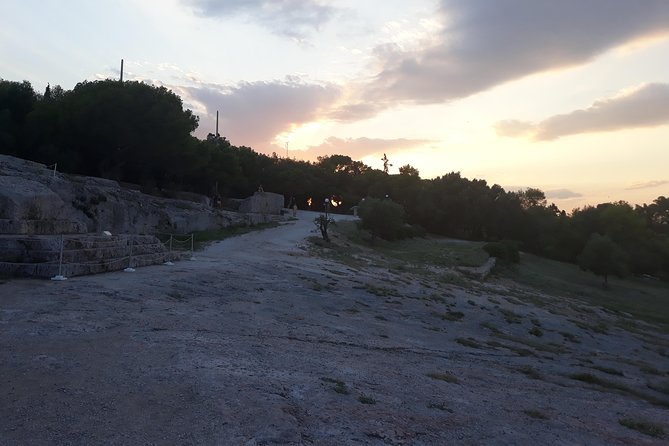
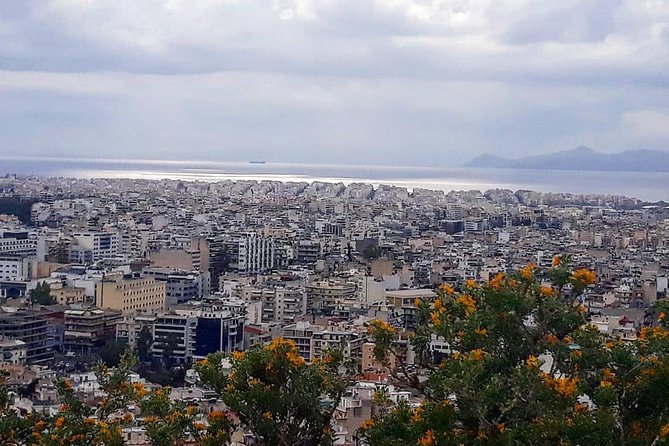
The route includes Pnyx and Philopappos Hill, also called the Hill of the Muses. These are among the strongest reasons to choose this walk instead of a standard central Athens history tour.
From the hills, you get wide views toward the Acropolis and across the city. The exact view changes with your position and the weather, but the point is clear: the Acropolis looks different when seen from its surrounding slopes rather than only from the entrance path.
The hills are also tied to ancient stories. Your guide explains the legends of the city while you walk, using the views to show how Athens was arranged. A late departure may bring sunset light, but there is no guarantee of a dramatic sky. Even without sunset, the elevated route is worthwhile for orientation and photographs.
The drawback is physical. A three-hour walk with hill sections is not the best choice for a very hot afternoon. One person who took the route in spring found the wildflowers and mild weather ideal, but warned that summer could be brutally hot. That is sound advice. In warm months, pick an earlier or later departure, carry water, and wear a hat. Food and drinks are not included.
The Roman Conservatory and the city’s later layers
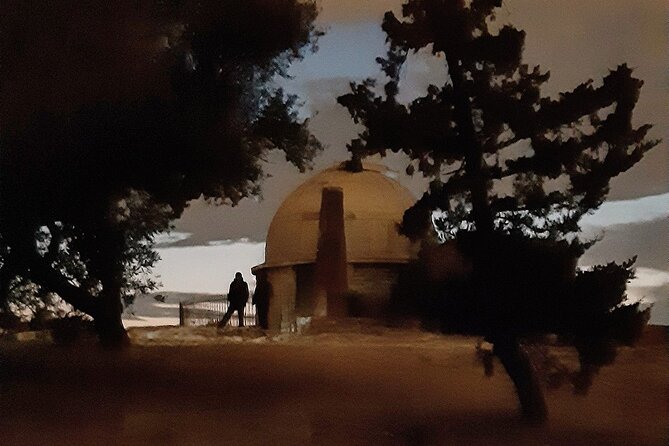
One stop passes the Roman Conservatory of Athens, better known as the Odeon of Herodes Atticus. It gives you another example of how Athens changed after its classical peak.
The structure belongs to the Roman period, yet it sits within the visual world of the Acropolis. That contrast is part of the tour’s appeal. Ancient Athens was not frozen at the height of Pericles. Roman patrons added their own buildings, and later Christian communities left their own traces.
The route also points out Roman baths and Christian church remains. These stops may not carry the instant fame of the Acropolis, but they help you understand how the same ground served different communities over time.
This is where a good guide earns the fee. Helena has been praised for a friendly manner and strong command of the subject. Eleni is particularly good at connecting ancient culture with Athens’ later development and modern life, and has made a point of keeping younger members of a group involved. Dionysus and Arthur have also led the walk, with Arthur guiding a private French-speaking experience according to the language available in the supplied information. The tour is offered in English, so confirm language needs before booking.
What the private format means for you
This is a private tour, so only your group takes part. That changes the experience in useful ways. You can ask why a river disappeared, pause over a myth, or spend more time on a view without worrying about a large group’s schedule.
It also means the guide has a bigger effect on the day. A strong guide can turn an ordinary rock, buried channel, or broken wall into a clear story. A less polished guide could make the same route feel like a long walk between scattered ruins.
The available feedback points to guides as the most praised part of the experience. Their value is not just factual recall. The best version of this tour links Socrates, river gods, public assemblies, Roman buildings, and modern streets into one readable story. If you are booking for young people, Eleni’s effort to keep teenagers interested is worth noting. A small snack such as koulouri was even provided on one occasion, but do not treat that as an included feature.
A private format can also be good for repeat visitors. One couple who knew Athens well still found new places and new explanations along the route. That is the right audience for this tour: people who want a fresh angle rather than a basic introduction to the Acropolis.
Is $83.77 good value for three hours?
At $83.77 per person, this is not a cheap walk. Its value depends on what you want from a guide and whether you are sharing the cost across a private group.
You are paying for a themed route, an English-speaking local guide, and the ability to ask questions within your own group. You are not paying for food or drinks, and the supplied inclusions do not list admission tickets. Check the ticket situation for any archaeological areas you plan to enter.
The price makes more sense if you care about context. A casual stroll past the Acropolis costs less, but it will not necessarily explain the buried rivers, the old Ilissos, the Assembly, or the link between mythology and the city’s physical layout.
I would be less quick to recommend it to someone visiting Athens for the first time with only a few hours and no plan to see the main monuments. In that case, a tour focused directly on the Acropolis may give you more immediate value. If you have already seen the headline sights, this route offers a fresh three-hour use of your time.
Timing, meeting point, and what to wear
Several departure times are available, which lets you choose between cooler conditions, brighter views, and possible sunset light. The tour runs in all weather, so check the forecast and dress for the day rather than assuming Athens will be dry and mild.
Wear casual clothes and shoes suited to uneven paths. The hills are the main physical demand. Carry water, especially in summer, even though food and drinks are not included.
The stated end point is in front of the Acropolis Museum at Str. Makryianni 1. That makes the route easy to combine with the museum, the Acropolis area, or an evening meal nearby. Public transportation is close to the route, and the experience is described as suitable for most people.
You receive confirmation at booking, and free cancellation is available until 24 hours before the start time. Changes or cancellations inside that window are not accepted for a refund.
Who should book Athens Riverside?
I would choose this walk if you have already visited Athens’ main monuments, enjoy mythology, or want to understand how the city grew around rivers and hills. It is also a good fit if you prefer a private setting and like stopping to ask questions.
It is less suitable if you want a flat route, a museum-heavy tour, or guaranteed entry to every major site. Summer heat is a real concern, and the price is high enough that guide quality matters.
Book it for the stories beneath the pavement, the quieter archaeological corners, and the views from the hills. Skip it if you want only the famous monuments with minimal walking. For the right schedule and weather, this is a thoughtful way to see Athens as a living city built over its own myths, waterways, and old civic ground.
FAQ
How long does the Athens Riverside tour last?
The walk lasts approximately three hours.
Where does the tour start?
The stated start point is Ermou 111, Athens 105 55, Greece, near central Monastiraki. Confirm the exact meeting location with your booking confirmation.
Where does the tour finish?
The tour finishes at Str. Makryianni 1, Athens 117 42, in front of the Acropolis Museum.
Is the tour private?
Yes. Only your own group takes part in this private activity.
Is the tour offered in English?
Yes. The experience is offered in English.
Are food, drinks, and admission tickets included?
Food and drinks are not included. The listed inclusion is a local guide, and admission tickets are not listed as included, so confirm ticket arrangements before you go.
Newly reviewed around Athens
- Athens: workshop for painting landscape with local artist★ 4.6 · 3 reviews
- Athens: Greek Wine & Olive Oil Tasting at Brettos Plaka★ 4.5 · 3 reviews
- Outdoor Yoga and Pilates with Akropolis view★ 4.0 · 5 reviews
- Acropolis of Athens: 60′ Tour in a Vintage Motorcycle★ 5.0 · 4 reviews
- Ultimate Tasting of the Volcanic Wines of Greece★ 5.0 · 3 reviews
- workshop for painting acropolis/landscape with local artist★ 5.0 · 3 reviews
- Athens at Twilight Night Tour with Drinks and Meze Dishes★ 4.8 · 4 reviews
- Breakfast in the markets with olive oil and honey tasting★ 4.8 · 8 reviews
Athens Mythology Tours, compared.
Mythology of Delphi, Museum and Arachova Guided Tour
Read our review →
Athens & Acropolis Highlights: Greek Mythology Small-Group Tour
Read our review →
Acropolis and Mythology Highlights Small Group Tour
Read our review →
The History of Athens: Greek Mythology Private Tour
Read our review →
Athens Highlights: Myths & Philosophers Walking Tour
Read our review →
Greek Mythology Treasure Hunt for Kids – Athens Private Tour
Read our review →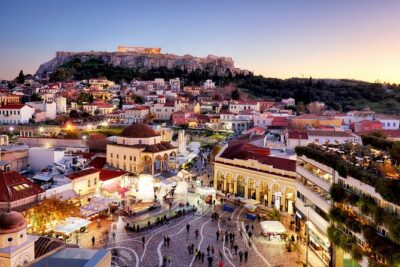
Browse the lists this tour appears in