
Reviewed · ANCIENT CORINTH TOURS
The Apostle Paul’s Missionary Journey in Athens and Corinth
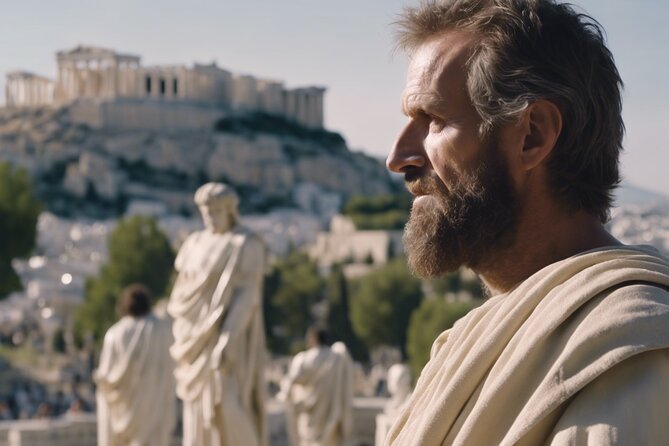
Paul’s Athenian speech makes most sense when you see the places where it unfolded. This private day trip links the Ancient Agora and Areopagus with Kenchreai and Corinth, giving you biblical landmarks alongside temples, Roman ruins, churches, and a remarkable mountain fortress.
I like the door-to-door pickup and the freedom of a private car. I also like that the day is not limited to Paul’s story: the Corinth Canal, Temple of Apollo, local churches, and Acrocorinth show you the wider Greek world he entered. The main drawback is the long day, with rough walking surfaces and extra admission fees.
Key points to know before you book
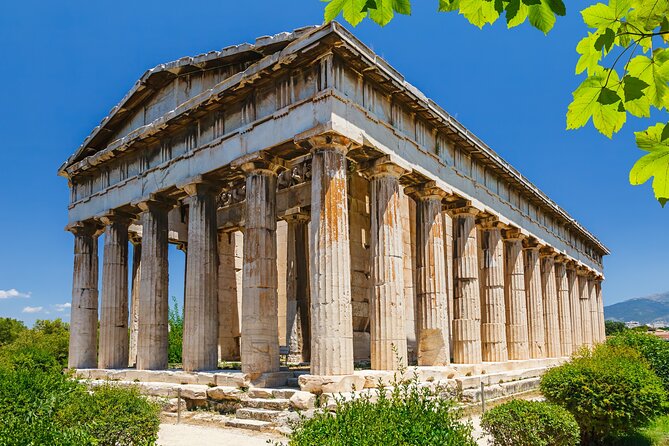
- Paul’s Athens begins at the Agora: You can picture him meeting philosophers and debating ideas in the city’s public center.
- Kenchreai adds an important harbor setting: This was the eastern port where Paul arrived in Corinth in 51 A.D.
- The private format gives you flexibility: Drivers such as Ruslan, Yannis, Giannis, Kostas, George, and Fortis have been praised for careful driving, patience, and clear explanations.
- Acrocorinth is the visual high point: The climb brings wide views, but it requires steady footing and comfortable shoes.
- The $200.25 price buys convenience, not all-inclusive entry: Transport, water, Wi-Fi, and pickup are covered, while archaeological admissions and a licensed site guide cost extra.
- Plan for eight to nine hours: This is a serious day trip, best for people who want Athens and Corinth in one outing.
Why this Athens to Corinth day matters
Many Athens excursions give you either classical ruins or a religious theme. This one connects both. You begin in the center of ancient Athenian public life, then travel to the port and city where Paul spent time preaching, working, and facing Roman authority.
That connection matters because Corinth was not just a Bible-study setting. It was a busy commercial city, a Roman provincial capital, and a place where Greek traditions, Roman power, Jewish communities, and early Christianity met. You see that mixture in the ruins.
The tour is private, so you travel only with your own group. For one to four people, the vehicle is a sedan. Larger groups use another vehicle, though the precise vehicle type is not provided. Air-conditioning, bottled water, and Wi-Fi make the long drive easier, especially in the hot months.
Your driver is an English-speaking professional with a strong background in Greek history. The service has used guides including Ruslan, Yannis, Giannis, Kostas, George, Fortis, and Katerina. A key distinction is worth understanding: the driver provides historical interpretation, but a licensed guide to accompany you inside archaeological sites is not included.
More Ancient Corinth and canal trips:
- From Athens: Ancient Corinth Day Trip with Canal & VR Guide
★ 4.6 · 1,073 reviews - Private Biblical Tour Ancient Corinth & Isthmus Canal from Athens
★ 5.0 · 762 reviews - Athens: Ancient Corinth & Nafplio Full Day Trip with Swim
★ 4.8 · 523 reviews
Starting among philosophers at the Ancient Agora
The Ancient Agora is the right place to begin. This was ancient Athens’ center for government, trade, social life, and religious activity. It was not a quiet museum zone. It was where people met, argued, bought goods, handled public business, and discussed the ideas shaping their city.
For Paul, the Agora offers a useful setting for understanding his approach in Athens. He was speaking in a city already filled with competing schools of thought and religious traditions. Standing among the ruins helps you picture Christianity entering an established world of public debate.
Allow about an hour here. You will walk over uneven archaeological ground, so sturdy shoes matter. Admission is not included, and you should budget for that separately. If you want detailed interpretation at every monument, ask in advance about hiring a licensed guide, since the included driver is not a licensed site guide.
The Agora is also a place where your guide can help you read what remains. Names, columns, foundations, and civic buildings can blur together without explanation. Guides such as Ruslan have been praised for first explaining what to look for, then giving people time to examine the site at their own pace.
Looking down from the Areopagus
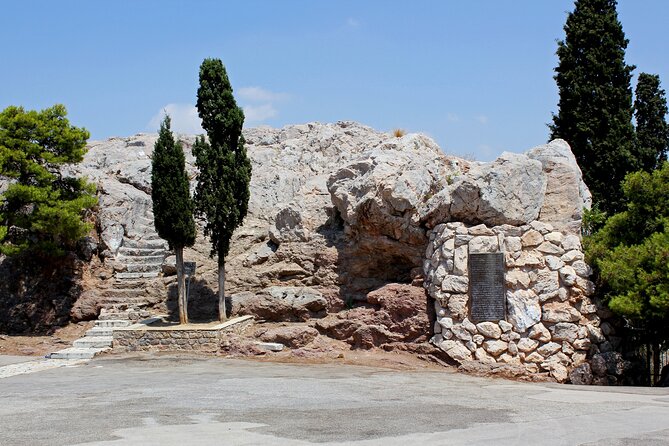
The Areopagus sits northwest of the Acropolis on a bare marble hill. It served as a judicial and political meeting place, and it was also associated with philosophical debate. Paul’s address here is one of the tour’s strongest biblical links.
You spend about 30 minutes at the hill. Admission is free, but the footing is not polished or level. The rock can be slippery, particularly in hot weather when visitors are rushing or wearing thin-soled shoes.
This stop works best when your guide explains both the setting and the speech. Paul was not speaking in an empty wilderness. He was addressing people accustomed to public argument, multiple gods, and sophisticated philosophical ideas. The site gives his message a physical setting without pretending that every detail of the ancient scene survives.
The view toward Athens also helps. You can look across the city and understand how close the intellectual and religious centers were to the wider urban life of ancient Athens.
A short church visit in Kolonaki
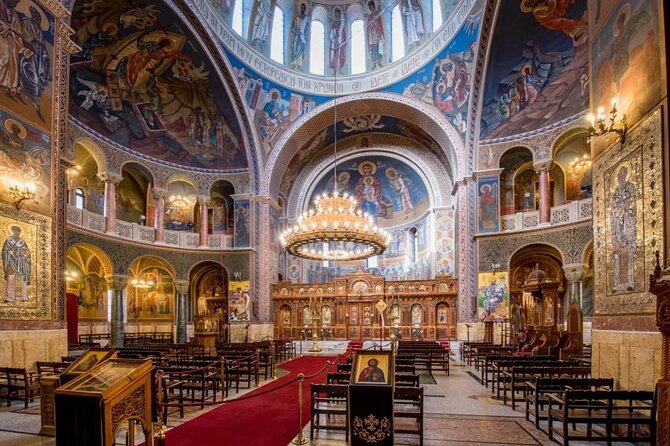
The Church of Saint Dionysius the Areopagite brings the story into a later Christian setting. It is on Skoufa Street in the Kolonaki district and is dedicated to Athens’ patron saint, Dionysius.
According to Christian tradition, Dionysius was converted by Paul and later became the city’s first bishop. The church is not an archaeological site from Paul’s lifetime, so you should treat it as a place of later memory and devotion rather than direct evidence from the first century.
The visit lasts about 20 minutes and admission is free. It offers a change of pace after the exposed Agora and Areopagus. If a service is taking place, follow the usual rules for quiet behavior and appropriate dress. A Greek Orthodox service may be part of the day when timing allows, but it is not guaranteed as a scheduled feature.
More biblical and Apostle Paul tours in Athens:
- Biblical Tour Letters ToThe Corinthians St Paul’s Footsteps 6Hour
★ 5.0 · 1,065 reviews - Private Tour of Apostle Paul’s Footsteps in Ancient Corinth
★ 5.0 · 275 reviews - Paul”s Footsteps Ancient Corinth Biblical Tour
★ 5.0 · 184 reviews - Private Luxury Biblical Tour: Apostle Paul in Athens & Corinth
★ 5.0 · 162 reviews
The Corinth Canal puts the geography in focus
The drive from Athens to Corinth is a major part of the day. The Corinth Canal makes a useful stop because it explains the region’s geography at a glance.
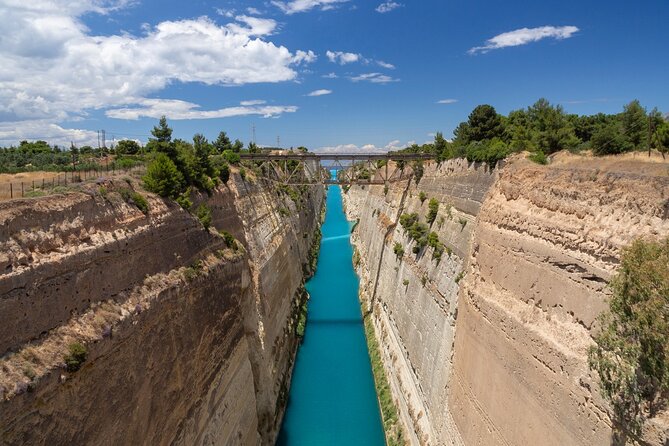
The canal cuts through the Isthmus of Corinth, linking the Gulf of Corinth with the Saronic Gulf. It separates the Peloponnese from mainland Greece, making the peninsula effectively an island. The canal was built long after Paul’s time, so do not confuse it with an ancient Roman project.
Still, it shows why Corinth mattered. This narrow strip of land controlled movement between northern and southern Greece. The canal stop lasts about 20 minutes and is free. It is mainly a viewpoint and orientation stop, not a long visit.
The stop also breaks up the drive. With roughly eight to nine hours for the whole outing, that matters. You get out, stretch your legs, take in the engineering work, and continue toward the ancient sites.
Reaching Corinth through Kenchreai
Kenchreai, also written Kechrees, was Corinth’s eastern port. This is where the biblical story gains a strong sense of place. Paul arrived here in 51 A.D. as he began his work in Corinth.
Much of the ancient harbor is now ruined or underwater, but you can still see remains linked to its old function. These include Roman engineering, storerooms, breakwaters, a nymphaeum, sanctuaries, and an early Christian basilica from the fourth century A.D.
The visit lasts about 20 minutes and admission is free. It is not a grand, intact port, so set your expectations correctly. You are reading fragments and coastal remains rather than walking through a fully preserved ancient harbor.
That is also what makes it useful. Kenchreai shows the practical side of Paul’s journeys. He moved through working ports, commercial routes, and towns tied to shipping. This stop prevents the day from becoming a string of famous ruins without a sense of how people and goods actually moved.
Ancient Corinth and the place of the Bema
Ancient Corinth is the central stop. Plan on about an hour at the archaeological site, with additional time at the museum.
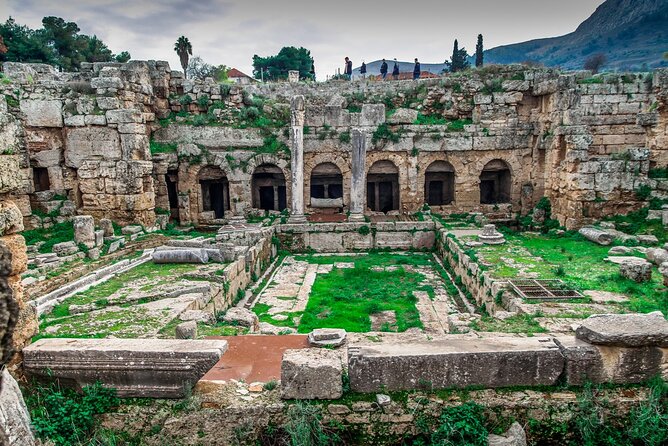
The city was one of the most powerful and prosperous in the ancient Greek world. Under Roman rule, it remained an important center. The Agora gives you the broadest sense of daily life. This was a place of commerce, public movement, and social contact, not simply a collection of temples.
The Bema is especially meaningful for Christian visitors. This raised platform in the city center is traditionally linked with Paul’s appearance before the Roman proconsul. The exact details of ancient events require care, but the setting brings the account of Paul’s trial into view.
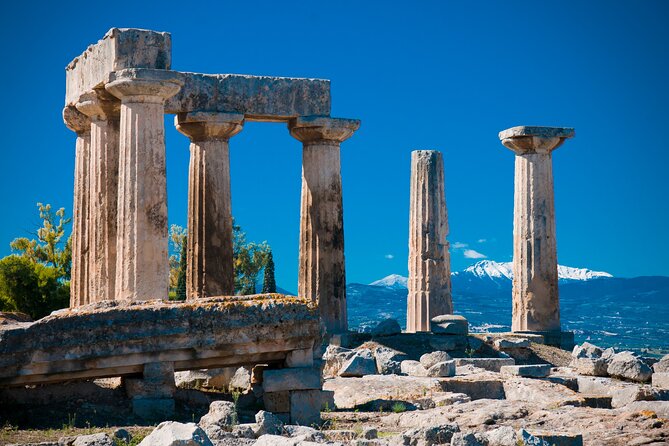
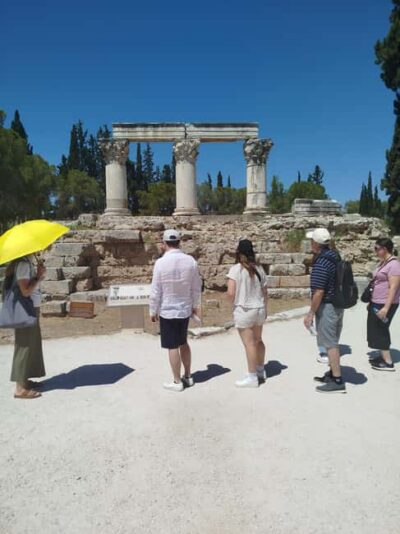
Nearby, the Temple of Apollo gives you a striking reminder of Corinth’s older religious traditions. Its surviving columns are among the most recognizable remains at the site. They also help you understand the world Paul was addressing. Early Christianity did not arrive in a blank space. It entered a city with established worship, public rituals, civic pride, and long-standing religious institutions.
Admission to Ancient Corinth is not included. The ground is uneven, and you will be outside for much of the visit. Wear shoes that can handle gravel and worn stone. In June and other hot months, a hat, sunscreen, and water are practical necessities. Bottled water is supplied, but you should still prepare for sun exposure.
The Archaeological Museum fills in the missing details
The Museum of Ancient Corinth makes the open-air site easier to understand. Its exhibits cover the area’s long past, from prehistoric material to finds connected with the Sanctuary of Asklepios.
You can see objects that explain daily life, religious practice, and artistic work. That is useful because ruins often show scale and layout better than human detail. The museum gives you the smaller evidence: objects, decoration, and artifacts that show how people used the buildings you have just seen.
Allow about 45 minutes. Entrance fees for museums and archaeological sites are not included in the tour price, so confirm the current combined cost before the day begins. The museum visit is especially helpful if you are interested in archaeology rather than only biblical landmarks.
Climbing Acrocorinth for the big view
Acrocorinth is the final major stop and the most physically demanding one. The fortified hill rises above Ancient Corinth and served as both a defensive stronghold and a religious center.
The site is linked with the Temple of Aphrodite, traditionally said to have housed as many as 1,000 priestesses. That figure belongs to the historical tradition surrounding the site, and the remains themselves require imagination. What you can see clearly is the hill’s strategic value and the layers of fortification.
You will get broad views over Corinth and the surrounding area. The climb and stone surfaces can be difficult for anyone with mobility limits. One practical option mentioned by the tour’s guests is lunch at Taverna Kastro after the visit, but lunch is not included in the tour and is not guaranteed as part of the scheduled program.
The stated visit is about 30 minutes, though the exact time may depend on walking pace and access conditions. If Acrocorinth is a priority, tell your driver at the start. The day includes many stops, and private transport gives you a better chance of adjusting the pace than a large coach tour would.
What the $200.25 price really covers
At $200.25 per person, this is not the cheapest way to reach Corinth. Its value comes from the private transport and the amount of ground covered in one day.
You receive hotel or port pickup, return transport, an air-conditioned vehicle, Wi-Fi, bottled water, and an English-speaking driver. For a couple or small family, avoiding a rental car, navigation, parking concerns, and the long return drive can justify the price.
The cost does not include archaeological admission, museum admission, lunch, or a licensed guide inside the sites. Airport pickup is possible for an additional charge. Group discounts may reduce the per-person cost when more people share the vehicle, but the exact discount is not provided.
I would compare the price with the cost of separate transport and entry tickets, not with a basic group bus fare. You are paying for a private schedule, direct pickup, and the chance to ask questions throughout the day.
How to prepare for the long day
Pickup is offered from Athens hotels and apartments, with the driver waiting outside. At the port, the driver waits in the arrival area with a sign bearing your name. Airport pickup costs extra.
Start with comfortable walking shoes. The Agora, Ancient Corinth, and Acrocorinth all involve uneven ground, and the final hill can be demanding. Bring a hat and sunscreen, especially in June and other hot periods.
The tour is offered in English and confirmation is provided at booking. Child seats are available on request. Most people can participate, but the combination of rough surfaces, climbing, heat, and a full day means it is not the best choice for serious mobility limits.
Free cancellation is available up to 24 hours before the start time. Changes made inside that window are not accepted, and poor weather can lead to a new date or a full refund.
Who should book this private Corinth excursion?
You should consider it if Paul’s life is a major reason for visiting Greece, but you also want classical sites and practical historical context. It is a good fit for couples, families, cruise passengers, and small groups that prefer a private car to a large bus.
The strongest part of the experience is the human service. Ruslan, Yannis, Giannis, Kostas, George, Fortis, and Katerina have each been associated with careful driving, clear explanations, patience, and help with small needs such as coffee, snacks, local restaurants, or a different drop-off point. These extras depend on the driver and the day, so do not treat them as guaranteed inclusions.
The tour currently carries a 4.9 rating from 50 ratings, with 96 percent recommending it. That matches the main strengths: attentive drivers, strong historical storytelling, and a full route that reaches places a standard Athens tour misses.
Should you book it?
Book this tour if you want to connect Paul’s Athenian message with the actual ports, streets, public spaces, and ruins of Corinth. The Agora, Areopagus, Kenchreai, Bema, and Acrocorinth create a clear story, while the private car keeps the long day manageable.
Skip it if you want a relaxed Athens-only outing, dislike archaeological walking, or need all admissions and meals included. Before booking, confirm the site entry costs, request a licensed guide if detailed archaeological interpretation matters to you, and ask for a child seat or airport pickup when needed. For a private, Bible-focused day beyond Athens, this is a strong and unusually well-rounded choice.
FAQ
How long does the tour last?
The tour lasts approximately eight to nine hours.
Where can pickup take place?
Pickup is offered from Athens hotels or apartments and from the port. Airport pickup is available for an additional cost.
How does port pickup work?
The driver waits in the port arrival area and holds a sign with your name.
Is the tour private?
Yes. Only your group participates in the private tour.
What language is the tour offered in?
The tour is offered in English.
Is a licensed guide included?
No. The tour includes a professional English-speaking driver with historical knowledge, but a licensed guide to accompany you inside archaeological sites is not included.
Are entrance fees included?
No. Entrance fees for archaeological sites and museums are not included. The Corinth Canal, Areopagus, Kenchreai, Church of Saint Dionysius, and Acrocorinth are listed with free admission, but confirm access details before departure.
Is lunch included?
No. Lunch is not included. A local restaurant stop may be possible depending on the timing and driver, but it is an extra cost.
What should you bring?
Bring comfortable shoes, a hat, sunscreen, and water for the warm outdoor sections. Bottled water is supplied, and child seats are available upon request.
Newly reviewed around Athens
- Athens: workshop for painting landscape with local artist★ 4.6 · 3 reviews
- Athens: Greek Wine & Olive Oil Tasting at Brettos Plaka★ 4.5 · 3 reviews
- Outdoor Yoga and Pilates with Akropolis view★ 4.0 · 5 reviews
- Acropolis of Athens: 60′ Tour in a Vintage Motorcycle★ 5.0 · 4 reviews
- Ultimate Tasting of the Volcanic Wines of Greece★ 5.0 · 3 reviews
- workshop for painting acropolis/landscape with local artist★ 5.0 · 3 reviews
- Athens at Twilight Night Tour with Drinks and Meze Dishes★ 4.8 · 4 reviews
- Breakfast in the markets with olive oil and honey tasting★ 4.8 · 8 reviews
Ancient Corinth Tours, compared.
Ancient Corinth Day Trip with Canal & VR Guide
Read our review →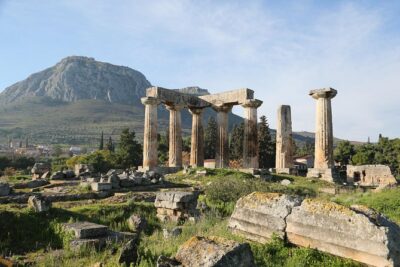
Private Biblical Tour Ancient Corinth & Isthmus Canal from Athens
Read our review →
Ancient Corinth & Nafplio Full Day Trip with Swim
Read our review →
Private Tour of Apostle Paul’s Footsteps in Ancient Corinth
Read our review →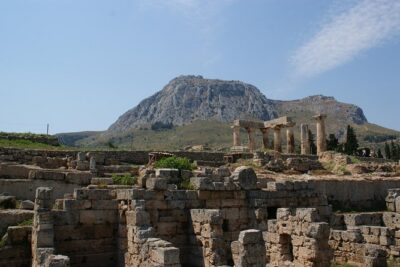
Corinth Half-Day Trip from Athens with Entrance Tickets
Read our review →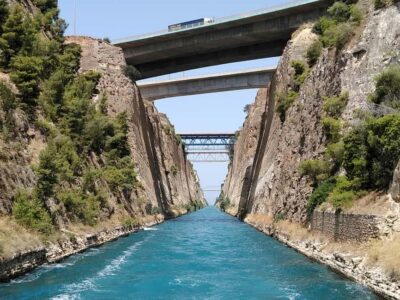
Browse the lists this tour appears in