
Reviewed · ANCIENT CORINTH TOURS
Private Tour of Apostle Paul’s Footsteps in Ancient Corinth
Ancient Corinth gives this tour its real pull. You can stand near the Bema where Paul is believed to have addressed the Corinthian community, walk through the Agora where daily business once took place, and look up at Acrocorinth, the fortress above the city. The connection between the New Testament and the surviving ruins is unusually direct.
I like the private format, which lets your driver adjust the pace and stop for photos, rest breaks, or extra questions. I also like the mix of biblical sites, Greek engineering, Roman remains, and sweeping views, rather than a tour focused only on Paul.
The main thing to understand is that this is a driver-led tour, not a private licensed guide inside the archaeological sites. The driver can explain the history and biblical connections, but admission fees and a separate site guide are not included. If you want a detailed, verse-by-verse Bible lesson, this may feel too broad.
Key points to know before you book
- The Bema and Agora connect the ruins directly to Paul’s time in Corinth.
- Kenchreai gives the tour a personal link to Paul’s travels and Phoebe.
- Acrocorinth is the visual high point, with fortress walls and wide views.
- The private car makes hotel, port, and flexible pickup easy.
- The €15 site and museum admission fee is extra, and no licensed site guide is included.
- Guides including Giannis, Nick, Ruslan, George, and Fotis have been praised for safe driving, patience, and clear explanations.
Why Corinth is worth the half-day from Athens
If you are based in Athens, Corinth is one of the most worthwhile nearby excursions for anyone interested in ancient Greece, early Christianity, or the New Testament. The drive takes you out of the city and across the Isthmus of Corinth, the narrow strip joining mainland Greece to the Peloponnese.
Paul spent about 18 months in Corinth during his ministry, and the city later became the setting for two important letters in the New Testament. You are not simply looking at disconnected ruins. You are moving through a place shaped by trade, seafaring, Roman power, pagan worship, and a growing Christian community.
The tour lasts about five to six hours, including driving time. That makes it a good choice if you want a focused half-day rather than a full excursion with several distant stops. Pickup and drop-off are offered at Athens hotels, apartments, and the port. Airport pickup is also possible for an additional €50 per booking.
For groups of one to four people, transportation is normally in a sedan. Larger groups may use a larger vehicle. Every vehicle is air-conditioned, bottled water is provided, and WiFi is available onboard.
More Ancient Corinth and canal trips:
- From Athens: Ancient Corinth Day Trip with Canal & VR Guide
★ 4.6 · 1,073 reviews - Private Biblical Tour Ancient Corinth & Isthmus Canal from Athens
★ 5.0 · 762 reviews - Athens: Ancient Corinth & Nafplio Full Day Trip with Swim
★ 4.8 · 523 reviews
The Corinth Canal puts the journey in context
Your first stop is the Corinth Canal, cut through the 6.3-kilometer-wide isthmus in 1893. The canal changed the geography of the Peloponnese by turning it into an island, at least in practical terms, and created a faster sea route between the Gulf of Corinth and the Saronic Gulf.
You get about 20 minutes here. That is enough for a look at the steep limestone walls, the water below, and photographs from the crossing area. It is a short stop, but it helps explain why Corinth became so important. The isthmus controlled movement between northern and southern Greece, while its ports connected routes across the wider Mediterranean.
I like this opening because it gives you a physical sense of Corinth’s position. Paul did not arrive in an isolated inland settlement. He came to a major crossroads shaped by commerce and ships.
The stop is free, though the time is limited. If you want a long visit or detailed engineering discussion, the schedule may feel brisk.
The Diolkos shows ancient Greek problem-solving
A few minutes from the canal, you see remains of the Diolkos. This stone-paved trackway predates the modern canal by more than two thousand years and was used to haul ships overland across the isthmus.
The idea sounds strange until you consider the alternative. Ships traveling around the southern tip of the Peloponnese faced a difficult and dangerous route. Moving vessels across land saved time and reduced risk, though it required enormous organization and labor.
You spend about 10 minutes here. That is enough to see the surviving section and understand its purpose, but not enough for a long archaeological visit. I find it a useful stop because it adds practical context to Corinth. The city’s importance was not only religious or political. It was also about solving the hard transport problems of the ancient world.
Kenchreai links Paul to the sea
The ancient port of Kenchreai, also spelled Kechrees in the tour information, was Corinth’s eastern harbor. Paul arrived here during his first visit to the city around AD 51, and later sailed from this port toward Ephesus.
The site is not a fully preserved harbor town. You see modest remains, so it helps to arrive with the right expectations. This is a place of historical association rather than a large ruin complex.
For Christian visitors, the connection is especially meaningful. Kenchreai is linked with Phoebe, a prominent Christian woman and deaconess of the local church. The letter to the Romans was entrusted to her, according to the account presented on the tour. That detail gives the early Christian community a more human scale. Paul’s story here is not only about preaching. It is also about people who traveled, carried letters, offered support, and helped organize the church.
You spend about 20 minutes at the port. The stop works best when your guide explains what the visible remains cannot show. Guides such as Giannis, Nick, Ruslan, and George have been praised for connecting each location to Paul’s journeys and to the wider setting of ancient Greece.
More biblical and Apostle Paul tours in Athens:
- Biblical Tour Letters ToThe Corinthians St Paul’s Footsteps 6Hour
★ 5.0 · 1,065 reviews - Paul”s Footsteps Ancient Corinth Biblical Tour
★ 5.0 · 184 reviews - Private Luxury Biblical Tour: Apostle Paul in Athens & Corinth
★ 5.0 · 162 reviews - Private Luxury Biblical Tour: Apostle Paul’s Footsteps – Corinth
★ 5.0 · 148 reviews
Ancient Corinth brings the Bible and ruins together
Ancient Corinth is the central stop. You have about 40 minutes at the archaeological site, followed by another 45 minutes in the museum. Entrance to both is extra, with a listed fee of €15 per person.
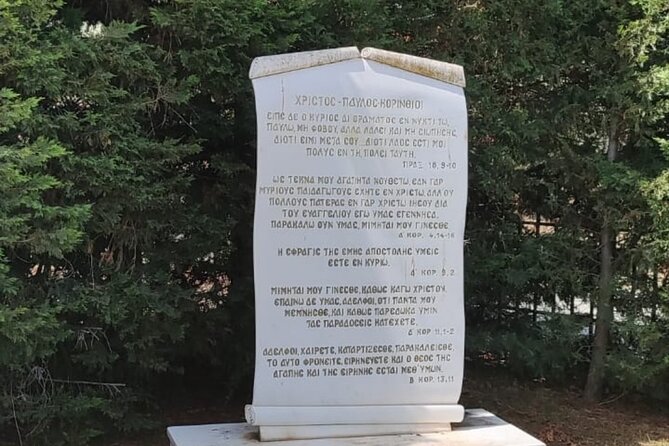
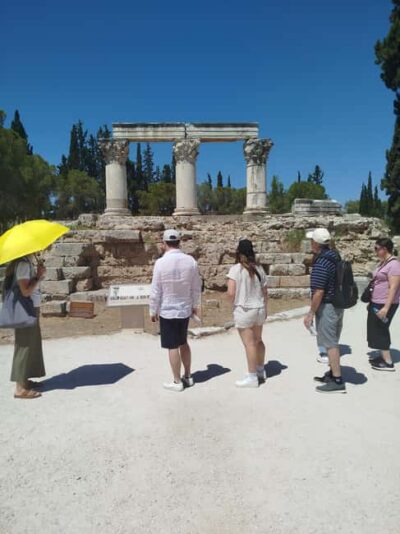
The Agora was the commercial and civic heart of the city. As you walk among the remains, you can picture the shops, public spaces, and religious buildings that made Corinth a busy urban center. Paul’s work took place in this setting, not in a remote retreat. He preached among merchants, officials, craftsmen, and residents of a prosperous Roman city.
The Bema is the key biblical location. This raised platform was used for public proceedings, and Paul is believed to have appeared here before the Roman proconsul. Standing in front of it gives the Acts of the Apostles a strong physical setting. You can see how Roman authority was displayed and why the location mattered to the early Christian community.
The nearby remains also connect with Aquila and Priscilla, who worked with Paul as tentmakers. One guide pointed out the shops where Paul, Aquila, and Priscilla are associated with making and selling tents. You may also see the street connected with Erastus, a civic official who became a co-worker of Paul.
The Temple of Apollo adds another layer. Its surviving columns are among the most recognizable remains at Corinth, and they remind you that Paul preached in a city with long-established pagan beliefs. The contrast between the old religious order and the new Christian message is one of the tour’s main themes.
This is where the tour can feel either rewarding or limited, depending on what you want. The driver offers historical explanations and can point out the biblical connections, but a licensed guide is not included inside the site. If archaeology is your main interest, you may want more time than the scheduled visit allows. If you want a clear overview tied to Paul’s story, the visit is well paced.
The museum fills in what the ruins leave out
The Archaeological Museum of Corinth was built in 1932 to protect objects found during excavations. Its galleries add detail to the city you have just seen outside.
The collections cover long periods, including prehistoric material and objects from the Sanctuary of Asklepios. You can use the museum to understand how people lived, worshipped, worked, and created art in Corinth across different eras.
I like the order of these two visits. First, you see the Agora, Bema, Temple of Apollo, and streets in their original setting. Then the museum gives you smaller objects and clearer detail. A statue, religious item, or household artifact can make the open-air ruins easier to understand.
You have about 45 minutes inside. That is enough for a useful visit, though not for every gallery in depth. The €15 admission covers the archaeological sites and museum according to the tour information, but confirm the current fee when booking since entrance charges can change.
Acrocorinth is the tour’s big view
Acrocorinth rises above Ancient Corinth and served as the city’s fortified acropolis. It was strengthened over many centuries by Greek, Byzantine, Frankish, Venetian, and Ottoman rulers.
The walls, towers, gates, and bastions show how useful this high position was. From above, Corinth’s location becomes clear. You can look over the ancient city, the surrounding countryside, and the routes that made the area valuable.
You have about 40 minutes here. Wear proper shoes. The site includes uneven ground, slopes, and stone surfaces, and the climb can be tiring in Greece’s heat. Bring a hat, sunscreen, and water. Bottled water is supplied, but you may also want to refill your own bottle during the day.
Acrocorinth is also tied to the Temple of Aphrodite, a sanctuary known in antiquity for its large community of priestesses. The story adds a religious contrast to the Christian sites visited later. It also shows why Paul’s message met a society with established gods, rituals, and sacred places.
This stop may be difficult if you have trouble walking on uneven ground. The private format helps because your driver can assist at the vehicle and adjust the pace, but the site itself remains a hilltop fortress. Ask about the walking conditions before you book if mobility is a concern.
Saint Paul Church gives the day a modern ending
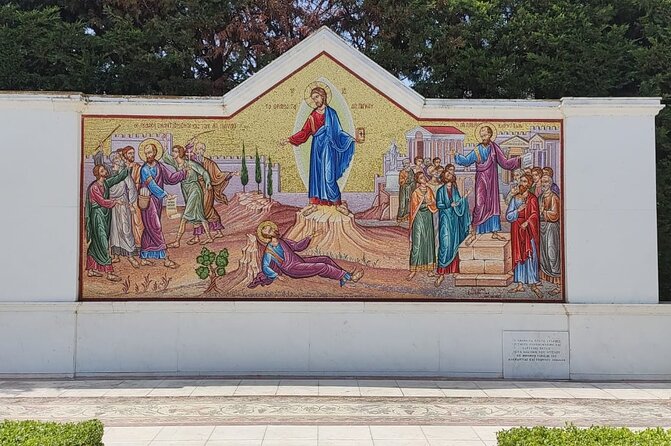
The final stop is the modern Apostolos Pavlos Church in the heart of Ancient Corinth. Inside, a mosaic by Pastorutti and Tsotsonis depicts Paul’s journey and mission in the city.
After the Agora, Bema, Temple of Apollo, and Acrocorinth, the church provides a quiet change of mood. It connects the ancient setting with the continuing importance of Paul to modern Greek Christianity.
You spend about 20 minutes here. The church is not an archaeological ruin, so it offers something different from the earlier stops. I find that useful. The day does not end with stones and walls alone. It closes with a present-day place of worship and a visual account of Paul’s role in Corinth.
The tour itself is not exclusively religious. It includes Greek engineering, ancient trade, military architecture, archaeology, and local history. That makes it suitable for mixed groups, but someone seeking a dedicated Bible study may want to ask the company how much scriptural discussion their assigned driver usually provides.
What the private format really adds
The private setup is the strongest practical feature. Only your group participates, so you do not have to match the pace of a large bus tour. Guides have adjusted stops for older family members, helped people in and out of the vehicle, allowed time for photos, and made restroom breaks easier to arrange.
The ride from Athens is part of the five to six hour total, so a comfortable car matters. The tour includes air conditioning, WiFi, water, and hotel or port pickup. Several guides, including Nick, Ruslan, Giannis, George, Fotis, and Dennis, have been singled out for safe driving, courtesy, and useful local advice.
The exact style may vary by driver. Some guides focus more on Paul and Scripture, while others give a broader account of Greek history and culture. That variation is worth keeping in mind. If Paul is your main reason for booking, tell the company clearly when you reserve and ask for a guide who is comfortable discussing the biblical material.
Is the $169 price good value?
The listed price is $169.03 per person. The value depends on your group size. For a couple, it is more expensive than joining a large coach excursion, but you receive direct pickup, private transportation, a flexible pace, and a focused route covering several Corinth sites.
The price does not include the €15 archaeological site and museum admission fee. It also does not include a licensed guide inside the sites. Airport pickup costs an additional €50 per booking.
For a family or small group, the price becomes easier to justify because you are paying for a private vehicle and driver rather than buying several separate transfers. The tour also saves you from arranging transportation between the canal, Diolkos, Kenchreai, Ancient Corinth, Acrocorinth, and the church.
You might find a cheaper way to reach Corinth, but it would not offer the same door-to-door convenience or private timing. I would view this as a comfort and convenience purchase, not a budget sightseeing trip.
Practical advice for a smoother day
Wear comfortable shoes with a firm sole. The archaeological site and Acrocorinth include uneven surfaces, and the fortress requires walking on historic stone paths.
Plan for strong sun. A hat, sunscreen, and water are important, particularly at Acrocorinth where shade may be limited. Comfortable clothing also helps because the day combines time in the car with outdoor walking.
The tour is offered in English. Child seats are available on request, and most people can take part. Hotel and apartment pickup takes place at the entrance, while port pickup is arranged at the gate with a sign showing your name.
Free cancellation is available if you cancel at least 24 hours before the start time. Poor weather can also lead to a new date or a full refund.
Who should book the Apostle Paul tour?
I would book this if you want three things in one outing: a serious look at Ancient Corinth, a clear connection to Paul’s ministry, and private transportation from Athens or the port.
It is especially suitable for Christian visitors, families, older relatives who benefit from car-to-site service, and history fans who want more than a quick ruin stop. It also works for mixed groups because the canal, Diolkos, museum, Temple of Apollo, and Acrocorinth offer plenty beyond biblical material.
I would hesitate if you want a long archaeological lecture, a fully licensed guide inside every site, or an exclusively devotional experience. The tour covers a lot in five to six hours, so some visits are brief.
For most people with a genuine interest in Paul and Corinth, the combination is strong. Tell the company what matters most to you, prepare for walking and sun, and treat the private driver as a flexible historian and escort rather than a formal museum guide.
FAQ
How long does the private Corinth tour last?
The experience lasts approximately five to six hours, including travel time between Athens and the Corinth sites.
Is pickup from my Athens hotel included?
Yes. Hotel and apartment pickup and drop-off are included. The driver waits at the entrance.
Can I be picked up at the port?
Yes. At the port, the driver waits at the gate holding a sign with your name.
Is airport pickup included?
Airport pickup and drop-off are optional and cost an additional €50 per booking.
Are entrance fees included?
No. Admission to the archaeological sites and museum is not included. The listed entrance cost is €15 per person.
Is a licensed guide included inside Ancient Corinth?
No. A licensed guide to accompany you into the archaeological sites is not included. The tour provides an English-speaking professional driver with historical knowledge.
What should I wear?
Wear comfortable shoes for walking over archaeological areas and around Acrocorinth. A hat and sunscreen are recommended because the Greek weather can be hot and sunny.
Can children join the tour?
Yes. Most people can participate, and child seats are available upon request.
Newly reviewed around Athens
- Feel Ancient thermal Spa Visit Delphi, Leonidas ℨoo Spaʀtan★ 5.0 · 4 reviews
- Food Tour★ 5.0 · 3 reviews
- Eat Your Way Through Athens: A Local Food Walk★ 4.9 · 97 reviews
- Explore the Hidden Food Gems of Athens★ 5.0 · 57 reviews
- Food Experience in Athens including Unlimited Lunch★ 5.0 · 3 reviews
- From Athens: Delphi Private Tour with Lunch Time★ 4.0 · 3 reviews
- Delphi: Spanish guided one day tour★ 4.6 · 55 reviews
- Early Entry Acropolis & Museum. Beat the Crowds & the heat★ 5.0 · 3 reviews
Ancient Corinth Tours, compared.
Ancient Corinth Day Trip with Canal & VR Guide
Read our review →
Private Biblical Tour Ancient Corinth & Isthmus Canal from Athens
Read our review →
Ancient Corinth & Nafplio Full Day Trip with Swim
Read our review →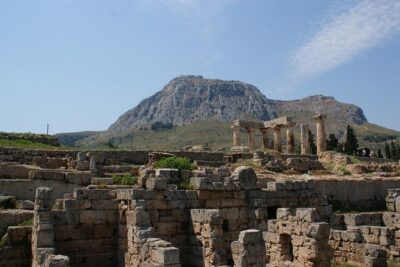
Corinth Half-Day Trip from Athens with Entrance Tickets
Read our review →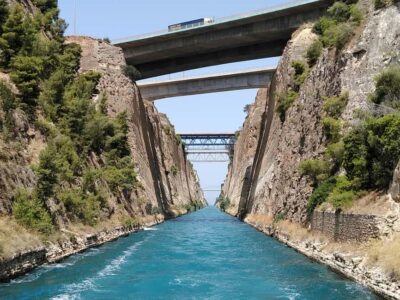
Ancient Corinth, Epidaurus, Nafplio full day private tour from Athens
Read our review →Browse the lists this tour appears in