
Reviewed · ATHENS BIBLICAL TOURS
Biblical Tour Letters ToThe Corinthians St Paul’s Footsteps 6Hour
Paul’s connection to Corinth becomes much clearer when you move from the Athenian rock where he addressed the city to the forum where he faced Roman authority. This six-hour journey from Athens to Corinth links biblical passages with real places, including the Bema, Kenchreai, and the ancient port roads.
I like the private pickup and drop-off, especially for cruise passengers who cannot risk a late return. I also like the comfortable van, bottled water, Wi-Fi, and the warm, story-driven style associated with guides such as Chris, Yannis, Panos, Alex, and Christos. The main consideration is that your driver cannot guide inside archaeological sites unless you pay an additional €160 for a licensed guide.
Key points at a glance
- Paul’s Athens speech: Visit Areopagus Hill, where Paul spoke about the Unknown God.
- A practical private ride: Hotel, apartment, cruise-port, and optional airport pickup are available.
- More than one Corinth: See the canal, Isthmia, Kenchreai, Ancient Corinth, and St. Paul’s Church.
- Comfort for a long outing: The private minivan includes air-conditioning, Wi-Fi, bottled water, and luggage storage subject to space.
- Allow for entrance fees: Ancient Corinth costs €15 per person, and Isthmia costs €5 per person.
- Best for Bible and history fans: The tour connects Acts and the Corinthian letters with temples, ports, games, and Roman government.
From Areopagus Hill to the Corinthian world
The day begins with pickup at your Athens hotel, apartment, or cruise port. The exact pickup time can be adjusted, which helps if you are working around a ship schedule or a busy morning in Athens.
Your driver meets you in the hotel lobby, at the entrance of an apartment building, or at the port gate with a sign bearing your name. For airport pickup, the driver waits in the arrival hall. These small details matter when you are tired, carrying bags, or trying to find a vehicle in an unfamiliar city.
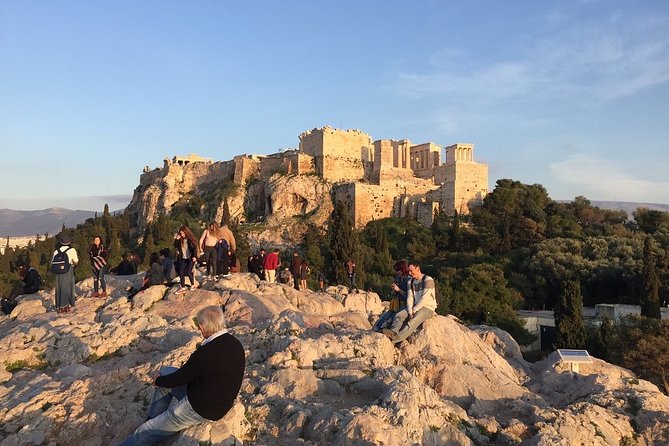
The first stop is Areopagus Hill, also called Mars Hill, beside the Acropolis. This is not a full Acropolis visit. You are visiting the rocky court and meeting place where Paul addressed Athenians and spoke about the altar to the Unknown God.
You have about 15 minutes here, so wear shoes with a good grip. The rock can be uneven, and the stop is brief. Its value is not the length of the visit but the direct connection to Acts 17 and Paul’s encounter with Athens.
The tour then leaves the city for Daphni Monastery, about 20 minutes on the stated schedule. The monastery sits near Mount Aigaleo and occupies the site of an ancient sanctuary associated with Apollo. Strong walls and towers give it the feel of a fortified religious center rather than a simple church.
Inside, the Byzantine mosaics are the main attraction. The site has suffered earthquake damage, and restoration continues, so conditions may vary. The short visit gives you a useful contrast: Paul’s world was shaped by Greek temples and Roman cities, while the monastery reflects the later Christian history of Greece.
More biblical and Apostle Paul tours in Athens:
- Private Biblical Tour Ancient Corinth & Isthmus Canal from Athens
★ 5.0 · 762 reviews - Private Tour of Apostle Paul’s Footsteps in Ancient Corinth
★ 5.0 · 275 reviews - Paul”s Footsteps Ancient Corinth Biblical Tour
★ 5.0 · 184 reviews
The Corinth Canal and the crossing into the Peloponnese
The drive toward Corinth is part of the experience, not just dead time in a vehicle. Several guides, including Chris and Yannis, have been praised for filling the ride with background on Paul, Greek history, local customs, and the places ahead.
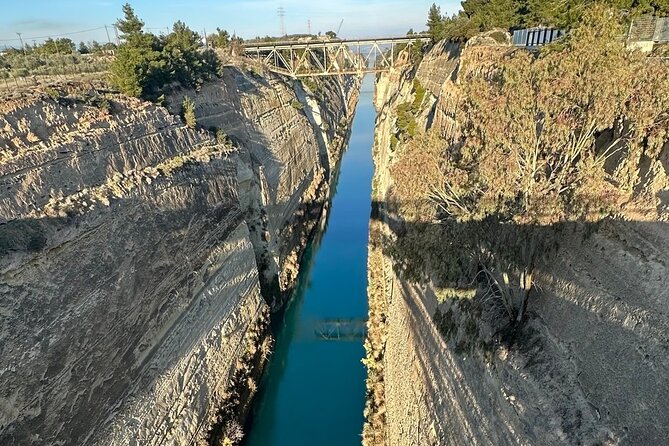
The Corinth Canal is the first major stop outside Athens. It cuts through the narrow isthmus and links the Saronic Gulf with the Gulf of Corinth. In practical terms, it separates the Greek mainland from the Peloponnese, which becomes an island in geographical terms.
You get about 20 minutes at the canal. The modern waterway dates to the late 19th century, but the idea reaches back to antiquity. Periander of Corinth is said to have considered cutting through the isthmus, but ancient engineers lacked the tools for such a project. Instead, the diolkos allowed ships or cargo to cross overland on a stone route.
The canal is a quick viewpoint stop rather than a boat trip. You will see the steep cut and the narrow strip of water below, but the tour does not include a canal cruise. The short visit works well on a packed itinerary, though you should not expect much time for extended photography.
Isthmia, the games, and the archaeological museum
Near the canal, Isthmia brings the story into the world of ancient sport and religion. The Isthmian Games were among the most important athletic contests in the Greek world, ranking after the Olympic Games in prestige.
The biblical connection here is especially interesting. Paul is associated with the Isthmian region, and his work as a tentmaker fits a busy athletic festival filled with athletes, officials, merchants, and visitors. The site helps you picture Paul not as an isolated preacher but as a working man moving through a crowded commercial and sporting center.
The Archaeological Museum of Isthmia requires an additional €5 admission. You have about 20 minutes listed for the museum, so this is a highlights visit rather than a slow museum morning.
Look for the marble pediment from the Temple of Poseidon, colored glass panels from the sanctuary of Isis at nearby Kenchreai, animal figurines, commercial amphorae, weapons, and objects from Mycenaean and Roman cemeteries. The glass pieces are particularly unusual. Their colored scenes include ships, animals, plants, landscapes, philosophers, and geometric designs.
The nearby Archaeological Site of Isthmia adds the larger setting. You can see the Temple of Poseidon, the stadium, the Sanctuary of Palaimon, and the theater. The stadium preserves an ancient starting mechanism called the ysplex, a rare example of a triangular release system used to begin races.
The site also has links to major political gatherings. Greek city-states met here before the Persian Wars, and later rulers used Isthmia for declarations and meetings. You are looking at more than sports ruins. Isthmia was a place where religion, politics, trade, and public spectacle met.
The theater was built around 400 BC for musical contests. Roman baths later added mosaics showing sea creatures and figures associated with Dionysus. The amount of ground covered here can make the stop feel rushed, especially if you want to study every monument. That is one reason to consider adding the licensed guide.
Ancient Corinth and the Bema
Ancient Corinth is the central stop, and you receive about an hour at the archaeological site. Admission is not included, with the listed fee at €15 per person.
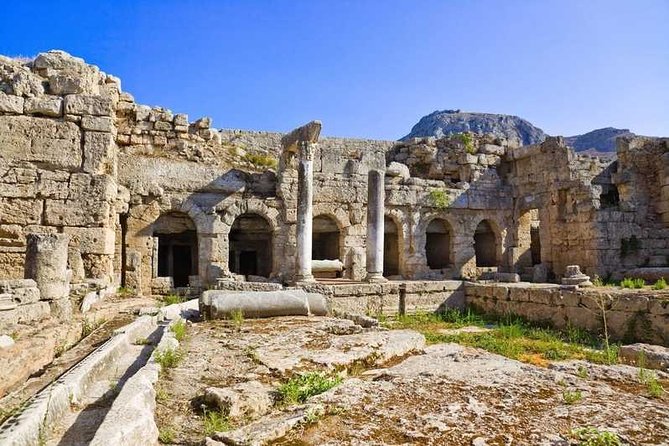
Corinth controlled the isthmus and prospered from trade between mainland Greece and the Peloponnese. Its position made it a useful place for merchants, sailors, soldiers, workers, and religious communities. Paul spent about a year and a half here in AD 51 and 52, and the city became one of the most important communities connected to his work.
The ruins reflect several layers of history. Corinth was destroyed by Rome in 146 BC, rebuilt as a Roman colony in 44 BC, and later became the Roman provincial capital of Greece. The visible city is therefore not simply the Greek city Paul entered. It is a Roman city built over an older Greek center.
The Agora is the heart of the visit. This large rectangular public area held shops, temples, altars, and civic buildings. The Bema, a raised platform in the forum, is traditionally linked with Paul’s appearance before the proconsul Gallio.
The charge against Paul concerned illegal teaching. Gallio treated the matter as an internal religious dispute and declined to judge it. That episode gives the Bema more meaning than a pile of stones. It places Paul within the legal and political machinery of Roman Corinth.
Your driver can explain the setting outside the archaeological enclosure, but Greek law allows only licensed guides to provide guiding inside archaeological sites. This is the most important practical limitation of the tour. Drivers can give you context before entry and answer questions during the day, but you explore the ruins on your own unless you arrange the optional licensed guide.
That arrangement has two sides. You save €160 if you do not need formal site commentary, and many people prefer to wander at their own pace. On the other hand, Ancient Corinth has enough monuments and historical layers that a licensed guide can help you understand what you are seeing.
A different kind of day out from Athens:
- Athens: Acropolis & up to 5 Archaeological Sites Combo Pass
★ 4.4 · 12,619 reviews - Athens: Acropolis Ticket with Optional Audio or Live Guide
★ 4.2 · 11,055 reviews - Athens: Acropolis, Parthenon & Acropolis Museum Guided Tour
★ 4.8 · 9,316 reviews - Athens: Cape Sounion & Poseidon Temple Sunset Half-Day Trip
★ 4.8 · 8,241 reviews
Kenchreai, Apollo, and St. Paul’s Church
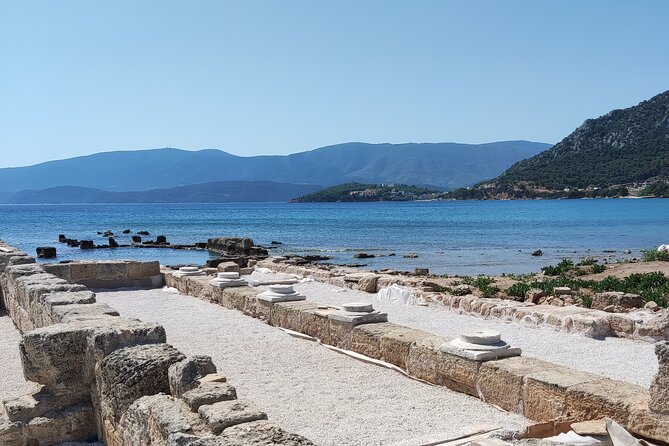
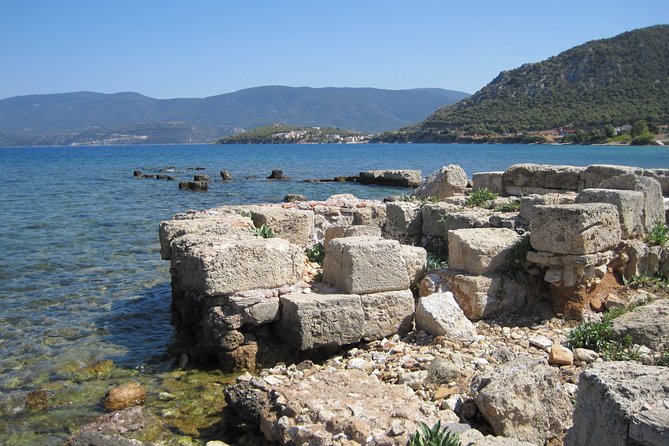
Kenchreai, now called Kechries, was Corinth’s eastern port on the Saronic Gulf. Acts places Paul here during his second missionary journey, when he stopped before sailing toward Syria. Romans also mentions Phoebe, associated with the Christian assembly at Kenchreai.
The stop lasts about 30 minutes and is free. The present-day setting is not a fully restored ancient port, so you should approach it as a place of biblical geography rather than a polished archaeological attraction. The importance lies in understanding how Paul moved through Corinth’s network of ports and roads.
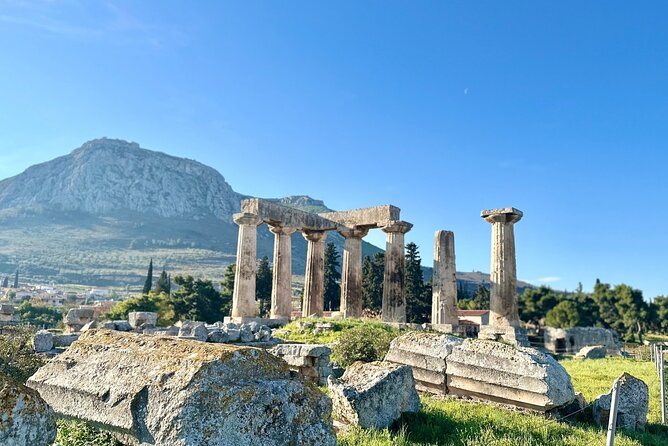
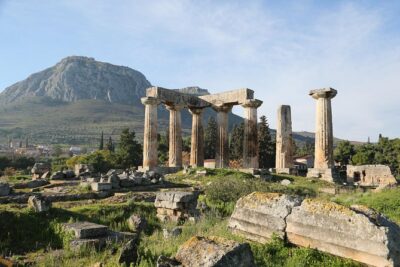
The Temple of Apollo at Ancient Corinth is another short stop, listed at about 10 minutes, with admission not included. Built around 550 BC, it is among the earliest Doric temples in mainland Greece and the Peloponnese to use monolithic columns.
Only a portion survives, but those columns are powerful markers of the older Greek city. They also help you see the religious world Paul entered when he arrived in Corinth, a city filled with established cults, temples, trade, and public ritual.
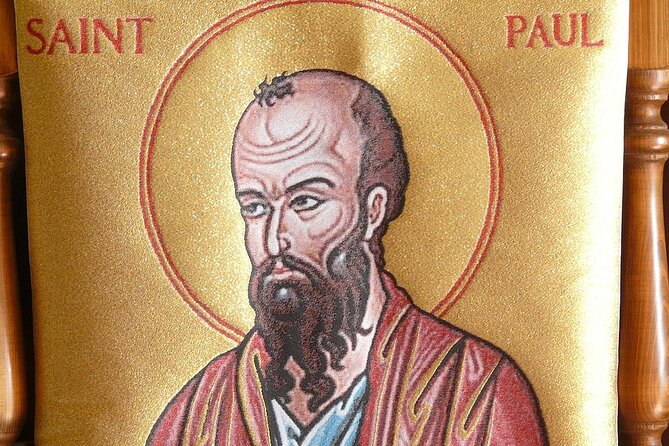
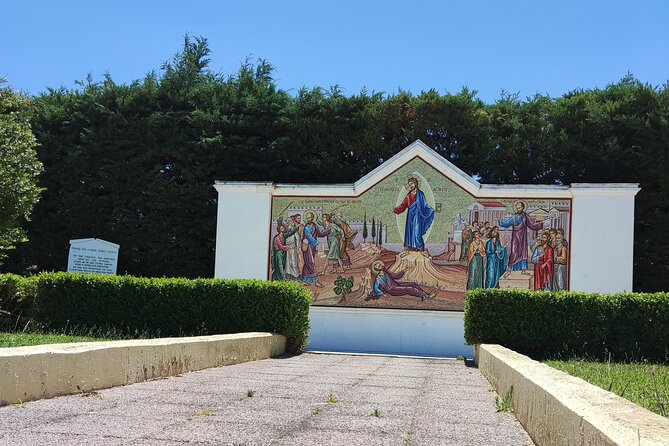
The final stop is the Church of St. Paul in modern Corinth. The visit lasts about 20 minutes and is free. Paul’s long stay in Corinth led to the founding of the local metropolitan church, and the city remains closely tied to the two New Testament letters addressed to the Corinthians.
This final church stop gives the day a modern Christian endpoint. You begin at the place where Paul spoke in Athens, move through the city where he worked and faced a legal accusation, then finish at a church dedicated to his connection with Corinth.
What the private vehicle adds
At $170.50 per person, this is not the cheapest way to reach Corinth. The value depends heavily on your group size and your priorities.
For two to six people sharing a private vehicle, the price covers transport, pickup, drop-off, air-conditioning, Wi-Fi, bottled water, and a driver focused on your group. A private ride also avoids the planning burden of combining buses, taxis, and separate tickets across several sites.
The tour is especially useful for cruise passengers. The operator plans the route around a return to the ship and can adjust pickup details. One guide also accommodated a port return for a group with an evening sailing, which is the kind of practical help that matters more than a polished speech when the ship is waiting.
The vehicle is described as a luxury minivan with room for up to eight, though the tour’s usual group size is smaller. Luggage can be stored in the car depending on how much you carry. Confirm this before booking if you plan to travel with several large cases.
Meals are not included. Lunch stops are scheduled, but you pay for your own food. Airport pickup is also optional and costs an additional €60 per booking. Tips are not included.
The tour requires good weather. You can cancel for a full refund up to 24 hours before departure. If poor weather cancels the experience, you are offered another date or a full refund.
Which guide style suits you?
The strongest part of the experience is the driver-host relationship. Chris is described as especially clear, prepared, and generous with historical detail. He has been praised for sending arrival updates, waiting patiently at sites, and carrying useful extras such as umbrellas and bottled water.
Yannis and Yiannis are praised for kindness, patience, and a personal approach. Panos is noted for bringing energy and clear explanations to the stops. Alex is described as conversational and attentive to questions, while Christos is associated with strong biblical and ancient-history background.
Your exact driver depends on availability, so you should not book on the assumption that one named person is guaranteed. The consistent pattern is an English-speaking driver who can explain Paul’s life, the ancient sites, and the route between Athens and Corinth.
If you want formal teaching inside the ruins, request the licensed guide early. If you prefer privacy, flexibility, and the freedom to walk at your own pace, the driver-only format may suit you better.
Who should book this Corinth tour?
I would choose this tour if you want to connect the Bible with physical places and prefer a private ride over a large coach. It is also a strong choice for first-time visitors who want to see Corinth without spending a full day arranging transport.
The tour suits church groups, families, cruise passengers, and people who enjoy ancient history as much as biblical study. The mix of Athens, Byzantine Daphni, the canal, Isthmia, Kenchreai, Ancient Corinth, and modern Corinth gives you a broad day rather than a single ruins visit.
I would hesitate if you want a slow archaeological study. The schedule includes many stops, and some visits last only 10 to 30 minutes. I would also think twice if your main goal is the Acropolis, since Areopagus Hill is the only Acropolis-area stop and admission to the Acropolis itself is not part of this outing.
Should you book it?
Book this experience if Paul’s journeys are central to your trip, you value door-to-door service, and you want to reach several Corinthian sites without driving yourself. The high 4.9 rating from 1,065 ratings and the 98 percent recommendation figure fit the tour’s strongest features: punctual pickups, comfortable vehicles, flexible pacing, and engaging driver commentary.
Before paying, calculate your group’s total cost with Ancient Corinth, Isthmia, meals, tips, and possibly the €160 licensed guide. If those extras fit your budget, this is a practical and meaningful way to connect Athens and Corinth in one day. If you want only the major Corinth ruins, a shorter and less costly outing may be enough.
FAQ
How long does the tour last?
The experience lasts approximately 6 hours and 15 minutes. The actual timing can vary with traffic, weather, parking, and the amount of time you spend at each site.
Where can pickup and drop-off take place?
Pickup and return are available from an Athens hotel, Airbnb apartment, or cruise port. Airport pickup is also available for an extra €60 per booking.
How many people can join the private tour?
The tour is designed for an intimate private group, generally two to six passengers. The luxury minivan has capacity for up to eight passengers.
Are entrance fees included?
No. Ancient Corinth is listed at €15 per person, and the Archaeological Site of Isthmia is listed at €5 per person. The Daphni Monastery and Corinth Canal stops include no additional admission fee as listed.
Can the driver guide inside the archaeological sites?
Greek law allows only officially licensed guides to guide visitors inside archaeological sites. A licensed guide can be arranged upon request for an additional €160 per booking, subject to availability.
Is the tour suitable for cruise passengers?
Yes. The tour is designed for cruise passengers and includes pickup and return to the port. The route is planned to help you return to the ship on time, though traffic and weather can still affect the schedule.
Newly reviewed around Athens
- Feel Ancient thermal Spa Visit Delphi, Leonidas ℨoo Spaʀtan★ 5.0 · 4 reviews
- Food Tour★ 5.0 · 3 reviews
- Explore the Hidden Food Gems of Athens★ 5.0 · 57 reviews
- Food Experience in Athens including Unlimited Lunch★ 5.0 · 3 reviews
- Eat Your Way Through Athens: A Local Food Walk★ 4.9 · 97 reviews
- Delphi: Spanish guided one day tour★ 4.6 · 55 reviews
- Early Entry Acropolis & Museum. Beat the Crowds & the heat★ 5.0 · 3 reviews
- From Athens: Delphi Private Tour with Lunch Time★ 4.0 · 3 reviews
Athens Biblical Tours, compared.
Private Biblical Tour Ancient Corinth & Isthmus Canal from Athens
Read our review →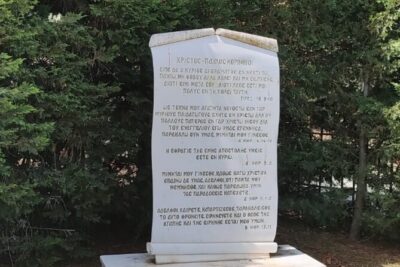
Private Tour of Apostle Paul’s Footsteps in Ancient Corinth
Read our review →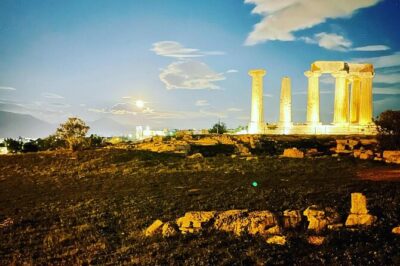
Private Luxury Biblical Tour: Apostle Paul in Athens & Corinth
Read our review →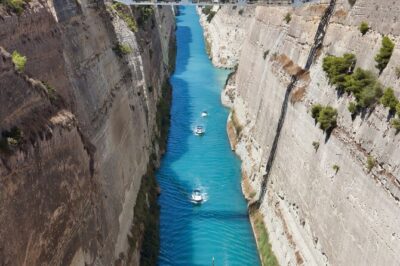
Private Luxury Biblical Tour: Apostle Paul’s Footsteps – Corinth
Read our review →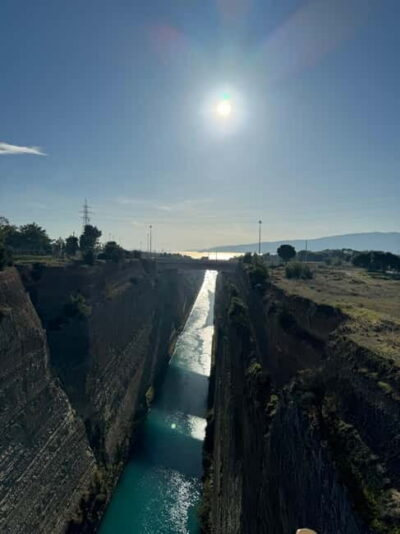
Biblical Private Tour St Paul’s Footsteps Athens & Corinth
Read our review →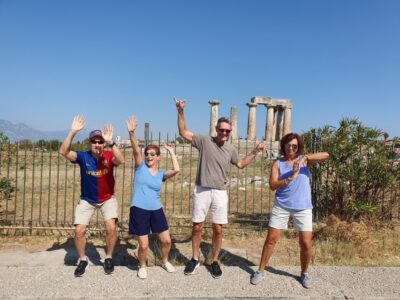
Private Biblical Tour of Ancient Corinth & Isthmus Canal
Read our review →Browse the lists this tour appears in