

Reviewed · ATHENS ACROPOLIS TOURS
Acropolis Mythology & Food Tour
The clever part of this Athens tour is its two-part rhythm: ancient stone in the morning, then the city’s food stalls, markets, and working neighborhoods. You get the major Acropolis sights, but you also see where Athenians shop, eat, and spend time.
I like the small-group limit of 15, which should make questions and conversation easier. I also like the route from the Acropolis to Monastiraki, since it links famous monuments with less polished corners of central Athens. The main catch is that archaeological admission costs extra, and five and a half hours on foot will feel long in hot weather.
Key points at a glance
- Early start at 8:00 am: Begin at Hadrian’s Arch before the day gets busier and warmer.
- Two hours at the Acropolis: Allow time for the Parthenon, Erechtheion, Temple of Athena Nike, Propylaea, and the Theater of Dionysus.
- Food beyond the tourist center: Tastings continue through Plaka, Monastiraki, Psiri, and the Central Market.
- Small group of up to 15: A useful size for an urban walking tour with questions and street-level stops.
- Tickets require planning: Entry to archaeological sites is not included, with pre-purchase available for €30 per person.
- Finish at Monastiraki Square: You end near food, shopping, metro connections, and several good places to continue your day.
Why this route works for an Athens first day
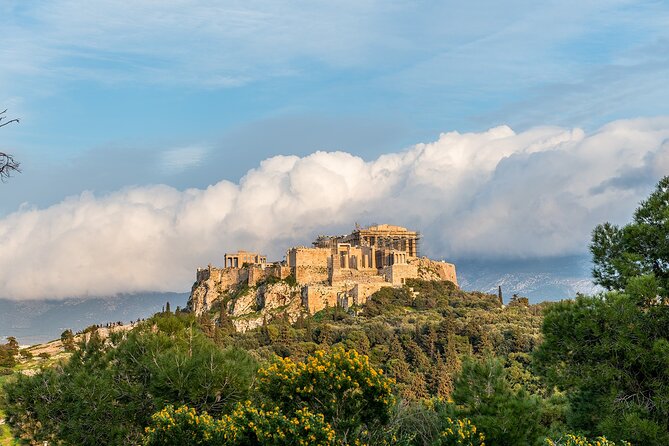
This is a walking tour with a clear purpose: help you understand both ancient Athens and the modern city built around it. The route begins beside the Acropolis, climbs to the hilltop sanctuary, then moves downhill through old quarters and food districts.
That order matters. You first get the grand monuments and their myths, while your mind is fresh. Later, you see how the city functions now, from Parliament and busy Syntagma Square to the Central Market. You are not simply checking off ruins. You are watching Athens change from sacred center to royal capital, shopping district, workshop quarter, and food city.
The five-and-a-half-hour length gives the guide room to explain things rather than rush past them. Still, this is not a gentle sightseeing circuit. You will walk through narrow streets, uneven archaeological ground, and areas with little shade. Good shoes, water, and a sensible hat matter.
The group is capped at 15 people. That is small enough to keep the guide close in crowded streets and large enough to retain a social feel. The tour is offered in English, and confirmation arrives when you book.
More ways to see the Acropolis:
- Athens: Acropolis & up to 5 Archaeological Sites Combo Pass
★ 4.4 · 12,619 reviews - Athens: Acropolis Ticket with Optional Audio or Live Guide
★ 4.2 · 11,055 reviews - Athens: Acropolis, Parthenon & Acropolis Museum Guided Tour
★ 4.8 · 9,316 reviews
Starting at Hadrian’s Arch and the Temple of Olympian Zeus
Meet at 8:00 am by the Arch of Hadrian, at Leoforos Vasilisis Amalias 50. This is a useful starting point because the arch sits between the Acropolis and the former sanctuary of Zeus.
The first stop is the Temple of Olympian Zeus, known in ancient Athens as the Olympeion. The guide discusses the temple from outside for about 15 minutes. You will not enter as part of this stop, so do not expect a full site visit here.
Even from the street, the scale of the surviving columns helps explain the ambition behind the project. This was one of the ancient world’s great marble temples, dedicated to Zeus, king of the gods. The opening discussion also gives the mythology a practical setting. Instead of hearing disconnected stories in a museum, you hear them beside the remains of a building made to honor the most powerful Olympian god.
The short stop is a good use of time. It provides context without spending too much of the morning on a site you will not enter. If seeing the temple grounds is important to you, plan a separate visit or check the ticket arrangement before booking.
Two hours on the Acropolis
The Acropolis receives the largest share of the tour, about two hours. Admission is not included in the tour price. The operator can pre-purchase the archaeological ticket for €30 per person if you request it.
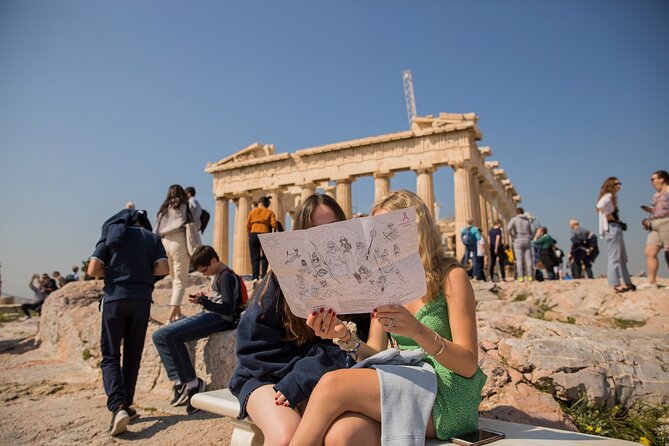
The hilltop sanctuary was dedicated mainly to Athena, the city’s patron goddess. Its buildings have shaped European art and architecture for centuries, but the value of a guided visit is not just naming the monuments. A guide can connect the buildings to the myths, civic identity, religious rituals, and political confidence of ancient Athens.
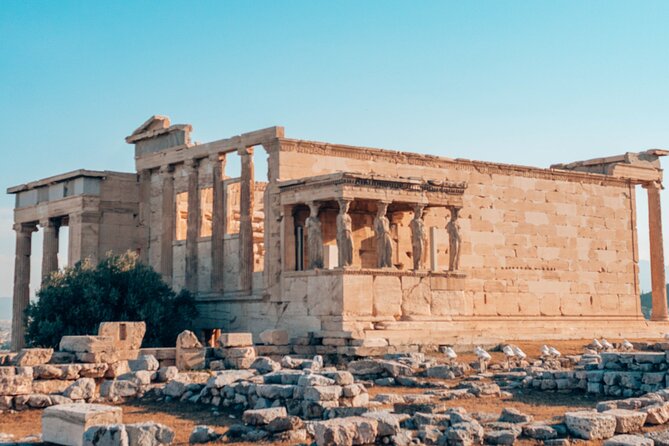
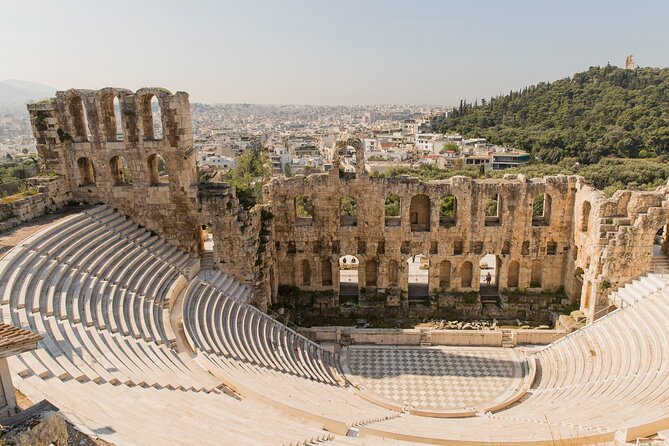
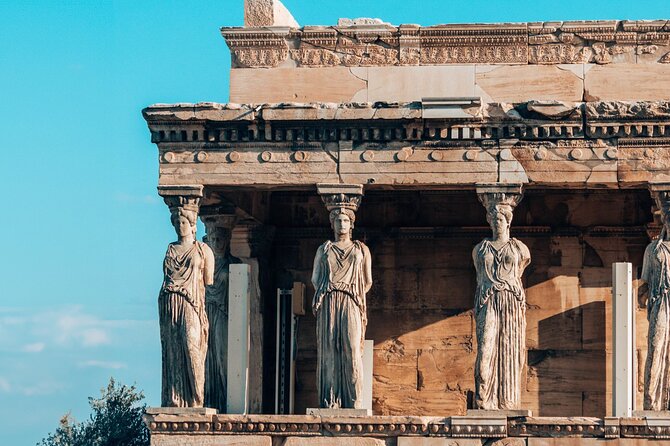
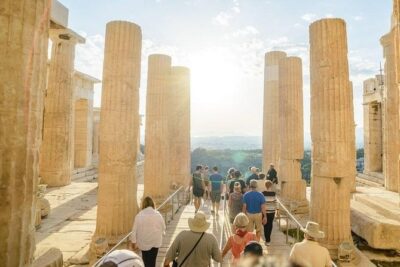
You should expect attention to the Parthenon, the most famous temple on the hill, along with the Temple of Athena Nike, the Erechtheion, and the Propylaea. The Theater of Dionysus is also part of the Acropolis area. Each site gives you a different view of Athenian life, from worship and public ceremony to theater and city power.
The two-hour window is long enough for a serious introduction, though not for every detail. The Acropolis can feel crowded, and the stone surfaces are uneven. Large backpacks, big bags, and strollers are not allowed, so arrive with only what you can comfortably carry in a small bag.
If you qualify for a reduced archaeological admission price, bring an identity card or passport, especially if you are under 25. European students may qualify for a discount with proper proof. Ask about your exact eligibility before the tour so you do not arrive expecting a discount that cannot be confirmed at the entrance.
Syntagma Square and the modern capital
After the Acropolis, the route includes about 40 minutes at Syntagma Square. This is the center of modern Athens, dominated by the Greek Parliament, once the Royal Palace.
The square gives you a useful contrast to the ancient sanctuary. Here, Athens is a capital city in motion. People cross the square, connect with public transport, work nearby, and pass through the busiest crossroads in the center.
This stop may appeal most if you want political and civic context, not just old stones. The guide can place the Parliament building within the story of modern Greece and explain why this square remains central to city life.
Forty minutes is enough to take in the setting without turning the tour into a long architectural lecture. It also gives the group a change of pace after the Acropolis climb. If you are mainly interested in food, this may feel like the least essential stop, but it helps make the rest of the walk easier to understand.
More Greek mythology tours in Athens:
- Athens: Mythology of Delphi, Museum and Arachova Guided Tour
★ 4.6 · 4,008 reviews - Athens & Acropolis Highlights: Greek Mythology Small-Group Tour
★ 5.0 · 2,370 reviews - Athens: Acropolis and Mythology Highlights Small Group Tour
★ 4.8 · 2,275 reviews - Athens: Mythology Tour for Families
★ 4.8 · 173 reviews
Plaka: old streets beneath the Acropolis
Plaka occupies about 45 minutes of the route. This is the oldest part of Athens, a patchwork of narrow alleys, small shops, ancient fragments, and souvenir stalls beneath the Acropolis.
Plaka is attractive, but it is also the most tourist-focused neighborhood on the walk. You will find plenty of shopping and photo stops, along with streets that can feel busy and commercial. The benefit of seeing it with a guide is that you can look past the souvenirs and notice how ancient remains fit into the later city.
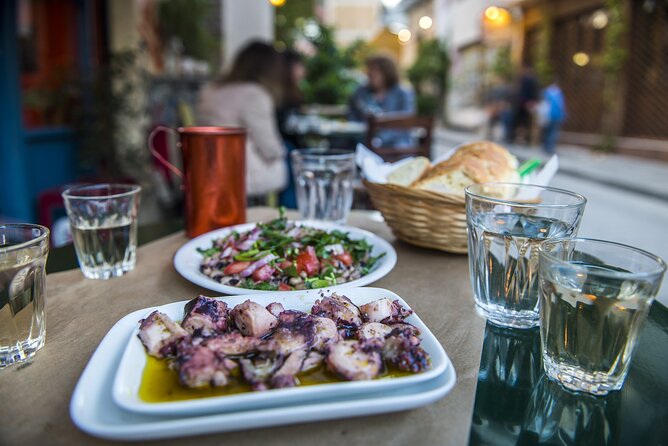
This is also one of the better places to connect food with geography. The route includes food tastings, and Plaka gives the guide a natural setting for discussing everyday Greek eating. The supplied details do not specify each tasting, so do not book expecting a fixed menu unless the operator confirms it directly.
I like the way Plaka follows the Acropolis. You move from the monumental hilltop into the neighborhood that grew around it. It is a simple visual lesson in how old Athens and modern Athens overlap.
Monastiraki’s food, ruins, and metro archaeology
The walk continues to Monastiraki for about 40 minutes. This area mixes street food, flea-market shopping, ancient remains, and one of Athens’ surviving Ottoman mosques.
Hadrian’s Library is one of the historical sights connected with this part of town. The area also has an unusual modern feature: an underground river can be seen in a metro station. That combination is very Athenian. Ancient walls, Ottoman traces, public transport, and food counters occupy the same compact district.
This is one of the tour’s strongest transitions. You have seen grand religious buildings on the Acropolis, and now you are in a place shaped by trade and movement. Monastiraki is a good spot to ask the guide about what survived, what disappeared, and how the city kept building over its older layers.
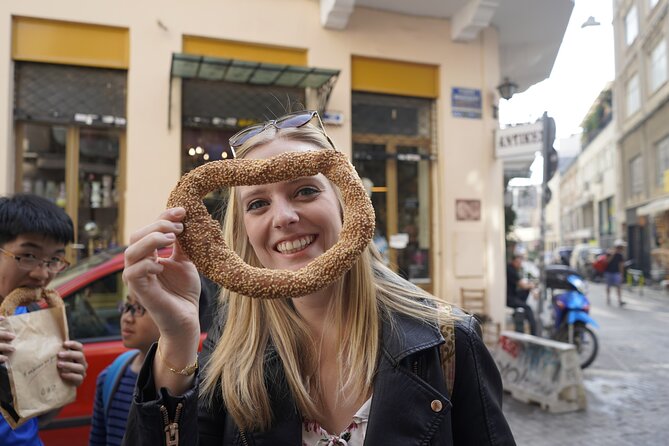
The food side of the stop is practical. You can taste local items as part of the tour, then return later if you find something you want to buy. Keep in mind that food or drinks you purchase independently are not included in the tour price.
Psiri, street art, and a changing neighborhood
Psiri receives about 30 minutes. It was once known for small workshops and local craftsmen. Today it is one of central Athens’ popular areas for evening food and drinks, with street art adding color to its walls.
The short visit gives you a look at a neighborhood in transition. Psiri is not presented as a preserved ancient quarter. Its interest comes from the change between older trades and newer restaurants, bars, and creative work.
For me, this is exactly the sort of stop that improves an ancient-city tour. You get a glimpse of Athens as a living place rather than a backdrop for ruins. The street art also gives the group something immediate to look at after several hours of temples and formal squares.
Because the stop lasts only half an hour, think of it as an introduction, not a full neighborhood tour. If the area catches your attention, you can return after the tour for more food and a slower walk.
The Varvakios Central Municipal Market
The final scheduled stop is the Varvakios Central Municipal Market, with about 15 minutes set aside for it. This is Athens’ main food market, where locals shop for produce, meat, and fish.
A quarter of an hour is brief, but the market works well as a final snapshot. After tasting food in several central districts, you see the ingredients and daily shopping behind the city’s meals. The setting is direct and practical, with the sights, smells, and movement of a working market rather than a display made for sightseeing.
You may wish you had more time here. The tour’s broad route explains why the stop is short: the market comes after major monuments and several neighborhoods. If you are especially interested in food markets, make a note to return independently.
The tour ends at Monastiraki Square, at Apollonos 21. That makes the finish convenient. You can continue exploring, find lunch, shop in the market area, or use public transportation from central Athens.
What the $138.55 price includes
At $138.55 per person, this is not a bargain walking tour. You are paying for a five-and-a-half-hour route, an English-speaking professional guide, food tastings, a small group, and an ancient Athens map.
The biggest extra cost is archaeological admission. Entry tickets are not included, and pre-purchase through the operator costs €30 per person. Add that amount when comparing this experience with other Acropolis tours. You should also budget for any food or drinks you choose to buy on your own.
The value depends on how much structure you want. If you only need a guide for the Acropolis, a shorter visit will cost less and leave you more independent. If you want the Acropolis tied to Syntagma, Plaka, Monastiraki, Psiri, and the market, this long route saves you the work of planning those connections yourself.
The published rating is 4.9 from 26 reviews, with 100 percent recommending the experience. That is a strong signal, though the sample is modest. One practical point repeated in the supplied feedback is the importance of checking student discounts for paid archaeological sites. Bring the required proof.
Timing, tickets, and comfort
The 8:00 am start is one of the tour’s best practical choices. You reach the Acropolis early in the day, when heat and crowds may be less demanding than later. Athens can be very hot, and the schedule includes a climb and several hours outside.
The tour is near public transportation, but transfers are not included. You need to make your own way to Hadrian’s Arch and from Monastiraki Square afterward. The start and finish are both central, which keeps the logistics simple.
The activity is suitable for most people, but the information provided does not promise a fully accessible route. Expect walking on uneven archaeological surfaces and through narrow streets. Strollers, backpacks, and big bags are not allowed at the Acropolis, so pack light.
Cancellation terms require close attention. Full refunds are available if you cancel at least 24 hours before the start time. Tickets purchased for the archaeological sites have stricter conditions: they can be refunded up to 30 days before the tour, but after that they are non-refundable and non-exchangeable. If you miss your Acropolis time slot because of a late flight, cruise delay, or personal delay, you may need to buy new tickets yourself.
Who should book this Athens food and mythology walk?
I would choose this tour if you have limited time in Athens and want a strong first-day orientation. It gives you the city’s biggest ancient sight, several central districts, food stops, and a clear finish near Monastiraki.
It also suits you if you like context. The Acropolis is magnificent on its own, but the connections to Zeus, Athena, Parliament, Ottoman Athens, street markets, and modern nightlife make the city easier to read.
I would hesitate if you dislike long walks, need a slow pace, or want to spend most of your time inside the Acropolis. The route covers a lot of ground, and the food tastings are part of a larger city walk rather than a dedicated cooking experience.
Book it if you want ancient Athens and everyday Athens in one morning and afternoon, and if you are willing to add the €30 archaeological ticket. Skip it in favor of a shorter Acropolis visit if monuments are your only goal.
FAQ
How long does the Acropolis Mythology & Food Tour last?
The tour lasts approximately 5 hours and 30 minutes.
What time does the tour begin?
The tour begins at 8:00 am.
Where does the tour start?
It starts at the Arch of Hadrian, Leoforos Vasilisis Amalias 50, Athens 105 58, Greece.
Where does the tour end?
The tour ends at Monastiraki Square, Apollonos 21, Athens 105 57, Greece.
Is admission to the Acropolis included?
No. Admission to archaeological sites is not included. The operator can pre-purchase entry tickets for €30 per person if you request this service.
Are food tastings included?
Yes. Food tastings described as part of the tour are included. Food or drinks you buy separately are not included.
How many people can join the tour?
The maximum group size is 15 people.
What should I bring for a possible archaeological discount?
People under 25 should bring an identity card or passport for possible discounts. European students should also bring valid proof of student status when seeking a reduced admission price.
More food tours in Athens
- Greek Food Walking Tour in Athens
★ 5.0 · 4,740 reviews - Athens: Street Food Tasting Tour
★ 4.9 · 2,557 reviews - Small Group Greek Traditional Food Tour in Athens 20+ Tastings
★ 5.0 · 1,759 reviews - Athens: Food Market Visit and Cooking Class with Wine
★ 4.9 · 1,087 reviews
Newly reviewed around Athens
- Athens: workshop for painting landscape with local artist★ 4.6 · 3 reviews
- Athens: Greek Wine & Olive Oil Tasting at Brettos Plaka★ 4.5 · 3 reviews
- Outdoor Yoga and Pilates with Akropolis view★ 4.0 · 5 reviews
- Acropolis of Athens: 60′ Tour in a Vintage Motorcycle★ 5.0 · 4 reviews
- Ultimate Tasting of the Volcanic Wines of Greece★ 5.0 · 3 reviews
- workshop for painting acropolis/landscape with local artist★ 5.0 · 3 reviews
- Athens at Twilight Night Tour with Drinks and Meze Dishes★ 4.8 · 4 reviews
- Breakfast in the markets with olive oil and honey tasting★ 4.8 · 8 reviews
Athens Acropolis Tours, compared.
Acropolis & up to 5 Archaeological Sites Combo Pass
Read our review →
Acropolis, Parthenon & Acropolis Museum Guided Tour
Read our review →
Acropolis, Parthenon & Acropolis Museum Guided Tour
Read our review →
Acropolis monuments & Parthenon Walking Tour with Optional Acropolis Museum
Read our review →Browse the lists this tour appears in