
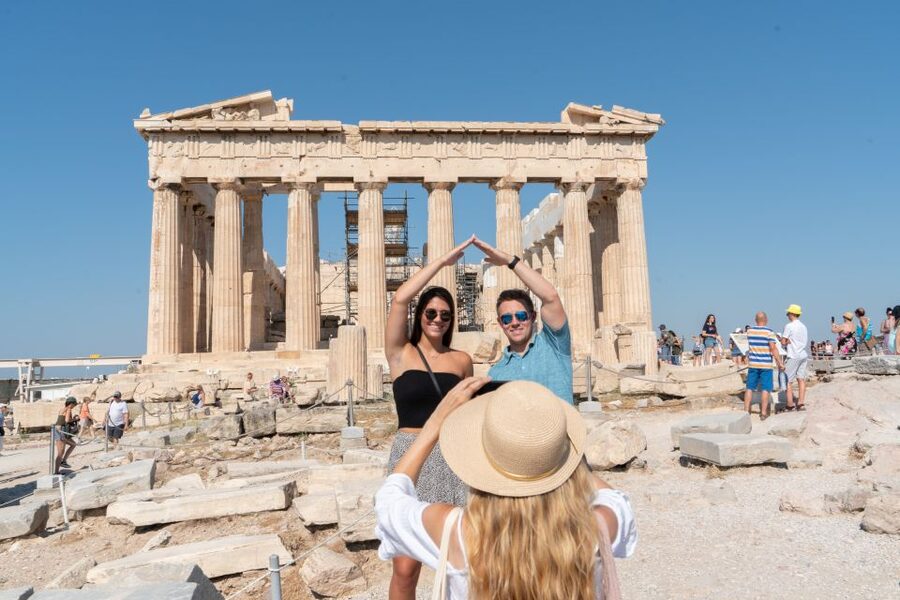
Reviewed · ATHENS ACROPOLIS TOURS
Athens: The Mythology Tour of Acropolis & Acropolis Museum
Greek mythology becomes much clearer when you meet it in the places where Athenians once honored their gods. This four-hour private tour links the Theater of Dionysus, the Asklepieion, the Parthenon, the Erechtheion, and the Acropolis Museum into one story about power, healing, drama, and civic identity.
I like the way the tour connects myth to actual monuments, rather than treating the old stories as a detached list of gods. I also like the private format, which lets the guide adjust explanations for a family, a first-time visitor, or someone already familiar with ancient Greece. The main caution is cost: at $518 for up to two people, and with entrance fees not included, this is a premium choice.
Key points at a glance
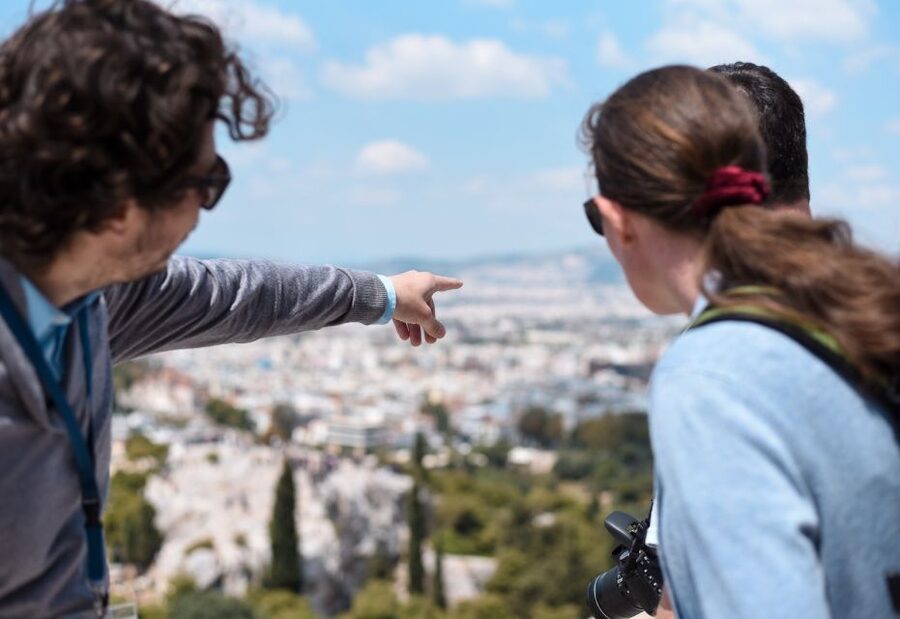
- The Theater of Dionysus begins the story: See the birthplace of ancient drama and learn why theater was part of religious life.
- The Asklepieion adds a human side: Explore the ancient healing tradition tied to Asclepius, the mythical physician.
- The Parthenon gets a mythological reading: Look beyond the famous columns to the political and religious ideas tied to Athena.
- The Erechtheion recalls Athena and Poseidon: This temple marks the legendary contest over who would protect Athens.
- The museum completes the picture: Ancient statues and artifacts help you connect myths with objects made for worship and display.
- The private guide is the big advantage: English-speaking guides including Nino Tsavalos and Tavouti M. Sapfo have received especially warm praise for clear, engaging explanations.
Why this mythology tour works
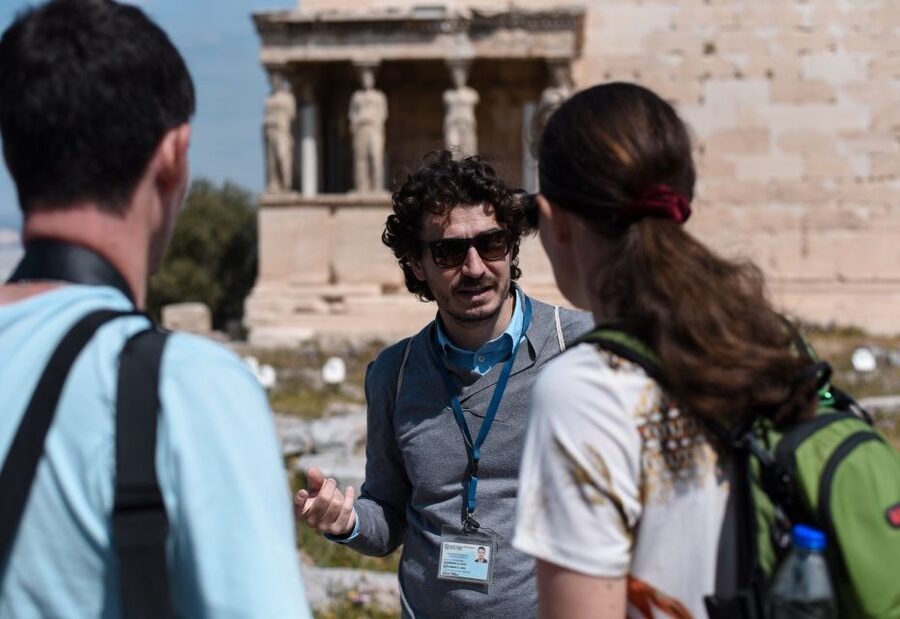
The Acropolis can be a difficult place to read on your own. You see marble, broken columns, carved figures, and a lot of people taking photographs, but the meaning behind the hill is easier to grasp with a strong narrative.
This tour gives you that narrative. Its central idea is simple: Greek myths were not only bedtime stories. They helped Athenians explain the city’s origins, honor its gods, understand illness and healing, and express what their society valued.
I especially like that the route begins with Dionysus rather than rushing directly to the Parthenon. That choice gives you a useful reminder that the Acropolis was not just a hilltop of temples. It was part of a larger sacred area tied to performance, healing, ritual, and public life.
The experience lasts four hours, with about two hours at the Acropolis and two hours at the Acropolis Museum. That is enough time for a connected visit, but it is also a substantial block of your day. You should choose it because you want interpretation, not because you simply need a quick look at the main monument.
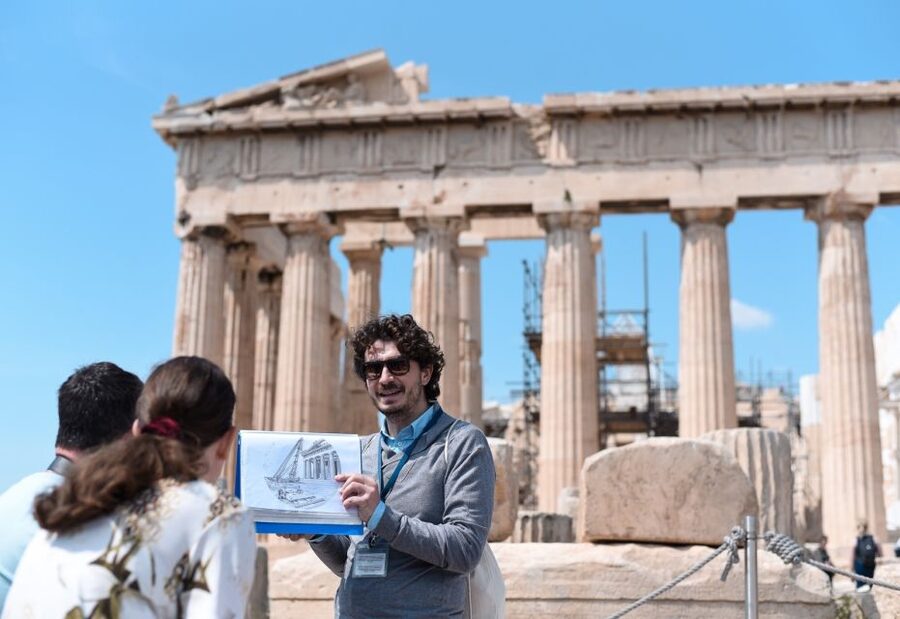
The tour is private, with an English-speaking guide. That matters at a site where questions often come up. You can pause over a myth that interests you, ask for more context, or keep things moving if younger members of your group need a change of pace.
More ways to see the Acropolis:
- Athens: Acropolis & up to 5 Archaeological Sites Combo Pass
★ 4.4 · 12,619 reviews - Athens: Acropolis Ticket with Optional Audio or Live Guide
★ 4.2 · 11,055 reviews - Athens: Acropolis, Parthenon & Acropolis Museum Guided Tour
★ 4.8 · 9,316 reviews
Meeting your guide near the Acropolis Metro Station
The meeting point is at the entrance of the Acropolis Metro Station on Makrygianni Street. This is a practical place to begin, close to the main archaeological area and easy to identify in central Athens.
From there, you head toward the Acropolis and begin the climb. The route involves slopes, ancient surfaces, and stairs, so this is not a good match for people with mobility impairments. Wear shoes with a firm grip and plan for a physically active morning or afternoon.
Food and drinks are not allowed during the activity. Have water and anything you need before starting, and avoid treating this as a casual snack break on the hill.
Your guide leads the entire experience in English. Names connected with this tour include Nino Tsavalos and Tavouti M. Sapfo. The strongest praise has focused on guides who explain the site clearly for mixed experience levels, including families with children aged 10, 14, and 16.
The Theater of Dionysus and the birth of drama
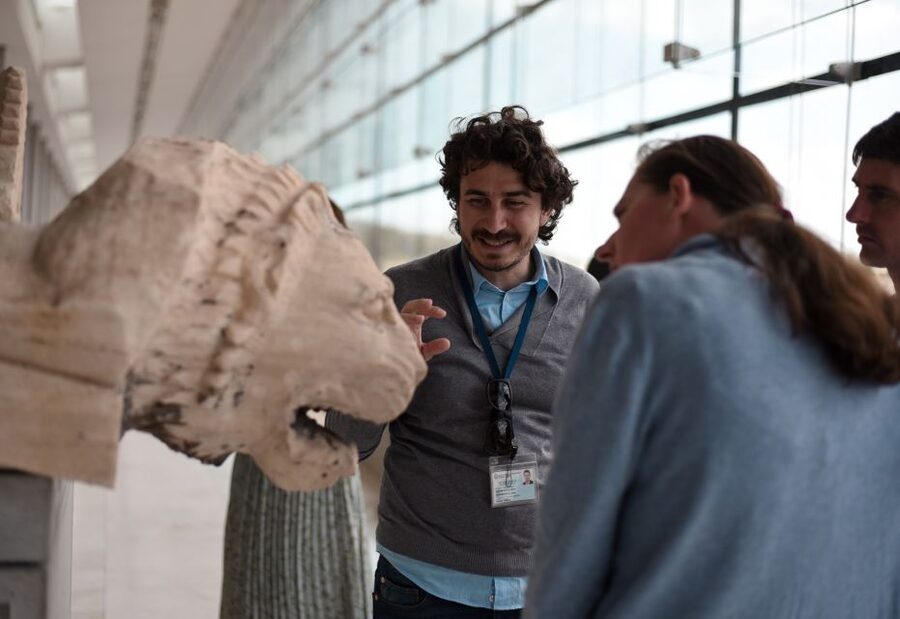
The first major stop is the Theater of Dionysus, located on the southern slope of the Acropolis. This is where the tour opens the door to one of the most important parts of Greek religious life: drama.
The theater was linked to Dionysus, the god associated with wine, performance, and altered states of feeling. Ancient drama was not simply entertainment in the modern sense. Plays formed part of religious festivals, and the stories of gods, heroes, and flawed mortals gave Athenians a way to examine pride, duty, violence, family, and fate.
This stop is particularly useful if you think of mythology as a collection of strange tales. Your guide can show how those tales worked in public life. The stories mattered because people encountered them in festivals, temples, ceremonies, and performances.
You will likely appreciate the stop most if you enjoy literature or theater. It also gives children and teenagers an immediate point of connection. Instead of beginning with a damaged temple, you begin with the idea of a live performance and the lasting question of why people tell stories about gods and heroes.
The drawback is that the theater is not the main visual prize of the Acropolis visit. Much of its impact comes from understanding what took place there, so the guide’s explanation is important.
The Asklepieion and the myths of healing
The route continues past the Asklepieion, an ancient healing center connected to Asclepius. In mythology, Asclepius was an extraordinary physician whose ability to heal was so powerful that it stirred the jealousy of Zeus.
This story gives the tour a different tone. The Parthenon represents civic pride and divine protection, while the Asklepieion brings you closer to ordinary human worries: illness, pain, hope, and the wish for recovery.
I find this one of the most useful parts of the itinerary because it broadens your idea of what the Acropolis area was for. The sacred hill and its slopes were not only places for grand state ceremonies. They were also linked to personal needs and religious practices.
The healing myths can also help you see the ancient Greeks as people facing problems that remain familiar. Their explanations were shaped by gods and divine powers, but the concerns themselves were recognizably human.
Do not expect a separate, fully restored monument comparable to the Parthenon. The Asklepieion is most meaningful when your guide explains its role and connects the surviving remains to the wider beliefs of ancient Athens.
More museums and ancient sites in Athens:
- Athens: Acropolis, Parthenon & Acropolis Museum Guided Tour
★ 4.8 · 3,579 reviews - Acropolis monuments & Parthenon Walking Tour with Optional Acropolis Museum
★ 5.0 · 2,678 reviews - Athens: Acropolis Museum Ticket with optional Audio Guide
★ 4.4 · 2,652 reviews - Parthenon & Acropolis Museum with Audio or Live Tour Option
★ 4.1 · 2,446 reviews
The Propylaea and Athena Nike
As you continue upward, the sacred way leads to the Propylaea, the monumental gateway to the Acropolis. This is the threshold between the ordinary city and the sacred summit.
A gateway can seem like a simple architectural necessity, but the Propylaea helped frame the approach to the temples above. It marked the moment when visitors entered a place associated with the gods and the city’s highest religious ideals.
The tour also introduces Athena Nike, the victorious goddess honored by the Athenians. Athena was not only a wise and protective figure. She was closely tied to the city’s success, military strength, and political identity.
This is where mythology and public power meet most clearly. The Athenians used sacred buildings and stories to say something about who they were. A city protected by Athena could present itself as disciplined, favored, and capable of defending its people.
The Propylaea also gives you a strong sense of arrival. You move from the climb and the lower monuments into the most famous part of the Acropolis. A guide who explains the transition helps you understand why the setting mattered, not just what the stones look like.
The Parthenon and Athena’s place in Athens
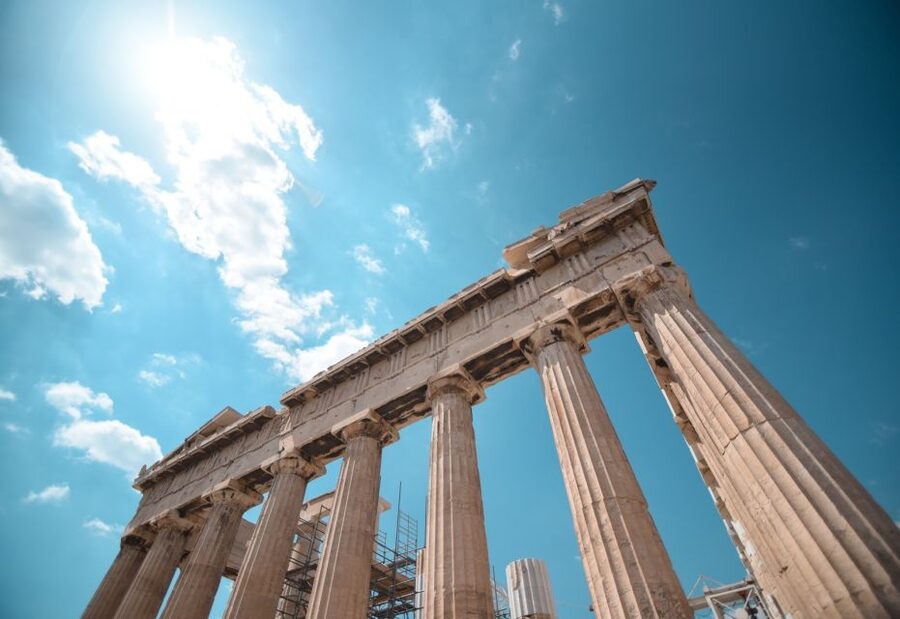
The Parthenon is the central sight, and the tour gives it a mythological reading rather than treating it as a famous photograph with columns attached.
The temple was dedicated to Athena, the city’s divine guardian. Your guide explains how myth shaped the identity, values, and political vision of classical Athens. That approach is valuable because the Parthenon was never only a religious building. It expressed the power and confidence of the city that commissioned it.
You will see why the monument has such lasting force even in its damaged condition. Its scale, setting, and deliberate design continue to dominate the hill. Yet the mythological context adds another layer: this was a place where architecture, worship, civic pride, and stories about the gods worked together.
I recommend listening for the difference between the mythic Athena and the political Athena. One is a divine protector in ancient stories. The other becomes part of the way Athens presented itself to its own citizens and to the wider Greek world.
The Parthenon area can be crowded and exposed. The tour cannot remove those practical conditions, and the pace may feel slower than a simple photo stop. Still, the guide’s interpretation is the reason to spend time here. If you already know the building’s basic story, you can ask for more detail about Athena, the city, or the role of myth in public life.
The Erechtheion and the contest between Athena and Poseidon
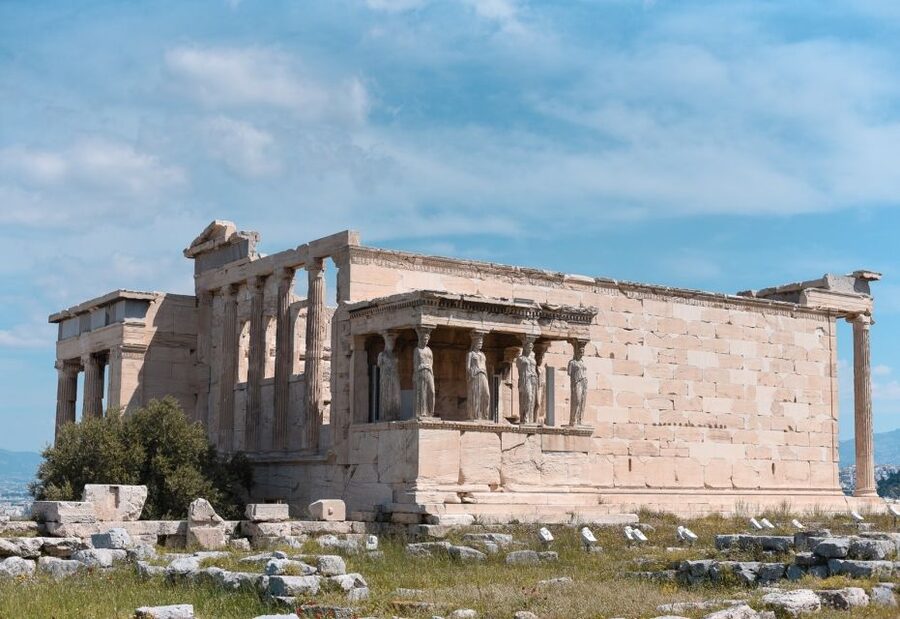
The next major stop is the Erechtheion, a temple with its own set of sacred associations. It is linked to Athena and to the legendary contest between Athena and Poseidon over who would protect Athens.
This myth explains a great deal about the city’s character. Athena offered the olive tree, associated with useful resources and long-term prosperity, while Poseidon’s challenge expressed the power of the sea and the force of nature. The contest is not just a story about two gods competing. It reflects the different needs of a city shaped by farming, trade, warfare, and the sea.
The Erechtheion also feels different from the Parthenon. Its unusual form and layered traditions make it a good place to consider how ancient sacred sites could gather several stories and rituals over time.
For you, this is likely one of the best stops for questions. Ask your guide how the story of Athena and Poseidon supported the city’s sense of identity, or how the temple’s different sacred associations fit together.
Two hours with the Acropolis Museum
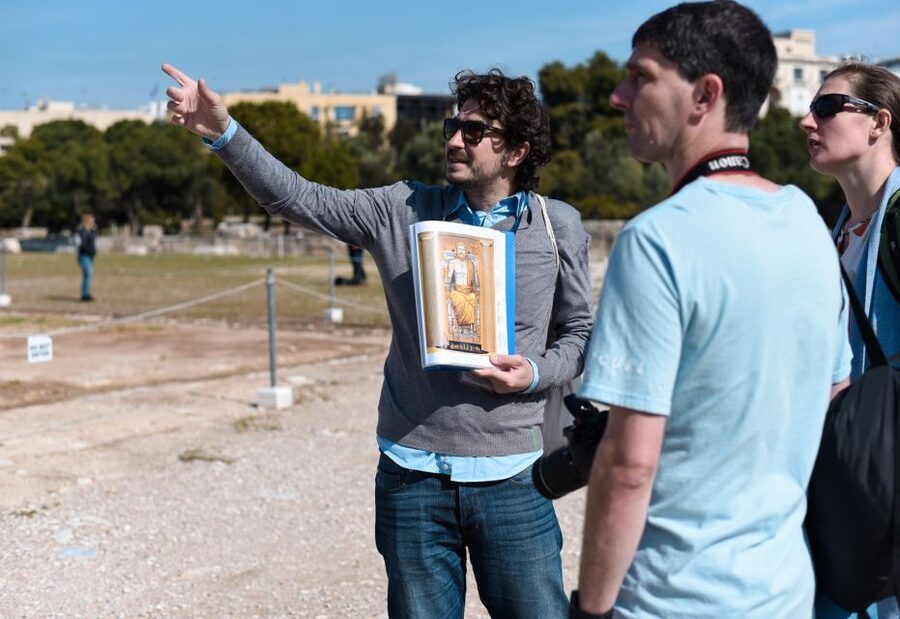
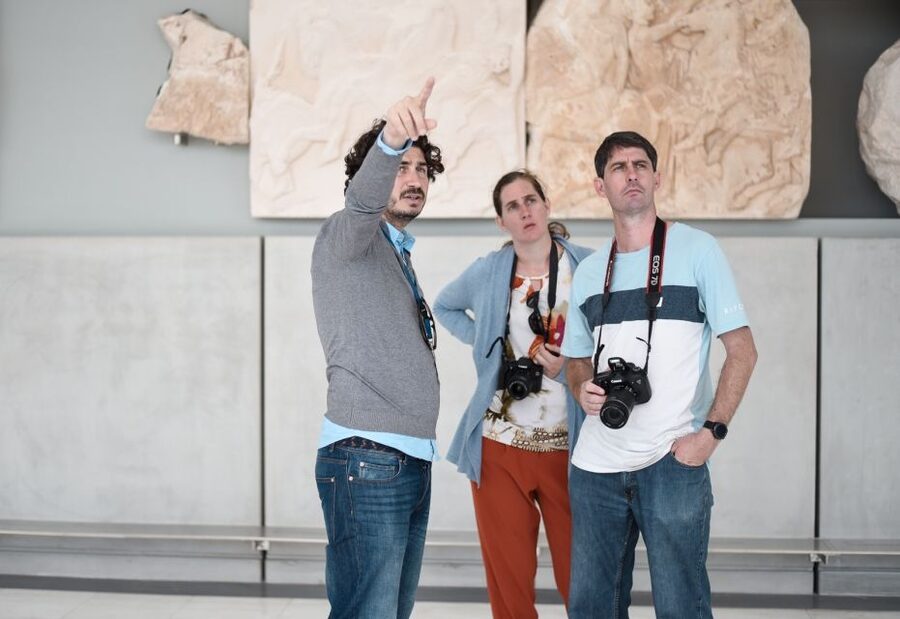
The second half of the tour takes place in the Acropolis Museum. This is not an afterthought. The museum provides the objects and sculpture needed to make sense of what you saw outside.
The building contains artifacts connected to the Acropolis and to the myths honored there. Your guide brings the statues and treasures into the same story as Dionysus, Asclepius, Athena, Poseidon, and Athena Nike.
I like the museum portion because it gives you a chance to look closely. On the hill, you are often focused on scale, views, and the broad shape of the monuments. In the museum, you can study carved figures and decorative details at a more manageable distance.
The two-hour museum visit also helps balance the physical effort of the Acropolis. You still need to walk and remain attentive, but you are no longer dealing with the same climb and exposed setting.
One important point must be clear before you book: entrance fees are not included in the tour price. This was a serious source of frustration for at least one participant, who expected the payment to cover admission and felt the extra museum cost had not been made clear enough. Confirm the current entrance arrangements and total cost before committing, especially if you are booking for more than two people.
Is $518 for two people good value?
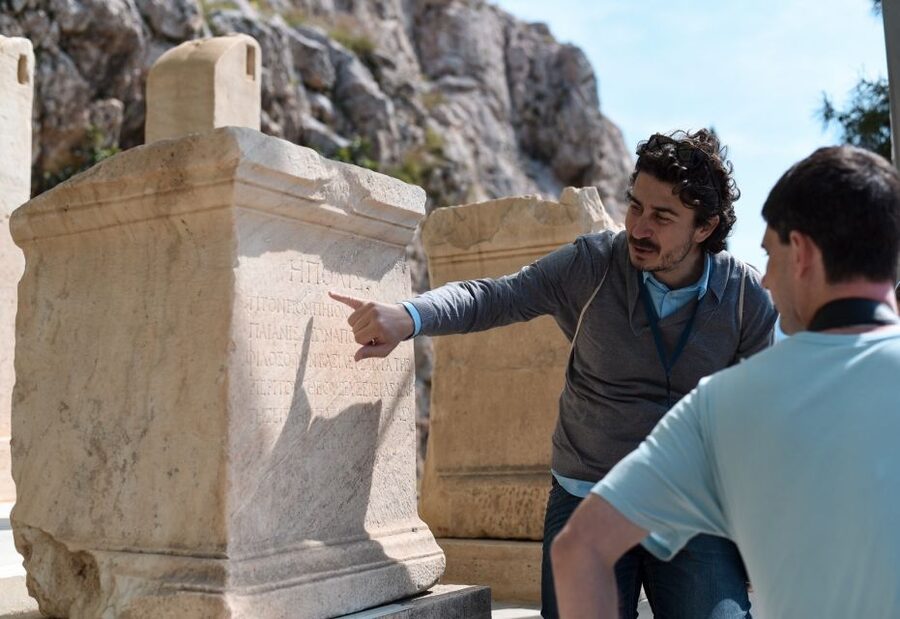
The listed price is $518 per group of up to two people. That is a high price, particularly because site admission is extra. You are paying for a private, four-hour guided experience, not for a basic ticket.
The value improves if you are a couple or a small family that wants personal attention. With a private guide, you are not tied to a large group’s pace, and you can ask questions without waiting. The tour also covers two major sights in one connected visit, which can save you from arranging separate explanations for the hill and the museum.
The value is weaker if you only want a short orientation or if you already know Greek mythology and ancient Athenian history well. In that case, the price may feel steep for a guide-led visit, especially after adding entrance fees.
This is also a better use of money for people who care about interpretation. The tour does not simply point out the Parthenon and name a few gods. It explains how myths shaped public life and how the buildings supported those beliefs.
The overall rating is 5 out of 5 from eight reviews, with especially strong praise for guides who make the material approachable. Still, the admission-fee complaint deserves attention. Ask for the full price before the day of the tour so there are no surprises.
Who should book this experience?
I would choose this tour for a family with older children or teenagers, a couple wanting a focused private visit, or anyone who feels that mythology will make the Acropolis more memorable.
It also suits you if you prefer stories with your monuments. The guide can help connect the Theater of Dionysus to drama, the Asklepieion to healing, the Parthenon to Athena and civic identity, and the Erechtheion to the contest with Poseidon.
The four-hour length is a plus for serious sightseeing, but it is not ideal if you want to keep the day loose. The route requires walking on the Acropolis, and people with mobility limitations should choose another way to see these places.
If you book, arrive ready to listen and ask questions. Guides such as Nino Tsavalos and Tavouti M. Sapfo have been praised for clear explanations and a warm manner. The best result will come when you treat the visit as a conversation about myth, architecture, and the people who used both.
Should you book the Athens Mythology Tour?
Book it if you want the Acropolis to feel like a connected religious and civic world, not just a group of famous ruins. The combination of a private guide, myth-based storytelling, the hilltop monuments, and two hours in the museum gives you a strong, focused introduction to ancient Athens.
Skip it if your priority is the lowest possible cost, a brief visit, or independent sightseeing. The $518 price for up to two people is substantial, and entrance fees come on top.
For the right visitor, the tour’s strongest feature is its focus. It gives you a clear thread from Dionysus to Asclepius, Athena, Poseidon, and the objects preserved in the museum. Confirm the admission cost first, then book if you want the stories behind the stones.
FAQ
How long does the Athens Mythology Tour last?
The tour lasts four hours, with a two-hour guided visit to the Acropolis and a two-hour guided visit to the Acropolis Museum.
Where does the tour begin?
It begins at the entrance of the Acropolis Metro Station on Makrygianni Street.
Where does the tour end?
The tour ends at the Acropolis Museum.
Is the tour private?
Yes. It is offered as a private group experience.
What language does the guide speak?
The live tour guide speaks English.
Are entrance fees included?
No. Entrance fees to the Acropolis and Acropolis Museum are not included in the tour price.
Is the tour suitable for people with mobility impairments?
No. The activity is not suitable for people with mobility impairments.
Can I cancel for a refund?
Yes. You can cancel up to 24 hours in advance for a full refund. You can also reserve now and pay later, keeping your plans flexible.
More Greek mythology tours in Athens
- Athens: Mythology of Delphi, Museum and Arachova Guided Tour
★ 4.6 · 4,008 reviews - Athens & Acropolis Highlights: Greek Mythology Small-Group Tour
★ 5.0 · 2,370 reviews - Athens: Acropolis and Mythology Highlights Small Group Tour
★ 4.8 · 2,275 reviews - Athens: Mythology Tour for Families
★ 4.8 · 173 reviews
Newly reviewed around Athens
- Feel Ancient thermal Spa Visit Delphi, Leonidas ℨoo Spaʀtan★ 5.0 · 4 reviews
- Food Tour★ 5.0 · 3 reviews
- Explore the Hidden Food Gems of Athens★ 5.0 · 57 reviews
- Food Experience in Athens including Unlimited Lunch★ 5.0 · 3 reviews
- Eat Your Way Through Athens: A Local Food Walk★ 4.9 · 97 reviews
- From Athens: Delphi Private Tour with Lunch Time★ 4.0 · 3 reviews
- Delphi: Spanish guided one day tour★ 4.6 · 55 reviews
- Early Entry Acropolis & Museum. Beat the Crowds & the heat★ 5.0 · 3 reviews
Athens Acropolis Tours, compared.
Acropolis & up to 5 Archaeological Sites Combo Pass
Read our review →
Acropolis, Parthenon & Acropolis Museum Guided Tour
Read our review →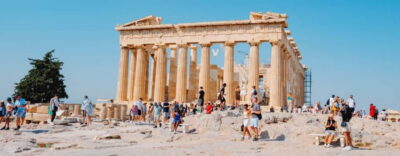
Acropolis, Parthenon & Acropolis Museum Guided Tour
Read our review →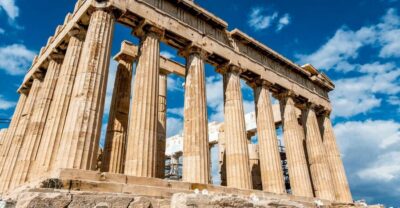
Acropolis monuments & Parthenon Walking Tour with Optional Acropolis Museum
Read our review →Browse the lists this tour appears in