
Reviewed · ANCIENT CORINTH TOURS
8 Days Apostle Paul tour/Neapolis, Philippi, Veria,Thessaloniki, Athens,Corinth
The striking part of this eight-day private tour is its sweep. You follow Apostle Paul from Neapolis, today’s Kavala, through Philippi, Veria, Thessaloniki, Corinth, and Athens, while also visiting Meteora, Pella, Vergina, Delphi, Mount Olympus, and the Corinth Canal. It is a Bible-focused trip with plenty of ancient Greek history around the edges.
I like the freedom of a private vehicle and the chance to stop in small towns such as Trikala, Livadia, and Kastraki. I also like the personal touch from Nikolaos, known as Nikos, and his wife Angela, who can help arrange hotels and restaurants. The main drawback is cost: the advertised $2,961.45 per person does not include your accommodation or entrance fees, so the final bill will be higher.
Five things to know before you book
- Follow Paul through northern Greece: Visit Neapolis, Philippi, Lydia’s baptistery, Veria, Thessaloniki, Amphipolis, and Corinth.
- Add major ancient sites: Meteora, Vergina, Pella, Dion, Delphi, the Acropolis, and the Acropolis Museum are all part of the route.
- Travel privately: Your group has an air-conditioned vehicle, hotel pickup, hotel drop-off, and a flexible schedule.
- Expect mountain roads and long days: Greece’s mainland is largely mountainous, and several days combine many stops with substantial driving.
- Budget beyond the tour price: Hotels and most site tickets cost extra, and an archaeological guide must be hired separately if you want guided walks inside the ruins.
A Bible journey with Greek history at every turn
This is best understood as a private road trip, not a standard sightseeing package. The religious thread gives the journey its shape, but the ancient Greek and Roman sites often provide the strongest visual moments.
You will travel from Athens into Central Greece, Thessaly, Macedonia, and back south to the Peloponnese and Athens. That means changing scenery almost every day: mountain passes, broad plains, coastal cities, archaeological parks, Orthodox monasteries, and old market towns.
Nikos drives and provides an audio documentary during the journey. He is not a licensed archaeological guide, so you should not expect a formal lecture beside every temple or museum object. If you want detailed interpretation inside the sites, arrange a licensed archaeologist in advance.
That distinction matters. The private format gives you time control and personal attention, but the depth of explanation depends on what you arrange. For a church group, Bible study group, or family with shared interests, that flexibility may be worth more than a fixed sightseeing program.
More Ancient Corinth and canal trips:
- From Athens: Ancient Corinth Day Trip with Canal & VR Guide
★ 4.6 · 1,073 reviews - Private Biblical Tour Ancient Corinth & Isthmus Canal from Athens
★ 5.0 · 762 reviews - Athens: Ancient Corinth & Nafplio Full Day Trip with Swim
★ 4.8 · 523 reviews
Day 1: Thermopylae, Trikala, and sunset at Meteora
The first morning begins with pickup at 8:00 a.m. from your hotel or apartment in Athens or Piraeus. The road heads north toward Thermopylae, where the famous 480 BC battle took place.
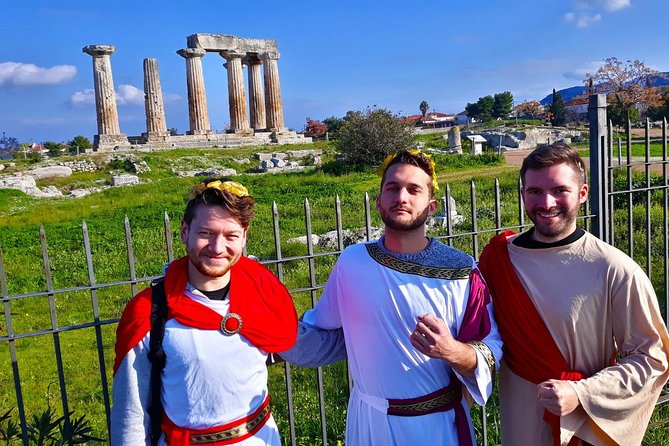
The Leonidas monument is the quick outdoor stop. Nearby, an interactive museum explains the battle, with admission listed at €3, or €1 at the reduced rate. Thirty minutes is enough for a look, but anyone fascinated by Greek military history may want more time.
Trikala gives the day a different rhythm. Built on ancient Trikka, the city is associated with Asclepius, the healing god, and its river Lithaios runs through the center. You can walk across its bridges and take a break from the highway. This is a useful stop because it brings you into present-day Greek life instead of keeping you among monuments all day.
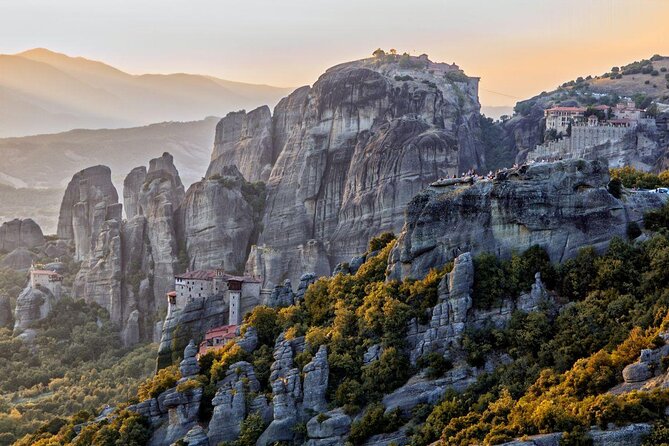
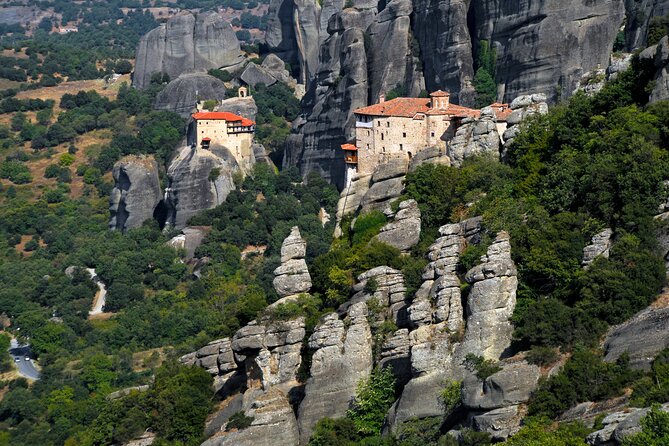
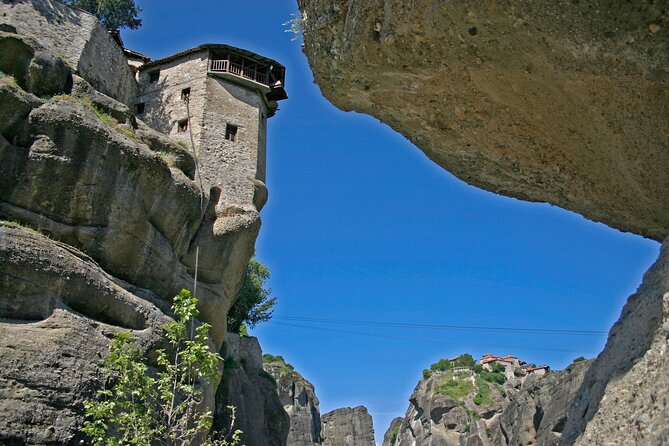
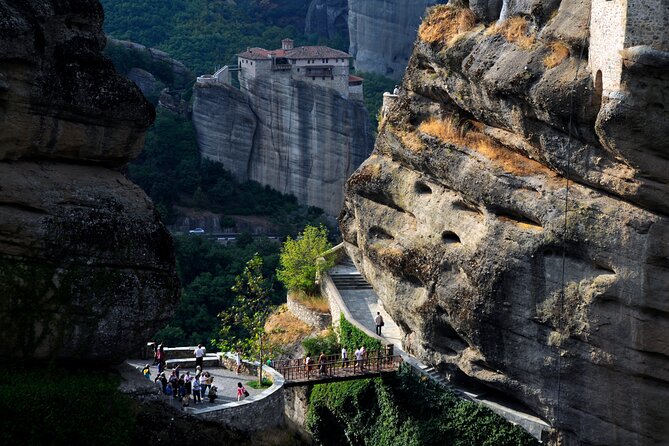
Then comes Meteora, one of Greece’s great visual surprises. Huge rock pillars rise above the Plain of Thessaly, with Orthodox monasteries perched on top. Six monasteries remain from an original twenty-four, and the tour plans visits to at least two. Each monastery charges a small entrance fee, listed as €3.
You spend the night in Kastraki, a quiet village beneath the rocks. The sunset and photography drive is one of the more thoughtful touches in the program. Instead of seeing Meteora only from the monastery entrance, you are taken to viewpoints chosen for changing light and broad views.
The first day is long. Thermopylae, Trikala, and Meteora cover a lot of ground, so this is not a gentle arrival day. Still, the overnight in Kastraki gives the rock formations room to make an impression.
Day 2: Royal Macedon, Aristotle, and hot springs
An early morning drive around Meteora lets you see the cliffs in softer light and with fewer people. This is worth doing even if you visited the monasteries the day before. The rocks look different from every angle, and morning gives you a calmer photography window.
Next comes Vergina, ancient Aigai, the first capital of Macedon. The Museum of the Royal Tombs is one of the most important archaeological stops in northern Greece. The burial site includes the tomb of Philip II, father of Alexander the Great, found intact in 1977.
The museum is built over the royal tombs, so you see the objects in the setting where they were discovered. The entrance fee is listed as €6 in winter and €12 in summer. Allow at least an hour and fifteen minutes. This stop has more impact if you read about Macedonian kings beforehand, since the displays can otherwise feel dense.
In Veria, or Berea, you visit the Vima Apostolou Pavlou, linked to Paul’s preaching after he left Thessaloniki. It is a short stop, but important for anyone following the New Testament route.
The School of Aristotle at Mieza connects the religious journey to classical education. Aristotle taught the young Alexander here between 343 and 340 BC. The site is open and straightforward, with no admission fee listed. You will not find a grand building surviving from the classroom, but the setting helps you picture the connection between Philip, Aristotle, and Alexander.
The day ends at Loutra Pozar, a thermal spring near Loutraki. The water flows at about 37 degrees Celsius and the area has long been associated with rest and recovery. The program places your overnight stay on the slopes of Mount Kaimaktsalan, with accommodation arranged at extra cost.
This is a welcome change of pace after two days of ruins and roads. Confirm in advance exactly what is included at the baths and hotel, since the tour description gives the stop but not a full bathing package.
Day 3: Pella and the layered city of Thessaloniki
Pella was the capital of ancient Macedon and the birthplace of Alexander the Great. The archaeological museum is designed around a central courtyard, echoing the layout of ancient Macedonian homes.
You can see mosaics, sculpture, maps, models, and objects from the palace and city. The combined museum and site ticket is listed as €8, or €4 at the reduced rate. Allow an hour and a half, especially if Alexander and Macedonian archaeology are central reasons for booking.
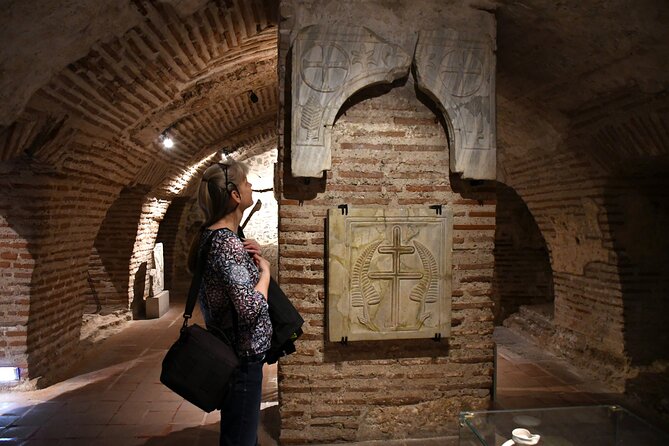
Thessaloniki then brings you into a living city with several periods stacked together. At the Church of Saint Demetrius, you can descend to the crypt associated with the martyrdom of the city’s patron saint. The church is a UNESCO World Heritage site, and admission is listed as free.
The White Tower sits on the waterfront and now contains a museum. It began as part of the city’s fortifications and later served as a prison during Ottoman rule. The €6 entrance gives you access to the upper levels and a 360-degree view across Thessaloniki.
The Rotunda adds another layer. Built in the fourth century during the time of Galerius, it was later converted into a Christian church. Its massive circular interior and surviving mosaics make it one of the city’s most unusual ancient buildings. Admission is extra.
Three city sights in one day is manageable, but you should expect a full schedule. Thessaloniki deserves several days on its own, so this visit is a highlights tour rather than a complete introduction.
More biblical and Apostle Paul tours in Athens:
- Biblical Tour Letters ToThe Corinthians St Paul’s Footsteps 6Hour
★ 5.0 · 1,065 reviews - Private Tour of Apostle Paul’s Footsteps in Ancient Corinth
★ 5.0 · 275 reviews - Paul”s Footsteps Ancient Corinth Biblical Tour
★ 5.0 · 184 reviews - Private Luxury Biblical Tour: Apostle Paul in Athens & Corinth
★ 5.0 · 162 reviews
Day 4: Philippi, Lydia, and Kavala
Philippi is the central stop for the Apostle Paul theme. It became a Roman colony after the battle of Philippi in 42 BC, and Paul arrived around AD 49 or 50. The archaeological museum and ruins help explain why this was an important city, not simply a name from the New Testament.
The museum admission is not included. Plan for at least an hour and a half, since the Roman streets, public buildings, and Christian remains deserve a steady walk rather than a rushed glance.
Nearby, Saint Lydia’s Baptistery marks the place associated with Lydia of Thyatira, regarded as the first documented convert to Christianity in Europe. Paul and his companions met her in Philippi, and the stop gives the biblical account a clear physical setting.
You then continue to Palea Kavala, the old part of Kavala. Ancient Neapolis is linked to Paul’s arrival in Europe, and a monument outside the Church of Agios Nikolaos commemorates the event. Kavala also has Byzantine and Ottoman remains, including its castle and aqueduct.
The overnight in Kavala is one of the practical strengths of the route. You are not simply stopping for a photograph and leaving. You have time to absorb the town, eat locally, and enjoy the waterfront setting.
Day 5: Amphipolis, Dion, and Mount Olympus
Amphipolis adds another important Paul connection. Paul and Silas passed through the area on the way from Philippi to Thessaloniki. The archaeological museum also covers the city’s role in Macedonian and Roman history. Admission is listed at €6.
Dion was a religious center for ancient Macedon, dedicated especially to Zeus. Philip II and Alexander celebrated victories here, and Alexander gathered his forces and made sacrifices before his campaign in Asia. The archaeological park and museum ticket costs €6 in winter and €12 in summer.
Dion is a good example of how this tour broadens beyond Paul. You are not only tracing Christian sites. You are seeing the political and religious world that Paul entered centuries later.
The overnight is on the slopes of Mount Olympus, Greece’s highest mountain, with its highest peak reaching 2,917 meters. Olympus is tied to Greek mythology as the home of the gods and is also a national park and UNESCO Biosphere Reserve.
Accommodation here is extra. The stated examples range from €100 per double room, with higher rates on weekends and holidays. Confirm the exact seasonal price before booking.
Day 6: Delphi and the road across Parnassus
The move from northern Greece to Delphi creates one of the tour’s longest-feeling travel days, even though the program focuses on Delphi once you arrive. The ancient sanctuary was home to the oracle of Apollo and was regarded by the Greeks as the center of the world.
The main archaeological site includes the Temple of Apollo, treasuries, and the famous route climbing through the sanctuary. The combined site and museum ticket is €12 in summer and €6 in winter or at reduced rates. The schedule allows two hours at the ruins and another hour at the museum.
The Archaeological Museum of Delphi is especially useful because it gathers sculpture, architectural pieces, and small objects from the sanctuary. The Charioteer of Delphi is among the objects associated with the museum, though the supplied program does not promise specific exhibits, so your visit should be guided by the current displays.
The Tholos of Athena Pronaia sits less than a mile from the main sanctuary. Its circular form is one of Delphi’s most photographed structures, and the outdoor stop is free.
You then cross Mount Parnassus and spend the night in a traditional village on its slopes. The route offers views over olive groves and central Greece. Hotel arrangements are extra, with quoted rates from €120 per double room and higher weekend prices.
This day suits people who like connecting mountains and sacred places. It is less suitable if you prefer slow museum visits and long time in one town.
Day 7: Livadia and Paul’s Corinth
The road south passes through Boeotia and near Thebes before reaching Livadia. You stop by the Karya River, where springs are linked to ancient stories about the oracle of Trophonius Zeus. The hour here provides a pleasant break from archaeological sites.
The drive through Mount Kithaeron adds more scenery and ancient connections before you reach the Peloponnese. The route is one reason a private car matters. You can pause in small towns and mountain areas that are awkward to fit into a conventional group tour.
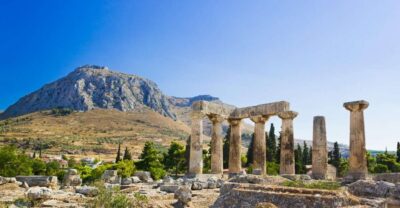
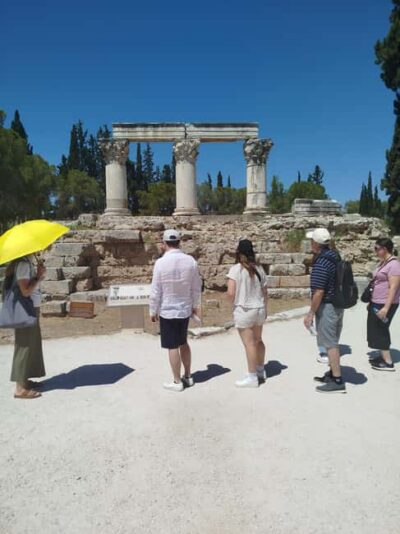
Ancient Corinth is one of the strongest Christian stops of the entire journey. Paul lived and preached here, and the city is linked to the First and Second Corinthians as well as Acts. The archaeological site includes the ancient agora and the Bema, or platform, associated with Paul’s trial.
The combined site and museum ticket costs €8 in summer and €4 in winter. Two hours is a sensible minimum. Corinth is much more than a quick photo stop, with a large open area that needs comfortable walking shoes and protection from the sun.
You spend the night in Nafplio, the first capital of modern Greece. Hotel costs are extra, with quoted rates from €130 per double room and higher holiday pricing. Nafplio is a good place to end the road portion of the trip, though the schedule does not leave a full day to explore it.
Day 8: Corinth Canal and Athens’ final highlights
The Corinth Canal is a short but worthwhile stop. Workers dug the 6,400-meter channel between 1881 and 1893, and you can view it from a pedestrian bridge roughly 80 meters above the water. Twenty minutes is enough for photographs.
Back in Athens, the Acropolis and Areios Pagos provide the final major biblical and classical connection. Paul preached to Athenians at Areios Pagos around AD 51. The Acropolis, meanwhile, brings you into the political, artistic, and philosophical center of classical Athens.
The program allows about an hour and a half at the Acropolis, followed by an hour at the Acropolis Museum. Admission is not included. You should expect walking on uneven stone and a busy setting, especially during the warmer months.
The museum is devoted to finds from the Acropolis site. It is a strong final stop because it gives context to objects and architectural pieces you have seen among the ruins.
The tour ends with drop-off at your Athens hotel. It is a packed finish, not a leisurely last morning, so avoid booking a tight onward flight on the same day.
What the $2,961.45 price really covers
The per-person price covers private transportation, an air-conditioned vehicle, pickup and drop-off, and an English-speaking experienced driver. Nikos also provides an audio documentary during the drives.
It does not include accommodation or entrance fees. Site tickets can run about €20 per person at some locations, with winter prices often half that amount. Over eight days, the separate admissions add up, especially if you visit every museum and archaeological site.
Hotels are arranged at additional cost, often in boutique or three-star and four-star properties. The driver’s room is complimentary when the company arranges the lodging. If you book hotels yourself, you must reserve an extra room for the driver.
The value is strongest for a small group that wants a custom route and does not want to manage Greek mountain roads. The value is weaker for a solo visitor or couple seeking the lowest possible price. You are paying for private driving, route planning, flexibility, and the ability to combine places that would otherwise require several separate trips.
The cancellation policy is strict: the experience is non-refundable and cannot be changed after booking. Book only after confirming the full hotel plan, site schedule, and final cost.
Who should book this journey
I would recommend it to people with a clear interest in Paul’s ministry, early Christianity, Macedonian history, or Orthodox sites. It also suits families and friend groups that want a private vehicle rather than a fixed coach schedule.
The route has received especially strong praise for Nikos’s safe driving, including small villages and mountain roads, along with his spacious, clean vehicle. The accommodation and restaurant planning from Nikos and Angela is another useful benefit when you do not want to research every overnight stop yourself.
I would be cautious if you want long stays in Athens, Thessaloniki, Nafplio, or Delphi. The trip covers a great deal of Greece, but that means many visits are brief. You should also be comfortable with long drives, early starts, stairs, uneven ruins, and a changing hotel each night.
FAQ
Where does the tour begin and end?
The tour begins with pickup at 8:00 a.m. from your hotel or apartment in Athens or Piraeus. It ends with drop-off at your Athens hotel.
Is this a private tour?
Yes. Only your group participates, and transportation is provided in a private air-conditioned vehicle.
Who drives the tour?
The tour is driven by Nikolaos, also called Nikos. His wife Angela may assist with accommodation and restaurant arrangements.
Is accommodation included in the price?
No. Accommodation costs extra. The company can arrange boutique, three-star, or four-star hotels with breakfast, and the price varies by city, season, weekends, and holidays.
Are entrance fees included?
No. Entrance fees are paid separately. The listed prices range from free outdoor stops to about €12 for several major summer sites.
Is the driver a licensed archaeological guide?
No. The driver is not a licensed archaeological guide for walks inside museums or archaeological sites. You can hire an archaeologist separately if you want formal site guiding.
Can the schedule be changed?
The schedule is described as flexible and suited to your group’s needs. Confirm desired changes in advance, since the route includes hotel reservations and many timed site visits.
Is the tour suitable in winter?
Yes, but opening hours and ticket prices change. Many sites close earlier from November through March, and some museums or archaeological sites may close on Tuesdays.
Newly reviewed around Athens
- Athens: workshop for painting landscape with local artist★ 4.6 · 3 reviews
- Athens: Greek Wine & Olive Oil Tasting at Brettos Plaka★ 4.5 · 3 reviews
- Outdoor Yoga and Pilates with Akropolis view★ 4.0 · 5 reviews
- Acropolis of Athens: 60′ Tour in a Vintage Motorcycle★ 5.0 · 4 reviews
- Ultimate Tasting of the Volcanic Wines of Greece★ 5.0 · 3 reviews
- workshop for painting acropolis/landscape with local artist★ 5.0 · 3 reviews
- Athens at Twilight Night Tour with Drinks and Meze Dishes★ 4.8 · 4 reviews
- Breakfast in the markets with olive oil and honey tasting★ 4.8 · 8 reviews
Ancient Corinth Tours, compared.
Ancient Corinth Day Trip with Canal & VR Guide
Read our review →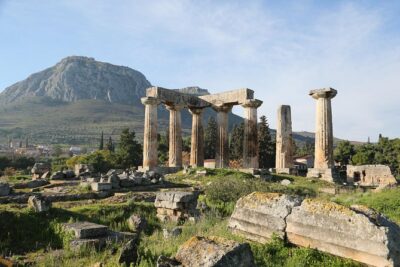
Private Biblical Tour Ancient Corinth & Isthmus Canal from Athens
Read our review →
Ancient Corinth & Nafplio Full Day Trip with Swim
Read our review →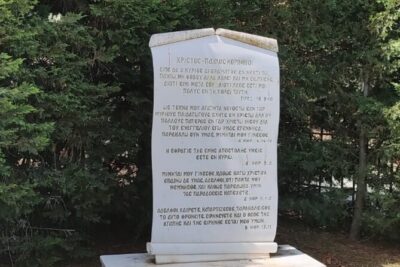
Private Tour of Apostle Paul’s Footsteps in Ancient Corinth
Read our review →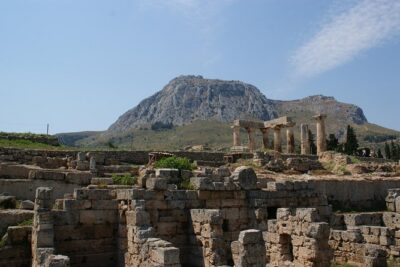
Corinth Half-Day Trip from Athens with Entrance Tickets
Read our review →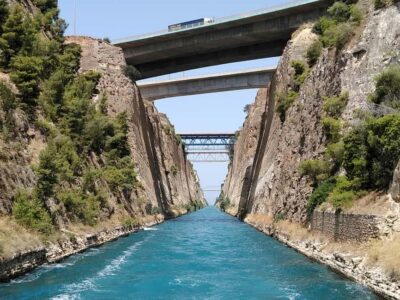
Browse the lists this tour appears in