
Reviewed · ANCIENT CORINTH TOURS
“Tour of Ancient Corinth:Follow in the footsteps of Apostle Paul”
Ancient Corinth gives you far more than a quick ruin stop. In one half-day, you can look across the Corinth Canal, walk among Roman-era remains, see the Temple of Apollo, and climb toward the great fortress of Acrocorinth, a rock that guarded the route into the Peloponnese. The Apostle Paul connection adds a personal thread to the stones.
I like the private vehicle and flexible pickup, especially if you are staying in Athens or arriving by cruise ship. I also like the human touch: drivers such as Andreas and Spyros are praised for adjusting the pace, sharing local stories, and helping with practical needs such as phone charging. The main catch is that the driver is not licensed to guide you inside the archaeological sites, and admission fees are extra.
Key points to know before booking
- The Corinth Canal is a quick but worthwhile first stop, with about 30 minutes to view the cut through the Isthmus.
- Ancient Corinth combines famous Christian connections with major Greek and Roman remains, including Paul’s Step, the Agora, and Apollo’s Temple.
- Acrocorinth is the dramatic finale, but its steep rock and fortress setting require sensible shoes and steady footing.
- You travel privately, with pickup from a hotel, Airbnb, Piraeus Port, or an agreed metro or bus stop.
- The $204.50 price buys transport and flexibility, not admission, so budget separately for the museum and archaeological sites.
- A licensed guide is available by request, but only depending on availability and at an additional cost.
Why Corinth makes a strong half-day trip from Athens
Corinth sits at a natural crossroads. The narrow Isthmus connects mainland Greece with the Peloponnese, so armies, merchants, pilgrims, and apostles all passed through this corridor. That location explains why the area has layers from ancient Greece, Roman Corinth, the Byzantine period, and later fortress building.
For you, the appeal is variety. The trip is not just a museum visit or a pile of fallen columns. You get water engineering at the canal, an open archaeological site, an excellent small museum, and a mountain fortress with broad views over the region.
The Apostle Paul connection is especially useful if you want a biblical angle. Paul spent time in Corinth and addressed the early Christian community there. The tour includes the place identified as Paul’s Step, along with the remains of the city he knew as a Roman colony. You should still expect the experience to be primarily an archaeological visit, not a dedicated religious pilgrimage.
At roughly four to five hours, the outing fits neatly into a busy Athens schedule. It also works well for a port day, since pickup and drop-off at Piraeus are included without an extra charge. The private format means you do not need to wait for a large group or follow a fixed bus-tour rhythm.
More Ancient Corinth and canal trips:
- From Athens: Ancient Corinth Day Trip with Canal & VR Guide
★ 4.6 · 1,073 reviews - Private Biblical Tour Ancient Corinth & Isthmus Canal from Athens
★ 5.0 · 762 reviews - Athens: Ancient Corinth & Nafplio Full Day Trip with Swim
★ 4.8 · 523 reviews
Crossing the Isthmus at the Corinth Canal
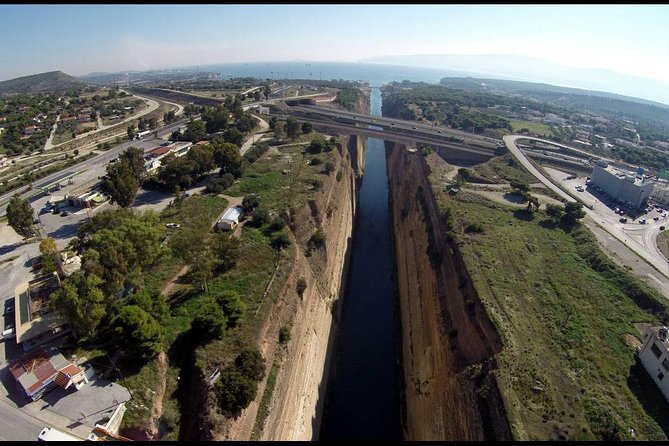
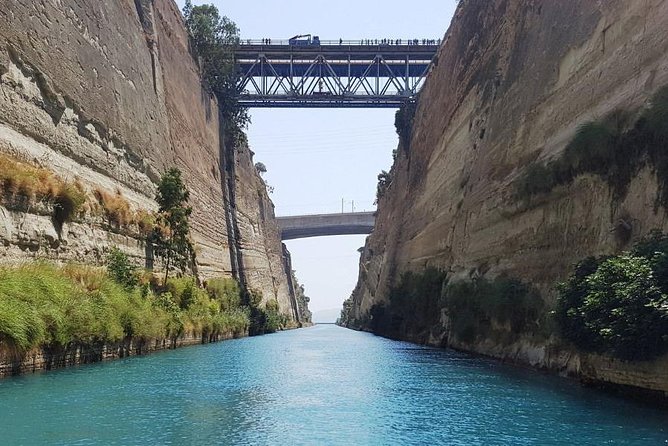
The first stop is the Corinth Canal, where the modern waterway cuts through the narrowest part of the Isthmus. The canal links the Saronic Gulf with the Gulf of Corinth and runs for about six kilometers. It was built between 1880 and 1893, but the strategic value of the location is much older.
Allow about 30 minutes here. That is enough for a look at the canal and a few photographs, but not a long visit. The stop works best as an introduction to the geography. Once you see how narrow the land bridge is, Corinth’s military importance becomes easy to understand.
Ancient defenses once crossed the Isthmus. The Hexamilion wall, built in antiquity and maintained into the Byzantine period, helped block movement between central Greece and the Peloponnese. You will not get a full tour of the wall on this outing, but your driver can explain why this strip of land mattered so much.
The canal stop is free, which helps keep the overall cost in check. It is also a good place to reset after the drive from Athens. Do not expect a long historical presentation here. Think of it as a sharp visual lesson in Greek geography before the ruins.
Ancient Corinth and the world of Apostle Paul
The main archaeological site lies about five kilometers from the modern city of Corinth. Systematic excavation began in 1896 under the American School of Classical Studies at Athens, and work by Greek archaeologists has continued to reveal more of the ancient city.
You may have around 30 minutes specifically listed for the ancient city, though the exact pacing can change because the tour is private. Ask your driver at the start how much time is planned for the ruins, museum, and Acrocorinth. That simple question will help you decide where to linger.
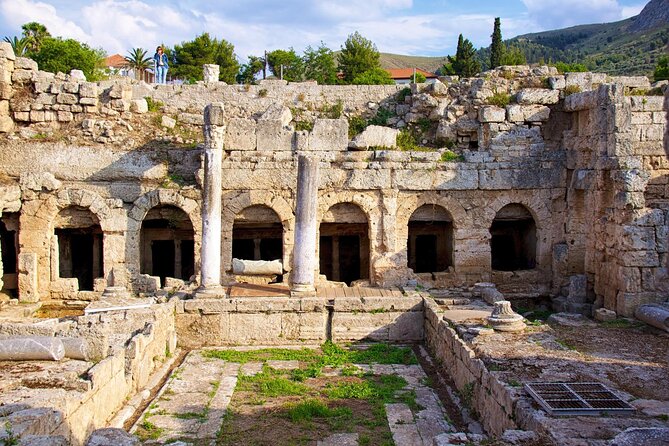
The remains show Corinth as both a Greek city-state and a Roman colony. Its position brought wealth, trade, and political power, but it also made the city a prize for anyone seeking control of the Isthmus. The ruins are spread across an open site, so comfortable shoes, sun protection, and water matter even during a short visit.
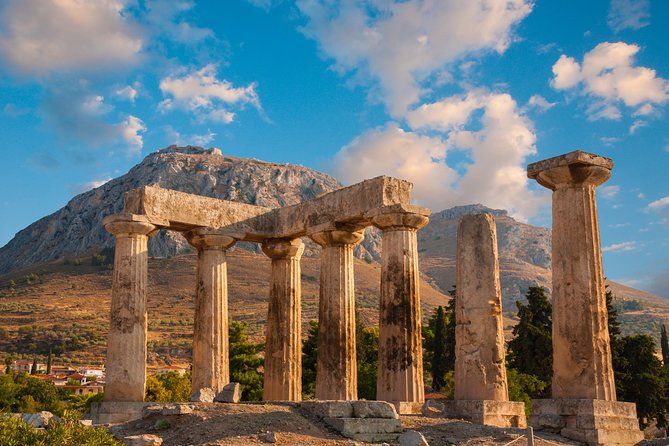
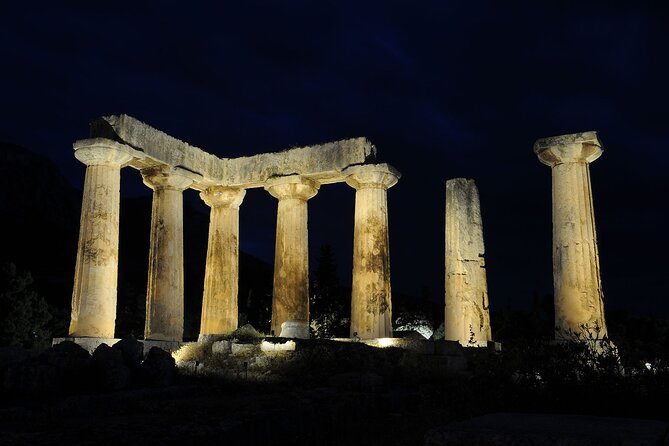
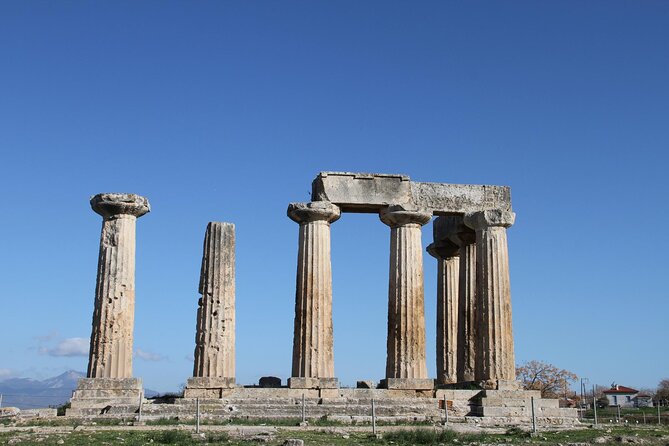
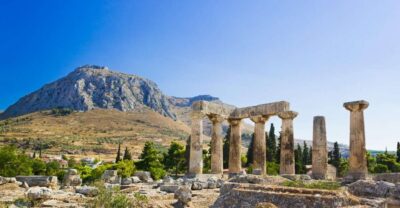
The Temple of Apollo is the visual anchor. It was built with 40 monolithic Doric columns, though only seven remain standing. The temple’s earliest form dates to the early seventh or early sixth century BC. What you see today is a powerful fragment, not a complete building, but the surviving columns make it easier to picture the scale of the old city.
The ancient marketplace, or Agora, once formed the civic center. Nearby are remains connected with the Asklepieion, a sanctuary devoted to healing. Corinth was not only a political and commercial center. It also had places where people sought religious help and medical care.
The tour also includes several other remains in the site area:
- Paul’s Step, associated with the Roman governor’s tribunal
- The theater and conservatory
- The Fountain of Glauke
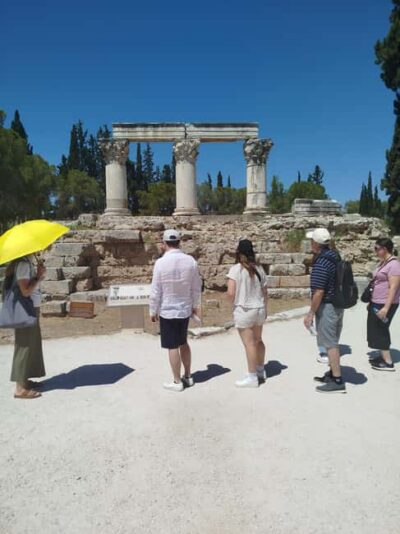
- The Temple of Octavia
- The Peirene Fountain
- Early Christian basilicas, including the Basilica of Lechaion and the Basilica of the Skull
- Sanctuaries dedicated to Demeter and Kore
You should ask your driver which features are easiest to reach during your visit. The supplied description groups several of these places under the ancient Corinth portion, but the four to five hour schedule may not allow equal time at every feature.
The driver can explain the setting and help you find the main points, but the driver is not licensed to accompany you inside every site or museum. That distinction matters. If you want formal archaeological interpretation at the ruins, request a licensed guide when booking and confirm availability. Otherwise, you will have transportation, local orientation, and historical commentary, then explore the paid areas on your own.
The Archaeological Museum of Ancient Corinth
Plan about an hour for the Archaeological Museum of Ancient Corinth. It sits within the archaeological site and was built in 1932 by the American School of Classical Studies. Its displays give you the objects that the open-air ruins cannot provide: sculpture, pottery, religious finds, and everyday artifacts.
The collection covers prehistoric material through the Byzantine period. Particularly useful sections include finds from the Asklepieion and objects from the Geometric period. The museum also includes the Twin Kouroi from ancient Tenea, noted examples of Archaic sculpture that became part of the display more recently.
This is one of the best parts of the visit for anyone who likes context. At the ruins, you see foundations and columns. In the museum, you can connect those spaces with objects made, used, or worshipped by the people who lived there.
Admission is not included. The stated museum price is €20 per person, while archaeological-site prices can vary by season. The information provided also notes that the museum closes on January 1, March 25, May 1, Easter Sunday, December 25, and December 26. Check the date before you pay for the tour, especially if you are visiting around a Greek holiday.
Because the museum takes about an hour, it may be the first place affected if traffic or a late pickup reduces your time. I would protect this hour if you care about ancient art and objects. If your main goal is the Apostle Paul connection or the fortress, tell the driver early so the schedule matches your priorities.
More biblical and Apostle Paul tours in Athens:
- Biblical Tour Letters ToThe Corinthians St Paul’s Footsteps 6Hour
★ 5.0 · 1,065 reviews - Private Tour of Apostle Paul’s Footsteps in Ancient Corinth
★ 5.0 · 275 reviews - Paul”s Footsteps Ancient Corinth Biblical Tour
★ 5.0 · 184 reviews - Private Luxury Biblical Tour: Apostle Paul in Athens & Corinth
★ 5.0 · 162 reviews
Acrocorinth, the fortress above the ruins
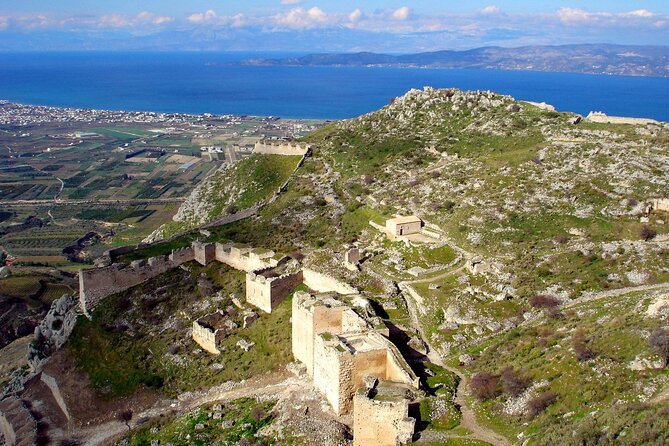
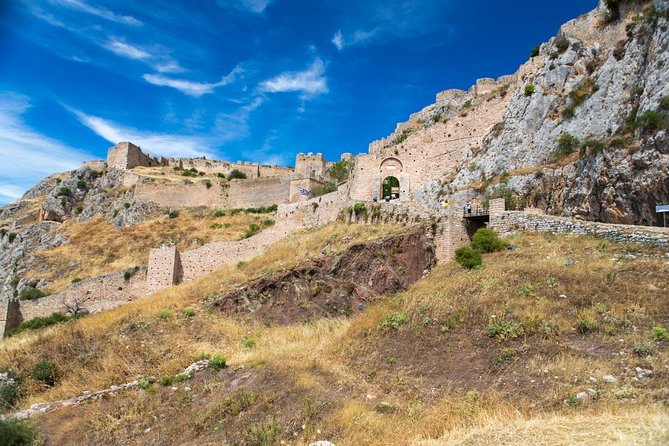
Acrocorinth rises on a steep rock about 575 meters high above ancient Corinth. Its height and secure water supply made it a natural defensive position. Control of this fortress meant control of the Isthmus, which explains why it was used repeatedly as a last line of defense in southern Greece.
This is the most dramatic portion of the outing, but it is not the easiest. The rock, paths, and fortress setting call for sturdy shoes and a reasonable level of mobility. The description allows about an hour here, so you should not expect to inspect every corner of the site.
The reward is scale. From above, the ancient city, the Isthmus, and the surrounding countryside make more sense. You can see why Corinth was valuable and why Acrocorinth was so difficult to take. The fortress is not simply another ruin stop. It explains the strategic story that links all the other places on the tour.
The listed points at or around Acrocorinth include an amphitheater, Paul’s Step, the theater, the Sanctuary of Asclepius, the Sanctuary of Demeter and Kore, the Fountain of Glauke, the Temple of Apollo, the Temple of Octavia, early Christian basilicas, Peirene, and the conservatory. Some of these features are associated with the ancient city below, so ask for a clear plan rather than assuming all can be visited during the one-hour stop.
The name Acrocorinth is sometimes used for the fortified upper site, while the archaeological remains of ancient Corinth sit below. Keeping that distinction in mind will help you understand the geography and avoid expecting one compact ruin field.
What the private format changes
The private arrangement is the tour’s biggest practical advantage. You are not sharing the vehicle with strangers, and only your own group participates. Pickup can be arranged at a hotel, Airbnb, Piraeus Port, or a metro or bus station, with flexible start times.
The vehicle is a Mercedes-Benz with air conditioning, WiFi, bottled water, mobile chargers, and child seats. Those details matter on a warm Greek day or during a port call. One detailed account specifically praised the driver for providing a phone charger, a small service that can save a low-battery day.
The drivers named in the feedback include Andreas, Spyros, and Ted. Andreas is repeatedly singled out for thoughtful service, conversation, local folklore, and making stops beyond the standard bus-tour pattern. Spyros is praised for balancing site information with relaxed conversation, while Ted is described as attentive from ship pickup through drop-off.
You should understand the service correctly. The English-speaking driver has historical knowledge but is not a licensed guide for the interiors of sites and museums. The driver can assist with skip-the-line ticket purchases, but you pay the ticket cost. A licensed guide may be requested, subject to availability.
That setup suits you if you want control, comfort, and an easy ride more than a formal lecture. It is less suitable if you expect a guide to lead every step inside each ruin and explain every inscription.
Is $204.50 per person good value?
At $204.50 per person, this is not a budget excursion. The price makes more sense for couples, families, or small groups who value a private car, pickup, flexible timing, and a direct Athens to Corinth connection.
The cost does not include entrance fees. The Archaeological Museum of Ancient Corinth is listed at €20 per person, and site fees vary by season. You should treat the advertised price as transport, driver service, and planning convenience rather than an all-inclusive ticket.
For a larger group, the value can improve because the vehicle and driver cost are spread across more people. Group discounts are offered, so check the final price for your party rather than judging only by the per-person figure.
The private format can also save time. You avoid collecting other passengers and can adjust the balance between the canal, museum, ruins, and fortress. On a short Athens stay, that flexibility may be worth more than a cheaper fixed bus tour.
Who should book this Corinth tour?
I would choose this outing if you want to see Corinth without renting a car or working out regional transport. It is a strong match for:
- Couples and families wanting a private day outside Athens
- Cruise passengers using Piraeus pickup and drop-off
- People interested in Apostle Paul and early Christianity
- Visitors who want both archaeology and a fortress viewpoint
- Small groups that prefer flexible timing
- Anyone who values an English-speaking driver and comfortable transport
I would pause before booking if you need a licensed guide at every site, dislike steep or uneven ground, or want a slow archaeological study of every ruin. Four to five hours is enough for a strong introduction, not an exhaustive examination.
The tour has a perfect 5 rating from 14 published ratings, and the strongest praise centers on punctual pickup, considerate drivers, good conversation, and attention to the group’s interests. That pattern suggests the service side is the safer bet. The depth of site interpretation depends more on your driver and whether you arrange a licensed guide.
Free cancellation is available up to 24 hours before the start time. Changes or cancellations inside that window are not accepted for a refund. Pickup from Rafina or Lavrio costs extra, and ending somewhere other than the agreed drop-off point may also bring an additional fee.
Should you book it?
Book this tour if you want a comfortable, private route from Athens to the Corinth Canal, Ancient Corinth, its museum, and Acrocorinth, with the freedom to shape the day around your interests. The Apostle Paul connection, Apollo’s surviving columns, and the fortress above the Isthmus give the outing real variety.
Before confirming, ask about three things: the exact time at each stop, the total admission cost for your date, and whether a licensed guide is available. If the answers fit your priorities, the price buys a convenient and personal way to see one of mainland Greece’s most important archaeological areas.
FAQ
Is hotel pickup included?
Yes. Pickup and drop-off are included from hotels, Airbnbs, Piraeus Port, and agreed metro or bus stations. Provide the exact address or meeting point when booking.
Can I be picked up at Piraeus Port?
Yes. The driver can meet you outside your cruise ship with a sign showing your name. Pickup from Rafina Port or Lavrio Port costs extra.
How long does the tour last?
The tour lasts approximately four to five hours. Pickup times are flexible, and hourly extensions are available for an additional fee.
Is the tour private?
Yes. Only your group participates in the activity.
Is the driver a licensed tour guide?
No. The English-speaking driver has historical knowledge but is not licensed to accompany you inside archaeological sites or museums. A licensed guide can be requested, subject to availability.
Are entrance tickets included?
No. Archaeological-site and museum tickets are paid separately. Assistance with purchasing skip-the-line tickets is included.
How much is admission to the Archaeological Museum of Ancient Corinth?
The stated entrance fee is €20 per person. Archaeological-site prices can vary between the winter and summer seasons.
When is the museum closed?
The Archaeological Museum of Ancient Corinth is closed on January 1, March 25, May 1, Easter Sunday, December 25, and December 26.
Newly reviewed around Athens
- Athens: workshop for painting landscape with local artist★ 4.6 · 3 reviews
- Athens: Greek Wine & Olive Oil Tasting at Brettos Plaka★ 4.5 · 3 reviews
- Outdoor Yoga and Pilates with Akropolis view★ 4.0 · 5 reviews
- Acropolis of Athens: 60′ Tour in a Vintage Motorcycle★ 5.0 · 4 reviews
- Ultimate Tasting of the Volcanic Wines of Greece★ 5.0 · 3 reviews
- workshop for painting acropolis/landscape with local artist★ 5.0 · 3 reviews
- Athens at Twilight Night Tour with Drinks and Meze Dishes★ 4.8 · 4 reviews
- Breakfast in the markets with olive oil and honey tasting★ 4.8 · 8 reviews
Ancient Corinth Tours, compared.
Ancient Corinth Day Trip with Canal & VR Guide
Read our review →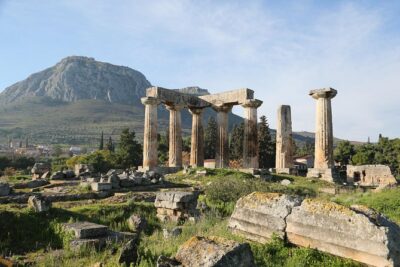
Private Biblical Tour Ancient Corinth & Isthmus Canal from Athens
Read our review →
Ancient Corinth & Nafplio Full Day Trip with Swim
Read our review →
Private Tour of Apostle Paul’s Footsteps in Ancient Corinth
Read our review →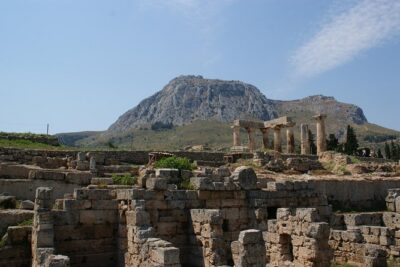
Corinth Half-Day Trip from Athens with Entrance Tickets
Read our review →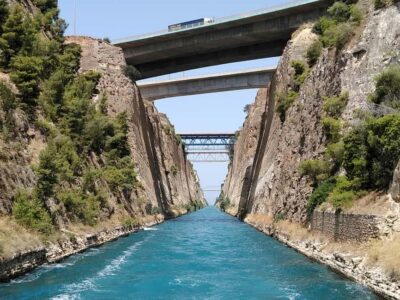
Browse the lists this tour appears in