
Reviewed · ANCIENT AGORA TOURS
Private Walking Tour: Ancient Agora, Plaka and Monastiraki monuments
Athens reveals its layers best on foot, and this tour moves through them in a tidy three-hour route. You begin with ancient finds beneath Syntagma, pass through the old Turkish quarter and Monastiraki’s market lanes, then reach the Ancient Agora, where trade, politics, and public life shaped early Athenian democracy.
I like the private format because your guide can adjust the pace and explain things in terms your group will understand. I also like the mix of major sites and everyday Athens, from Avyssinias Square’s food and spice stalls to the reconstructed Stoa of Attalos. The main drawback is price: at $319.39 per person, this is a serious splurge, and the €20 Agora admission is extra.
Key points to know before booking
- Syntagma starts the story underground: See ancient tombs, Roman mosaics, and a 2,000-year-old beehive in the metro station museum.
- The private guide shapes the experience: Only your group takes part, with English guiding and room for questions.
- Monastiraki brings Ottoman Athens into view: See Tzistarakis Mosque, Fethiye Mosque, the Medrese doorway, and the flea market lanes.
- The Ancient Agora is the tour’s main event: Allow about an hour for the former marketplace and civic center.
- Stoa of Attalos adds an indoor museum stop: Its artifacts show how ordinary Athenians lived and worked.
- The tour ends at the Agora, not your hotel: After the museum, your guide leaves you to continue exploring on your own.
Starting beneath Syntagma Square
Meet your guide at Syntagma Square, near the central Syntagma Metro station. This is a useful place to begin because Athens history appears almost immediately, before you have even reached an outdoor monument.
The station has a small museum displaying finds uncovered during construction. You can see ancient burial tombs, Roman mosaic remains believed to date to the fifth century BC, and a 2,000-year-old beehive. These are not grand ruins in the usual sense. They are fragments of daily life, preserved in a modern transport hub.
I like this opening because it gives you a quick lesson in how old Athens is without requiring a separate museum visit. Your guide can help connect the objects to the city beneath your feet. Since this is a private walk, ask questions early if your group is especially interested in archaeology, religion, or everyday life.
The metro museum is a short introduction rather than a full gallery visit. If you want long explanations for every object, the three-hour schedule may feel tight. The value comes from the context and the setting, not from the size of the collection.
More Ancient Agora and Kerameikos walks:
- Athens: Agora and Hephaistos Temple Entrance Ticket
★ 4.0 · 449 reviews - Athens: Ancient Agora E-Ticket and Audio Tour
★ 3.9 · 413 reviews - Athens: Kerameikos Stone House Cooking Class
★ 5.0 · 165 reviews
Athens Cathedral and the city’s Orthodox center
From Syntagma, the route continues to Mitropoleos Square and the Cathedral of Athens. The church was built in 1862 and serves as the seat of the city’s archbishop in the Greek Orthodox Church.
This stop shifts the focus from ancient Athens to the modern Greek capital. The cathedral’s ornate design gives you a visual change after the underground remains. It also helps explain the importance of Orthodox Christianity in Greek public life.
The cathedral is passed as part of the walking route, so you should not expect an extended church tour based on the information provided. Still, the square makes a natural bridge between Syntagma and the older streets beyond it.
Because the route includes several religious and historic structures, respectful behavior is sensible if you enter a church. Your guide can tell you more about the building and its role in Athens, but the main point here is orientation rather than a lengthy interior visit.
Monastiraki’s Ottoman streets and market life
The walk then reaches Monastiraki, one of the city center’s most active shopping areas. You move through narrow lanes lined with shops, flea-market stalls, and older buildings. This is where the tour feels least like a sequence of archaeological sites and most like a walk through living Athens.
You will see the Tzistarakis Mosque and Fethiye Mosque, reminders of the Ottoman period. You will also pass the Doorway of the Medrese, the surviving entrance to a former Turkish theological school. These structures matter because Athens is not only a classical Greek city. Its streets also carry traces of later rulers and changing religious communities.
The flea market is a useful part of the tour for another reason: it gives you a feel for the city’s commercial side. The route does not promise shopping time or purchases, so treat the market as a moving street scene rather than a dedicated retail stop.
This section can be busy and visually crowded, especially around the shop-filled lanes. That may be a plus if you want energy and local street activity. If you prefer quiet ruins, the Monastiraki section may feel less relaxed than the Agora.
Plaka, Hadrian’s Library, and the Ottoman layers
From Monastiraki, the route enters Plaka, Athens’ old town. Its paved lanes form a compact maze below the Acropolis area, though this tour focuses on the listed monuments rather than an Acropolis visit.
You will see the remaining columns of Hadrian’s Library, built by Emperor Hadrian in AD 132. The library was more than a place for books. It was part of a large Roman complex, and the columns help you picture the scale of Roman Athens even though much of the structure is gone.
The Doorway of the Medrese adds a different layer nearby. Seeing a Roman monument and an Ottoman remnant within the same walking circuit is one of the strongest features of this experience. You do not need a full day of museums to grasp that Athens was repeatedly rebuilt, occupied, and adapted.
Hadrian’s Library is viewed from the route, while the Ancient Agora and Stoa of Attalos are the main paid stops. The information states that entrance to the Ancient Agora costs €20 per person and is not included. Bring that cost into your planning, especially since the tour itself already costs $319.39 per person.
More walks around Plaka and Monastiraki:
- Culinary Backstreets of Plaka – Athens Food Tour
★ 5.0 · 182 reviews - Acropolis monuments, Parthenon and Plaka, Monastiraki walking tour
★ 5.0 · 182 reviews - Traditional Greek Show in Plaka with Dinner
★ 3.6 · 178 reviews - VIP Private Guided Tour of Athens Acropolis & Plaka in a Sidecar
★ 5.0 · 108 reviews
The Ancient Agora, Athens’ public square
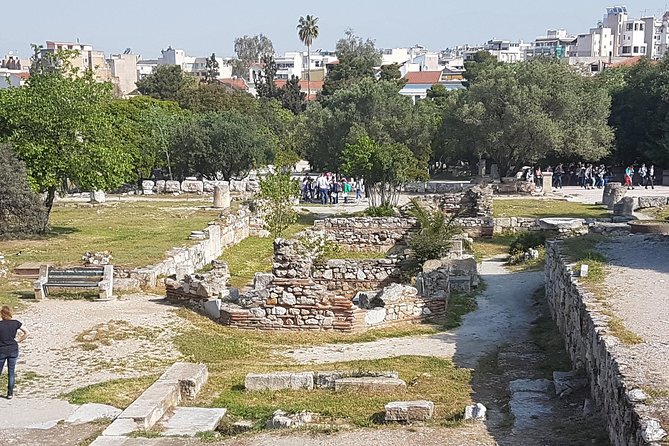
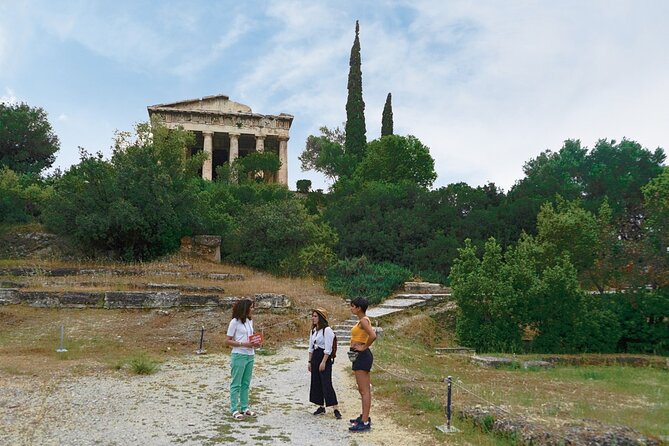
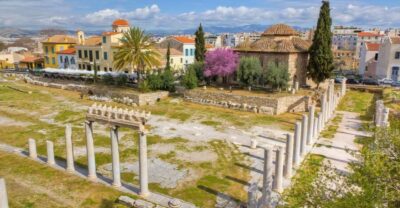
The Ancient Agora is the tour’s central stop, with about an hour set aside for the site. In ancient Athens, this was a marketplace, but it was also a place where people gathered to discuss city affairs. It is closely tied to the development of democratic ideas.
That combination makes the Agora more meaningful than a simple collection of broken stones. You are looking at a civic center where commerce, public debate, and social life met. Your guide’s explanation is particularly useful here because the remains can be hard to read without a map of what once occupied the space.
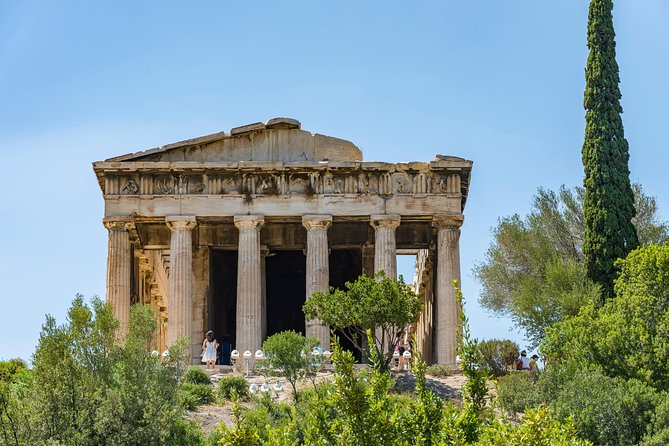
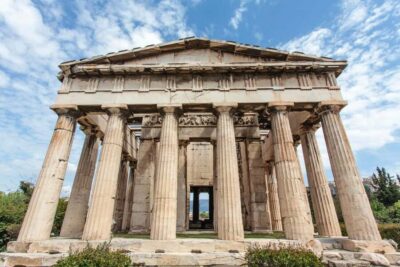
The tour description also includes the Temple of Hephaestus. This is one of the notable monuments within the Agora area, and it helps give the site a strong visual focus. You may find it easier to understand the ancient setting once you can identify the buildings that framed the open public space.
The Agora is an outdoor archaeological site, so the experience depends on walking between remains rather than moving through a series of polished rooms. That is part of its appeal, but it also means you should expect uneven ground and exposure to the weather. The provided information says most people can participate, yet it does not promise a fully accessible route.
The entry fee is separate, and the tour price does not include food or drinks. Plan for that before setting out, since the walk ends later near the market area rather than at your hotel.
The Stoa of Attalos and its daily-life artifacts
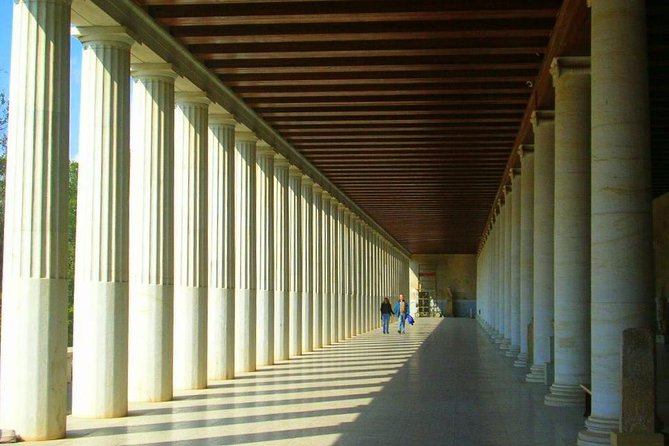
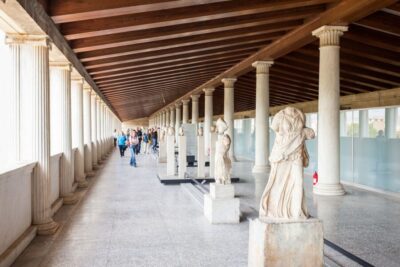
About 45 minutes are assigned to the Stoa of Attalos. This reconstructed ancient shopping hall now houses the Museum of the Ancient Agora, with objects connected to the daily life of Athenians.
This is a useful complement to the open-air ruins. At the Agora, you see the remains of a civic and commercial center. Inside the Stoa, artifacts help show how people used that setting. The museum can make the site easier to understand because small objects often explain ordinary routines better than monumental ruins do.
The Stoa also gives you a break from walking outdoors. The visit is included in the route, but admission is listed as not included, with the Ancient Agora entrance priced at €20 per person. Confirm the exact ticket arrangement when booking, since the information presents the fee for the Agora site rather than a separate Stoa price.
After the museum visit, the guide leaves you at the Ancient Agora. This is important: the tour does not return you to Syntagma, provide hotel drop-off, or continue with you through the old town. You can stay and explore further, but you will need to make your own plans from that point.
Avyssinias Square and the food markets
The route also includes Avyssinias Square and Athinas Street, where food and spice stalls add color and strong smells to the walk. This is one of the more sensory parts of the experience. Ancient stones tell you about the past, while the markets show how central trade remains to Athens today.
You can expect aromas from food and spices, shop displays, and the sound of commerce around the lanes. This is not a cooking class or a food tasting tour. Food and drinks are not included, so any snack or purchase is your responsibility.
Still, I like having this market section in the route. It prevents the walk from becoming a nonstop march between official monuments. The market gives you a chance to see how the center works now, not only how it worked in the sixth century BC or under Roman and Ottoman rule.
The supplied route information places the formal ending on Athinas Street, while the meeting details say the guide departs after the Stoa of Attalos at the Ancient Agora. Read those details together as a practical planning point: the guide’s service ends around the Agora area, and you should confirm the precise finish with the provider before the walk.
What the private format adds
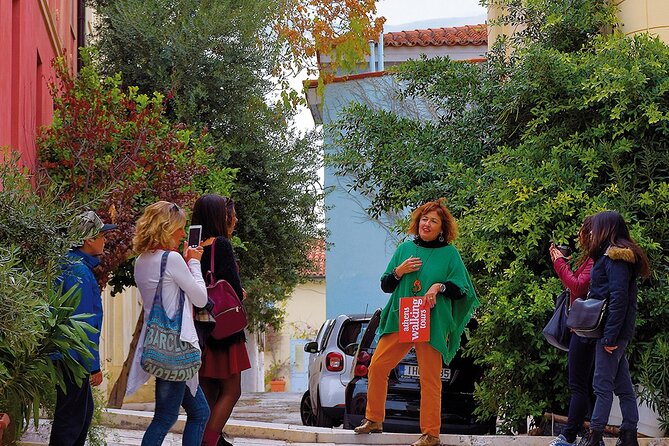
This is a private activity, so only your group participates. That matters most when your group has mixed interests or different ages. One review describes a group with teenagers aged 15 and 16, and the guide made the material easy for them to understand and enjoy.
The strongest praise centers on the guides’ ability to make the history clear and interesting. Kostas is specifically named as a superior guide in one review, while another says the guide made the tour memorable. If you have a preference, ask whether Kostas is available, though the information does not promise that he will lead every departure.
A private walk also lets you stop for questions without holding up strangers. You can ask for more detail at the Agora, keep the market section brisk, or spend more time on Ottoman buildings if that suits your group. The tradeoff is cost. At $319.39 per person, private attention needs to be a priority for the purchase to make sense.
For a couple or a small family, the price may feel hard to justify beside a larger group tour. For a group that wants personal attention, an English-speaking guide, and a flexible pace, the cost may be more reasonable, especially if divided among several people and paired with the group discount option.
Time, meeting point, and practical planning
The walk lasts about three hours. It starts at Syntagma Square and finishes around the Ancient Agora area, with no hotel pickup or drop-off. Since the route crosses central Athens, the stated meeting point near Syntagma Metro is convenient for reaching by public transportation.
Wear shoes suited to city streets and archaeological ground. The information says most people can participate, but it does not describe special mobility services or a guaranteed step-free route. If anyone in your group has mobility concerns, ask the provider before booking.
Bring water, especially since food and drinks are not included. You will pass markets where you can buy something, but the tour is not built around a scheduled refreshment stop.
The experience is offered in English. Confirmation normally arrives at booking, though reservations made within two days of travel may take up to 48 hours and remain subject to availability. Free cancellation is available if you cancel at least 24 hours before the start time. Cancellations or changes made later are not accepted for a refund.
Who should book this Athens walk?
I would choose this tour if you want a compact introduction to several periods of Athens in one outing. It links ancient Greek civic life, Roman building projects, Ottoman remains, Orthodox Athens, and present-day market streets without making you arrange separate visits.
It suits first-time visitors who want a guide to explain the Agora, families who need history made clear for teenagers, and anyone who prefers a private pace. The guide’s role is especially valuable at the Agora, where a good explanation can turn scattered ruins into an understandable public square.
I would be more cautious if your main goal is the Acropolis, a food tour, or a full museum day. The Acropolis is not part of this experience. Food and drinks are not included. The tour also provides only about 45 minutes at the Stoa of Attalos and about an hour at the Agora, so it is an introduction rather than an exhaustive archaeological study.
Should you book this private Athens tour?
Book it if personal guiding matters more to you than keeping costs low. The route has real variety: an underground metro museum, Athens Cathedral, Ottoman monuments, Plaka lanes, Hadrian’s Library, the Ancient Agora, the Temple of Hephaestus, the Stoa of Attalos, and the markets around Avyssinias Square.
Skip it if $319.39 per person feels too steep for three hours, especially after adding the €20 Agora entrance fee. You can still visit many of these central sights independently. But if your group wants clear explanations, a private English-speaking guide, and a walk that connects Athens’ different eras in one sitting, this is a well-focused choice. Ask about Kostas, confirm the exact endpoint, and budget extra time after the tour to continue exploring around the Agora.
FAQ
Where does the tour begin?
The tour begins at Syntagma Square near Syntagma Metro station in central Athens.
Where does the tour end?
The meeting details state that the tour ends at the Ancient Agora of Athens. After visiting the Museum of the Stoa of Attalos, the guide departs and you may continue exploring independently.
How long does the walking tour last?
The experience lasts approximately three hours.
Is the Ancient Agora admission included?
No. The Ancient Agora entrance fee is listed as €20 per person and is not included in the tour price.
Is this a private tour?
Yes. Only your group participates in the activity.
Is the tour offered in English?
Yes. English is the listed tour language.
Does the tour include hotel pickup or food?
No. Hotel pickup and drop-off are not included, and food and drinks are excluded unless specifically stated otherwise.
More walking tours in Athens
- Athens: Acropolis and Parthenon Guided Walking Tour
★ 4.6 · 5,882 reviews - Greek Food Walking Tour in Athens
★ 5.0 · 4,740 reviews - Acropolis: Acropolis and Parthenon Guided Walking Tour
★ 4.7 · 3,442 reviews - Acropolis monuments & Parthenon Walking Tour with Optional Acropolis Museum
★ 5.0 · 2,678 reviews
Newly reviewed around Athens
- Athens: workshop for painting landscape with local artist★ 4.6 · 3 reviews
- Athens: Greek Wine & Olive Oil Tasting at Brettos Plaka★ 4.5 · 3 reviews
- Outdoor Yoga and Pilates with Akropolis view★ 4.0 · 5 reviews
- Acropolis of Athens: 60′ Tour in a Vintage Motorcycle★ 5.0 · 4 reviews
- Ultimate Tasting of the Volcanic Wines of Greece★ 5.0 · 3 reviews
- workshop for painting acropolis/landscape with local artist★ 5.0 · 3 reviews
- Athens at Twilight Night Tour with Drinks and Meze Dishes★ 4.8 · 4 reviews
- Breakfast in the markets with olive oil and honey tasting★ 4.8 · 8 reviews
Ancient Agora Tours, compared.

Roman Agora & Ancient Agora E-ticket & 2 Audio Tours
Read our review →
Ancient Athens Segway Tour with Agora and Kerameikos
Read our review →
Ancient Athens, Agora, and Keramikos Segway Tour
Read our review →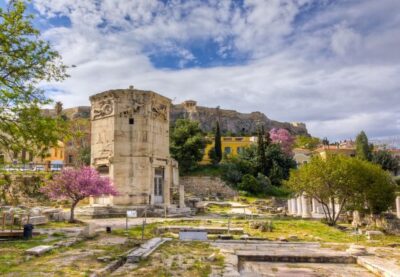
Ancient Agora: Audiovisual self-guided tour with 3D models
Read our review →Browse the lists this tour appears in