
Reviewed · ANCIENT CORINTH TOURS
Ancient Corinth And Corinth Canal Half Day Tour From Athens
The Corinth Canal is the star of this half-day outing. Cut through towering limestone cliffs, it links the Aegean and Ionian Seas and gives you a sharp sense of why this narrow isthmus mattered for both ancient trade and modern shipping. From there, you move into the ruins, museum, fortress, and old transport routes of Corinth.
I like the private vehicle and hotel pickup, which spare you the fuss of arranging buses or rental cars. I also like the freedom to explore at your own pace rather than trail a group behind a guide. The trade-off is important: your English-speaking driver can explain the sights, but is not licensed to guide you inside them. A licensed guide is available for an added fee.
Key points to know before booking
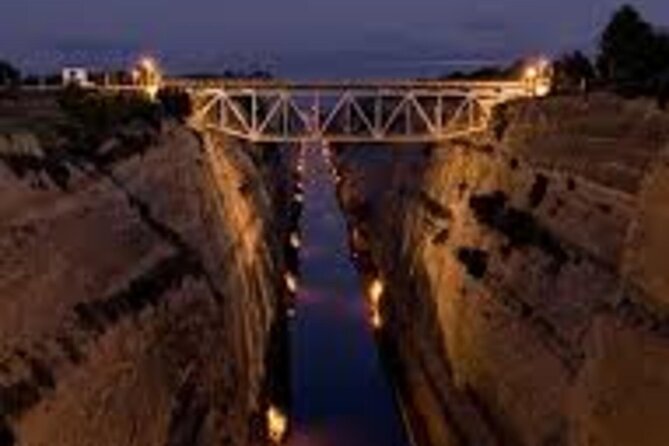
- The Corinth Canal is a quick but dramatic first stop, with about 20 minutes for views and photographs.
- Ancient Corinth receives the most time, about one hour, but the €15 entrance fee for Ancient Corinth and its archaeological museum is extra.
- Akrokorinthos includes admission, though the 30-minute stop may feel short for a large fortress complex.
- You ride privately, in a sedan for one to three people or a minivan for four to seven.
- Early morning is the smart choice, especially if you want cooler conditions and fewer people around the major sites.
- The tour works well from Athens or Piraeus, with airport and Rafina or Lavrio pickup available at an additional cost.
Why Corinth makes a strong half-day trip from Athens
Corinth sits close enough to Athens for a half-day visit, yet it feels like a change of scene. The route takes you across the Corinthian Isthmus, the narrow strip of land joining mainland Greece to the Peloponnese. Here, geography shaped everything: shipping, war, trade, religion, and the growth of one of Greece’s most important city-states.
This tour is built for you if you want to see the major Corinth sights without renting a car. Your driver handles the road and pickup arrangements while you look out at the countryside, the gulf, and the rocky slopes around Akrokorinthos.
The experience lasts about five hours. That sounds generous, but the schedule includes several stops and the drive from Athens in both directions. You should think of it as a well-planned introduction rather than a slow archaeological study. The route gives you a useful overview, but you will need a longer visit if you want to read every inscription, examine every object, or climb extensively at the fortress.
More Ancient Corinth and canal trips:
- From Athens: Ancient Corinth Day Trip with Canal & VR Guide
★ 4.6 · 1,073 reviews - Private Biblical Tour Ancient Corinth & Isthmus Canal from Athens
★ 5.0 · 762 reviews - Athens: Ancient Corinth & Nafplio Full Day Trip with Swim
★ 4.8 · 523 reviews
A private ride that keeps the day simple
Pickup is included from an Athens city-center hotel, apartment, Airbnb, or Piraeus Port. At a hotel, you wait in the lobby. At a private residence, you wait outside the main entrance or building gate. At Piraeus, the driver meets you at the arrival pier or cruise terminal exit.
The driver carries a sign with the lead passenger’s name. Keep the phone number used for booking active, since the driver may need to contact you if there is a delay or trouble finding the pickup point. These are small details, but they matter when you are leaving a hotel before breakfast or stepping off a cruise ship with luggage and fellow passengers around you.
Groups of one to three use a luxury sedan. Groups of four to seven use a minivan. Every vehicle has air-conditioning, Wi-Fi, and bottled water. That setup is particularly useful in warm weather, when the open archaeological sites offer little shade.
Your driver is an English-speaking professional with historical knowledge, but not a licensed guide. This distinction affects the experience. You can ask questions during the drive and get background on what you are seeing, but you should not expect a formal guided talk beside every ruin. If interpretation is central to your visit, request a licensed guide in advance. It costs extra and depends on availability.
One review specifically praised a driver named Paul for his driving and site knowledge. You should not assume Paul will be assigned to your booking, but the comment points to the kind of service this format aims to provide.
The Corinth Canal: a fast lesson in geography and engineering
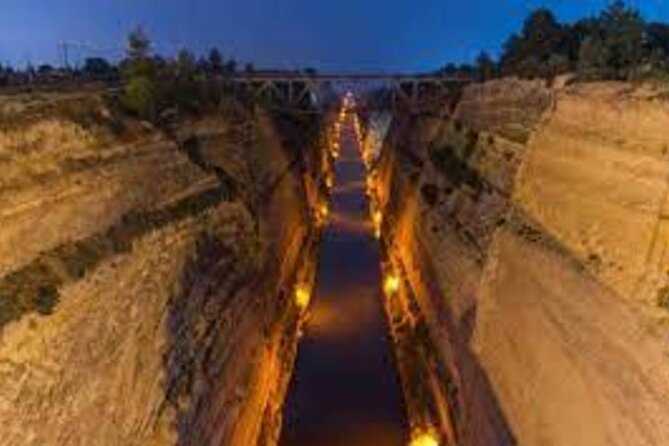
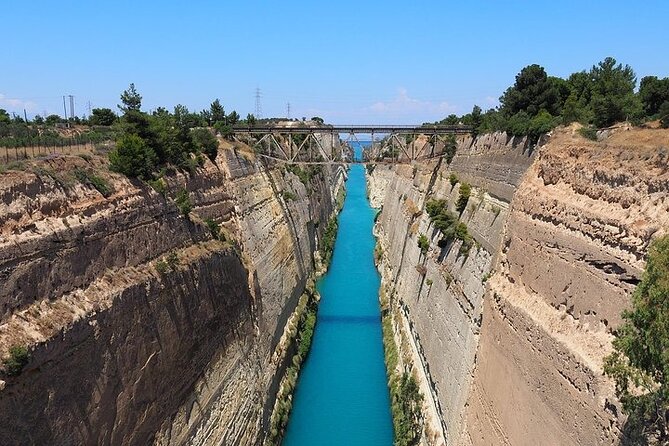
The first stop is the Corinth Canal, usually allotted about 20 minutes. You look down from above at a narrow waterway cut through high limestone walls. The canal connects the Saronic Gulf, leading toward the Aegean, with the Gulf of Corinth, leading toward the Ionian Sea.
The view is powerful because the canal is both natural-looking and clearly made by people. Its steep sides show the scale of the excavation, while the thin strip of water below gives the site its drama. This is the place for quick photographs and a short explanation of why ships once wanted to avoid sailing around the Peloponnese.
The canal’s importance stretches from antiquity to modern times. Ancient rulers and engineers considered ways to cross the isthmus, while the modern canal reshaped maritime travel. You will not spend long here, so arrive ready to look, listen, and take in the scale.
The stop also includes the wider Isthmia area, once a key crossing point in the ancient Greek world. Isthmia was home to the Panhellenic Isthmian Games, which ranked just below the Olympics in prestige. The Sanctuary of Poseidon drew athletes, pilgrims, and city-states to honor the sea god.
The short timing means you should not expect a full archaeological visit at Isthmia. Instead, it gives you a useful connection between the modern canal and the ancient religious and sporting life of the isthmus.
Ancient Corinth and the Temple of Apollo
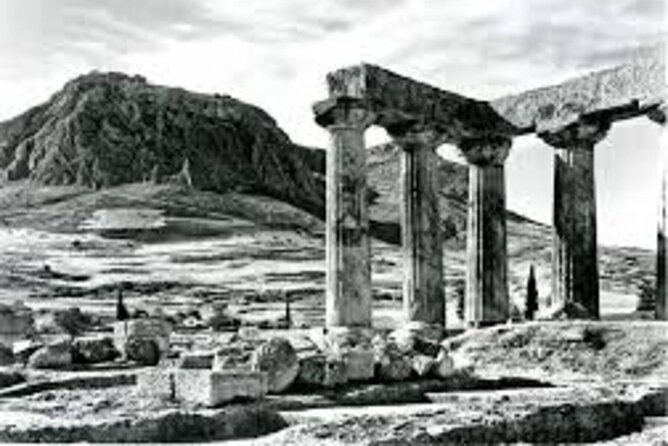
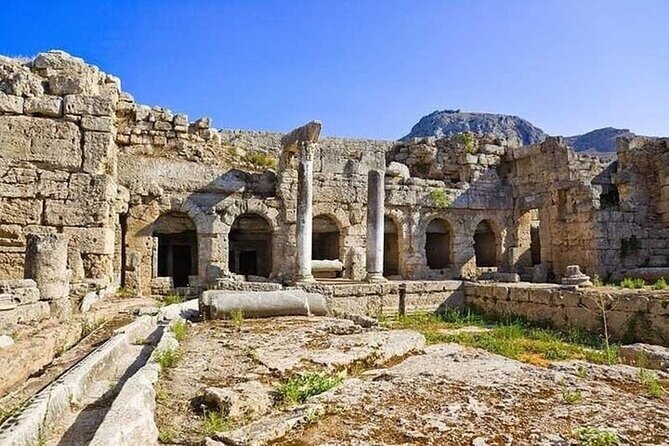
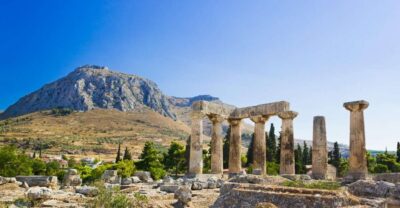
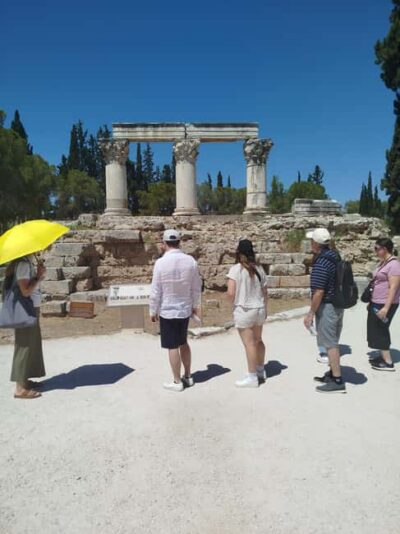
Archaia Korinthos, or Ancient Corinth, is the heart of the visit. You receive about one hour among the remains of the old city, with the Temple of Apollo, the agora, Roman fountains, public buildings, and fragments of the city walls forming the main points of interest.
Corinth was not a small, isolated settlement. It was a major city-state and a crossroads for commerce and culture. Its remains show layers of classical, Hellenistic, and Roman life. As you walk through the site, you can picture the agora as a civic and commercial center, rather than treating the ruins as a collection of unrelated stones.
The Temple of Apollo is the visual anchor. Dating from the sixth century BC, it is one of the important early Doric temples in Greece. Its surviving monolithic limestone columns give you a direct look at the scale and style of early Greek temple building.
The temple is allotted about 20 minutes as a separate stop, followed by about an hour at Archaia Korinthos. In practice, the two parts fit together. You first see the most recognizable remains, then have time to place them within the wider city.
There is one cost to plan for. Entrance to Ancient Corinth and the Archaeological Museum of Corinth is not included. The stated fee is €15 per person, payable directly on the day. This is the main extra expense beyond the tour price, so include it when comparing the total cost.
A different kind of day out from Athens:
- Athens: Acropolis & up to 5 Archaeological Sites Combo Pass
★ 4.4 · 12,619 reviews - Athens: Acropolis Ticket with Optional Audio or Live Guide
★ 4.2 · 11,055 reviews - Athens: Acropolis, Parthenon & Acropolis Museum Guided Tour
★ 4.8 · 9,316 reviews - Athens: Cape Sounion & Poseidon Temple Sunset Half-Day Trip
★ 4.8 · 8,241 reviews
The Archaeological Museum: the context the ruins need
The Archaeological Museum of Corinth is beside the site and receives about 30 minutes. Its displays include sculpture, mosaics, pottery, inscriptions, and everyday objects from prehistoric times through the Roman period.
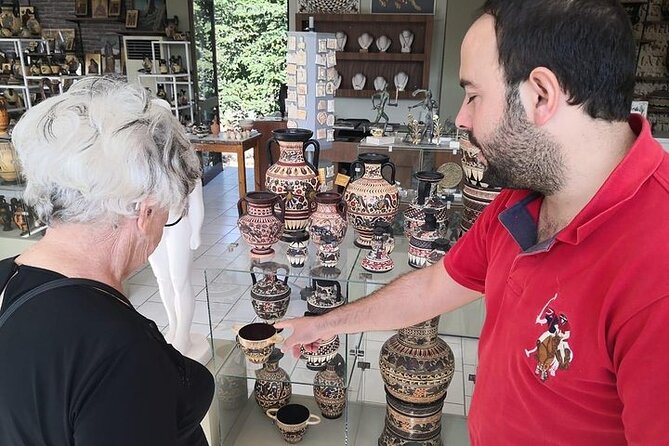
This stop matters because ruins can leave you guessing. The museum gives faces to the gods and emperors, patterns to the floors, and practical objects to the people who lived and worked in Corinth. Roman mosaics are among the listed highlights, along with finds from the agora and nearby sanctuaries.
Thirty minutes is enough for a focused visit, not a thorough museum study. I would use the time to see the Roman mosaics, statues, and the objects tied to daily life and religious practice. If you are especially interested in archaeology, ask your driver about adding a licensed guide and consider arranging a longer private visit instead of trying to absorb everything at speed.
The museum entrance is part of the same €15 Ancient Corinth and museum admission charge. It is not included in the tour price, despite the fact that transportation and certain other admissions are covered.
Akrokorinthos: big views, limited time
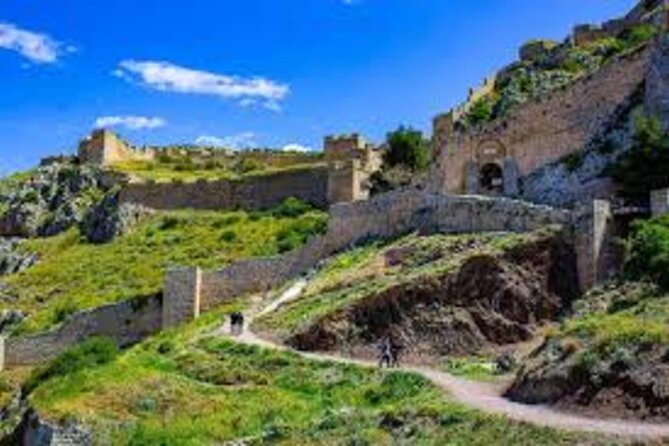
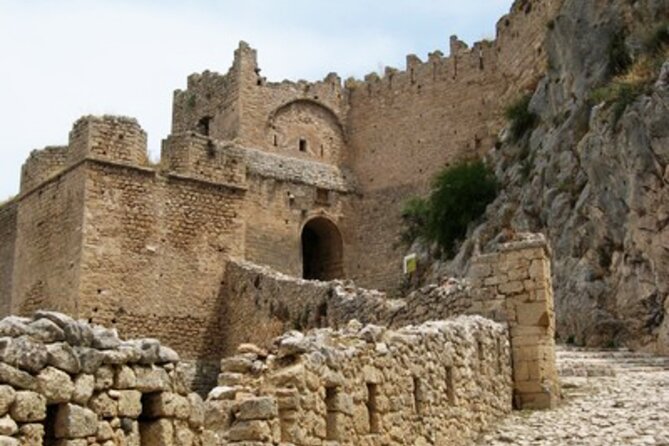
Akrokorinthos rises above Ancient Corinth on a rocky summit. The fortress includes layers of construction by Greeks, Romans, Byzantines, Franks, Venetians, and Ottomans. Its walls and gates tell a long military story, while the height explains why the site mattered.
You receive about 30 minutes here, and admission is included. That is convenient, but the timing is tight for such a large complex. The tour gives you a strong taste of the fortress and its views, not a complete exploration of every path and defensive wall.
The climb and uneven ground are worth taking seriously. The supplied information says most people can participate, but it does not promise a level, easy route. Wear practical shoes and be ready for rocky surfaces. You can see across the Corinthian Gulf, the Peloponnese, and the plains below, so even a short visit can deliver a memorable view.
Ancient worship also shaped this summit. Sacred places dedicated to Aphrodite once stood here, adding a mythological layer to the fortress story. The site is a good example of how Corinth combines military power, religion, and geography in one place.
If you want a long walk around the walls, this tour may feel rushed. If you want the high viewpoint and a quick look at one of Greece’s most imposing strongholds, the 30-minute stop is more useful.
The Diolkos and the practical genius of ancient Corinth
The Diolkos of Loutraki is a rare and unusual stop. Dating to the sixth century BC, this stone-paved roadway allowed ships to be hauled overland across the Isthmus instead of sailing around the Peloponnese.
You can see surviving limestone tracks with grooves made by repeated use. The idea is striking: a ship could be moved between the Aegean and Ionian sides by land. That required planning, labor, and a clear understanding of how much time and danger could be saved.
The Diolkos supported trade, military movement, and communication. It also helps you understand why Corinth became so powerful. The city controlled a narrow but crucial passage, and that control had commercial and strategic value.
The stop lasts about 20 minutes. It is not a large site, so the short visit makes sense. You get a direct look at one of ancient Greece’s most inventive transport solutions, with the modern canal and Gulf nearby.
What the $163.22 price really covers
The listed price is $163.22 per person. That is not a bargain bus outing, but the comparison is not simply ticket price versus ticket price. You are paying for private round-trip transportation, an English-speaking driver, pickup and drop-off, air-conditioning, Wi-Fi, bottled water, and a vehicle reserved for your group.
The value improves for a small group sharing the booking. One to three people travel in a sedan, while four to seven share a minivan. Group discounts may also be available, though the exact saving is not specified. Ask for the current group price before booking.
The tour includes entrance to the Corinth Canal and Akrokorinthos. It does not include the €15 Ancient Corinth and Archaeological Museum admission, lunch, gratuities, or a licensed guide. Airport, Rafina Port, and Lavrio Port pickup cost extra depending on vehicle type.
For a couple or family that values privacy and door-to-door transport, the price can make sense. For a solo visitor focused on keeping costs low, a group excursion may be cheaper. The private format earns its keep through convenience and flexibility, not through a packed list of included admissions.
Timing, meals, and how to make the day work
The tour runs about five hours, with the listed stops taking roughly three hours in total. The remaining time covers driving and transitions. Lunch is not included, and the schedule does not list a dedicated meal stop.
Eat before departure or plan to ask the driver about practical timing. Do not count on a relaxed restaurant meal during the five-hour route. Bottled water is supplied, but you may want additional water for walking around the ruins, especially in warm weather.
The advice to go early is sound. An early start can help you enjoy the sites with fewer people around, and it gives you a better chance of avoiding the strongest midday heat. The one published experience specifically recommends an early morning departure for more personal time at the sites.
The tour is private, so only your group participates. That gives you a better chance of asking for a brief pause, clarifying a question, or adjusting the pace within the fixed half-day frame. Still, the route covers several places, so major changes may not be possible.
Who should book this Corinth tour?
I would choose this tour if you are staying in Athens, arriving at Piraeus, or taking a cruise and want Corinth without handling the roads yourself. It suits couples, families, and small groups that place a high value on private transport and a simple pickup.
It also fits you if you want a broad introduction to Corinth: canal, ancient city, museum, fortress, sacred sites, and Diolkos. The range is the main strength. In five hours, you see how geography, religion, trade, and defense shaped the area.
I would hesitate if you want a slow archaeological day or a formal lecture at every stop. The driver is not a licensed site guide, and some visits are brief. Add the licensed guide if interpretation matters, and remember that the main archaeological admission is extra.
The tour has a 4.7 rating from seven reviews, with one especially positive account praising Paul and urging an early start. That is a small sample, so I would treat it as a useful signal rather than a guarantee of a particular driver.
Should you book it?
Book this private Corinth tour if you want efficient transportation, a flexible private setting, and a wide mix of ancient sites in one morning or afternoon. The Corinth Canal and Akrokorinthos provide the drama, while Ancient Corinth and its museum supply the substance.
Skip it if your priority is the lowest possible cost, a long lunch, or an unhurried archaeological study. Before paying, add the €15 site and museum fee, check any port or airport surcharge, and request a licensed guide if you want formal interpretation. For the right small group, it is a practical way to connect Athens with one of Greece’s most important historic crossroads.
FAQ
How long does the Ancient Corinth and Corinth Canal tour last?
The tour lasts approximately five hours.
Where does pickup take place?
Pickup is included from Athens city-center hotels, Airbnb residences, and Piraeus Port. Airport, Rafina Port, and Lavrio Port pickup are available for an additional cost depending on the vehicle type.
Is transportation private?
Yes. Only your group participates. Groups of one to three use a sedan, while groups of four to seven use a minivan.
Is an English-speaking guide included?
An English-speaking driver is included. The driver has historical knowledge but is not licensed to accompany you inside the archaeological sites. A licensed guide can be requested for an extra cost, subject to availability.
Is Ancient Corinth admission included?
No. Entrance to Ancient Corinth and the Archaeological Museum costs €15 per person and is paid directly on site.
Which entrance fees are included?
Admission to the Corinth Canal and Akrokorinthos is included. Ancient Corinth and its archaeological museum are not included.
Is the Corinth Canal part of the tour?
Yes. The tour includes a visit of about 20 minutes to the Corinth Canal and the Isthmia area.
Is lunch included?
No. Lunch is not included in the tour price.
Does the vehicle have air-conditioning and Wi-Fi?
Yes. The vehicles have air-conditioning and Wi-Fi, and bottled water is provided.
Can I cancel for a full refund?
You can cancel at least 24 hours before the experience start time for a full refund. Cancellations made less than 24 hours in advance are not refunded, and changes within that period are not accepted.
Newly reviewed around Athens
- Athens: workshop for painting landscape with local artist★ 4.6 · 3 reviews
- Athens: Greek Wine & Olive Oil Tasting at Brettos Plaka★ 4.5 · 3 reviews
- Outdoor Yoga and Pilates with Akropolis view★ 4.0 · 5 reviews
- Acropolis of Athens: 60′ Tour in a Vintage Motorcycle★ 5.0 · 4 reviews
- Ultimate Tasting of the Volcanic Wines of Greece★ 5.0 · 3 reviews
- workshop for painting acropolis/landscape with local artist★ 5.0 · 3 reviews
- Athens at Twilight Night Tour with Drinks and Meze Dishes★ 4.8 · 4 reviews
- Breakfast in the markets with olive oil and honey tasting★ 4.8 · 8 reviews
Ancient Corinth Tours, compared.
Ancient Corinth Day Trip with Canal & VR Guide
Read our review →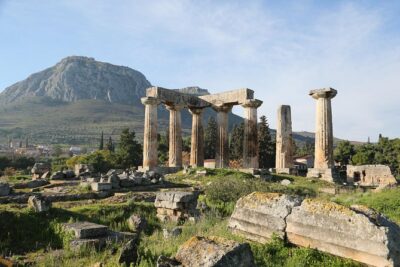
Private Biblical Tour Ancient Corinth & Isthmus Canal from Athens
Read our review →
Ancient Corinth & Nafplio Full Day Trip with Swim
Read our review →
Private Tour of Apostle Paul’s Footsteps in Ancient Corinth
Read our review →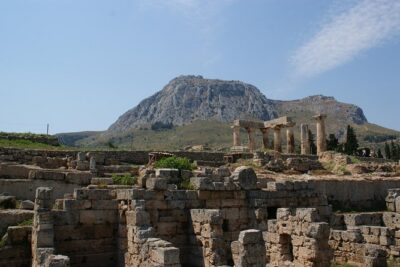
Corinth Half-Day Trip from Athens with Entrance Tickets
Read our review →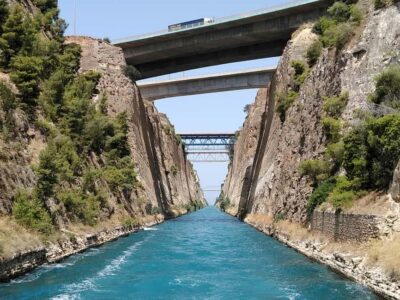
Browse the lists this tour appears in