
Reviewed · ATHENS ACROPOLIS TOURS
Acropolis and Agora Tour: The Rise & Fall of Democracy
The clever idea here is to see Athens not just as a collection of old stones, but as the setting for an experiment in democracy. You move from the Acropolis, where civic pride was carved in marble, to the Ancient Agora, where citizens debated, traded, judged, and governed. The political theme gives familiar monuments a sharper purpose.
I like the small maximum of 15 people and the chance to ask questions without shouting across a crowd. I also like the mix of mythology, archaeology, theater, and political history, along with the useful ancient Athens map. The main caution is time: the advertised visit is about three hours, while several similar outings with this provider have run closer to four, and some stops may feel brief.
Key points to know
- Democracy is the main thread: The Parthenon and Agora are explained as parts of Athenian public life, not isolated ruins.
- Small groups keep the visit personal: The maximum is 15 people, with guides such as Athena, Demi, Christina, Kimon, and Vassia named in the tour feedback.
- Seven major sights fit into one morning: You see the Acropolis, Parthenon, Theater of Dionysus, several temples, and the Ancient Agora.
- Entry costs are separate: The tour price is $67.43 per person, plus €50 for attraction admission if tickets are pre-purchased.
- The walk ends in the Agora: You finish near one of Athens’ most important archaeological sites, not back at the starting point.
- Bring only what you need: Backpacks, large bags, and strollers are not allowed at the Acropolis.
Why democracy makes the Acropolis more interesting
Most people first meet the Acropolis through the Parthenon. It is the giant marble landmark on the hill, and it can be hard to see beyond the famous columns and postcard views. This tour gives you another way in.
The Acropolis was the great sanctuary of Athens, dedicated mainly to Athena, the city’s patron goddess. Its buildings also expressed the power and confidence of the city at the height of its influence. That creates a useful tension for the tour’s theme: Athens developed democratic government for some citizens while also building monuments that proclaimed civic power and military success.
I like that the experience links the political world below with the sacred and symbolic world above. You are not simply asked to admire the Parthenon. You are encouraged to consider what kind of city could produce it, who had a voice in that city, and how the democratic system later weakened and fell.
The central story is not a simple celebration of democracy. It is a rise-and-fall story. The supplied description promises attention to both parts, though a three-hour schedule may limit how fully the guide can explain the later decline. If the political question matters most to you, ask your guide early to leave room for it.
More ways to see the Acropolis:
- Athens: Acropolis & up to 5 Archaeological Sites Combo Pass
★ 4.4 · 12,619 reviews - Athens: Acropolis Ticket with Optional Audio or Live Guide
★ 4.2 · 11,055 reviews - Athens: Acropolis, Parthenon & Acropolis Museum Guided Tour
★ 4.8 · 9,316 reviews
Starting at 9:00 am beside the Acropolis

The meeting point is Dionysiou Areopagitou 45, near the Acropolis, with a 9:00 am start. You finish at the Ancient Agora in central Athens. There is no transfer to or from the meeting point, so you need to arrange your own way there and away afterward.
Starting in the morning is sensible. Athens can be hot, and the Acropolis includes sloping, uneven walking surfaces with limited shade. The exact tour length is listed as approximately three hours, but accounts of visits with this company describe four-hour versions as well. Plan your morning around a generous window rather than scheduling a tight lunch, museum booking, or ferry departure immediately afterward.
The group limit is 15. That is small enough for questions and personal attention, but it is not a private tour. You will still need to stay close to the guide, especially in busy areas around the Acropolis.
The Acropolis: a city’s sacred center
The first major stop receives about an hour. The Acropolis includes several monuments, so this part is less a single sight than a guided look at the sacred hill as a whole.
You should expect attention to the Parthenon, Temple of Athena Nike, Erechtheion, Propylaea, and Theater of Dionysus. These buildings were created for different purposes, but together they show how religion, public identity, art, and power worked together in ancient Athens.
The Acropolis is also the point where the tour’s mythological side can take hold. Athena was not an abstract symbol to the ancient Athenians. She was the city’s patron, and the monuments honored her protection and the city’s success. Guides on this tour have been praised for connecting mythology with archaeology and political history, which is useful if you want more than a list of construction dates.
Admission is not included in the tour price. You can arrange for the operator to pre-purchase entry, but the listed fee is €50 per person. The information also says entry fees are non-refundable and non-exchangeable, so check your plans before accepting that option.
Theater of Dionysus: where drama became public life
The Theater of Dionysus receives about 15 minutes. That is short, but the site deserves a focused explanation.
Dionysus was associated with wine and the grape harvest, and the theater was the oldest founded in Athens. This is where works by Aeschylus, Sophocles, Euripides, and Aristophanes were first performed. Those plays were not merely private entertainment. Theater formed part of civic life, and performances could question leaders, expose human folly, and make citizens think about justice and responsibility.
This is one of the tour’s most appealing links between culture and democracy. Athenian public life did not happen only in council spaces. It also happened through stories performed before a large audience.
With only 15 minutes, you will not get a full lecture on Greek drama. Still, a good guide can use the theater to show that political thought was carried through plays as well as speeches and votes. If this stop interests you, keep your own questions ready.
More Ancient Agora and Kerameikos walks:
- Athens: Agora and Hephaistos Temple Entrance Ticket
★ 4.0 · 449 reviews - Athens: Ancient Agora E-Ticket and Audio Tour
★ 3.9 · 413 reviews - Athens: Kerameikos Stone House Cooking Class
★ 5.0 · 165 reviews - Athens: Roman Agora & Ancient Agora E-ticket & 2 Audio Tours
★ 4.1 · 107 reviews
Temple of Athena Nike: victory with a local address
The Temple of Athena Nike is another 15-minute stop. It honored Athena in her victorious form, combining the city’s patron goddess with Nike, the goddess of victory.
The small temple’s story fits the political theme neatly. Athens wanted protection, success in war, and a clear public identity. The tradition that the cult statue had no wings suggested that victory would remain in Athens rather than fly away.
This is a compact stop, so it works best as a symbol rather than a long architectural study. You will hear how religious belief supported civic confidence and military ambition. That also helps explain why the Acropolis was more than a place of worship. It was a public statement about Athens and its place in the Greek world.
Erechtheion: sacred stories in an unusual building
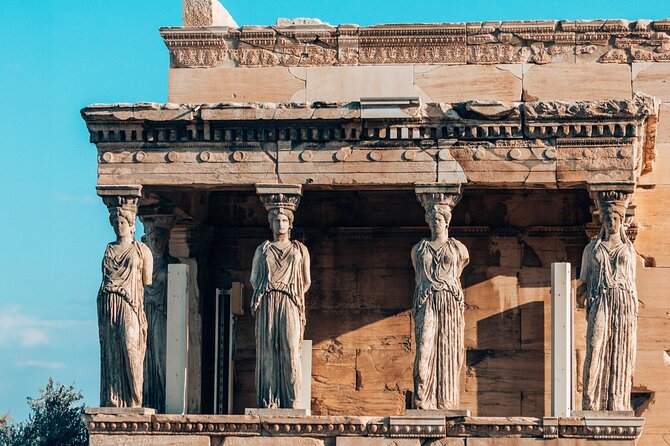
The Erechtheion is allotted 15 minutes. It was built to house an ancient wooden cult statue of Athena and to honor the city at the height of its power.
Its importance comes partly from the many sacred associations tied to the Acropolis. The building is also less straightforward in form than the Parthenon, which makes it a good reminder that ancient Greek architecture was not all about one clean row of columns.
Your guide may connect the Erechtheion to the myths and rituals that helped Athenians understand their city. This is where a guide’s storytelling ability matters. Several guides associated with this experience have been praised for clear explanations, good humor, and adapting their talks to different interests. You should expect interpretation rather than a silent walk from monument to monument.
The Parthenon: marble, power, and civic pride
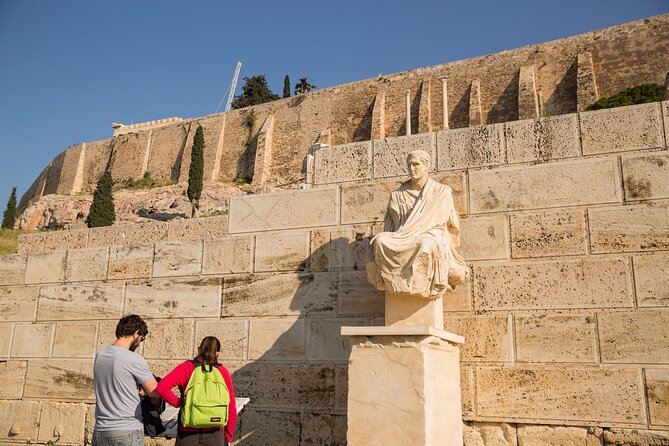
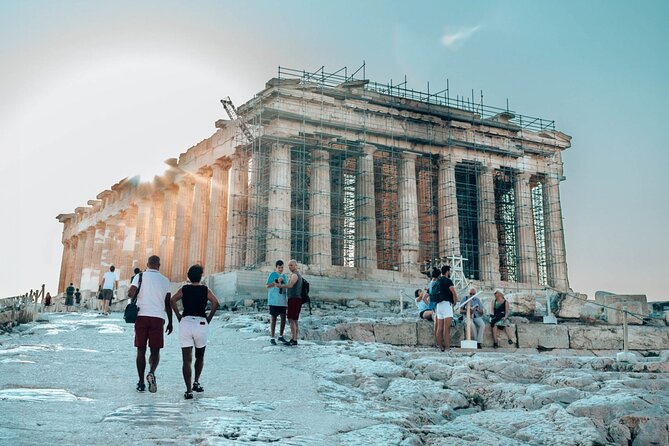
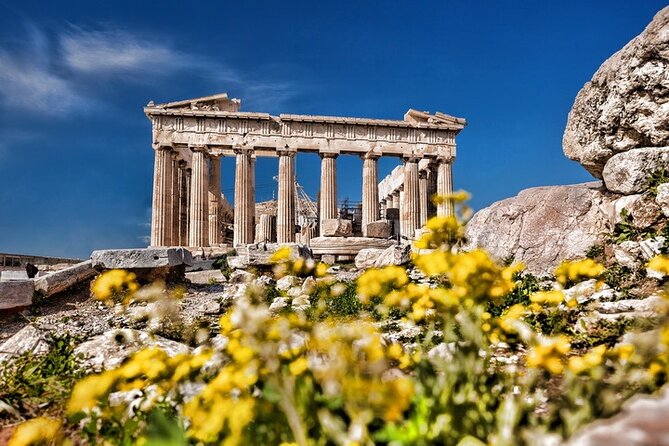
The Parthenon receives about 30 minutes, the longest single monument stop in the Acropolis portion. Built in the mid-5th century BCE, it was dedicated to Athena Parthenos, or Athena the Virgin.
The temple is often described as the high point of the Doric order, one of the main forms of Classical Greek architecture. You will see why the building has such lasting influence, even while dealing with crowds and the distance between modern visitors and its original religious purpose.
I like that this tour asks you to read the Parthenon politically. The building was a statement about Athens’ wealth, confidence, military position, and devotion to its patron goddess. It also raises questions about democracy itself. Monumental projects require money, labor, political control, and public agreement, or at least public acceptance.
Thirty minutes is enough for a strong overview. It is not enough for every architectural detail, every myth, and a full account of the building’s later history. If you already know the basics, use your questions to steer the guide toward the democratic angle.
Walking down to the Ancient Agora

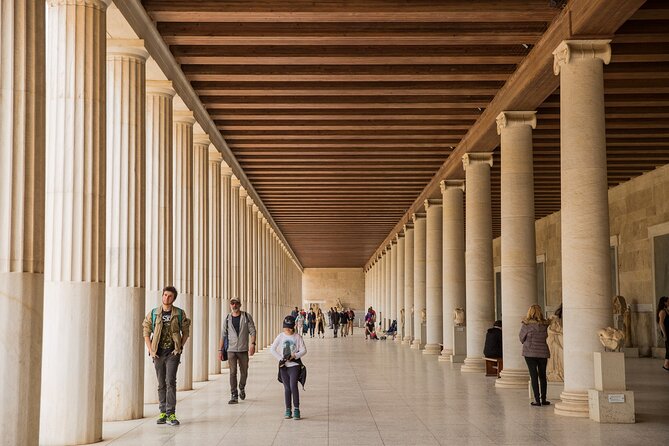
The tour ends at the Ancient Agora after moving through the Acropolis sights. The Agora was the heart of ancient Athens, serving political, commercial, administrative, social, religious, cultural, and legal roles.
This change of setting is the best part of the route. On the Acropolis, you see the city’s public image and sacred center. In the Agora, you get closer to the daily machinery of civic life. This was where public business, trade, discussion, and justice came together.
The democratic idea becomes more concrete here. Instead of treating democracy as a modern word attached to ancient ruins, you can connect it with places where Athenians conducted public affairs. The tour’s title promises the rise and fall of democracy, and the Agora is the natural place to discuss how that system worked and who was excluded from it.
The official schedule gives the Agora about 30 minutes. That may be enough for the key story, but it is the part I would most like to have expanded. The Agora is broad, and its importance is not always obvious at first glance. A guide can make the difference between seeing a field of foundations and understanding a functioning civic center.
The Temple of Hephaestus and the final stop
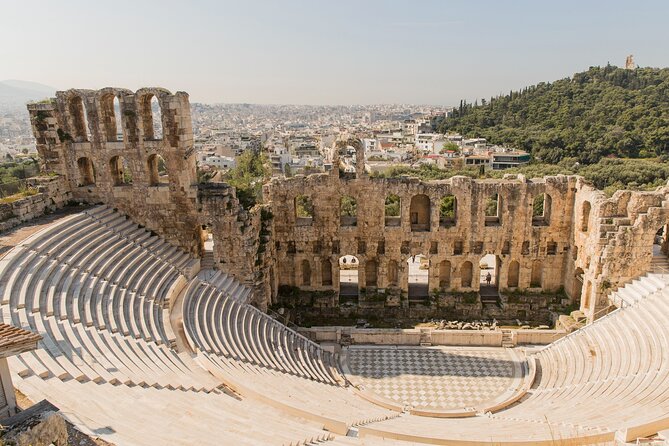
The final stop is listed as the Temple of Aries, while the description identifies the magnificent Temple of Hephaestus. It is described as one of the best-preserved ancient temples in the world.
The temple was linked with Hephaestus, protector of metalworkers, and Athena Ergani, who protected potters and cottage industries. That connection adds a practical, working-class side to the tour. Athens was not only philosophers, generals, and politicians. It was also a city of craftspeople, merchants, shop owners, and skilled labor.
You receive about 15 minutes here. That is enough to understand why the temple matters and to appreciate its preservation. It also gives the tour a fitting finish: after discussing government and civic ideals, you end with the trades and everyday work that kept the city running.
What the $67.43 price really includes
The tour costs $67.43 per person. That covers an expert certified guide, the small-group format, and a fun map of ancient Athens. It does not cover meals, transfers, or admission to the attractions.
The separate admission cost is important. The operator can pre-purchase tickets for you for €50 per person, but you should treat that as an additional expense, not part of the headline price. Since the entry fees are non-refundable and non-exchangeable, be certain of your date before using that service.
The value depends on how much structure you want. If you only need access to the Acropolis and Agora, a guided visit may cost more than arranging entry yourself. If you want the sites tied together through democracy, mythology, theater, and archaeology, the guide is the main reason to pay.
The small group also matters. A maximum of 15 is not the same as a private guide, but it is far more manageable than a large coach group. The provided map is a modest extra, yet it can help you remember how the ancient city was arranged after the walk ends.
Guide style, headsets, and standing time
The strongest praise for this experience centers on the guides. Athena, Demi, Christina, Kimon, and Vassia are specifically named in the available feedback. Their strengths include clear explanations, humor, patience, professional timing, and the ability to adjust the discussion to the group.
One account specifically liked the remote headsets. Another noted a lack of earphones and found it hard to hear in noisy areas. Equipment may vary, so do not assume every departure will use headsets. If you have trouble hearing, stay near the guide and speak up early.
There is also a physical point to consider. The visit includes a lot of standing on archaeological ground, and one account found the listening stops tiring. The group may walk between sites, but you should expect uneven surfaces and periods of standing while the guide explains a monument. Comfortable shoes are a practical choice.
Most people can take part, and the tour is near public transportation. Strollers, backpacks, and big bags are not allowed at the Acropolis, so bring as little as possible. An ID card or passport is required for people under 25 if they want to seek possible discounts.
Who should book this Athens tour
I would choose this experience if you want the Acropolis explained as part of a living political story. It suits first-time visitors who want a clear framework, history fans who like connections between buildings and institutions, and curious families or small groups who prefer questions over a memorized speech.
It is also a good fit if you want to see both the Acropolis and Agora in one morning without arranging separate guides. The route gives you the famous monuments, but its real value is the link between the sacred hill, theater, civic center, and working city.
I would be more cautious if you want a slow architectural study of every building. The schedule is tight, several stops last only 15 minutes, and the advertised three hours may not leave enough time for every question. If your top priority is a detailed discussion of the fall of democracy, ask how much time the guide expects to spend on that theme.
Should you book the Acropolis and Agora Tour?
Book it if the idea of democracy gives the Acropolis more meaning for you. The combination of a small group, strong guide focus, and a route ending in the Agora creates a thoughtful morning rather than a simple monument checklist.
Before booking, budget for the extra €50 entry fee, leave room for a possible four-hour visit, and travel light. If you want a brisk, well-framed introduction to Athens with mythology, theater, civic life, and famous architecture in one route, this is a good choice. If you prefer lingering at each ruin or exploring alone, buy the tickets separately and set your own pace.
FAQ
How long does the Acropolis and Agora Tour last?
The advertised duration is approximately three hours. Some versions of the visit have lasted about four hours, so leave extra time after the scheduled finish.
What time does the tour start?
The tour starts at 9:00 am.
Where does the tour begin and end?
It begins at Dionysiou Areopagitou 45, Athens 117 42, near the Acropolis. It ends at the Ancient Agora of Athens, Athens 105 55.
Are attraction entry fees included?
No. Entry fees are separate. The operator can pre-purchase tickets for €50 per person.
How many people are in the group?
The tour has a maximum of 15 participants.
Is the tour offered in English?
Yes. English is the listed language.
Are meals or transportation included?
No. Meals and transfers to or from the meeting point are not included.
What happens if the weather is poor or the minimum group size is not met?
If poor weather or an insufficient number of participants causes cancellation, you can choose a different date or experience, or receive a full refund. You can also cancel for a full refund if you do so at least 24 hours before the start time.
Newly reviewed around Athens
- Athens: workshop for painting landscape with local artist★ 4.6 · 3 reviews
- Athens: Greek Wine & Olive Oil Tasting at Brettos Plaka★ 4.5 · 3 reviews
- Outdoor Yoga and Pilates with Akropolis view★ 4.0 · 5 reviews
- Acropolis of Athens: 60′ Tour in a Vintage Motorcycle★ 5.0 · 4 reviews
- Ultimate Tasting of the Volcanic Wines of Greece★ 5.0 · 3 reviews
- Breakfast in the markets with olive oil and honey tasting★ 4.8 · 8 reviews
- workshop for painting acropolis/landscape with local artist★ 5.0 · 3 reviews
- Athens at Twilight Night Tour with Drinks and Meze Dishes★ 4.8 · 4 reviews
Athens Acropolis Tours, compared.
Acropolis & up to 5 Archaeological Sites Combo Pass
Read our review →
Acropolis, Parthenon & Acropolis Museum Guided Tour
Read our review →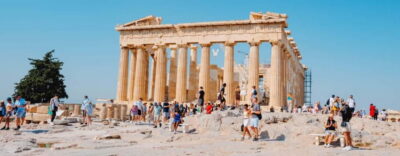
Acropolis, Parthenon & Acropolis Museum Guided Tour
Read our review →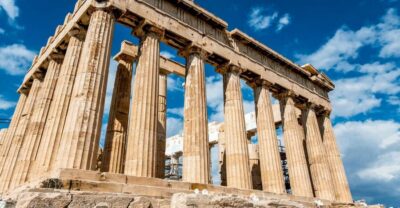
Acropolis monuments & Parthenon Walking Tour with Optional Acropolis Museum
Read our review →Browse the lists this tour appears in