
Reviewed · ANCIENT AGORA TOURS
Ancient Agora: Audiovisual self-guided tour with 3D models
The Ancient Agora was not simply a marketplace. It was the civic center of Athens, where trade, courts, worship, administration, and the early work of democracy all met in one open area. This self-guided Culture App tour helps you connect the scattered ruins to that larger story through 3D reconstructions and 360-degree views.
I like the freedom to use the guide before, during, or after your visit, and I like the unusually broad coverage: written and audio material for 16 monuments, plus models, videos, and panoramic views for most of the key sites. The main drawback is that you must bring your own charged smartphone and earphones, and the €10 entrance fee is not included.
Key points to know before you go

- See Athens’ first democratic center: Learn how the Agora served political, legal, commercial, and religious life.
- Rebuild vanished monuments: Fourteen sites include 3D models, immersive videos, and 360-degree views.
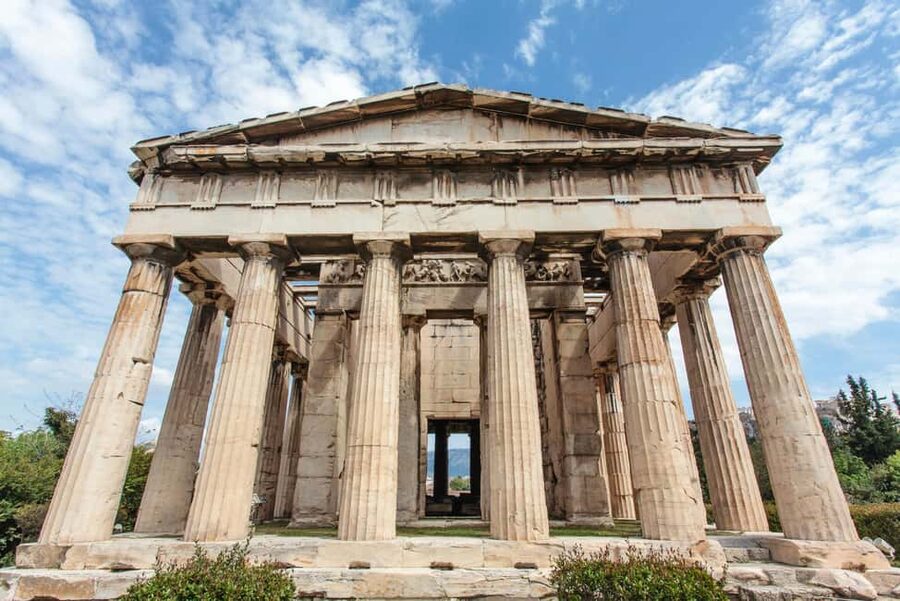
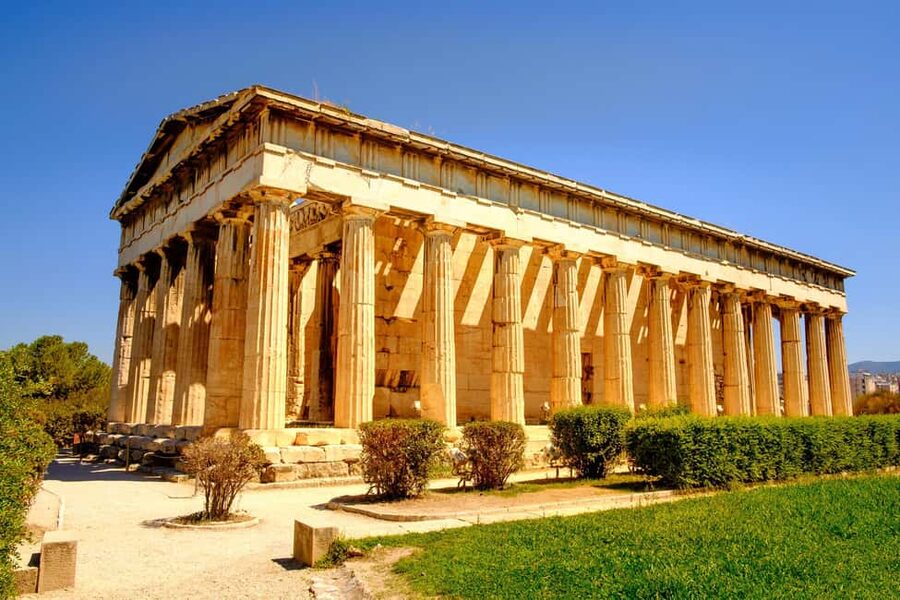
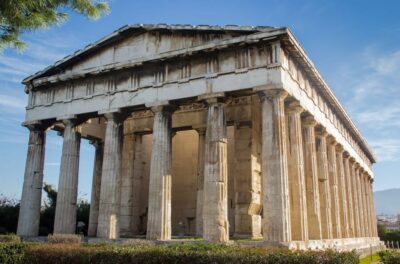
- Visit the Temple of Hephaistos: This remarkably well-preserved temple is one of the major sights inside the Agora.
- Use the guide on your schedule: Content remains valid for five days after first activation.
- Choose from eight languages: Audio is available in English, Greek, German, Spanish, Italian, French, Dutch, and Chinese.
- Plan for a separate ticket: Admission costs €10 full price or €5 at the reduced rate.
Why the Ancient Agora matters
If the Acropolis represents the grand public face of Athens, the Ancient Agora shows how the city worked day to day. This was the center for buying and selling goods, meeting friends, conducting official business, holding religious events, and settling legal disputes.
Most important, it was a place where citizens took part in public life. The idea of democracy was established here for the first time in world history, making the site more than a collection of broken columns. As you walk between the remains, the guide helps you picture the civic machinery that once filled this open space.
That context matters because the ruins can otherwise feel scattered. A wall here, a foundation there, and a few surviving columns do not always explain themselves. The app gives each monument a role in the wider city, so you can understand how temples, stoas, courts, fountains, workshops, and administrative buildings fit together.
I would not treat this as a simple audio narration that tells you what to look at and then moves on. Its combination of text, sound, images, videos, and digital reconstruction is aimed at helping you imagine buildings that survive only in fragments.
More Ancient Agora and Kerameikos walks:
- Athens: Agora and Hephaistos Temple Entrance Ticket
★ 4.0 · 449 reviews - Athens: Ancient Agora E-Ticket and Audio Tour
★ 3.9 · 413 reviews - Athens: Kerameikos Stone House Cooking Class
★ 5.0 · 165 reviews
What you will explore inside the Agora
The guide identifies 16 monuments on an integrated map. That map is useful because the Agora contains several remains, and a first visit can otherwise become a slow search for the right ruin.
Each of the 16 monuments has written historical information and audio information. You can read along, listen through earphones, or switch between the two. That flexibility is helpful if you want a quick overview at one stop and a longer explanation at another.
Fourteen monuments also include 3D models, 360-degree panoramic views, and immersive videos. These digital elements are most valuable when the physical remains are hard to read. A 3D model can show the scale and shape of a building, while a panoramic view can help you understand where it sat in relation to the rest of the Agora.
Thirteen monuments include related stories. These extra pieces can add background beyond the basic identification of a structure. You also receive a gift collection of 68 written and audio pieces about culture and facts in ancient Greece. That material can be useful if you want to continue learning after leaving the site.
The Temple of Hephaistos and the clearest surviving monument
The Temple of Hephaistos is the visual centerpiece of the visit. It is described as one of Greece’s finest preserved ancient monuments, and it gives you a much clearer sense of a classical temple than the more damaged remains elsewhere in Athens.
The app’s reconstructions and panoramic views are particularly useful here, even though the temple itself remains the strongest physical attraction. You can use the digital material to place the building within the Agora and to understand how a temple related to the other public spaces around it.
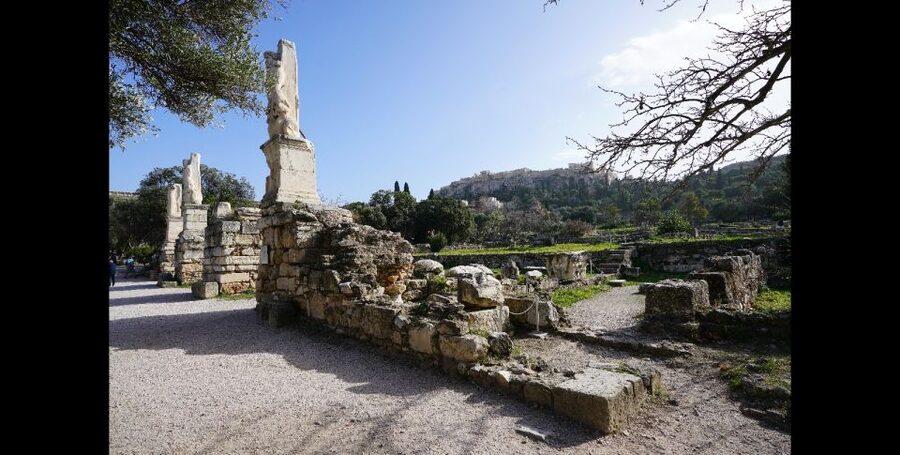
Do not rush past the surrounding remains after seeing the temple. The appeal of the Agora lies in the contrast between the intact monument and the fragmentary foundations nearby. The guide helps bridge that gap, showing you what the less complete structures may have looked like and what jobs they performed.
Democracy, courts, and daily business
The Agora’s political importance is one of the main reasons to choose this tour. The guide covers the area as the place where democracy was first established, but it also explains the ordinary systems that made civic life possible.
You can learn about the seat of civil administration, courts, stoas, fountains, and workshops. These were not decorative additions. They supported the work of government, law, trade, and social life.
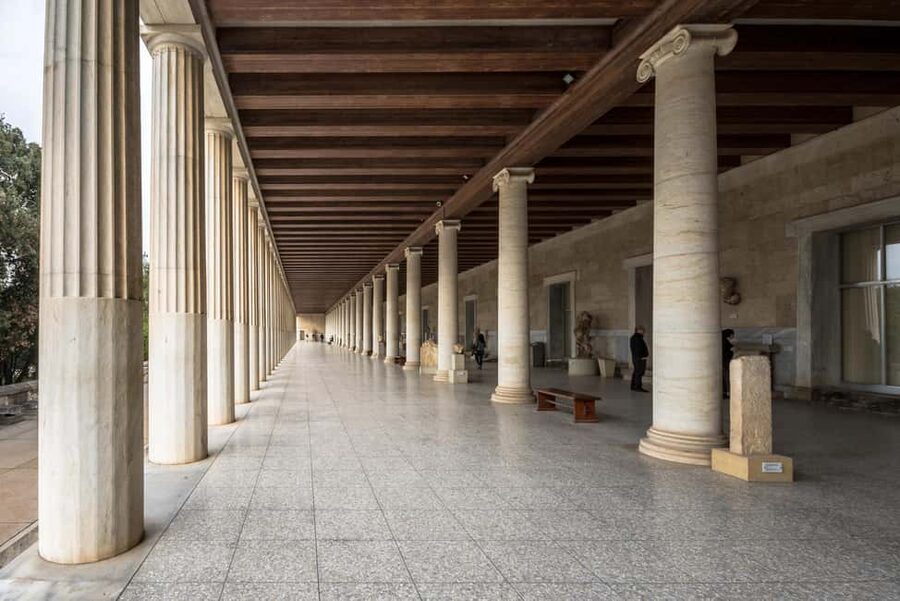
The stoas deserve attention because covered public buildings could serve several purposes at once. They offered space for meeting, commerce, and civic activity. The app’s visual material can help you picture these structures as active public places rather than isolated rows of columns.
The courts and administrative buildings also give the Agora a practical edge. This was where decisions were made and disputes handled, not only where citizens gathered for festivals. I like that the tour presents the site as a working center of the city instead of reducing it to a backdrop for famous philosophers.
More self-guided audio tours in Athens:
- Athens: Cape Sounio & Poseidon Temple Trip with Audio Guide
★ 4.4 · 4,521 reviews - Athens: Acropolis Ticket with Audio Guide
★ 4.0 · 3,575 reviews - Athens: Acropolis Museum Ticket with optional Audio Guide
★ 4.4 · 2,652 reviews - Athens: Acropolis Ticket & Optional Self-Guided Audio Tours
★ 4.1 · 2,542 reviews
Socrates and the philosophers
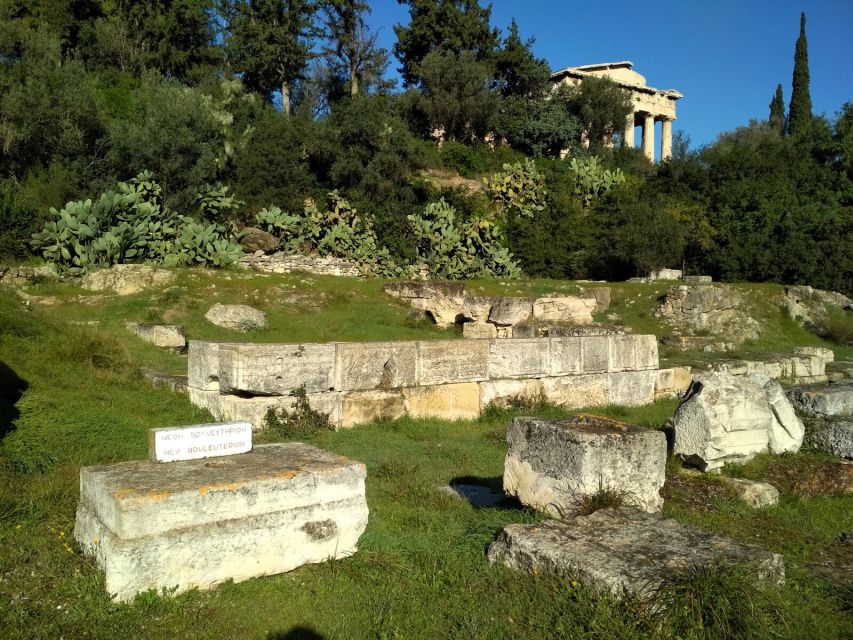
The Ancient Agora is closely tied to the world of Socrates and other philosophers. The tour points you toward places where philosophers taught and discussed ideas, linking the physical site to Athens’ intellectual life.
This part of the experience works best if you pause and imagine the Agora as a place of conversation. Philosophical teaching did not happen in a sealed classroom in the modern sense. It was connected to the streets, public spaces, civic arguments, and daily encounters of the city.
The app’s audio and related stories give you a way to take in this material without standing over a small information panel. You can listen at your own pace, then return to the written text if you want names or details to stick.
Why the digital features are useful
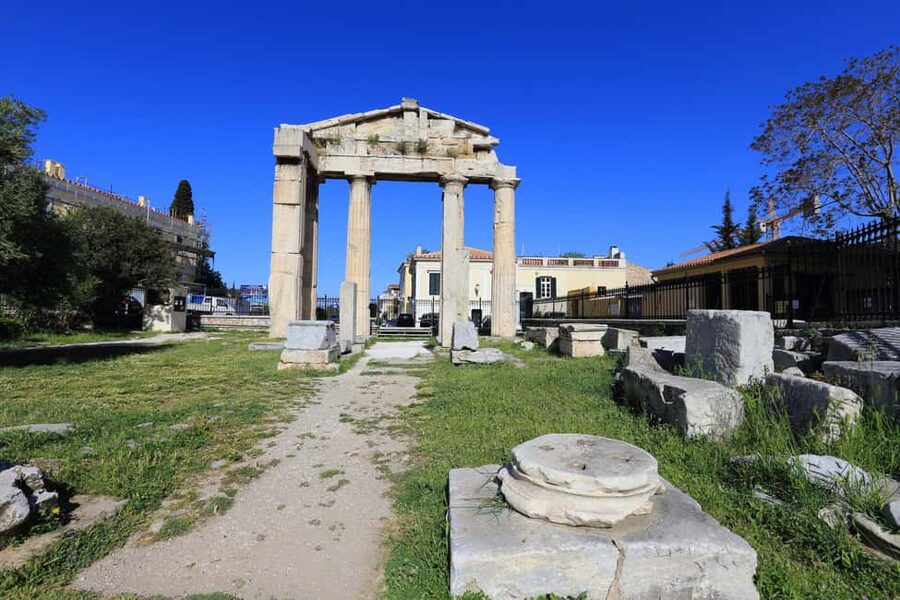
A self-guided app can be little more than a list of facts. This one offers several visual tools that give it more purpose.
The 3D models are useful for rebuilding missing architecture. They can help you see roofs, walls, columns, and proportions that are no longer complete.
The 360-degree views help you look around from the position of a monument. That is valuable at a site where orientation matters. You can better understand how the buildings related to one another and how the Agora formed one connected civic area.
The immersive videos provide another way to see the monuments. They may suit you if you prefer moving images to long blocks of text. The written and audio options remain important, though, since you may want to use the guide in different ways at different points.
You should download the content over Wi-Fi before arriving. Internet access is required for the tour to work effectively, and downloading in advance reduces your dependence on a mobile signal or data plan. The content needs about 200MB of storage.
Five days of access gives you room to plan
The tour is valid for five days from first activation. That is a useful feature if you do not want to rush through the Agora in one session.
You can use the content before visiting to learn the basic layout and choose the monuments you most want to see. At the site, you can listen and explore the map. Afterward, you can return to the material for another look at the 3D models, stories, or audio sections.
The guide can also be used anywhere and anytime, before, during, or after your visit. That flexibility makes it different from a fixed group tour. You do not need to keep up with a guide or follow a set timetable, but you also do not receive live answers to questions.
Price and what you still need to pay

The app costs $7.89 per person. That price covers the audiovisual content, but not entry to the archaeological site.
The entrance fee is €10 at the full rate and €5 at the reduced rate. You should include both costs when comparing this with a guided visit. The app is a relatively low-cost way to add structure and explanation, especially if you prefer exploring alone.
The value depends on how much you use the material. If you listen to only a few short sections, the price may feel less useful. If you work through the map, monument descriptions, models, panoramic views, and extra Greek culture content, the five-day access period gives you more room to get your money’s worth.
There is no guide service, transportation, food, or drink included. You arrange your own way to the Agora and handle your own visit once inside.
Practical preparation for the phone-based tour
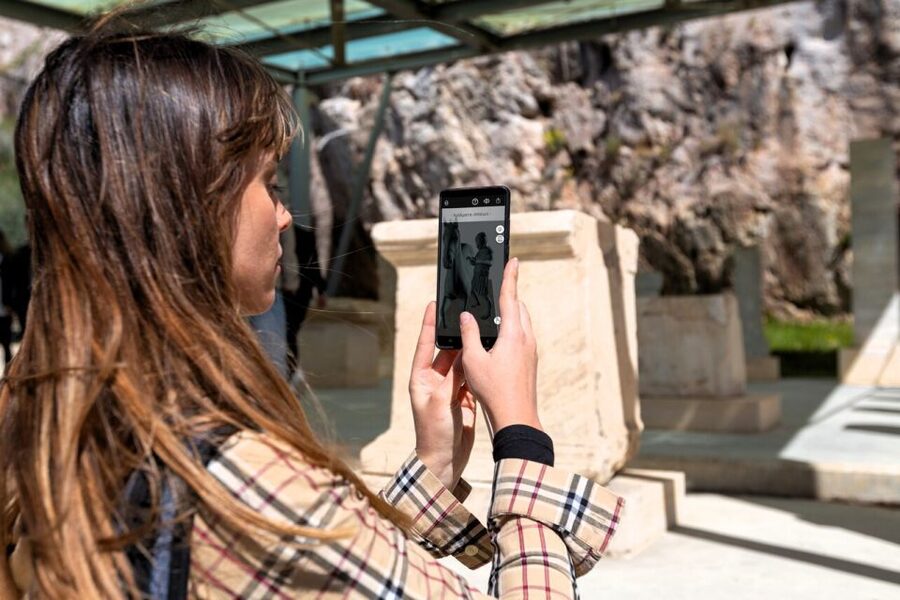
After booking, Culture App sends an email with instructions for downloading the content. Check your spam folder if it does not appear in your main inbox.
Your phone must use iOS 11.0 or later, or Android 5.1 or later. Bring earphones, since the guide includes audio, and charge your phone fully before heading out. A low battery could cut short the most useful part of the experience.
The tour does not provide a smartphone or headphones. It also is not a live guided walk, so you should be comfortable navigating an app and choosing your own pace.
Once you download the content, the paid price is not refundable. The activity does offer free cancellation up to 24 hours before the scheduled use, but downloading the paid material changes that situation. Read the instructions carefully before activating the content.
Who should choose this Agora experience
I would choose this for independent visitors who want more explanation than a bare site visit provides but do not want to join a group. It suits people who enjoy maps, visual reconstructions, and the freedom to stop whenever a monument catches their attention.
It also works well for repeat visitors to Athens. You can use the guide to look at the Agora from a new angle, focusing on democracy, philosophy, civic buildings, or architecture rather than simply ticking off another ancient site.
Families and mixed-interest groups may also find the different formats useful. One person can listen, another can read, and someone else can study the models or video material. The lack of a live guide means you will need to manage the visit yourself.
I would think twice if you want personal conversation, detailed answers to spontaneous questions, or someone to lead you through the site. This is a digital tool, not a substitute for a historian standing beside you.
Should you book the Culture App guide?
Book it if you want a low-cost, flexible way to make sense of the Ancient Agora, especially if 3D models, audio, and panoramic views help you understand ruined buildings. The Temple of Hephaistos, the birthplace of democracy, and the connection with Socrates give the site plenty of substance, while five-day access lets you use the material without rushing.
Skip it if you already have a guide, do not enjoy using your phone at archaeological sites, or want a live expert to shape the visit. Remember to budget for the separate €10 entrance fee, download everything on Wi-Fi, and arrive with earphones and a full battery.
FAQ
Is the entrance ticket included?
No. The app price does not include entry to the Ancient Agora. The stated admission price is €10 for a full ticket and €5 at the reduced rate.
How long is the tour valid?
The content is valid for five days from the moment you first activate it.
Which languages are available?
Audio is available in English, Greek, German, Spanish, Italian, French, Dutch, and Chinese.
Do I need internet access?
Yes. Internet access is required for the tour to work effectively. You are advised to download the content over Wi-Fi before visiting unless you have enough mobile data.
What phone systems are supported?
The self-guided tour requires iOS 11.0 or later, or Android 5.1 or later. You also need about 200MB of storage.
Does the tour provide headphones or a smartphone?
No. You must bring your own smartphone and earphones. A fully charged phone is recommended.
Newly reviewed around Athens
- Feel Ancient thermal Spa Visit Delphi, Leonidas ℨoo Spaʀtan★ 5.0 · 4 reviews
- Food Tour★ 5.0 · 3 reviews
- Explore the Hidden Food Gems of Athens★ 5.0 · 57 reviews
- Food Experience in Athens including Unlimited Lunch★ 5.0 · 3 reviews
- Eat Your Way Through Athens: A Local Food Walk★ 4.9 · 97 reviews
- From Athens: Delphi Private Tour with Lunch Time★ 4.0 · 3 reviews
- Delphi: Spanish guided one day tour★ 4.6 · 55 reviews
- Early Entry Acropolis & Museum. Beat the Crowds & the heat★ 5.0 · 3 reviews
Ancient Agora Tours, compared.

Roman Agora & Ancient Agora E-ticket & 2 Audio Tours
Read our review →
Ancient Athens, Agora, and Keramikos Segway Tour
Read our review →


Browse the lists this tour appears in