
Reviewed · ANCIENT AGORA TOURS
Athens: Roman Agora E-Ticket and Audio Guide
Athens’ Roman Agora is a small site with a big story. In less than an hour, you can move from the Gate of Athena Archegetis to the clever Tower of the Winds, then on to the remains of shops, public toilets, a fountain house, and a later mosque. The audio guide adds useful context to what can otherwise look like a scatter of stones.
I like two things here: the ticket lets you skip the ticket line, and the downloadable commentary works offline, so you do not need roaming data. The audio tour is available in six languages and can be used before or after your visit, giving you room to set your own pace.
The main caution is value. At $18, this is not a long visit, and one recent French review found the site nearly empty and the on-site ticket easy to buy. The audio guide was praised in that same review, but another user found its directions hard to follow, so download it early and check that you can move between stops.
Key points to know before you book

- The Roman Agora takes about 45 minutes to one hour, making it a good short stop between larger Athens sights.
- The Tower of the Winds is the star attraction, with the Gate of Athena Archegetis close behind.
- The audio tour is self-guided, with no live guide or fixed group.
- Offline maps, text, and narration save phone data, but you need a charged Android or iPhone and 100 to 150 MB of storage.
- The $18 price pays for convenience and commentary, not a full-day sightseeing experience.
- Orientation can be the weak point, so read the app instructions before entering the site.
What the Roman Agora adds to an Athens visit
The Roman Agora is easy to overlook beside Athens’ larger archaeological sites. That is part of its appeal. You are not signing up for a long march through a huge complex. Instead, you get a compact historic stop where the remains sit close together and the audio guide helps connect them.
This was a practical center of city life during the Roman period. The site shows how Athens handled trade, public business, water, sanitation, and timekeeping. You are not simply looking at columns. You are seeing the working side of an ancient city.
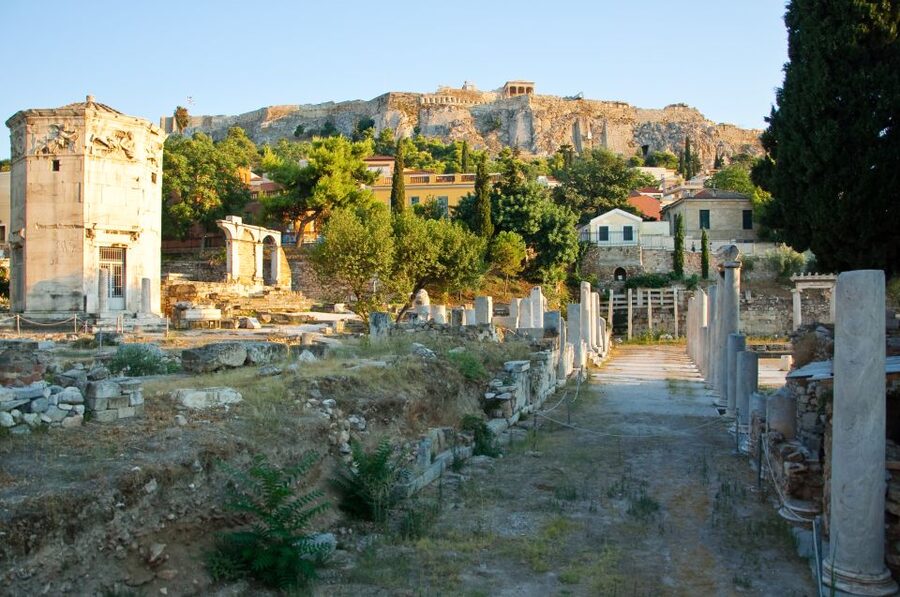
The short visit also makes sense on a busy Athens day. You can fit it between the Acropolis area, Monastiraki, and other central sights without giving up half a morning. The view toward the Acropolis adds a useful visual link between the Roman-era buildings below and the classical monument above.
The attraction suits you best if you enjoy history but do not want a formal tour group. You can stop for photographs, replay a section, or move on when you have had enough. If you want a guide to answer questions or lead you from point to point, this product will feel limited.
More Ancient Agora and Kerameikos walks:
- Athens: Agora and Hephaistos Temple Entrance Ticket
★ 4.0 · 449 reviews - Athens: Ancient Agora E-Ticket and Audio Tour
★ 3.9 · 413 reviews - Athens: Kerameikos Stone House Cooking Class
★ 5.0 · 165 reviews
Getting started with the Clio Muse audio tour
After booking, you receive an email with instructions and an activation link. You need to download the app and the audio content before your visit. Check your spam folder if the message does not arrive quickly.
This preparation matters. The audio works offline, but only after the content is downloaded. Set aside 100 to 150 MB of storage, charge your phone, and bring headphones. The service works with Android version 5.0 and later and with iOS, but it does not support Windows phones or several older Apple devices.
You buy per device, not per person. That detail matters if two people plan to listen separately. One phone can serve as the listening device, but sharing headphones may be awkward if you want to move at different speeds.
There is no live guide and no standard meeting point for the audio experience. The meeting point can vary by the option booked, so rely on the booking instructions rather than expecting a guide to meet you at a central location.
The content is offered in English, Spanish, German, French, Italian, and Greek. You can use the audio before entering to get a short historical introduction, during the visit for the main commentary, or afterward to revisit the stories.
Entering through the Gate of Athena Archegetis
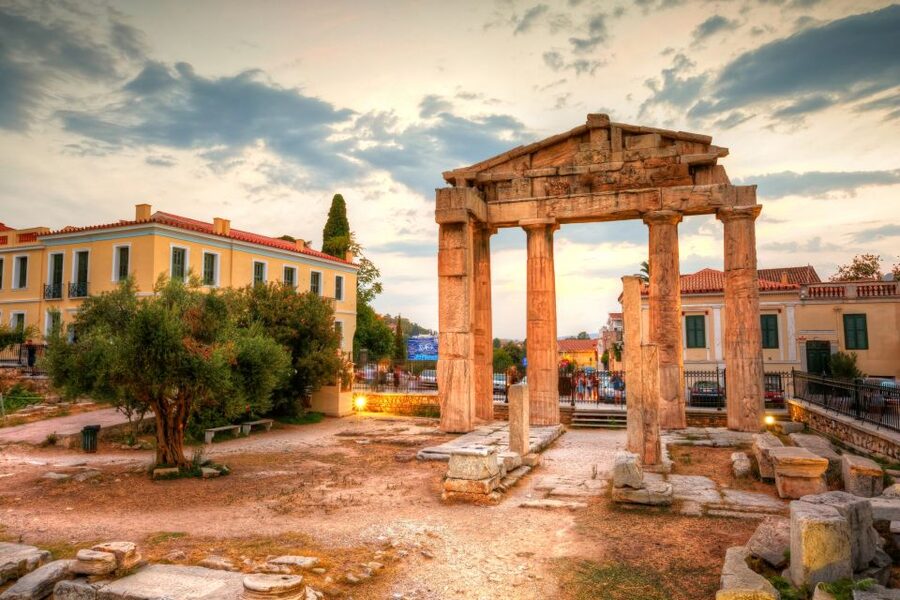
The Gate of Athena Archegetis is one of the first features to look for. Its name refers to Athena as the leader of the city, and the structure gives the Roman Agora a clear entrance rather than leaving you to wander among disconnected ruins.
This is a good place to begin the audio tour because it helps explain the site’s purpose and layout. Look closely at the large stone elements and the proportions of the gateway. The remains give you a sense of the formal edge of the marketplace.
The audio guide’s short story format is useful here. Instead of presenting a long lecture, it gives brief pieces of information that help you notice specific features. That approach works well for a compact site, especially if you are visiting with family members who do not want a long academic talk.
Take a moment to look beyond the gate toward the Acropolis. The view is one of the site’s practical pleasures. You can place the Roman Agora within the wider city rather than treating it as an isolated archaeological enclosure.
Meeting the Tower of the Winds
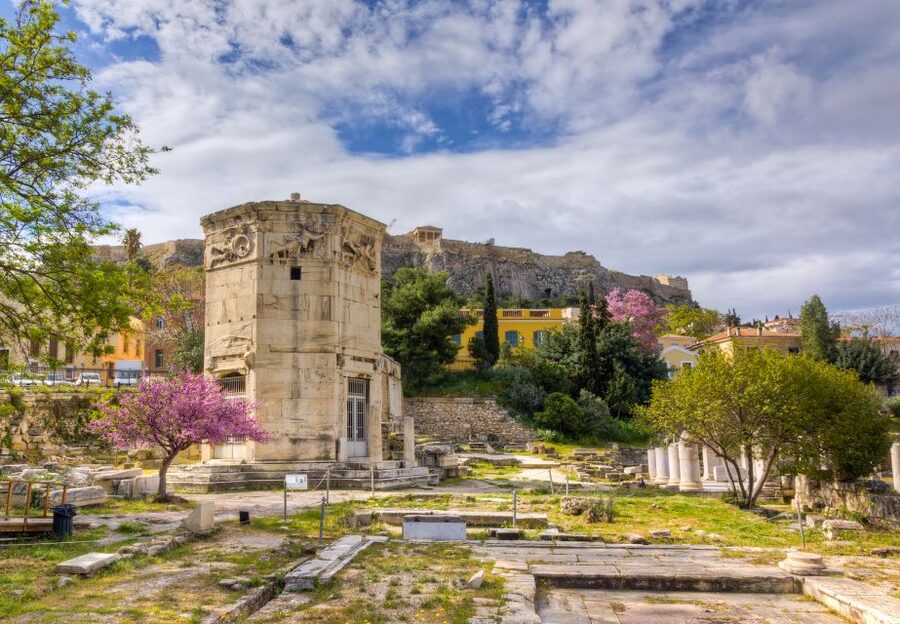
The Tower of the Winds is the most distinctive building in the Roman Agora. It is also where the site’s scientific and everyday side comes into focus.
The tower was linked to weather and time. Its exterior includes figures connected with the winds, which explains the attraction’s invitation to meet the Winds. The building is more than a decorative monument. It reflects ancient interest in measuring the conditions that shaped daily life.
You will want to slow down here. Examine the carved figures and the tower’s unusual form, then use the narration to understand why this structure mattered. The audio guide gives the visit a stronger sense of purpose because it explains the stories and uses behind the building.
The Tower of the Winds can also be the easiest place to lose your place in the audio route if the app’s directions are not clear. One French-language review specifically criticized the guide for making orientation difficult, while another praised the audio for bringing the past to life. My advice is simple: read the stop names first, keep the map open, and do not assume the audio will always tell you exactly where to walk next.
More self-guided audio tours in Athens:
- Athens: Cape Sounio & Poseidon Temple Trip with Audio Guide
★ 4.4 · 4,521 reviews - Athens: Acropolis Ticket with Audio Guide
★ 4.0 · 3,575 reviews - Athens: Acropolis Museum Ticket with optional Audio Guide
★ 4.4 · 2,652 reviews - Athens: Acropolis Ticket & Optional Self-Guided Audio Tours
★ 4.1 · 2,542 reviews
Shops, fountain house, and the working city
The Roman Agora is valuable because it shows ordinary city functions, not only grand architecture. The remains of shops help you picture commerce taking place around the formal public area.
The fountain house points to the practical need for water. Ancient cities depended on public water facilities, and even a fragmentary structure can help you understand the daily routines behind the monuments. The audio commentary is most useful when it moves from bare remains to those basic human habits.
You will also hear about the Vespasianae, the public toilets. This is a small but memorable detail. Sanitation rarely receives the same attention as temples and theaters, yet it tells you about how the city operated and how Roman influence affected public life.
These stops make the Roman Agora a good choice for history-minded visitors who want more than famous facades. You get a glimpse of shopping, water collection, hygiene, and public movement. The trade-off is that several features survive only as remains, so the narration does a lot of the interpretive work.
The Mosque of the Conqueror and later layers
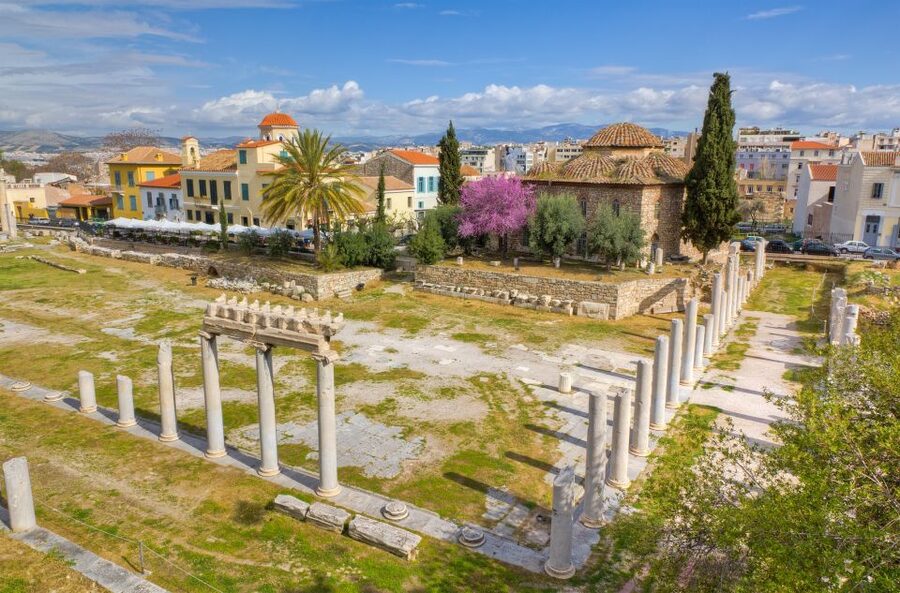
The Mosque of the Conqueror adds a later chapter to the visit. It reminds you that the Roman Agora did not stop mattering when ancient Athens changed hands. The site continued to be used and reshaped across different periods.
The audio guide covers the mosque along with the ancient buildings, helping you see the area as a place with several historical layers. That wider view is one reason an audio tour can be worthwhile here. Without explanation, the mosque may seem like an unrelated structure beside Roman ruins. With context, it becomes part of the site’s continuing story.
Do not expect a large interior tour or a separate religious-history program. The attraction is still a short archaeological visit centered on the Roman Agora. The mosque is one stop in the route, not a full standalone experience.
How the self-guided format works on the ground
You control the pace. If one stop interests you, listen again or pause to study it. If you have already visited the Tower of the Winds on a previous trip, you can shorten that section and spend more time with the fountain house or mosque.
That freedom is a real benefit for independent visitors. There is no group waiting while you take photographs, and no guide setting the rhythm for everyone. You can also replay the audio later, which is handy if you miss a detail in the open-air setting.
The weakness is the lack of personal direction. A live guide would help with questions, point out small features, and keep the sequence clear. Here, you must follow the app and make sense of the map yourself. Since one user found the route difficult to follow, I would not arrive with the idea that the phone will do all the work.
Download everything before you leave your hotel or accommodation. Confirm that the audio plays, check the language, and open the map. Headphones are not included, and neither is a smartphone, so those are your responsibility.
Is $18 fair for a 45-minute visit?
The $18 price is reasonable if your priority is convenience. You get an adult entry ticket, skip-the-line service, the app, audio narration, and offline maps and text. If the ticket queue is long, that convenience has a clear value.
The price is less convincing if you measure it only by time inside the site. The Roman Agora is compact, and you may finish in 45 minutes. A French review made this point clearly: the ticket felt expensive for the visit length, especially when the site was almost empty and an on-site ticket was easy to purchase.
That does not make the booking a poor choice. It means you are paying for a package rather than just admission. You are paying to arrange the ticket in advance, bypass the standard ticket line, and receive historical commentary in your chosen language.
Free and reduced admission tickets are different. They must be obtained at the ticket booth and do not include skip-the-line privileges. If you qualify for one of those categories, buying this package may not be the best value.
Who should book this experience
I would recommend it to independent visitors who want a short, structured introduction to the Roman Agora. It is also a good fit if you like listening in your own language and prefer not to join a group.
The experience makes sense for:
- First-time Athens visitors fitting several central sights into one day
- History fans interested in daily Roman-era life
- Visitors who want English, French, Greek, Italian, German, or Spanish commentary
- People who prefer an app to a live tour
- Anyone who wants to revisit the narration after leaving the site
I would think twice if you want a long guided experience, personal questions answered on the spot, or a large archaeological complex with hours of exploration. I would also compare the $18 package with the on-site ticket if the attraction is quiet and you are comfortable handling the visit without narration.
The site is partially accessible for people with disabilities, but the information does not give a detailed route or explain which areas may be difficult. If access is important for your visit, check current conditions before booking.
Practical tips for a smoother visit
Bring comfortable shoes. Even a short archaeological visit involves walking and standing, and the route is outdoors.
Use headphones rather than the phone speaker. You will hear the narration more clearly and avoid disturbing people nearby. Make sure the phone is fully charged, since the audio, map, and ticket instructions all depend on it.
Give yourself time to download the app before reaching the entrance. Do not wait until you are standing at the gate with a weak connection. The offline feature is helpful only after the content is stored on your phone.
Keep your expectations in proportion. The Roman Agora is not large, and a 45-minute visit may be enough for many people. Its appeal comes from the concentration of features and the chance to understand how a city functioned, not from a long list of monumental buildings.
Should you book the Roman Agora audio ticket?
Book it if you want a simple, self-paced visit with historical explanation and value skipping the ticket line. The strongest part is the audio content, especially at the Tower of the Winds, the shops, the Vespasianae, and the fountain house.
Skip it if you are watching every euro, the site is quiet, and you are happy to buy admission in person. You should also skip it if you want a live guide or find phone-based navigation frustrating.
For most independent visitors, this works best as a short add-on to a day in central Athens. Download the tour early, bring headphones, and treat the $18 as payment for convenience and interpretation, not for a full morning of sightseeing.
FAQ
How long does the Roman Agora visit take?
The suggested duration is 45 minutes to one hour. You can move faster or slower because the audio tour is self-guided.
Is a live guide included?
No. This experience includes a downloadable audio tour for your smartphone, but no live guide.
What does the ticket include?
It includes an adult entry ticket to the Roman Agora, skip-the-line service, the smartphone audio tour, an activation link, and offline text, narration, and maps.
Which languages are available?
The audio tour is available in English, Spanish, German, French, Italian, and Greek.
Do I need my own smartphone and headphones?
Yes. You must bring a compatible smartphone and headphones. The phone should be charged and have about 100 to 150 MB of available storage.
Can I use the audio tour without mobile data?
Yes. The content includes offline text, audio narration, and maps, but you need to download the app and tour before your visit.
Can I buy a reduced or free ticket through this service?
No. Free and reduced admission tickets must be obtained at the on-site ticket booth, and they do not include skip-the-line privileges.
Newly reviewed around Athens
- Feel Ancient thermal Spa Visit Delphi, Leonidas ℨoo Spaʀtan★ 5.0 · 4 reviews
- Food Tour★ 5.0 · 3 reviews
- Explore the Hidden Food Gems of Athens★ 5.0 · 57 reviews
- Food Experience in Athens including Unlimited Lunch★ 5.0 · 3 reviews
- Eat Your Way Through Athens: A Local Food Walk★ 4.9 · 97 reviews
- From Athens: Delphi Private Tour with Lunch Time★ 4.0 · 3 reviews
- Delphi: Spanish guided one day tour★ 4.6 · 55 reviews
- Early Entry Acropolis & Museum. Beat the Crowds & the heat★ 5.0 · 3 reviews
Ancient Agora Tours, compared.

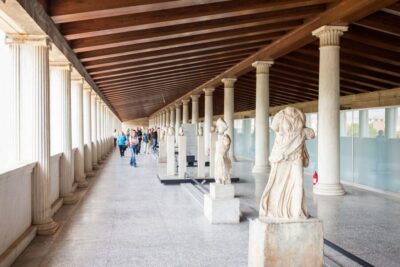


Roman Agora & Ancient Agora E-ticket & 2 Audio Tours
Read our review →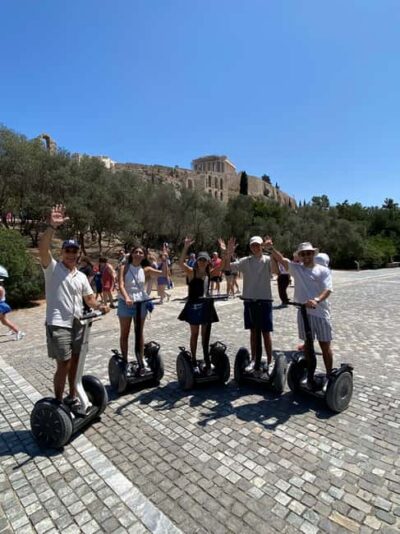
Ancient Athens, Agora, and Keramikos Segway Tour
Read our review →
Ancient Agora: Audiovisual self-guided tour with 3D models
Read our review →

Browse the lists this tour appears in