
Reviewed · ANCIENT CORINTH TOURS
Ancient Olympia & Ancient Corinth Private LuxuryTour from Athens
Ancient Olympia is a long way from Athens, but this private tour makes the journey possible in a single, very full day. You’ll cross the Peloponnese, stop at the Corinth Canal, walk through the birthplace of the Olympic Games, and return to Athens with your own driver rather than a large tour group.
I like the door-to-door pickup and the freedom to adjust the timing. I also like the small touches reported on the best outings, including Wi-Fi, bottled water, local pastries, and drivers such as Chris, Nikos, Michael, and Christo who add stories about Greek history and mythology along the way.
The catch is the distance. Athens to Olympia takes more than three hours each way, so this is a demanding 12-hour day. Also, your driver is not a licensed archaeological guide, and admission fees are extra. Confirm the vehicle and entrance costs before you go.
Key points to know before booking
- Ancient Olympia is the main event: Allow about two to three hours for the ruins, stadium, and museums.
- The Corinth Canal breaks up the drive: You get a short photo stop at this striking 19th-century waterway.
- Your driver is not a site guide: Drivers can explain history and point out sights, but a licensed guide inside the ruins is not included.
- Private means flexible: Your pickup time, stops, and return point can be adjusted for your group.
- Comfort matters here: Wi-Fi, air-conditioning, water, and a sedan or minivan make the long road easier.
- Budget for admissions: Olympia and Ancient Corinth entrance charges are separate from the tour price.
Olympia is worth the long haul
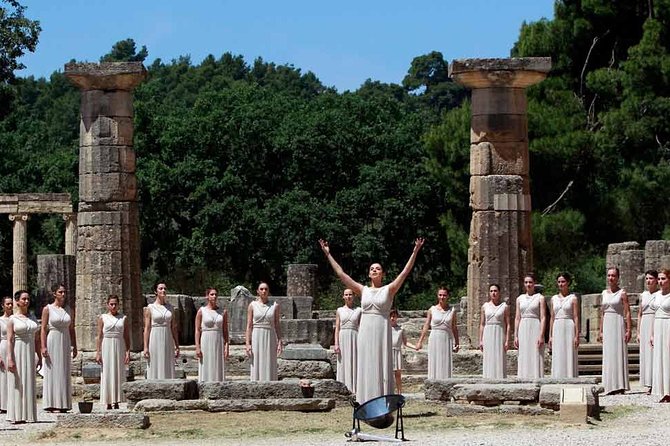
I see this as a road trip built around one major prize: Ancient Olympia. This was the sanctuary where the ancient Olympic Games began in 776 BC, and the site still has enough open space and surviving structures to give you a sense of its original purpose.
The setting helps. Olympia lies in the western Peloponnese, in the valley of the Alpheios River. You are not simply walking from one building to the next in a dense city ruin. The site spreads across an open archaeological area, with trees, columns, broken walls, and the long stadium track giving the visit room to breathe.
Your day begins with a long drive from Athens. That sounds tiring, and it can be, but a private car changes the experience. You can stop when needed, control the temperature, use the onboard Wi-Fi, and avoid waiting for a bus full of people. Groups of one to three use a sedan, while groups of four to seven are assigned a minivan.
The price is listed at $361.42 per person. That is not a cheap day trip, especially once you add entry tickets and lunch. Still, the price can make sense for a small group splitting the vehicle cost, particularly if you need airport, port, hotel, or apartment pickup and do not want to arrange a long-distance rental car.
More Ancient Corinth and canal trips:
- From Athens: Ancient Corinth Day Trip with Canal & VR Guide
★ 4.6 · 1,073 reviews - Private Biblical Tour Ancient Corinth & Isthmus Canal from Athens
★ 5.0 · 762 reviews - Athens: Ancient Corinth & Nafplio Full Day Trip with Swim
★ 4.8 · 523 reviews
The Corinth Canal makes a useful first stop
The Corinth Canal is usually the first major sight on the route. The stop lasts about 15 minutes, which is enough for photographs and a quick look from the bridge area. It is not a full visit, but it gives you a welcome break from the road.
The canal cuts through the narrow Isthmus of Corinth and links the Gulf of Corinth with the Saronic Gulf. It separates the Peloponnese from mainland Greece, making the peninsula technically an island. The modern canal dates from the late 19th century, though Greek leaders had dreamed of such a passage for centuries.
The stop also helps you understand the geography of the day. You are crossing the narrow neck of land that connects Athens and the Peloponnese, then continuing west toward Olympia. I would not book the tour for the canal alone, but it is a worthwhile 15-minute pause before the longest stretch of driving.
Ancient Corinth adds an older layer
After the canal, the tour continues to Corinth. Ancient Corinth was one of the major city-states of Greece, positioned between the Peloponnese and the mainland. Its location helped it become a powerful commercial center, and its later Roman history is especially important.
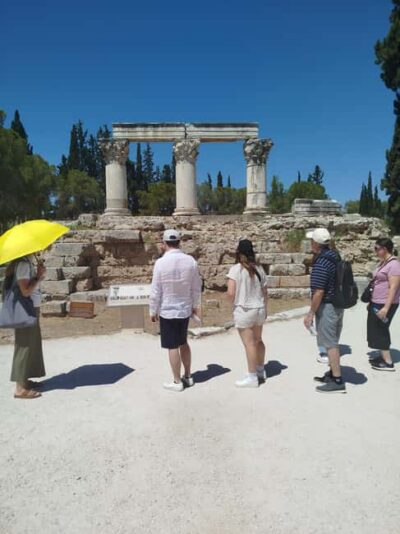
The visit includes the Temple of Apollo, constructed around 550 BC. Its monolithic Doric columns are among the oldest surviving examples on the Greek mainland and Peloponnese. The ruins here are more compact than Olympia, so the one-hour stop can give you a useful introduction without taking too much time from the main destination.
Corinth also has a strong connection to Saint Paul. The New Testament letters First and Second Corinthians are linked to the city, and the Acts of the Apostles describes Paul’s time there. You do not need a religious interest to appreciate the site, but this connection gives Corinth a different character from Olympia, where sport, ritual, and sculpture dominate the story.
Admission to the archaeological site is not included. The stated price is €15 per person, so include it in your planning. The itinerary also describes part of the Corinth visit as free, but that refers to the general stop rather than the archaeological entry.
The archaeological site of Olympia takes the most time
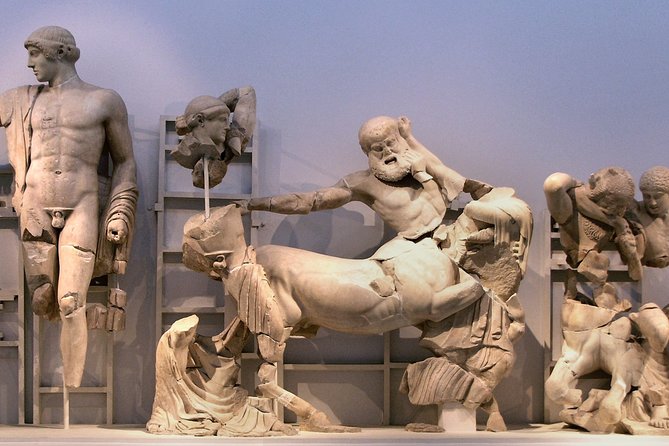
Plan to spend roughly two hours at the main site, with additional time for the museums. The tour brings you into the Altis, the sacred center of Olympia, where temples, athletic buildings, workshops, and public spaces once worked together as one religious and sporting complex.
The Temple of Zeus is the central sight. Built in the fifth century BC, it was a major Doric temple and once held the enormous gold-and-ivory statue of Zeus. The original statue is gone, but its scale is part of the story. It was about 13 meters tall and was considered one of the Seven Wonders of the ancient world.
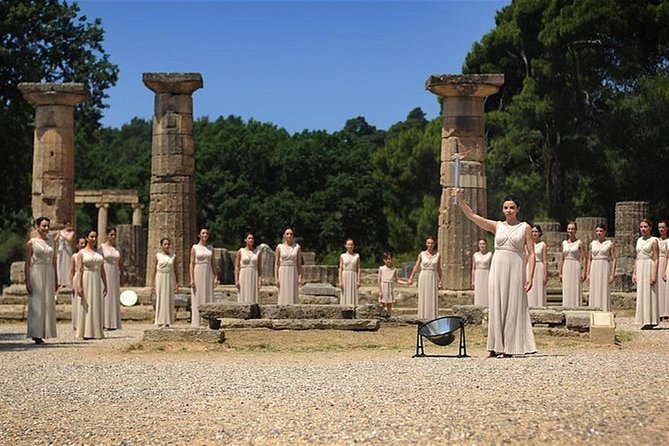
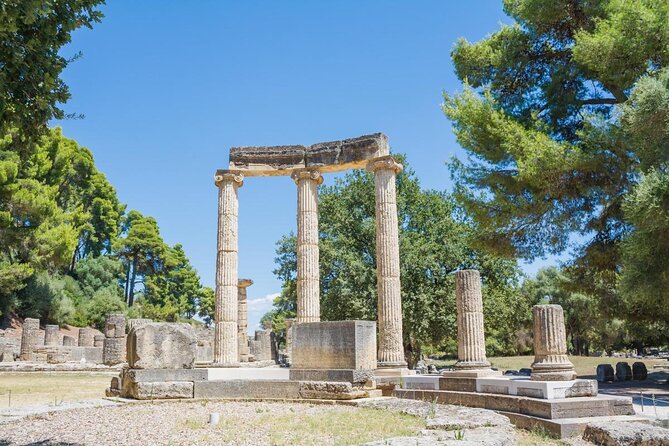
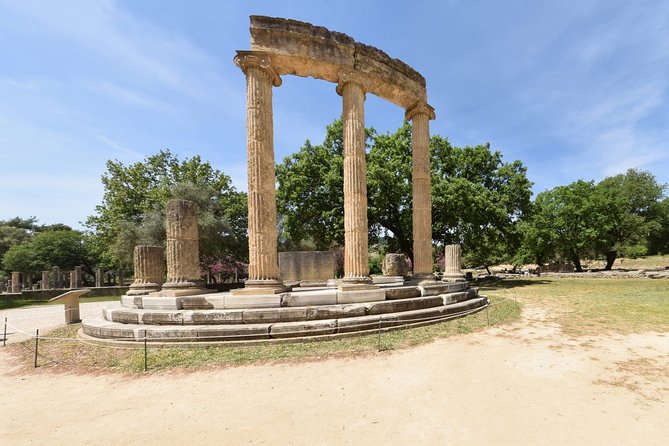
Nearby, the Temple of Hera dates from the Archaic period and was dedicated to Hera, queen of the gods. In modern times, the Olympic flame is lit at its ruins before being carried to the host city. That link between ancient ceremony and the modern Games makes the site especially meaningful, even when only the foundations and columns remain.
You will also see the Workshop of Pheidias. This is where the sculptor is believed to have created the colossal Zeus statue. The building is valuable because it connects the finished artwork to the work of making it. Olympia was not only a place where people worshipped and competed. It was also a place where skilled artists and craftspeople worked.
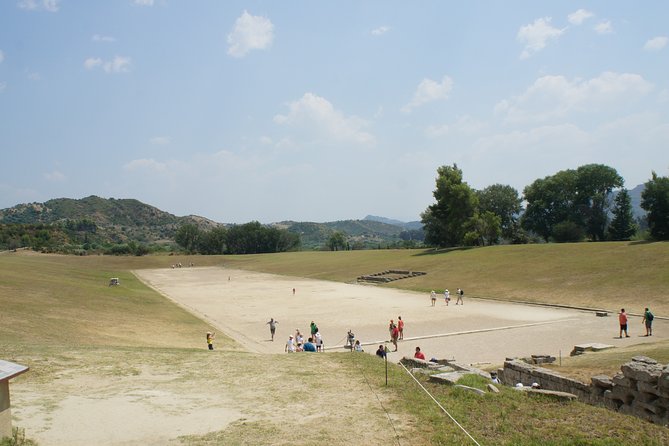
The Ancient Stadium is one of the most effective parts of the visit. You enter through a stone passage and step onto a 192-meter track. The stadium once held up to 45,000 spectators. The plain dirt course is more powerful than a modern stadium full of equipment because the setting leaves you to imagine the athletes, crowds, judges, and religious ceremonies.
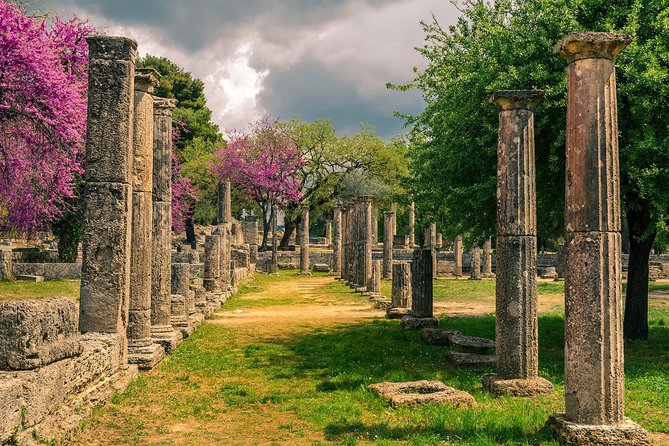
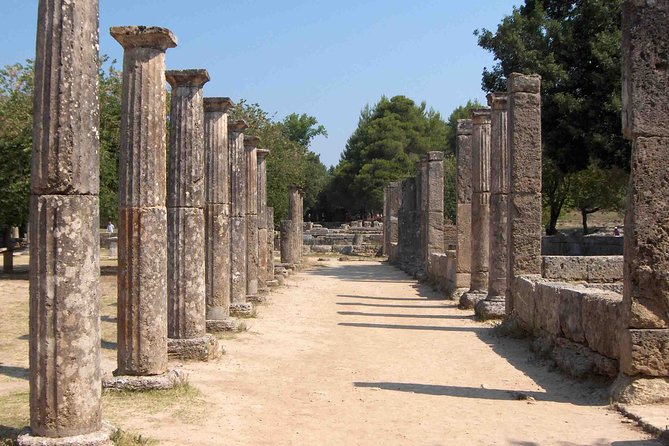
The Palaestra was a training area for boxing, wrestling, and jumping. Its columns and open plan help show how athletes prepared before competition. The Nymphaeum, a Roman fountain from the second century AD, adds a later chapter to the site and illustrates how Olympia continued to develop after the classical period.
The ground is broad and exposed, so comfortable shoes, water, and protection from the sun are sensible. The tour supplies bottled water, but you should still pace yourself. A driver can bring you to the site and explain the broader story, yet there is no licensed guide included inside the archaeological area.
More Ancient Olympia trips:
- 4-Day Classical Greece Tour: Epidaurus, Mycenae, Olympia, Delphi, Meteora
★ 4.5 · 732 reviews - 3-Day Classical Greece Tour: Epidaurus, Mycenae, Nafplion, Olympia, Delphi
★ 4.5 · 342 reviews - 4-Day Tour of Mycenae, Epidaurus, Olympia, Delphi & Meteora
★ 4.8 · 168 reviews - 4-Day Greece Highlights Tour: Epidaurus, Mycenae, Olympia, Delphi and Meteora
★ 5.0 · 79 reviews
The Olympia museums reward careful attention
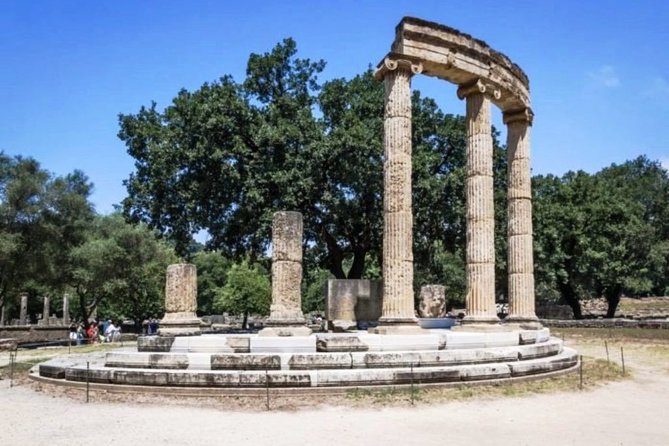
The Archaeological Museum of Olympia is one of the most useful stops because it puts original objects beside the ruins you have just seen. Its collection includes sculpture from the Temple of Zeus, pediment figures showing mythological battles, tools, offerings, and everyday objects.
The Hermes of Praxiteles is a major highlight. The museum also gives you a better sense of the artistic quality of Olympia, which can be harder to appreciate when you are looking at scattered stones outdoors. I prefer visiting the museum before or after the site depending on your interests, but one of the supplied suggestions is practical: start with the museum if you want context before walking among the ruins.
The Museum of the History of the Olympic Games in Antiquity focuses on sport and competition. You can see athletic equipment, inscriptions, and artworks connected to the Games, from their beginnings in 776 BC through their later development. It helps answer basic questions that the ruins alone cannot: who competed, what events mattered, and how sport fit into religious life.
The itinerary also refers to the Museum of Archimedes in Olympia. This is a separate hands-on museum devoted to replicas of the mathematician’s inventions. You can interact with mechanical devices and see how ancient scientific ideas worked in practice. If you want to include this museum, confirm the timing and entry arrangements with the operator, since the day already includes several Olympia stops.
The museum visits are listed at about 20 to 26 minutes each, but those times are short. If you enjoy ancient sculpture or want to read the displays, you may need to ask for a slower schedule. The private format makes that possible, but a 12-hour day still puts a limit on how long you can linger.
Olympia village brings the day back to the present
After the archaeological area, you get time in the village of Olympia. This is where a traditional Greek meal can fit into the day. Lunch is not included, so you choose and pay for your own food.
The suggested meal experience includes local dishes such as moussaka, souvlaki, fresh bread, and other Greek specialties. The supplied details mention La Belle Helene and a home-cooked meal associated with Konstantina, but restaurant arrangements can vary, so ask your driver what is open and suitable for your schedule.
You also have time to browse village shops and look for handmade souvenirs. This stop is modest, but it matters. After several hours among sanctuaries and fallen columns, a meal and a short stroll let you see Olympia as a living town rather than only an archaeological site.
One driver reportedly stopped at a local cake shop for traditional pastries. That sort of personal touch is not guaranteed, but it shows how much the driver can shape the day. Chris is praised for humor, mythology stories, flexible pickup, and thoughtful snacks. Nikos is described as attentive and well informed, while Michael and Christo also receive strong praise for their historical explanations and friendly service.
The driver makes or breaks the experience
This is a private driver tour, not a standard guided archaeological excursion. That distinction matters. Your driver can discuss Greek history, mythology, landmarks, and local places to eat, but a licensed guide to accompany you inside the sites is not part of the price.
For some people, this is exactly right. You get privacy, a relaxed conversation, and the freedom to explore on your own. For others, the ruins will make more sense with a specialist explaining the architecture and religious rituals at each stop. If you want detailed commentary inside the site, arrange a licensed guide separately or bring an audio guide if available.
The most praised drivers bring warmth and personality to a very long day. Chris is singled out for making the drive feel easy, with conversation, jokes, snacks, and flexible meeting points. That is valuable on a route with more than six hours of road time.
Vehicle details deserve attention. The tour promises a modern Mercedes-Benz sedan for groups of up to three and a comfortable minivan for larger groups. One four-person party received a Skoda instead of the expected Mercedes and found three people in the back uncomfortable during the 3.5-hour drive each way.
I would confirm the exact vehicle before departure, especially for four people. A luxury sedan is not the same as a compact car, and comfort matters more here than on a short city transfer.
What the price includes, and what it does not
The $361.42 per-person price includes private transportation, hotel, apartment, or port pickup and drop-off, fuel, tolls, air-conditioning, Wi-Fi, bottled water, and an English-speaking driver. Child seats are available if requested in advance.
Airport pickup is offered for an additional €60 per booking. The operator can monitor your flight, meet you in the arrivals hall, and hold a sign with your name. Port pickup works in a similar way, with the driver meeting you at the gate.
You still pay for archaeological admissions, museum tickets, lunch, tips, and any licensed guide. The supplied figures list Olympia admission at €20 per person and Ancient Corinth at €15 per person, though one past outing mentions paying only €6 at Olympia. Prices and ticket categories can change, so confirm the current amount before booking.
For a solo visitor, the cost is high. For two or three people, it becomes easier to justify because you are buying privacy and transport for the entire day. For four to seven people, the minivan can make the per-person cost more reasonable, provided everyone accepts the long hours on the road.
Who should book this day trip
I would choose this tour if Ancient Olympia is a priority and you have only one day available from Athens. It is also useful if you are staying in Athens before a cruise or flight and want door-to-door transport without dealing with a rental car.
It suits couples, families, and small groups who value flexibility. Parents should request car seats when booking. People who prefer a slow, scholarly visit should consider two days with an overnight stay near Olympia instead. That would allow more time for the museums, the Archimedes museum, lunch, and the archaeological site without racing the clock.
I would not choose it if you dislike long drives or want a fully guided archaeological experience. The day is rewarding, but it is not leisurely. You spend much of it in the vehicle, and the best parts depend on having a good driver and a vehicle that matches the promise.
Free cancellation is available up to 24 hours before the start time. The tour requires suitable weather, with a different date or refund offered if poor weather causes cancellation.
Should you book it?
Book this private tour if you want to see Olympia from Athens in one ambitious day and value personal transport, flexible stops, and an English-speaking driver. The Corinth Canal, Ancient Corinth, museums, stadium, and village meal make the route varied rather than a straight dash west.
Before paying, confirm three things: the exact vehicle, the current admission fees, and whether you want to arrange a licensed guide. If you can spare two days, an overnight near Olympia would be the better pace. If you have only one day, this tour gives you a practical way to reach one of Greece’s most important ancient sites without surrendering the whole day to a bus schedule.
FAQ
How long is the Ancient Olympia and Ancient Corinth tour?
The tour lasts approximately 12 hours. The drive from Athens to Olympia takes more than three hours each way, with stops at the Corinth Canal and Ancient Corinth.
Is pickup from my Athens hotel included?
Yes. Pickup and drop-off are offered from Athens hotels, Airbnb residences, and the port. The driver can also meet you at the airport for an additional €60 per booking.
Is this a private tour?
Yes. Only your group participates, and the pickup time and return point can be adjusted on request.
Is a licensed guide included at the archaeological sites?
No. The tour includes an English-speaking driver with historical knowledge, but a licensed guide to accompany you inside the archaeological sites is not included.
Are entrance fees and lunch included?
No. Lunch, tips, Olympia admissions, museum admissions, and Ancient Corinth admission are extra. The supplied price for Ancient Corinth admission is €15 per person, while Olympia is listed at €20 per person.
What vehicle is used for the tour?
Groups of one to three people are transported in a sedan, described as a luxury Mercedes vehicle. Groups of four to seven use a minivan. Confirm the exact vehicle in advance, especially if four people will be traveling together.
Newly reviewed around Athens
- Athens: workshop for painting landscape with local artist★ 4.6 · 3 reviews
- Athens: Greek Wine & Olive Oil Tasting at Brettos Plaka★ 4.5 · 3 reviews
- Outdoor Yoga and Pilates with Akropolis view★ 4.0 · 5 reviews
- Acropolis of Athens: 60′ Tour in a Vintage Motorcycle★ 5.0 · 4 reviews
- Ultimate Tasting of the Volcanic Wines of Greece★ 5.0 · 3 reviews
- Athens at Twilight Night Tour with Drinks and Meze Dishes★ 4.8 · 4 reviews
- Breakfast in the markets with olive oil and honey tasting★ 4.8 · 8 reviews
- workshop for painting acropolis/landscape with local artist★ 5.0 · 3 reviews
Ancient Corinth Tours, compared.
Ancient Corinth Day Trip with Canal & VR Guide
Read our review →
Private Biblical Tour Ancient Corinth & Isthmus Canal from Athens
Read our review →
Ancient Corinth & Nafplio Full Day Trip with Swim
Read our review →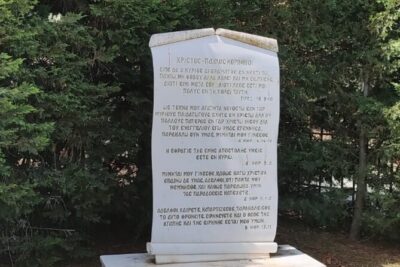
Private Tour of Apostle Paul’s Footsteps in Ancient Corinth
Read our review →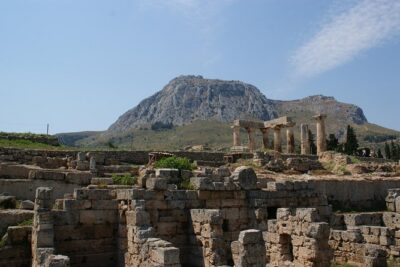
Corinth Half-Day Trip from Athens with Entrance Tickets
Read our review →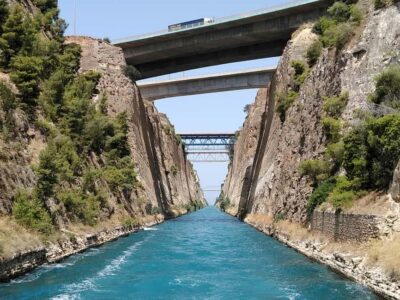
Browse the lists this tour appears in