
Reviewed · ANCIENT AGORA TOURS
Athens: Agora and Hephaistos Temple Entrance Ticket
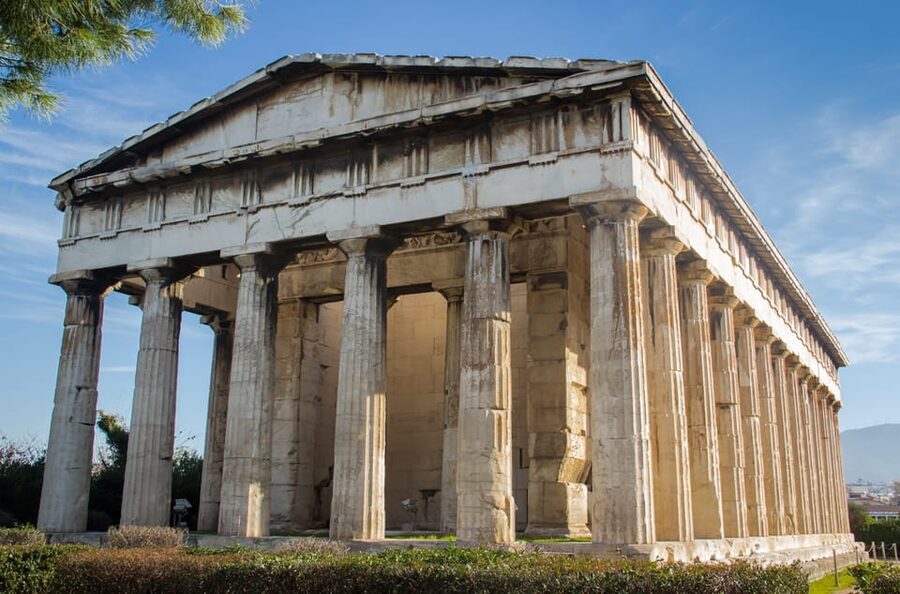
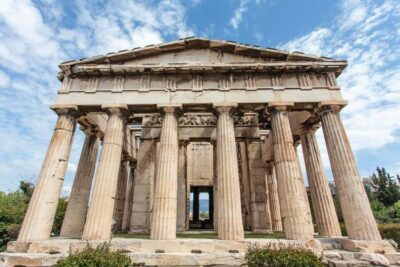
The Ancient Agora gives you something the Acropolis cannot: a look at daily Athenian life, not just grand monuments. This broad archaeological site once held markets, political meetings, law courts, and public debates. The Temple of Hephaistos is the star attraction, a remarkably complete Doric temple with a calm setting and fine views toward the Acropolis.
I like the simple ticket scan at the gate and the freedom to explore without being tied to a group. I also like the optional audio guide, especially for the smaller ruins and the Church of the Holy Apostles. The main drawback is practical: entrance directions have caused confusion, and you must arrive within 15 minutes before or after your chosen time slot.
Key points to know before you go
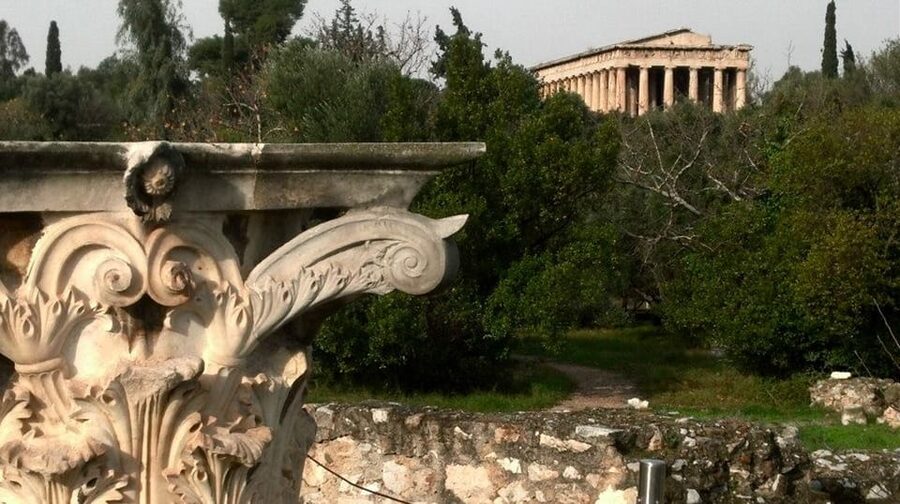
- The Temple of Hephaistos is the main prize: It is one of the best-preserved ancient Greek temples anywhere.
- The Agora explains ordinary Athenian life: Expect foundations, ruins, political spaces, and market buildings rather than one continuous monument.
- The entrance has changed: Current instructions place entry and exit at Thissio Square, also called Jacqueline de Romilly Square, on Apostolou Pavlou pedestrian street.
- The audio guide is optional: It is available in five languages and adds stories and explanations, but its route may not perfectly match the current entrance.
- The ticket is time-sensitive: Your date and entry slot cannot be changed, and admission is allowed only within the stated 30-minute window.
- Allow several hours if you want the full site: You can walk through quickly, but the Agora Museum and scattered ruins reward a slower visit.
Why the Ancient Agora deserves time after the Acropolis
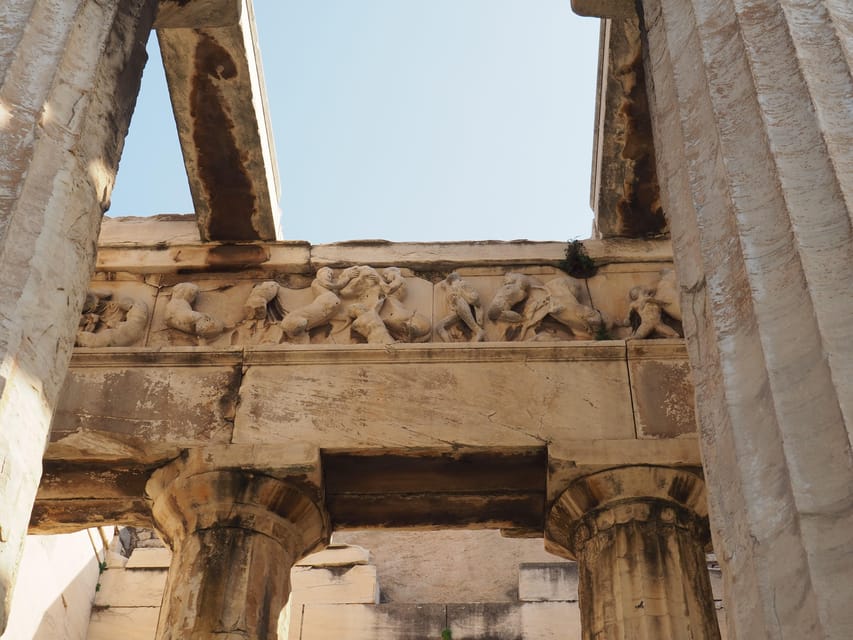
The Acropolis shows Athens at its most monumental. The Agora shows how the city worked.
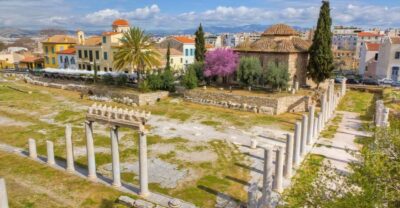
This was the public center of ancient Athens, a place for commerce, political discussion, legal business, religious activity, and everyday meetings. Today, much of it is made up of stone foundations and partial walls. That can sound less exciting than a perfect temple, but the open layout helps you understand the scale of the old city.
I find the Agora most rewarding when I stop trying to identify every broken stone and instead picture the area as a working part of town. The ruins mark the footprint of buildings that once shaped public life. You can see where people gathered, argued, traded, worshiped, and conducted business.
The setting also gives you a different angle on the Acropolis. From the Agora, the famous hill rises beyond the ruins, linking the city’s public life with its religious center. That view is one reason to visit even if you have already spent a morning among the Acropolis monuments.
The site is large enough to feel like a proper walk. One visitor spent four hours seeing everything, while others found it easy to scan the ticket and move through at a quicker pace. Your ideal visit will depend on how much attention you give to the museum, audio commentary, and smaller remains.
More Ancient Agora and Kerameikos walks:
- Athens: Ancient Agora E-Ticket and Audio Tour
★ 3.9 · 413 reviews - Athens: Kerameikos Stone House Cooking Class
★ 5.0 · 165 reviews - Athens: Roman Agora & Ancient Agora E-ticket & 2 Audio Tours
★ 4.1 · 107 reviews
Entering from Thissio Square
The most important practical detail is the entrance.
Current instructions specify that visitors enter and leave from Thissio Square, also called Jacqueline de Romilly Square, on Apostolou Pavlou pedestrian street. This is not always the entrance shown by older maps or app directions. A former entrance may appear on navigation services or in the audio guide, yet be closed or unused.
That mismatch has caused unnecessary uphill and downhill walking. Some people have reached a locked gate, walked around the site, then returned toward the correct entrance. If you are visiting in warm weather or have a tight schedule, this is more than a minor nuisance.
Before setting out, check the latest meeting-point information attached to your booking. Look for the entrance on Apostolou Pavlou rather than trusting an old map pin alone. If you are coming from the Acropolis area, the Agora is a short, easy walk, but allow extra minutes to locate the current gate.
Once you find the entrance, the process is straightforward. Go directly to the archaeological site, scan your ticket at the validating machine, and continue inside. There is no live guide waiting for you, so you can begin at your own pace.
The Temple of Hephaistos is the clear highlight
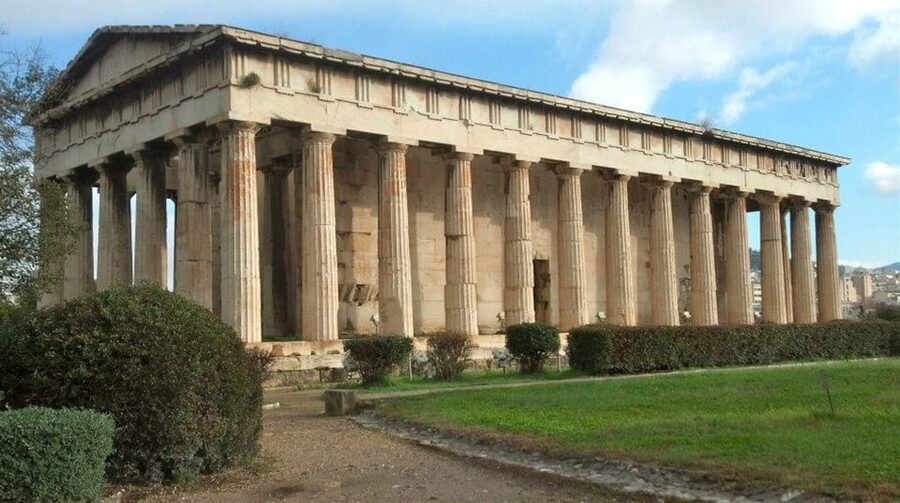
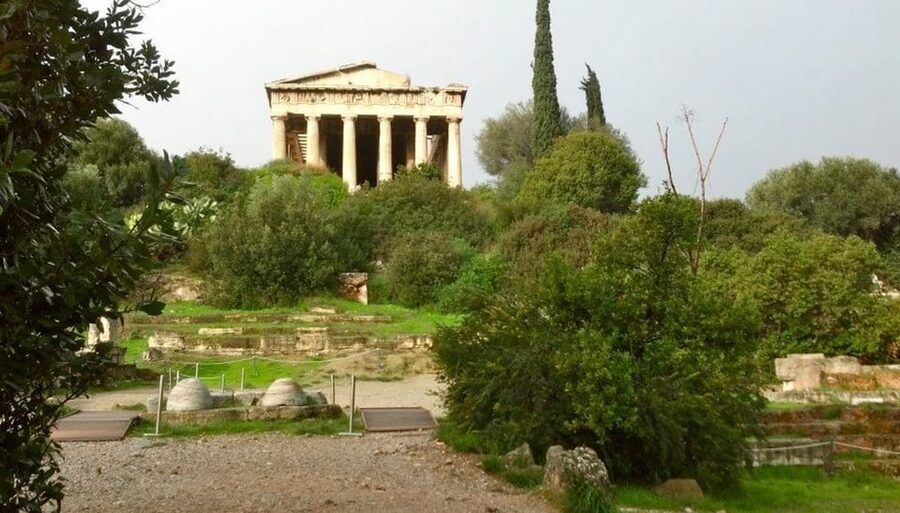
The Temple of Hephaistos is the best-preserved ancient Greek Doric temple in the world, and it earns the attention it gets.
Unlike many ancient buildings that survive only as columns or fragments, this temple retains much of its original form. Its strong rows of columns and solid proportions make it easier to understand how a Greek temple looked as a complete building. You cannot simply walk inside, but you can study the exterior from several angles.
The temple was dedicated to Hephaistos, the god associated with metalworking and craftsmanship. The building’s survival makes it especially fitting that a temple connected with skilled work remains such a fine piece of construction.
I recommend approaching it slowly rather than racing straight to the front. The temple looks different as you move around it, and the wider Agora gives you room to frame it against the sky and the Acropolis. Bring a camera, but also take a few minutes to look without one. The simple lines are easier to appreciate when you are not trying to photograph every column.
There is limited shade in parts of the Agora, and summer heat can make the walk tiring. Wear comfortable shoes, carry water, and bring a hat and sunscreen. The ground and paths are part of an outdoor archaeological site, so this is not a place for flimsy footwear.
What the Church of the Holy Apostles adds
The Church of the Holy Apostles is a very different sight from the temple.
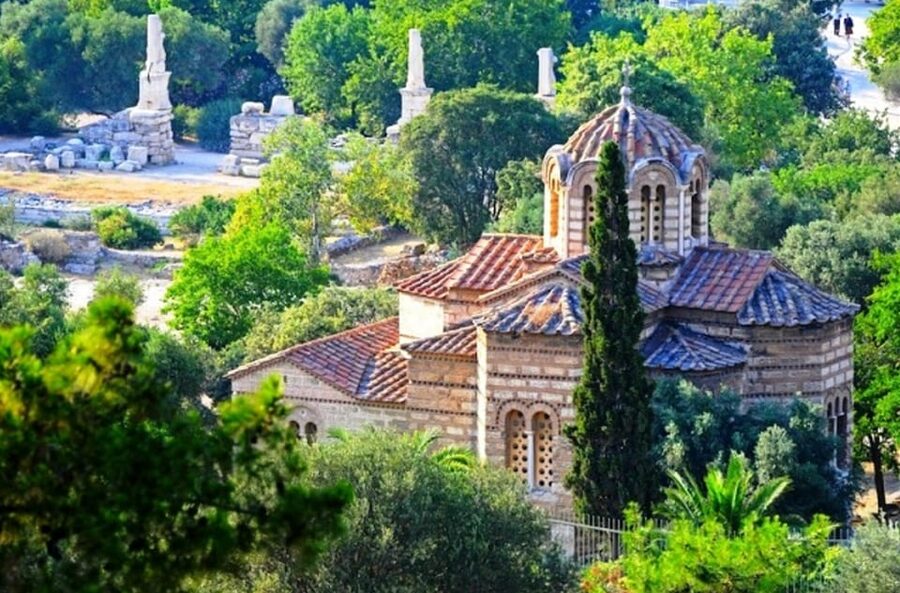
This small Byzantine church helps show that the Agora continued to matter long after classical Athens. Its presence adds a later layer to the site, reminding you that this was not an abandoned patch of ruins immediately after antiquity. The church is also connected with the tradition that St. Paul preached here.
Compared with the Temple of Hephaistos, the church can be easy to overlook. That would be a mistake. The two buildings together show the long religious life of the area: classical Greek worship in one part of the site and Christian worship centuries later.
The audio guide can be useful here because the church may not explain itself as clearly as the larger monuments. If you choose the guide, listen for the section on the Holy Apostles rather than treating the church as a quick stop on the way to the temple.
More Athens tickets worth pre-booking:
- Athens: Acropolis Ticket with Optional Audio or Live Guide
★ 4.2 · 11,055 reviews - Athens: Acropolis Ticket with Audio Guide
★ 4.0 · 3,575 reviews - Athens All Included: Acropolis and Museum Guided Tour with Ticket
★ 4.5 · 2,673 reviews - Athens: Acropolis Museum Ticket with optional Audio Guide
★ 4.4 · 2,652 reviews
The Stoa and the Agora Museum
The Stoa is another major reason to slow down.
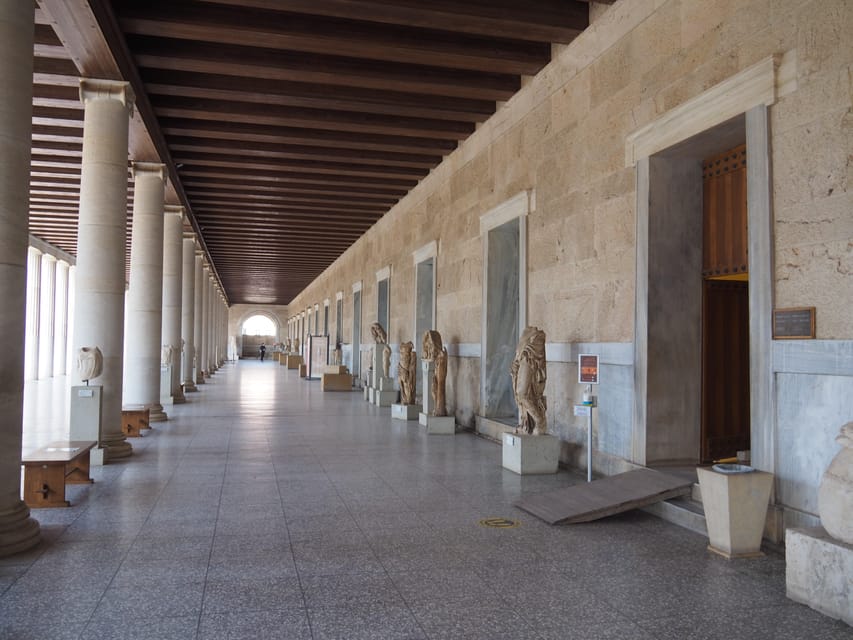
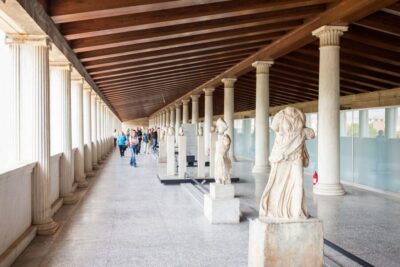
A stoa was a long covered walkway used for shelter, shopping, meeting, and public activity. The restored Stoa of Attalos helps you imagine the practical side of the Agora more clearly than a field of foundations can. It gives shape to the idea of the Agora as a working public center.
The Agora Museum is worth adding to your visit if it is open and included in your access at the time you go. One visitor specifically found it worthwhile, and it gives context to objects and structures that can seem abstract outdoors.
Among the displays, you might find the original Spartan bronze shield that has attracted particular attention. Objects like this help bridge the gap between a stone foundation and the people who once used the site. Instead of looking only at architecture, you get clues about politics, conflict, public ceremonies, and ordinary equipment.
Plan your energy accordingly. The Agora can be visited in an hour if you focus on the temple and main paths, but a museum stop and a slower look at the ruins can stretch the visit to several hours.
Choosing the audio guide
The self-guided audio tour is an add-on rather than a live tour. You receive access to commentary presented by professional licensed guides and storytelling specialists, with original stories and historical explanations. Languages are English, German, Spanish, Italian, and French.
I like the idea of an audio guide here because the Agora’s meaning is not always obvious from the remains. A voice can explain why a foundation matters, how a public building was used, and what role the site played in Athenian life.
The guide also includes short asides and stories, which can make a long walk more enjoyable. It gives you a narrative to follow instead of leaving you to read every sign.
There are two cautions. First, it is not a substitute for a live guide. You will not be able to ask questions or change the route to suit your interests. Second, the audio route may begin from an older or unused entrance. Because the current entrance has changed, the map and opening instructions may not match where you actually enter.
One person found the written signs easier to follow than the audio commentary. That is a fair point. If you prefer to stop, read, and set your own rhythm, you may not need the add-on. If you want more background while walking, especially in a language other than English, it can be worthwhile.
Bring your own headphones if the booking information does not specify otherwise. The supplied details say to put on your headphones, but they do not explain the equipment arrangement, so it is sensible to arrive prepared.
Is the $30 price good value?
The listed price is $30 per group up to one person, which effectively means a regular adult-price ticket for one visitor. The ticket covers entry to the Temple of Hephaistos and the Church of the Holy Apostles, with the audio guide included only if you select that option.
The value depends on your plan for Athens.
For a first visit focused only on the Acropolis, this ticket adds another cost and another timed entry. If you are trying to keep sightseeing simple, you may decide that the Agora can wait.
For anyone interested in how Athens functioned beyond the hilltop temples, the price is easier to justify. You get access to a large historical site, one exceptionally preserved temple, a Byzantine church, the Stoa area, and the museum. The ability to walk without a live group also lets you spend five minutes or five hours, depending on your schedule.
Pre-ordering can save time when the ticket line is long, and scanning the digital ticket is simple once you reach the correct gate. But the site is not always crowded. At quieter times, you might find that buying on site costs less or gives you more flexibility, particularly if you do not need an audio guide.
There is one important catch: this offer is for a regular adult-price ticket. People of all ages can use it, but everyone pays the full price under this option. From April 1, 2025, EU citizens under 25 and non-EU citizens under 18 may receive free admission by showing identification at the ticket booth. People with disabilities can also receive free admission by presenting a disability certificate.
Because availability depends on timed entry, buying on site is not risk-free. The ticket office may not have your preferred time available. Pre-booking makes more sense during busy periods, but only if you are certain about your date and arrival time.
Timing, comfort, and who will enjoy it most
The ticket is valid for one day, but admission is tied to the time slot you select. Entry is permitted only at that time or within 15 minutes before or after it. You cannot amend the date or time later, so do not book the Agora for a narrow gap between two other timed attractions.
The site is wheelchair accessible, though the outdoor setting means you should still consider the walking distance and surface conditions when planning your visit. The supplied information does not give a route-specific accessibility description, so anyone needing detailed mobility guidance should confirm the current path before booking.
The Agora suits you best if you:
- Want to understand ancient Athens beyond the Acropolis
- Enjoy self-guided sightseeing and setting your own pace
- Care about ancient architecture, politics, religion, or archaeology
- Have at least one spare hour, and ideally two to four hours
- Are comfortable walking outdoors in sun
- Prefer a digital ticket over waiting at a ticket office
It may suit you less if you want a personal guide, dislike timed tickets, or have little patience for ruins that require imagination. The Temple of Hephaistos is remarkably complete, but much of the surrounding Agora is made up of foundations and partial remains.
Should you book the Ancient Agora ticket?
I would book it if you have already planned the Acropolis and want a fuller picture of Athens. The Temple of Hephaistos, restored Stoa, Church of the Holy Apostles, museum, and open views make this a worthwhile second major archaeological stop.
I would be more cautious if your Athens schedule is packed or if you are only interested in fully intact monuments. In that case, the entrance confusion and fixed time slot may not be worth the extra planning.
Choose the audio guide if you want stories and explanation while walking. Skip it if you prefer site signs and quiet exploration. Most of all, verify the current Thissio Square entrance before you leave, arrive within the 30-minute entry window, and bring water. Those small steps will make this self-guided visit much easier.
FAQ
Where is the current entrance to the Ancient Agora?
The current entrance and exit are at Thissio Square, also called Jacqueline de Romilly Square, on Apostolou Pavlou pedestrian street. This arrangement is stated to remain in place until the end of 2025, so check the latest information before your visit.
How long is the ticket valid?
The ticket is valid for one day, but admission is tied to the selected time slot. You may enter only at the chosen time or within 15 minutes before or after it.
Does the ticket include a live guide?
No. The experience is self-guided. An audio guide is available if you select that option.
Which languages are available for the audio guide?
The audio guide is available in English, German, Spanish, Italian, and French.
Can children use this ticket?
People of all ages can use the regular adult-price ticket, but this option charges the full adult price. From April 1, 2025, EU citizens under 25 and non-EU citizens under 18 may receive free admission at the ticket booth with identification.
Is the Ancient Agora wheelchair accessible?
Yes, the activity is listed as wheelchair accessible. People with disabilities can receive free admission by showing a disability certificate at the ticket booth.
Newly reviewed around Athens
- Feel Ancient thermal Spa Visit Delphi, Leonidas ℨoo Spaʀtan★ 5.0 · 4 reviews
- Food Tour★ 5.0 · 3 reviews
- Explore the Hidden Food Gems of Athens★ 5.0 · 57 reviews
- Food Experience in Athens including Unlimited Lunch★ 5.0 · 3 reviews
- Eat Your Way Through Athens: A Local Food Walk★ 4.9 · 97 reviews
- From Athens: Delphi Private Tour with Lunch Time★ 4.0 · 3 reviews
- Delphi: Spanish guided one day tour★ 4.6 · 55 reviews
- Early Entry Acropolis & Museum. Beat the Crowds & the heat★ 5.0 · 3 reviews
Ancient Agora Tours, compared.

Roman Agora & Ancient Agora E-ticket & 2 Audio Tours
Read our review →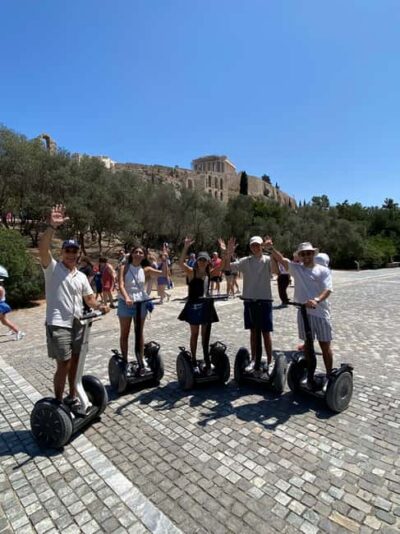
Ancient Athens, Agora, and Keramikos Segway Tour
Read our review →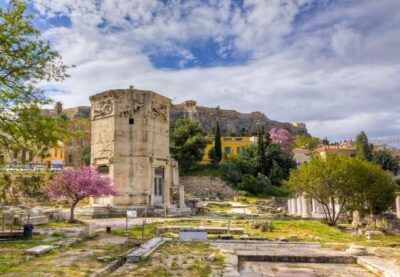
Ancient Agora: Audiovisual self-guided tour with 3D models
Read our review →

Browse the lists this tour appears in