
Reviewed · ANCIENT CORINTH TOURS
Ancient Corinth Half Day Tour
The most striking part of this private Corinth tour is how much ground you cover in about five hours. You see the modern canal, the ancient city, its huge hilltop fortress, and the old port of Kechries without changing hotels or wrestling with Greek bus schedules.
I like the easy door-to-door transport from Athens or Piraeus, and I like the mix of famous sights and quieter ruins. The main catch is that your driver cannot guide you inside the archaeological sites. For the fullest historical picture, you will need to add a licensed guide for 260 euros in cash, plus the 15-euro Ancient Corinth entrance fee per adult.
Key points to know before booking
- Four Corinth sights in one morning or afternoon: The route takes in the Corinth Canal, Ancient Corinth, Acrocorinth, and Kechries.
- Private car for up to two people: The quoted price is $363.71 per group, not per person.
- A driver, not a site guide: Your English-speaking driver explains the monuments and Greek history on the road but cannot accompany you inside.
- Acrocorinth is the physical highlight: The medieval castle occupies a huge rock above the ancient city and gives the outing its grandest views.
- Piraeus pickup is useful for cruise passengers: The driver meets you at the correct terminal exit, with a shuttle arrangement if Terminal B or C access is closed.
- Plan for extra costs: Ancient Corinth charges 15 euros per adult, and a licensed guide costs 260 euros when available.
Why this short Corinth outing works
Corinth is close enough to Athens for a half-day visit, but far enough away to feel like a change of scene. The drive follows the National Highway for about 45 miles, crossing the narrow Isthmus that links mainland Greece with the Peloponnese.
That geography explains Corinth’s power. Ships sailing between the Aegean and the Adriatic once had to circle the Peloponnese, adding about 185 nautical miles to the trip. Corinth controlled the shortcut, the ports, and much of the trade moving through the region.
You get this context from the driver during the ride. The driver is allowed to explain the monuments, myths, and history, but the law does not allow the driver to lead you through the archaeological sites. That difference matters. You will get useful background, yet you must read the signs and make your own way around the ruins unless you pay for the optional licensed guide.
The tour is fully private, so only your party rides in the air-conditioned vehicle. That gives you more flexibility than a large group outing. You do not have to wait for strangers at every stop, and the driver can focus on your questions.
More Ancient Corinth and canal trips:
- From Athens: Ancient Corinth Day Trip with Canal & VR Guide
★ 4.6 · 1,073 reviews - Private Biblical Tour Ancient Corinth & Isthmus Canal from Athens
★ 5.0 · 762 reviews - Athens: Ancient Corinth & Nafplio Full Day Trip with Swim
★ 4.8 · 523 reviews
The Corinth Canal and a 2,000-year-old idea
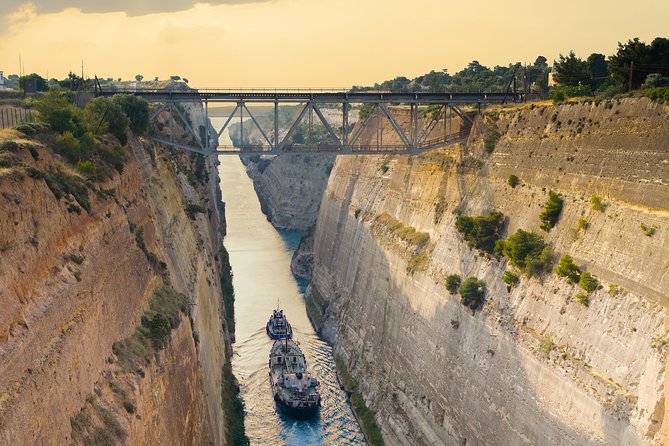
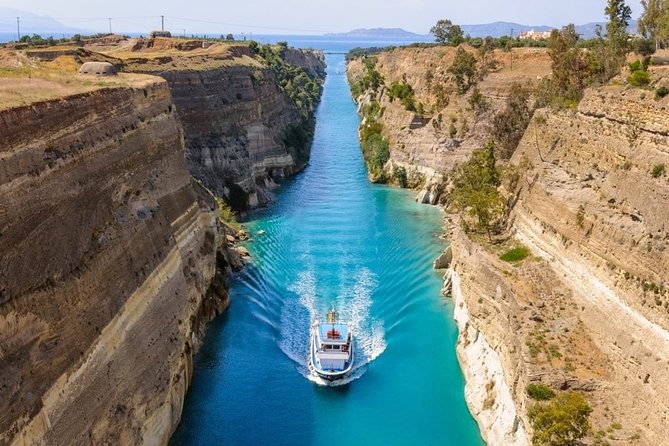
The first stop is the Corinth Canal, usually reached after the drive from Athens. You have about 20 minutes here, which is enough to look across the cut, take photographs, and understand why the canal changed shipping.
The canal itself was completed in the late 19th century, but the idea is far older. Periander, the tyrant of Corinth in the early 6th century BC, is said to have considered cutting through the Isthmus. Instead, the ancient Greeks built the diolkos, a stone route where ships could be hauled across the land on wheeled platforms.
Emperor Nero tried to begin the canal in AD 67 with 6,000 enslaved workers. He died before the plan could be completed. The final canal followed centuries later, turning an ancient ambition into a working waterway.
I like this stop because it sets up the whole day. You are not just looking at a deep trench in the ground. You are seeing the reason Corinth became wealthy, strategic, and often dangerous to its neighbors.
The drawback is timing. Twenty minutes is a quick look, not a full canal visit. If you want time for a long walk or a boat ride, this tour is not built around that. Its purpose is to give you the view, the story, and a photograph before moving on.
Ancient Corinth, where trade made a city powerful
Ancient Corinth is the heart of the tour. You have roughly an hour for the archaeological site and museum area, though the exact time can feel short if you want to study every ruin.
The city’s position gave it two advantages. It controlled the Isthmus and had access to ports on both sides of Greece. Corinth became wealthy through trade, pottery, colonization, and shipping. Its influence reached Corfu, Syracuse in Sicily, and other settlements founded by Corinthian colonists.
The site is also a lesson in repeated destruction and rebuilding. Corinth was destroyed by the Romans in 146 BC after the Achaean League went to war. Its inhabitants were killed or enslaved, and the area was later assigned to Roman colonists. Julius Caesar refounded the city in 44 BC as a Roman colony.
That Roman Corinth is the city you can best picture while walking the ruins. It became the administrative center of the province of Achaea and an important commercial city in the eastern Mediterranean. Later earthquakes, invasions, and changes in power repeatedly altered the settlement.
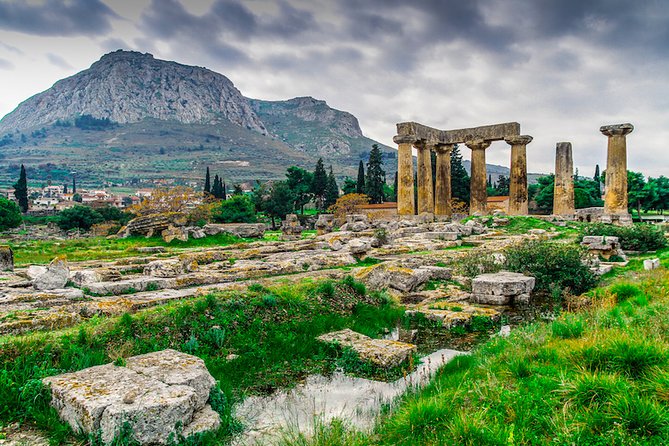
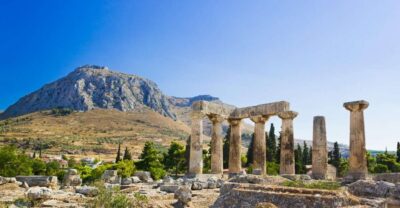
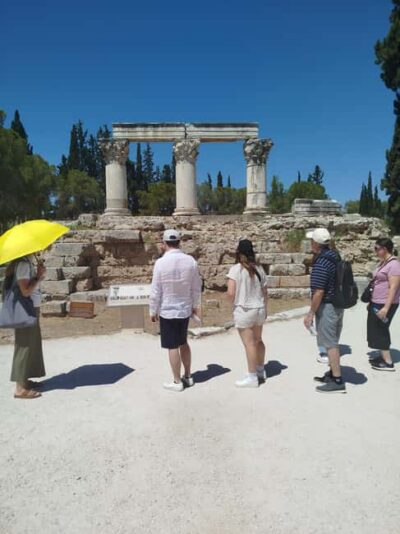
The most recognizable monument is the Temple of Apollo, built in the middle of the 6th century BC. Seven monolithic columns remain. Unlike temples built from stacked column drums, these columns were carved as single pieces, giving the ruins a particularly solid appearance.
The nearby agora, or public square, helps you picture daily life. It dates largely to the 4th century BC and continued to serve the city through later periods. At its center is the bema, a raised platform used for public and legal announcements.
You will also see the start of Lechaion Road. This paved street once led through a commercial district lined with shops. Walking on it gives you a better sense of ancient Corinth than simply viewing isolated stones. The road connected the public center with the city’s western port and carried people, goods, and official business.
The Fountain of Peirene is another worthwhile stop. Its water was linked in legend to Pegasus, and poets came to drink from the spring in search of inspiration. The fountain house once had decorated arcades and statues, though the remains are now much more restrained.
Near the entrance are the Roman Odeion and the ancient theater. The Odeion was a concert hall from the 1st century AD and was later enlarged by Herodes Attikos, the same benefactor associated with Athens’ Odeion. The theater began in the 4th century BC and was altered many times, including conversion for Roman spectacles and naval displays.
The site rewards a little preparation. Before you go, learn the basic sequence: Greek commercial city, Roman destruction, Roman refounding, later Byzantine and medieval occupation. Without that framework, the ruins can look like a collection of columns and foundations. With it, each section has a purpose.
Acrocorinth and the fortress above the plain
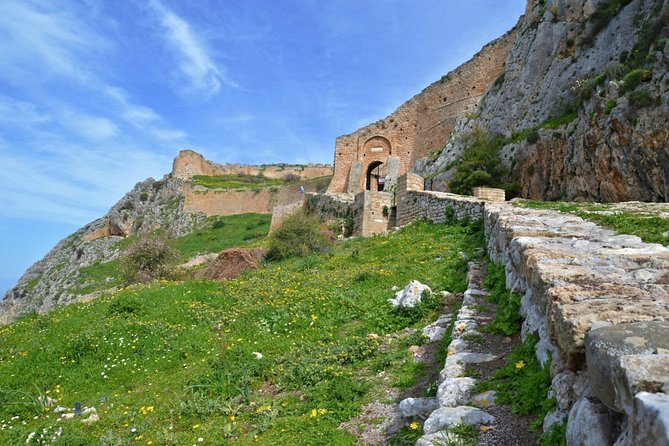
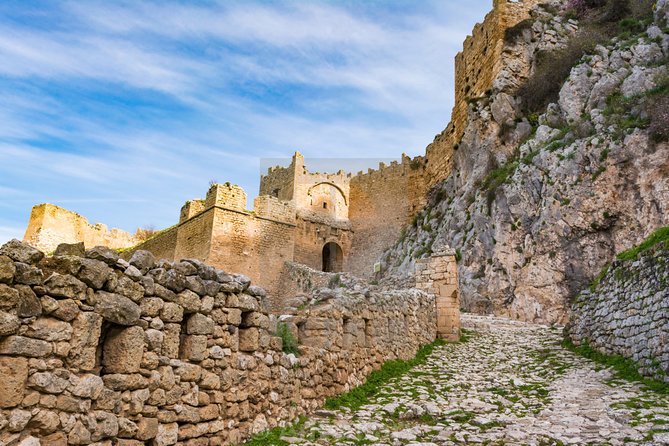
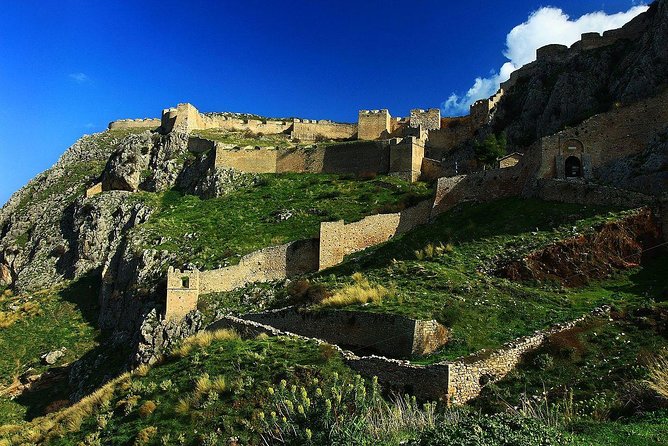
Acrocorinth is the tour’s most dramatic stop. The ancient city sits below a massive rock, and the fortress occupies the high ground above it. You have about an hour here.
The name means Upper Corinth. The rock was occupied from ancient times into the early 19th century, and its walls and gates show how useful the position remained long after the classical city declined. The site is now one of Greece’s major medieval castle locations.
I would give Acrocorinth your best walking shoes and your full attention. The route involves uneven ground and uphill movement, although the provided information does not specify how much walking your particular visit will require. The large rock, gates, walls, and open views make this feel very different from the orderly ruins below.
The ancient sanctuary at the summit was dedicated to Aphrodite, according to the historical tradition connected with Corinth. The city was one of the goddess’s major cult centers. Corinth was also known for the Isthmian Games, athletic contests held near the Isthmus and modeled in part on the Games at Olympia.
The modern appeal of Acrocorinth is not just the archaeology. It is the sense of control that comes from seeing the city’s position from above. The road, plain, and approaches to Corinth become easier to understand from the fortress. You can see why different powers wanted this stronghold.
The one limitation is the same as at Ancient Corinth: the driver cannot accompany you inside as a licensed guide. If you care about the layers of Greek, Roman, Byzantine, Frankish, Venetian, and Ottoman rule, the optional guide would be especially useful here.
A different kind of day out from Athens:
- Athens: Acropolis & up to 5 Archaeological Sites Combo Pass
★ 4.4 · 12,619 reviews - Athens: Acropolis Ticket with Optional Audio or Live Guide
★ 4.2 · 11,055 reviews - Athens: Acropolis, Parthenon & Acropolis Museum Guided Tour
★ 4.8 · 9,316 reviews - Athens: Cape Sounion & Poseidon Temple Sunset Half-Day Trip
★ 4.8 · 8,241 reviews
Kechries, a small port with a biblical connection
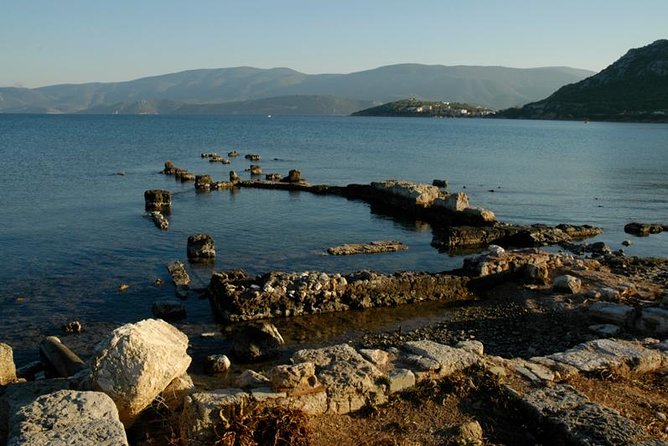
After Ancient Corinth, the route can include Kechries, the remains of one of Corinth’s two ancient ports. You get about 15 minutes, so treat it as a brief atmospheric stop rather than a major archaeological visit.
Kechries served routes across the Saronic Gulf and the eastern Aegean. Its position helped Corinth operate as a two-port city, with trade moving on both sides of the Isthmus.
The port is also connected with the Apostle Paul, who is traditionally said to have arrived at Kechries during his second missionary journey. The connection gives the site added interest for visitors following early Christian history, although the remains themselves are modest.
The schedule mentions stopping here after lunch, but lunch is not included in the tour. You should budget separately for food and clarify the timing with the company when you book. Since Kechries receives only 15 minutes, it is best viewed as a final short stop rather than a place to plan a long meal or extended walk.
What the driver can and cannot do
Your English-speaking driver provides more than a ride. Along the road, the driver explains the monuments, Greek myths, ancient history, and points about modern Greece. One driver named Planos was praised for explaining stories about Greek gods, while company owner Frank has also handled tours and helped arrange a rapid antigen test for a customer.
Those details point to a useful strength of the service: the driver can make the long road time productive and respond to practical needs. Still, you should keep the legal boundary clear. The driver is not a licensed guide and cannot walk into the archaeological sites to interpret the ruins.
You have two sensible choices. You can use the driver’s explanations for orientation, then explore independently. Or you can request the licensed English-speaking guide, subject to availability, for an additional 260 euros paid in cash.
That guide fee is substantial compared with the base price. For two people who want serious archaeological interpretation, it may be worthwhile. For visitors who mainly want transport, views, and a clear introduction to Corinth, the driver-only option may be enough.
Price, pickup, and practical value
The tour costs $363.71 per group of up to two people. That price includes a private, air-conditioned vehicle, bottled water, WiFi onboard, and pickup and drop-off at an Athens hotel or the Piraeus cruise port.
For two people, the price works out to about $181.86 each before site entrance fees. You are paying for private transport and time savings, not simply admission to the ruins. A public option might cost less, but it would not offer the same direct route from your hotel or ship, and it may not fit the five-hour schedule.
Ancient Corinth admission is not included and costs 15 euros per adult. Acrocorinth admission is also listed as not included, but no separate price is provided in the supplied tour information, so confirm the current total before departure.
Airport pickup is available on request for an additional fee that varies by vehicle type. For Piraeus, make sure you know your terminal. The port has Terminals A, B, and C, and the driver waits at the matching exit. If your ship uses Terminal B or C and that exit is closed, take the port shuttle to Terminal A, a ride of about three minutes, where the driver will be waiting.
The tour is offered in English and generally suits most participants. Because Acrocorinth includes a hilltop fortress with uneven terrain, ask the operator about the walking demands if mobility is a concern. No specific accessibility details are provided.
Who should book this Ancient Corinth tour
I would choose this outing if you have a short stay in Athens, a long port day at Piraeus, or no interest in renting a car. It gives you a useful introduction to Corinth without using a full day.
It is also a good fit if you prefer private travel. You get your own vehicle, your own driver, and no unknown passengers. The private format can be especially useful for two people who want to set their own pace at the canal and fortress.
History fans should decide how much explanation they need. The driver can give you background, but the main sites are better with a licensed guide. If you want to understand every building, period, and excavation detail, add the guide and accept the higher cost.
I would not choose this tour if you want a slow day at each site. The canal is a 20-minute stop, Kechries is only 15 minutes, and Ancient Corinth and Acrocorinth each receive about an hour. The route is broad rather than leisurely.
Should you book it?
Book this tour if you want the most efficient private introduction to Corinth from Athens or Piraeus. The combination of canal, ancient city, fortress, and port gives you four distinct chapters in roughly five hours, and the driver’s explanations make the road time useful.
Think twice if you want detailed guiding inside the ruins or need a low-cost excursion. Add 15 euros per adult for Ancient Corinth, consider the 260-euro licensed guide, and remember that airport pickup costs extra. For two people with limited time, the private transport and wide range of sights make the base price reasonable. For a slower, guide-led archaeological day, look for a longer tour.
FAQ
How long does the Ancient Corinth tour last?
The tour lasts approximately five hours.
How much does the tour cost?
The listed price is $363.71 per group of up to two people.
Is transportation from Athens included?
Yes. Private air-conditioned transportation, pickup, and drop-off at an Athens hotel are included.
Can the tour pick me up at Piraeus Port?
Yes. Pickup and drop-off at Piraeus Port are included. The driver meets you at the exit of the terminal where your ship docks. If Terminal B or C access is closed, take the shuttle to Terminal A.
Is airport pickup included?
Airport pickup is available on request, but it costs extra. The additional fee varies by vehicle type.
Is the tour private?
Yes. Only your group participates, with no unknown passengers.
Does the driver guide visitors inside Ancient Corinth and Acrocorinth?
No. The English-speaking driver explains the monuments and history but is not licensed to accompany you inside the sites.
Can I hire a licensed guide?
Yes, an English-speaking licensed guide can be arranged subject to availability. The additional cost is 260 euros, payable in cash.
Are entrance fees included?
No. Entrance to Ancient Corinth costs 15 euros per adult. The available tour information does not provide a separate price for Acrocorinth, so confirm that cost before your visit.
Newly reviewed around Athens
- Athens: workshop for painting landscape with local artist★ 4.6 · 3 reviews
- Athens: Greek Wine & Olive Oil Tasting at Brettos Plaka★ 4.5 · 3 reviews
- Outdoor Yoga and Pilates with Akropolis view★ 4.0 · 5 reviews
- Acropolis of Athens: 60′ Tour in a Vintage Motorcycle★ 5.0 · 4 reviews
- Ultimate Tasting of the Volcanic Wines of Greece★ 5.0 · 3 reviews
- workshop for painting acropolis/landscape with local artist★ 5.0 · 3 reviews
- Athens at Twilight Night Tour with Drinks and Meze Dishes★ 4.8 · 4 reviews
- Breakfast in the markets with olive oil and honey tasting★ 4.8 · 8 reviews
Ancient Corinth Tours, compared.
Ancient Corinth Day Trip with Canal & VR Guide
Read our review →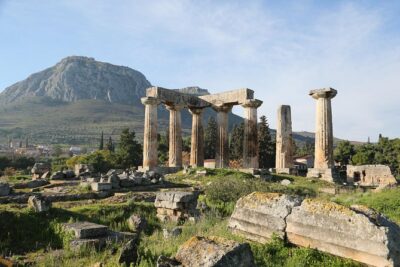
Private Biblical Tour Ancient Corinth & Isthmus Canal from Athens
Read our review →
Ancient Corinth & Nafplio Full Day Trip with Swim
Read our review →
Private Tour of Apostle Paul’s Footsteps in Ancient Corinth
Read our review →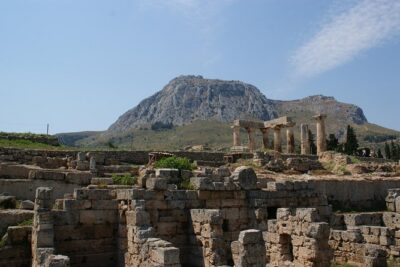
Corinth Half-Day Trip from Athens with Entrance Tickets
Read our review →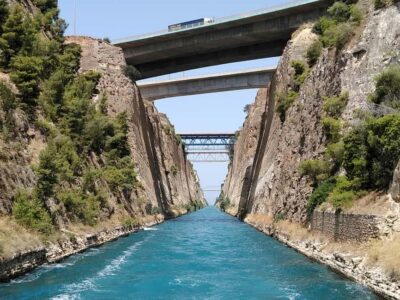
Browse the lists this tour appears in