Reviewed · DELPHI TOURS FROM ATHENS
4 Days Classical Private Tour/ Corinth,Mycenae,Nafplio,Sparta,Olympia,Delphi
Ancient Greece comes at you fast on this four-day private circuit: a canal cut through the Peloponnese, Mycenaean tombs, Sparta, Byzantine Mystras, Olympia, and Delphi. You cover a remarkable amount of ground without changing rental cars or solving Greek road signs yourself.
I like the direct hotel pickup and drop-off, and I like the freedom of a private car, especially when you want more time at Mycenae or a shorter stop in a small port town. Onboard Wi-Fi helps during the long drives. The catch is that the advertised price does not cover hotel rooms, site tickets, or an archaeologist guide, so the final bill can rise.
Key points to know before booking
- Four UNESCO World Heritage Sites: Mycenae, Mystras, Olympia, and Delphi anchor the route.
- A private English-speaking driver: Nikolaos is one named driver associated with the tour, praised for scenic roads, calm service, and thoughtful local routing.
- Nine major stops in four days: You see a lot, but this is an active schedule with long drives.
- Hotels are arranged separately: Boutique or three- and four-star rooms with breakfast cost extra, and your driver needs a room if you book hotels yourself.
- Archaeological guidance costs extra: Your driver can explain places, but is not a licensed guide who walks through each site with you.
- Vehicle choices suit different groups: Sedan or SUV, minivan, and minibus options are available, with pricing based on group size and vehicle type.
What this four-day Greek route really offers
This is not a slow beach holiday. It is a moving tour through the Peloponnese and central Greece, with a new layer of Greek culture almost every few hours. You begin with engineering and Roman Corinth, move into Bronze Age Mycenae, spend a night in Nafplio, then head through Sparta and Mystras before reaching Olympia.
The third day shifts from ancient sports to coastal towns and mountain roads. You cross toward the Gulf of Corinth, pass through Nafpaktos and Galaxidi, and sleep near Mount Parnassus. The final day belongs to Delphi, with a stop in Thebes before returning to Athens.
I would choose this format if you want maximum coverage and private transport. I would not choose it if you prefer two or three hours at every museum, long café breaks, or several nights in one town. The private setup gives you control, but it does not remove the distances.
More Delphi trips from Athens:
- Athens: Mythology of Delphi, Museum and Arachova Guided Tour
★ 4.6 · 4,008 reviews - From Athens: Delphi Full Day V.R. Audio Guided Tour
★ 4.6 · 3,028 reviews - From Athens: Small-Group Delphi, Museum & Arachova Day Trip
★ 4.8 · 2,476 reviews
Day one: Corinth, Mycenae, and a night in Nafplio

Your 8 a.m. pickup begins the longest first day. Pickup is available from an Athens or Piraeus hotel, apartment, or the airport, and the start time can be adjusted. An early start matters in summer, since the archaeological sites have more comfortable morning hours and the route has many stops.
The first photo stop is the Corinth Canal, a narrow cut linking the Gulf of Corinth with the Aegean and Ionian seas. Workers took twelve years, from 1881 to 1893, to cut the 6.4-kilometer passage. You get about 15 minutes to cross the pedestrian bridge and look down from roughly 80 meters above the water.
It is a quick stop, not a full canal visit, but it breaks up the drive and gives you one of the route’s clearest modern engineering sights. Hold on to your camera, and do not expect a long walk.
At Ancient Corinth, you have about an hour among the remains of one of Greece’s major ancient cities. Corinth had a population of about 90,000 in 400 BC, was destroyed by Rome in 146 BC, and was rebuilt as a Roman city in 44 BC. For Christian travelers, the place also connects directly with the letters of Saint Paul and his missionary work.
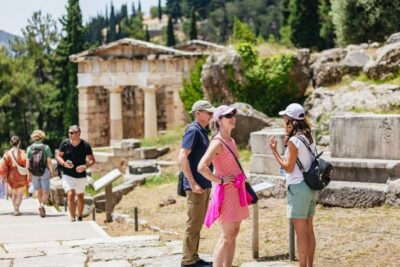
The Temple of Apollo is the visual centerpiece, with surviving Doric columns on a rocky rise. Around it are remains of a theater, shops, baths, workshops, villas, and other public buildings. The nearby museum adds prehistoric, Greek, Roman, and Byzantine objects, along with finds from the sanctuary of Asklepios.
The schedule gives about 30 minutes for the museum, but the stated visit information does not include its ticket in the tour price. Admission charges vary by season and by site, so you should confirm the current total before departure.
Next comes Mycenae, one of the strongest stops on the whole route. The citadel belonged to the Mycenaean civilization and is linked by myth to Agamemnon, Clytaimnestra, Iphigenia, Elektra, and Orestes. The Lion Gate, heavy defensive walls, palace remains, and hilltop setting make the site feel more dramatic than a simple collection of ruins.
The nearby Treasury of Atreus, also called the Tomb of Agamemnon, is a huge Bronze Age tholos tomb dating to about 1250 BC. The name comes from Heinrich Schliemann, not firm proof that Agamemnon or Atreus was buried there. Its precise stonework and tall beehive-shaped interior are worth the short stop.
You have about 90 minutes at the main site and another 30 minutes in the museum. The site involves uneven ground and some uphill walking, so good shoes matter. The itinerary lists combined admission for the tomb and citadel, with different summer and winter prices, but entry is not included.
The day finishes in Nafplio, one of mainland Greece’s prettiest small cities and the first capital of the modern Greek state. Its old town, waterfront, and Venetian and Ottoman layers make it a pleasant place to sleep after a demanding sightseeing day.
Hotel arrangements are optional and cost extra. The operator can book selected boutique, three-star, or four-star rooms with breakfast. If you arrange your own lodging, you must also reserve a room for the driver.
Day two: Nafplio, Sparta, and Byzantine Mystras
Day two begins with Nafplio rather than a rushed departure. The Archaeological Museum occupies a handsome Venetian building on Syntagma Square. Its prized object is the bronze armor from Dendra, displayed with related weapons and vessels. Allow about an hour and check opening days, since museums in Greece close on Tuesdays.
A short visit to Acronafplia Fortress gives you old walls and broad views over Nafplio, the bay, Arvanitia Beach, and the surrounding hills. It is a useful contrast to the formal museum visit, though the half-hour stop is brief.
The route then passes Argos, one of Europe’s oldest continuously inhabited cities. The town is only about 11 kilometers from Nafplio and has ancient monuments, but the schedule does not list a fixed length of stay there. Treat it as a drive-through or flexible sightseeing stop rather than a full Argos visit.
Sparta can surprise you. The modern city is not a preserved classical town, and the ancient remains are spread among the present-day streets. The Archaeological Museum is small, occupying a neoclassical building dating from 1874 to 1876, while the ancient acropolis and theater give you a sense of the old city’s scale.
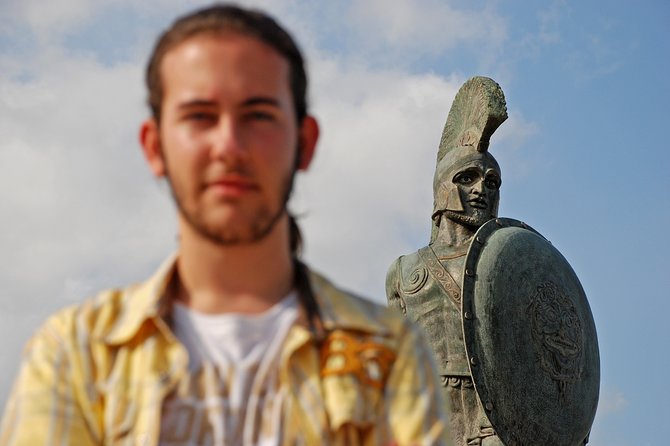
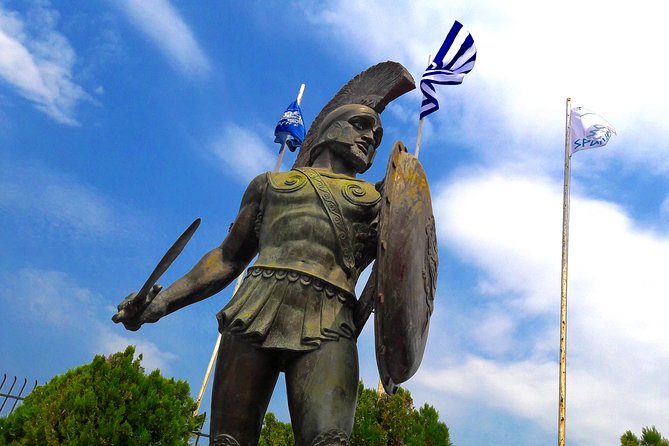
The Leonidas Monument is a short stop near the stadium. The statue recalls the Spartan king’s defense at Thermopylae, while a nearby ancient structure is traditionally linked to his tomb. The site is modest, so your driver’s explanation and the wider context make the visit more useful than the monument alone.
Mystras is the day’s major prize. Built around a fortress founded in 1249, the medieval city became a center of Byzantine power before Ottoman and Venetian rule and eventual abandonment. Churches, fortifications, and stone ruins climb the slopes of Mount Taygetos, with wide views over the surrounding countryside.
Allow two hours, and expect steep or uneven walking. Mystras is a UNESCO World Heritage Site, but it is not a flat, easy stroll. Wear shoes with a firm grip and keep water handy. The ticket is extra, with summer and winter rates listed separately.
You finish near Olympia, with another hotel night arranged separately. This is a long day, yet it gives you a useful progression: modern Nafplio, ancient Sparta, and medieval Mystras. If you want a slower visit, ask in advance which stop can be shortened.
Day three: Olympia, the Gulf of Corinth, and Mount Parnassus
Olympia deserves an early start. The sanctuary hosted the Olympic Games every four years from 776 BC, and the site spreads through a peaceful area near the Alpheios and Kladeos rivers. You have about two hours among the temple ruins, athletic facilities, and ancient stadium.
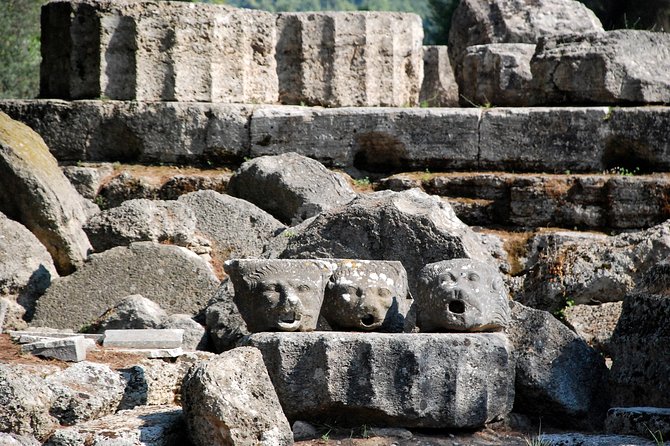
The Archaeological Museum of Olympia makes the ruins easier to understand. Its collection includes the Hermes of Praxiteles, the Nike of Paionios, and helmets dedicated to Zeus after the Battle of Marathon. Plan about an hour there, then allow 30 minutes for the Museum of the Olympic Games, which explains the original events, athletic equipment, and rules surrounding the ancient competition.
The combined ticket for the site and two museums is listed at different summer and winter rates. It is not included in the tour cost. This is one place where a licensed archaeological guide could add real value, since the site covers a wide area and the objects in the museums connect closely with what you see outdoors.
The route then heads toward the Gulf of Corinth. Instead of simply driving across the Rio-Antirrio Bridge, the plan calls for a roughly 20-minute ferry ride from Rio to Antirrio, giving you time to admire the cable-stayed bridge from the water. Ferry tickets are included in the private transport arrangement.
Nafpaktos is a good one-hour pause. Known as Lepanto in part of its past, this harbor town controlled access to the Gulf of Corinth and was the site of the 1571 Battle of Lepanto. Its setting gives the day a welcome change from temples and museums.
You then stop in Galaxidi, a small port with two natural harbors, for about 30 minutes. The main harbor has yachts, fishing boats, restaurants, bars, and shops. This is a short scenic break, not a full coastal-town tour.
The final drive climbs toward Mount Parnassus and Delphi. The mountain was sacred to Apollo, Dionysus, the Muses, and the Corycian nymphs in Greek mythology. Sleeping in a traditional village on the slopes gives you a quieter base for the next morning, though the exact hotel depends on the arrangement.
More Ancient Corinth and canal trips:
- From Athens: Ancient Corinth Day Trip with Canal & VR Guide
★ 4.6 · 1,073 reviews - Private Biblical Tour Ancient Corinth & Isthmus Canal from Athens
★ 5.0 · 762 reviews - Athens: Ancient Corinth & Nafplio Full Day Trip with Swim
★ 4.8 · 523 reviews - Private Tour of Apostle Paul’s Footsteps in Ancient Corinth
★ 5.0 · 275 reviews
Day four: Delphi, Thebes, and the return to Athens
Delphi is the tour’s intellectual and spiritual high point. The sanctuary was home to Pythia, the oracle consulted by Greek rulers and city-states, and ancient Greeks treated Delphi as the center of the world. The mountainside setting, with views toward the coastal plain, adds to the sense of place.
You have about 90 minutes at the Temple of Apollo and the main sanctuary. The site includes monuments funded by different Greek city-states, so you can see how Delphi worked as both a religious center and a shared meeting place for the Greek world.
The Delphi Archaeological Museum deserves its full hour. Its collections include architectural sculpture, statues, and smaller offerings dating from the eighth century BC through Late Antiquity. The museum helps fill in details that are missing from the open-air ruins.
The nearby Sanctuary of Athena Pronaia and its circular Tholos are scheduled for another 30 minutes. The Tholos was built in the fourth century BC with 20 Doric columns around its exterior. It is one of the most recognizable structures in the Delphi area, even though it is separate from the main sanctuary.
Livadia provides a short break before Thebes. The town was associated with the oracle of Trophonius, consulted by figures including Croesus and the Persian commander Mardonius. At the Archaeological Museum of Thebes, a one-hour visit covers material from the Paleolithic period through Byzantine times.
You return to Athens in the evening. Exact arrival time depends on road conditions, stop lengths, and your chosen start time, so do not schedule a tight flight or evening commitment.
Private transport, vehicle choices, and guide expectations
The tour includes an air-conditioned sedan, SUV, minivan, or minibus, depending on your group. A sedan or SUV suits up to three adults, or two adults and two children. A minivan can carry one to seven people, and a minibus can carry up to 14.
Fuel, tolls, parking, and ferry tickets are included. Wi-Fi in the vehicle is a practical bonus on the longer legs, especially for checking messages or keeping children occupied.
The driver is an experienced English-speaking tour leader, not a licensed guide for archaeological sites and museums. That distinction matters. You can walk through the sites independently, or arrange an archaeologist guide in advance for an additional charge of €180 per booking.
Nikolaos is specifically associated with this route and is praised for taking scenic, less-used roads, avoiding crowded stretches when possible, answering questions patiently, and making the trip feel personal. That kind of driver can improve a long road tour considerably, but you should request him specifically if availability matters.
Is the $1,376 price good value?
At $1,376.08 per person, the value depends heavily on your group size and final extras. Private transportation over four days, fuel, tolls, parking, ferry passage, hotel pickup, and an English-speaking driver are all built into the experience. For a family or small group that would otherwise rent a car, pay for parking, and organize several hotels, the convenience can make sense.
The advertised cost does not include accommodation, archaeological site and museum tickets, or an optional licensed guide. Hotel estimates vary in the supplied details, from roughly €80 to €130 per double room per night depending on location and dates, with another stated accommodation estimate of €160 to €180 per booking. Confirm the exact hotel supplement in writing.
Site entry also adds up. Many locations list winter admission around €10 and summer admission around €20, though individual museums and combined tickets differ. The route includes enough paid sites that you should budget beyond the headline price.
Who should book this private Greek circuit?

I would recommend it to first-time visitors who want the major classical sites without driving themselves. It also suits families, multigenerational groups, and friends who value a private vehicle and adjustable stops.
You should think twice if your main goal is deep museum study. Four days cover Corinth, Mycenae, Nafplio, Sparta, Mystras, Olympia, Delphi, Thebes, and several smaller stops. The reward is range. The cost is time on the road and limited hours at some museums.
Book at least two weeks ahead, especially for summer, weekends, or holidays, because rooms must be arranged for your group and driver. Also check the museum closure dates, including Tuesdays for museums, major public holidays, and the shorter winter opening hours.
FAQ
Where does the tour begin and end?
Pickup and drop-off are offered at hotels, apartments, or the airport in Athens and Piraeus. Another pickup location can be requested.
What time does the tour start?
The suggested start time is 8 a.m. or earlier during summer. The start can be adjusted if needed.
Is this a private tour?
Yes. Only your group participates in the activity.
Which languages are offered?
The tour is offered in English, with an English-speaking driver and tour leader.
Is accommodation included in the price?
No. Accommodation is an additional cost. The operator can arrange selected boutique, three-star, or four-star hotels with breakfast.
What happens if I book my own hotels?
You must reserve an extra room for the driver if you arrange your own accommodation.
Are archaeological admission fees included?
No. Site and museum tickets are paid separately, with prices varying by location and season.
Is a professional archaeologist guide included?
No. The driver is not a licensed site guide. An archaeologist guide can be hired in advance for an additional €180 per booking.
What vehicles are available?
You can request a sedan or SUV, minivan, or minibus. Capacity ranges from up to three adults in a sedan or SUV to up to 14 people in a minibus.
Can children join the tour?
Most people can participate. The stated vehicle information allows up to two children age 10 or younger to travel free, depending on the vehicle and group arrangement.
Should you book it?
Book this tour if you want to connect the major Greek sites in one carefully organized loop and prefer a private car to buses or self-driving. Its strongest points are the broad route, hotel pickup, scenic road options, and the chance to travel with a driver such as Nikolaos, who can make long transfers more pleasant.
Before paying, ask for the exact hotel supplement, current admission totals, vehicle type, and whether Nikolaos is available. If you accept the busy schedule and budget for the extras, this is an efficient and memorable way to see classical, Roman, Byzantine, and modern Greece in four days.
More Mycenae trips from Athens
- 4-Day Classical Greece Tour: Epidaurus, Mycenae, Olympia, Delphi, Meteora
★ 4.5 · 732 reviews - 3-Day Classical Greece Tour: Epidaurus, Mycenae, Nafplion, Olympia, Delphi
★ 4.5 · 342 reviews - Mycenae, Epidaurus, Nafplio Full Day Private Tour from Athens
★ 5.0 · 270 reviews - Mycenae, Epidaurus & Nafplio Full-Day V.R audio guided Tour
★ 4.5 · 248 reviews
More Nafplio trips from Athens
- From Athens: Mycenae, Epidaurus & Nafplio Full Day Trip
★ 4.8 · 2,438 reviews - From Athens: Mycenae, Epidaurus & Nafplio Full-Day Tour
★ 4.5 · 1,580 reviews - Mycenae and Nafplion Day Trip from Athens with Official guide
★ 4.5 · 501 reviews - Argolis: Full-Day Tour in Mycenae & Nafplio
★ 4.2 · 350 reviews
Newly reviewed around Athens
- Athens: workshop for painting landscape with local artist★ 4.6 · 3 reviews
- Athens: Greek Wine & Olive Oil Tasting at Brettos Plaka★ 4.5 · 3 reviews
- Outdoor Yoga and Pilates with Akropolis view★ 4.0 · 5 reviews
- Acropolis of Athens: 60′ Tour in a Vintage Motorcycle★ 5.0 · 4 reviews
- Ultimate Tasting of the Volcanic Wines of Greece★ 5.0 · 3 reviews
- workshop for painting acropolis/landscape with local artist★ 5.0 · 3 reviews
- Athens at Twilight Night Tour with Drinks and Meze Dishes★ 4.8 · 4 reviews
- Breakfast in the markets with olive oil and honey tasting★ 4.8 · 8 reviews
Delphi Tours from Athens, compared.
Mythology of Delphi, Museum and Arachova Guided Tour
Read our review →
Small-Group Delphi, Museum & Arachova Day Trip
Read our review →
Delphi English Day Trip from Athens with Official Guide
Read our review →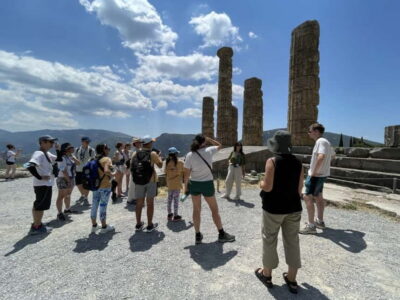
Delphi Guided Trip with Optional Lunch and Entry
Read our review →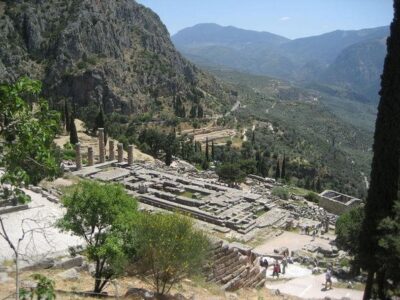
Historical Delphi One Day Tour with Arachova Stop & Expert Guide
Read our review →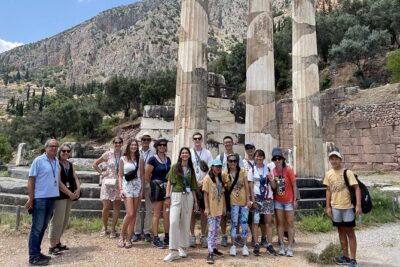
Premium Delphi Day Trip with an Expert Guide, Museum & Lunch
Read our review →