
Reviewed · ATHENS
Panorama of Athens in 6 hours
The best thing about this Athens tour is its reach. In half a day, you can stand on the Acropolis, look across the city from Lycabettus Hill, see the marble Panathenaic Stadium, watch the Evzones change guard, and still browse Monastiraki and Plaka. That is a lot of Athens without wrestling with taxis or public transport.
I like the private vehicle and hotel pickup, especially for a first visit or a short port stay. I also like the flexible drivers. Andrew, Andreas, Evangelos, and Alex are named in the feedback, and the strongest praise goes to their patience, history commentary, route planning, and ability to adapt the day to a family’s needs.
The catch is important: this is not a licensed guided tour inside each archaeological site. Your driver can explain Athens and bring you close to the sights, but you book the entrance tickets yourself and generally explore the Acropolis and Ancient Agora on your own.
Quick takeaways for your Athens half-day
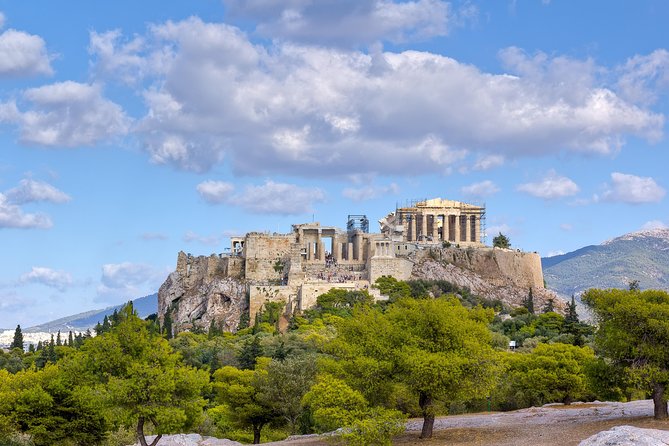
- The Acropolis anchors the day, with the Parthenon, Erechtheion, Propylaea, Temple of Athena Nike, Theatre of Dionysus, Odeon of Herodes Atticus, and Areopagus nearby.
- A private SUV or luxury vehicle carries your group of up to three, with hotel pickup, hotel drop-off, air conditioning, and bottled water included.
- The route covers ancient, royal, Olympic, and modern Athens, from the Temple of Olympian Zeus to the Presidential Guard and the Academy.
- Lycabettus Hill provides the broadest city view, reaching 277 meters above central Athens.
- Acropolis and other entrance fees are extra, with the supplied details listing Acropolis and slopes admission at €30 per person.
- The tour suits short visits best, but six hours is still tight if you want long, unhurried visits inside every monument.
Why this tour works for a short stay
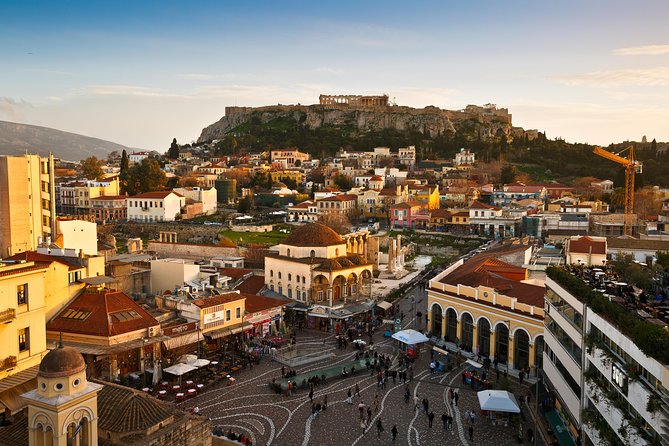
Athens can feel scattered on a first visit. The Acropolis rises above the old center, the Panathenaic Stadium sits east of the main archaeological zone, Lycabettus Hill is farther north, and the Temple of Olympian Zeus lies between them. A private driver removes much of the time spent figuring out how to connect these places.
The advertised duration is five to six hours. That is enough for a broad introduction, not a full archaeological day. You will see many landmarks, but several stops are brief photo and explanation breaks. The Acropolis itself receives about an hour in the planned schedule, while the Parthenon gets about 20 minutes and the Erechtheion about five.
That format is useful if you want to answer the big question, What should I see in Athens? It is less suitable if you want to study every inscription, museum display, or temple at length.
The private setup matters. You are not sharing the vehicle with strangers, and the whole group can shape the pace within the available time. The listed price is $459.74 for up to three people, not per person. For three people, that works out to roughly $153 per person before admission fees. For one person, it is a costly way to see the city, but for a small family or trio wanting comfort and door-to-door transport, the price is easier to justify.
Other Athens days people book alongside this one:
- Athens: Acropolis & up to 5 Archaeological Sites Combo Pass
★ 4.4 · 12,619 reviews - Athens: Acropolis Ticket with Optional Audio or Live Guide
★ 4.2 · 11,055 reviews - Athens: Acropolis, Parthenon & Acropolis Museum Guided Tour
★ 4.8 · 9,316 reviews
Starting at the Acropolis and its great monuments
The Acropolis is the heart of the tour. You walk up the naturally fortified hill, passing through the Propylaea, the monumental entrance created during the building program associated with Pericles. The approach gives you the first sense of why this rocky height mattered so much to ancient Athens.
The Parthenon is the main event. Built between 447 and 438 BC and dedicated to Athena Parthenos, it represents the power and confidence of classical Athens. Even with scaffolding or restoration work, the scale and setting are striking. You also get a sweeping view toward Athens and the port of Piraeus.
The Propylaea deserves more than a passing glance. The gate you see today belongs to the fifth-century BC rebuilding of the Acropolis, after earlier structures were damaged during the Persian Wars. The nearby Temple of Athena Nike is small compared with the Parthenon, but its position beside the entrance makes it easy to appreciate as an elegant Ionic shrine.
The Erechtheion offers a different mood. Its unusual design reflects the many cults and sacred stories tied to the Acropolis. The eastern chamber honored Athena, while the western section held shrines connected with Poseidon-Erechtheus, Hephaistos, and Boutes. The famous Caryatid porch is one of the most recognizable details in Athens, though the original figures are not all in place.
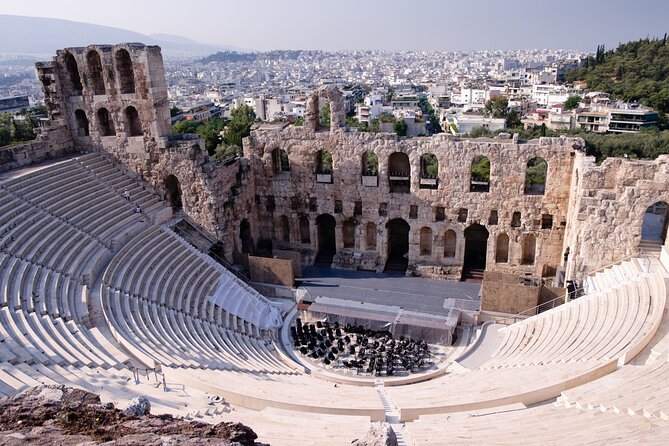
At the foot of the hill, the Theatre of Dionysus connects the Acropolis to the birth of Western drama. Aeschylus, Sophocles, Euripides, and Aristophanes had their works performed here. The Odeon of Herodes Atticus, a Roman-era stone theater, shows how the site continued to serve public life long after classical Athens.
The schedule places roughly an hour at the Acropolis and its slopes. That is enough to see the main monuments, but you should not expect a long pause at every structure. Entrance is not included. The supplied information lists Acropolis and slopes admission at €30 per person, with free admission for those up to age 18, and says tickets must be bought in advance. Check the exact current ticket instructions before you go.
One useful detail comes from the way the drivers handle the visit. Andrew helped a person with a broken knee get as close as possible to the sights and arranged access to the Acropolis elevator. That does not mean every visitor will receive elevator access, so you should discuss mobility needs when booking. The official information asks for a moderate fitness level, and the Acropolis remains a hilltop archaeological site with uneven walking.
Temple of Olympian Zeus, stadium, and the changing guard
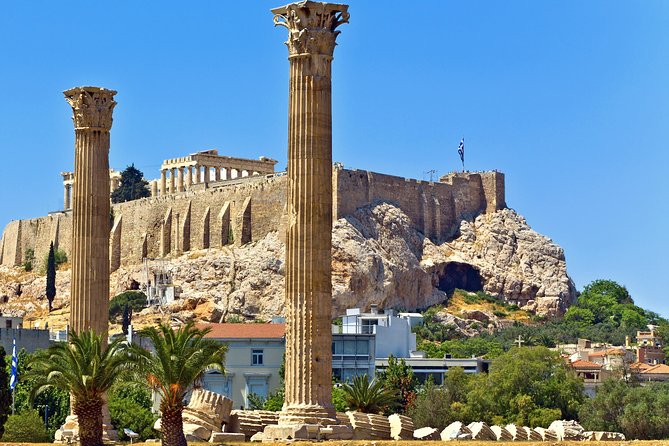
After the Acropolis, the route shifts from ancient sacred hill to the open center of modern Athens. The massive columns of the Temple of Olympian Zeus are a useful reminder of how grand ancient building plans could be. Work began in the sixth century BC, but the temple was not completed until the Roman period under Emperor Hadrian. Only part of the original structure survives, which makes the scale easier to imagine than the building itself.
The Panathenaic Stadium is one of the more unusual stops because it is not just a ruin. Its marble seating and track preserve the form of the ancient stadium, while its modern restoration made it the setting for the first modern Olympic Games in 1896. The stadium is a strong photo stop, but admission is not included.
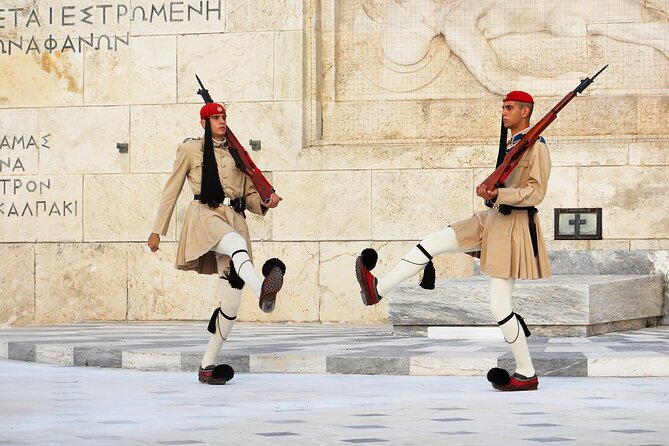
The changing of the guard takes place at the Presidential Mansion every hour, according to the supplied details. The Evzones wear a distinctive uniform and perform a slow, formal routine. The planned stop is about 15 minutes, so you will see the ceremony rather than spend a long time around Syntagma Square.
The route also passes the Academy of Athens, the University of Athens, and the National Library. These neoclassical buildings form an impressive civic row. The Academy is modeled on the Propylaea of the Acropolis, while the university, founded in 1837, was the first university in the newly liberated Greek state. The National Library’s role is to preserve Greek culture and important works of human thought.
Lycabettus Hill for the big Athens view
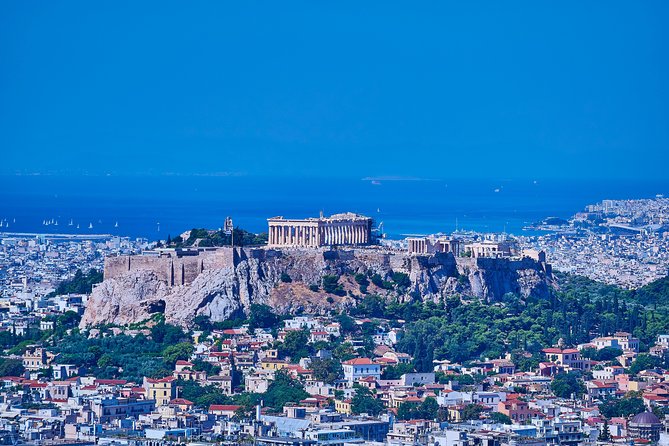
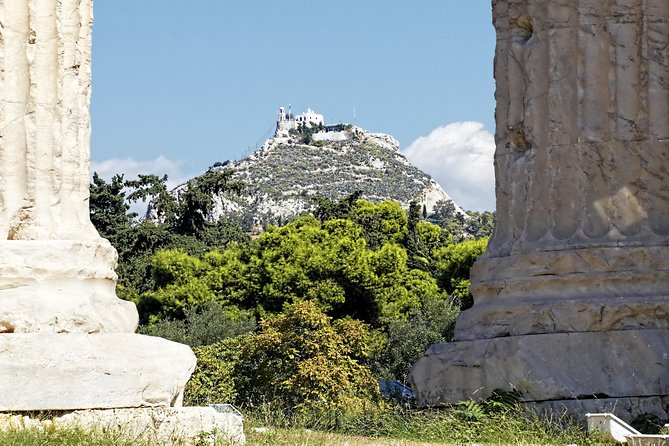
Lycabettus is the highest point in central Athens, rising 277 meters. The planned stop lasts about 15 minutes, so think of it as a quick viewpoint rather than a hill walk.
I like this stop because it changes the way you read the city. From the Acropolis, Athens feels centered on the ancient rock. From Lycabettus, you see the wider spread of the capital and the direction of Piraeus. It is also a good place to pause after the close quarters of the archaeological sites.
The amount of time here depends on the route and traffic. You should not assume that 15 minutes allows a long climb or extended time at the summit. The vehicle makes the viewpoint practical during a short private tour, but you will want to clarify exactly where you will be dropped and how much walking is expected.
A different kind of day out from Athens:
- Athens: Cape Sounion & Poseidon Temple Sunset Half-Day Trip
★ 4.8 · 8,241 reviews - Athens: Acropolis and Parthenon Guided Walking Tour
★ 4.6 · 5,882 reviews - All Day Cruise -3 Islands to Agistri,Moni, Aegina with lunch and drinks included
★ 5.0 · 4,958 reviews - Athens, Piraeus, and Coastline: Blue Hop-On Hop-Off Bus
★ 3.9 · 4,849 reviews
Monastiraki, Plaka, and the Ancient Agora
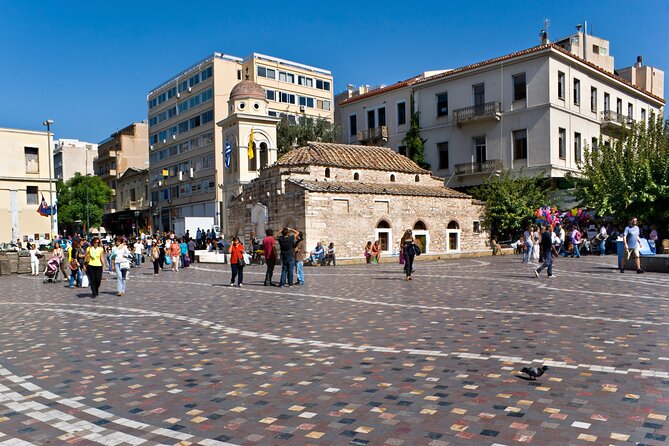
Monastiraki brings you into present-day Athens. The flea market around Monastiraki Square is the city’s best-known shopping area for souvenirs, small goods, and old objects. The planned stop lasts 30 minutes, enough to browse and get a feel for the district, but probably not enough for a serious shopping session.
From there, the Ancient Agora explains how Athens functioned beyond its temples. This was the center of political, commercial, administrative, social, religious, and legal life. If the Acropolis represents the city’s sacred and symbolic power, the Agora shows its daily machinery.
The Stoa of Attalos is the main reconstructed building in the Agora. It now houses a museum and gives you a strong sense of the colonnaded structures that framed ancient public space. The Temple of Hephaestus, dedicated to the god of fire, is among the best-preserved ancient temples in Greece. It is in the Thissio area and rewards a closer look at its columns and sculpted details.
Both the Agora and Stoa of Attalos require admission under the supplied plan. The itinerary allows about 20 minutes for the Agora and 30 minutes for the Stoa, with another 15 minutes at the Temple of Hephaestus. Those times are useful for a first look but short if you want to visit every museum room.
Plaka, the old neighborhood below the Acropolis, is a gentler finish. Narrow streets, neoclassical buildings, cafes, museums, and souvenir shops give it a village-like feel. The planned visit is only about 10 minutes, so use it for a quick walk and orientation rather than a full meal or long browse.
What the private vehicle adds

The tour includes hotel pickup and drop-off, an air-conditioned private vehicle, bottled water, and a vehicle described as a Skoda Kodiaq SUV or a luxury vehicle and C Class taxi. Airport pickup and drop-off are not included.
For a group of three, this setup is more comfortable than arranging separate taxis between every district. It also helps with heat, bags, and limited time. A driver who knows where to stop can get you close to several sights, then wait while you take photographs or walk through a neighborhood.
The driver is not a licensed guide permitted to accompany you inside the archaeological sites. That distinction is central to the value of the tour. You get transportation and commentary, not a formal guided lecture among the monuments. Several drivers are praised for explaining history in the vehicle, using historical photographs, suggesting lunch, and adjusting the route for family interests.
Alex is specifically noted for showing old photographs of Athens and helping with parking and lunch planning. Andrew is praised for his running commentary on the city’s past and present. Andreas is described as patient and flexible, while Evangelos is credited with tailoring the route to what the group wanted to see. Your assigned driver may differ, so treat these names as examples of the service style rather than a guarantee of who will drive.
Timing, tickets, and physical effort
The tour is a fast survey. The listed stops add up to more than six hours if treated as full visits, so the schedule clearly relies on short stops, drive-by views, and brief walks. Traffic, queues, weather, and the amount of time you spend at the Acropolis can change the balance.
Buy or arrange your entrance tickets ahead of time. The Acropolis and slopes are listed at €30 per person, and other archaeological sites also have fees. Food and drinks are not included, though a driver may help you find lunch. Bottled water is supplied.
Wear shoes suited to stone and uneven ground. The official requirement is moderate physical fitness, and you should expect walking at the Acropolis, the Agora, Plaka, and possibly Lycabettus. If you have a knee, mobility, or stamina concern, discuss it before the day begins. The experience can accommodate some needs through vehicle access and planning, but it is not a fully accessible tour by default.
Free cancellation is available up to 24 hours before the start time. Changes made inside that window are not accepted, and poor weather can lead to a different date or a full refund.
Who should book this Athens tour?
I would choose this tour for a first visit lasting only one day, a cruise stop with roughly six hours in Athens, or a small group that values a private car over a lower-cost group excursion. It is also a good fit if your group has different interests and you want a driver who can adjust the route.
I would not choose it if your main goal is a detailed archaeological lesson. Since the driver cannot guide you inside the sites, you may prefer a licensed guide plus a smaller number of monuments. I would also think twice if you want long meals, extensive shopping, or museum time.
The strongest reason to book is the combination of reach and flexibility. You can see Athens from several angles in one compact outing, from the Parthenon and Ancient Agora to the Olympic stadium, royal guards, and two major city viewpoints.
Should you book Panorama of Athens in 6 hours?
Book it if you want a private, comfortable overview and accept that many stops will be brief. At $459.74 for up to three people, it offers better value when shared by two or three people, especially since hotel transport and bottled water are included.
Before booking, plan for the extra entrance fees, confirm the pickup point, ask which vehicle and driver are assigned, and decide which stops matter most. If the Acropolis is your priority, reserve its admission in advance and protect enough time for it. For a broad first look at Athens, this tour covers an impressive amount of ground without forcing you to manage the city’s transport yourself.
FAQ
How long does the Panorama of Athens tour last?
The tour lasts approximately five to six hours.
How many people can join the private tour?
The price covers one private group of up to three people.
Is hotel pickup and drop-off included?
Yes. Hotel pickup and drop-off are included. Airport pickup and drop-off are not included.
Are entrance tickets included?
No. Entrance tickets must be purchased separately. The supplied information lists Acropolis and slopes admission at €30 per person, with admission free for those up to age 18.
Is a licensed guide included?
No. The tour includes professional drivers with historical knowledge, but they are not licensed to accompany you inside the archaeological sites.
What happens if the weather is poor?
Because the tour requires good weather, it may be canceled. You will then be offered a different date or a full refund.
Newly reviewed around Athens
- Athens: workshop for painting landscape with local artist★ 4.6 · 3 reviews
- Athens: Greek Wine & Olive Oil Tasting at Brettos Plaka★ 4.5 · 3 reviews
- Outdoor Yoga and Pilates with Akropolis view★ 4.0 · 5 reviews
- Acropolis of Athens: 60′ Tour in a Vintage Motorcycle★ 5.0 · 4 reviews
- Ultimate Tasting of the Volcanic Wines of Greece★ 5.0 · 3 reviews
- workshop for painting acropolis/landscape with local artist★ 5.0 · 3 reviews
- Athens at Twilight Night Tour with Drinks and Meze Dishes★ 4.8 · 4 reviews
- Breakfast in the markets with olive oil and honey tasting★ 4.8 · 8 reviews