

Reviewed · ATHENS ACROPOLIS TOURS
Guided walking tour of Acropolis with transportation
Athens opens with its best view: from the Acropolis, you look across the city to the sea while standing among the monuments of Pericles’ Golden Age. This tour pairs that 1,500-meter walk with a comfortable bus ride through central Athens, a sensible plan in the hot Greek sun.
I like the mix of ancient sights and modern city views, and I like having an English-speaking guide explain what you are seeing instead of simply handing you a map. Guides such as Maria Anna, Mina, and Zeta have been praised for warmth, patience, and clear explanations. The main drawback is that the Acropolis entrance fee is not included, and the rough stone surfaces can be hard work for anyone with limited mobility.
Key points to know before booking

- The Acropolis is the main event: See the Propylaea, Temple of Nike, Parthenon, Theater of Dionysus, and Odeon of Herodes Atticus.
- The bus saves your legs: After the uphill archaeological site, ride through central Athens in an air-conditioned coach.
- The route covers major landmarks: You pass the Panathenaic Stadium, Parliament, National Garden, Temple of Olympian Zeus, Syntagma Square, University, Academy, and National Library.
- The ticket costs extra: The supplied information lists an adult Acropolis ticket at €30. Children up to age 18 enter free.
- The walking surface is uneven: Wear sturdy, comfortable shoes and bring water and a sun hat.
- It is not an accessible tour: The experience is not suitable for wheelchair users or people with mobility impairments.
Starting at Syntagma Square
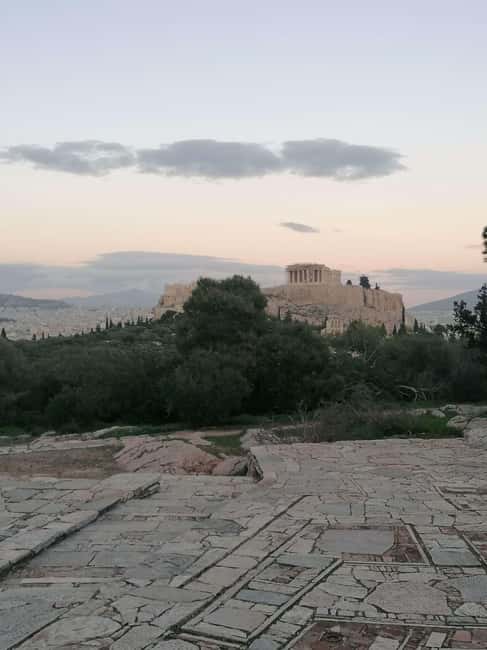
Your meeting point is outside Hotel Amalia at 10 Amalias Avenue, beside Syntagma Square. This is a central and practical starting place, close to several of Athens’ best-known sights and easy to identify in the busy city center.
The tour begins with the walking portion. That order makes sense because the Acropolis is the part that requires the most effort, and you want your guide with you while you are seeing the monuments rather than trying to make sense of them afterward.
The advertised duration is three hours, though exact timing can vary. One account finished in about two hours, while a separate upgraded experience lasted five hours and added the Acropolis Museum. For this booking, plan around the stated three-hour schedule and do not assume museum admission or a longer visit is included.
More ways to see the Acropolis:
- Athens: Acropolis & up to 5 Archaeological Sites Combo Pass
★ 4.4 · 12,619 reviews - Athens: Acropolis Ticket with Optional Audio or Live Guide
★ 4.2 · 11,055 reviews - Athens: Acropolis, Parthenon & Acropolis Museum Guided Tour
★ 4.8 · 9,316 reviews
Walking into the Acropolis
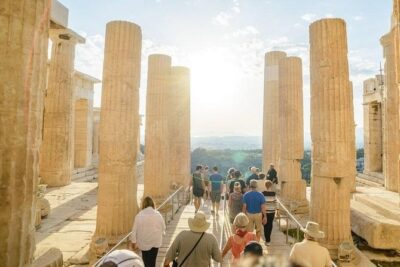
The Acropolis is not a quick photo stop. You will walk uphill over ancient stone and modern paths, then move among some of the most important buildings in classical Greece. The total distance is listed at approximately 1,500 meters, with some slippery surfaces along the way.
Your guide leads you toward the Propylaea, the monumental gateway to the Acropolis. Even before you reach the Parthenon, this entrance gives you a strong sense of the hill’s purpose. It was designed to make arrival feel grand, and the climb helps you understand why the site was both a religious center and a symbol of Athenian power.
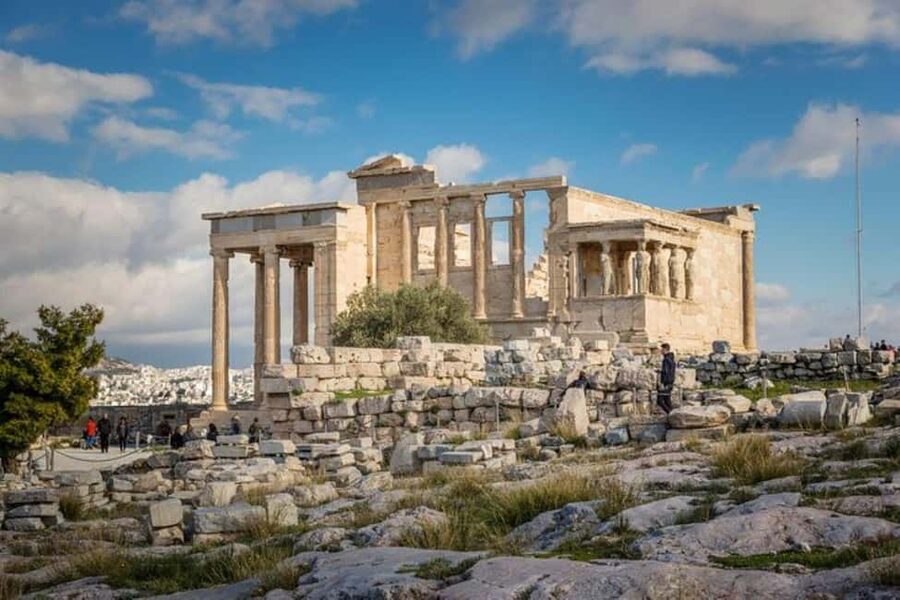
The Temple of Nike is another early highlight. It is a small temple compared with the Parthenon, but its position near the entrance makes it easy to appreciate. Your guide can help connect the surviving stones to the larger civic and religious world of fifth-century Athens.
This is where a live guide adds real value. Columns and foundations can blur together when you are on your own, especially in bright light and among large groups. A good guide gives you a sequence to follow and points out details that are easy to miss.
Standing before the Parthenon
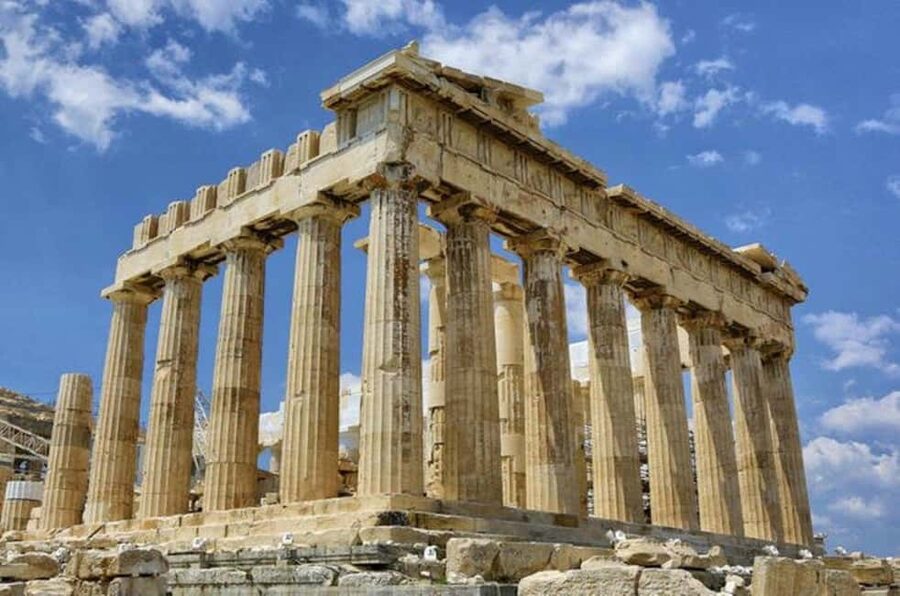
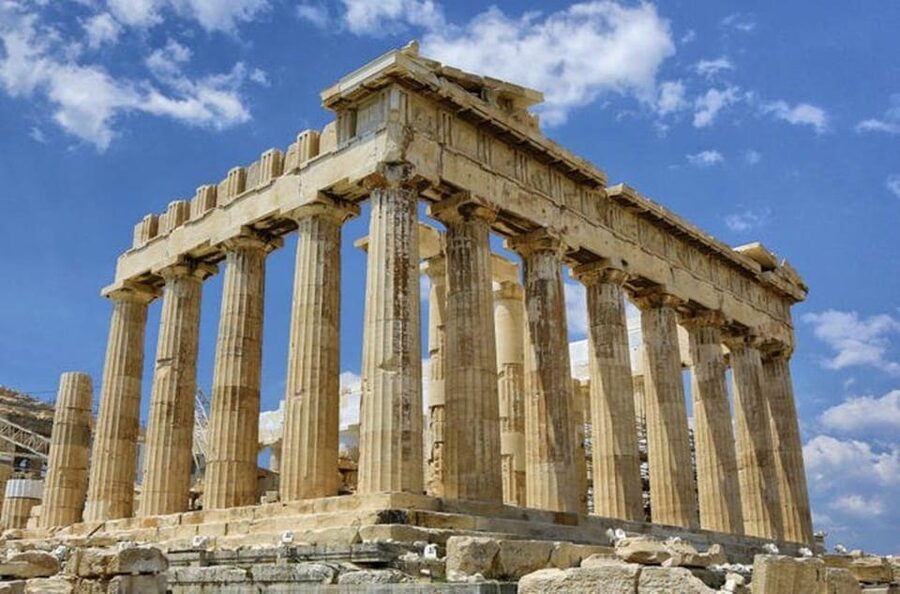
The Parthenon is the visual center of the visit. Built during the Golden Age of Pericles, it was dedicated to Athena, the city’s patron goddess. You will see the building from different angles as the route moves around the Acropolis, and each view reveals something slightly different about its scale and design.
The Parthenon is partly ruined, so you should not expect an untouched temple interior. Its surviving columns, sculptural elements, and restoration work tell a more complicated story. The building has endured war, explosions, religious changes, reuse, and centuries of weathering.
Your guide’s explanation matters most here. Without context, the Parthenon can become a famous building you photograph and leave behind. With context, you begin to see how architecture, religion, politics, and city pride were tied together in ancient Athens.
The top of the Acropolis also gives you sweeping views over Athens and toward the sea. The city spreads in every direction, with modern streets and apartment blocks reaching far beyond the ancient hill. That contrast is one of the pleasures of the visit. You are not looking at a museum piece isolated from daily life. You are seeing the old center of a city still functioning below you.
Theaters below the Acropolis

The route includes the Theater of Dionysus and the Odeon of Herodes Atticus. These sites sit below the Acropolis and add a welcome human element to the visit.
The Theater of Dionysus is linked with the beginnings of ancient Greek drama. This was not simply a venue for entertainment. Drama was part of public life, religion, and civic debate, and the theater’s setting helps you picture how performances fit into the city.
The Odeon of Herodes Atticus is a more compact performance space, known for its strong stone structure and striking position beneath the Acropolis. It is still used for performances, though this tour focuses on seeing it from the archaeological site rather than attending a show.
These stops also break up the focus on temples and columns. You get a better sense of ancient Athens as a city of performances, public gatherings, religious ceremonies, and political life, not just a collection of ruins.
More walking tours in Athens:
- Athens: Acropolis and Parthenon Guided Walking Tour
★ 4.6 · 5,882 reviews - Greek Food Walking Tour in Athens
★ 5.0 · 4,740 reviews - Acropolis: Acropolis and Parthenon Guided Walking Tour
★ 4.7 · 3,442 reviews - Acropolis monuments & Parthenon Walking Tour with Optional Acropolis Museum
★ 5.0 · 2,678 reviews
Seeing Athens from the air-conditioned bus
After the Acropolis walk, you return to the meeting point area and continue by air-conditioned coach. The bus portion lasts about 20 minutes according to the stated itinerary, while the wider guided city visit is described as part of the three-hour experience.
This is a useful change of pace. Athens can be hot, noisy, and tiring, particularly during the middle of the day. Sitting in an air-conditioned vehicle lets you see more of the center without adding another long walk to your schedule.
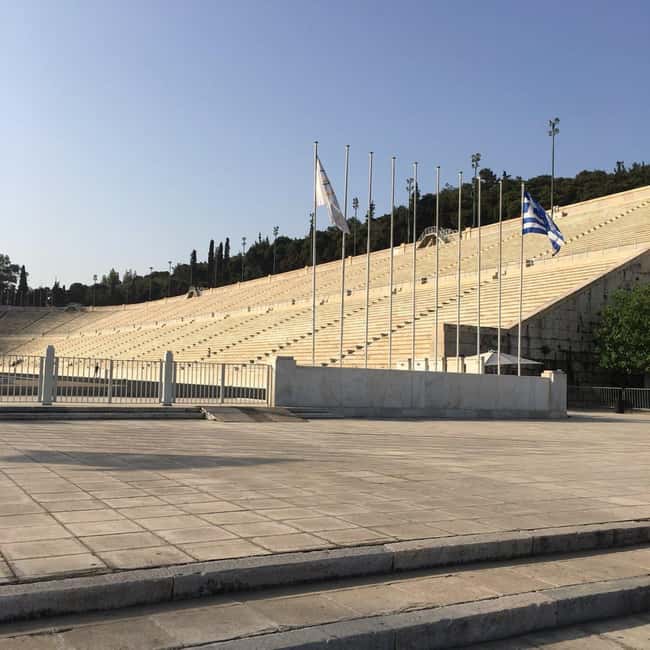
The city drive includes the Panathenaic Stadium, the only major stadium built entirely of marble. It is associated with the modern revival of the Olympic Games and also reflects the city’s effort to connect modern Athens with its ancient past.
You will also pass the Greek Parliament House at Syntagma Square. The square is one of the city’s main civic spaces, and the Parliament building gives the bus route a modern political counterpoint to the ancient Acropolis.
The National Garden provides a change from grand stone buildings and broad traffic routes. The Temple of Olympian Zeus brings you back to the ancient world, though the enormous surviving columns are best appreciated from the coach if you are short on time.
The route also includes the University, Academy, and National Library. These neoclassical buildings form an important part of central Athens and show how the modern Greek state used classical forms to express its national identity.
A bus tour cannot give you the same close look as walking. You may see some sights mainly from the window, and traffic can affect the pace. Still, this section works well as an overview. It helps you place the Acropolis within the wider city rather than treating it as a separate stop.
What your guide adds

The tour includes an official English-speaking guide, and the guide is central to the experience. The most praised qualities are warmth, patience, and the ability to explain the sights clearly.
Zeta has been described as patient and kind, with a calm manner that worked especially well when the group became very small. Mina has been praised for giving a strong overview and sharing a great deal of information. Maria Anna has received particularly warm praise for working well with both adults and children.
Those names may not be available on every departure, so you should not book on the assumption that one specific guide will lead your group. The useful point is that the tour depends heavily on the guide’s storytelling. The same route can feel rushed and flat with weak commentary, or clear and memorable with someone who knows how to connect the ruins to Athenian life.
The group size may also vary. One account began with five people and became a private-style Acropolis visit when another couple left before the hill. That is not a promise of a private tour, but a smaller group can make it easier to ask questions and stay close to the guide.
The real cost of the experience
The listed tour price is $32.75 per person, which is reasonable for a three-hour guided outing with transportation. It covers the guide and the air-conditioned bus, but not entry to the Acropolis.
The supplied information lists the adult Acropolis entrance fee as €30. That means your real cost will be higher than the advertised tour price, and you should budget for the ticket before deciding that this is a low-cost activity. Children up to age 18 have free admission to the Acropolis, according to the tour information, which can make the total more attractive for families.
The inclusion of transport is valuable if you want a broad first look at Athens without arranging a separate sightseeing bus. You are paying for structure, commentary, and convenience rather than admission alone.
One detail needs care: an account of an alternate or upgraded outing refers to a €20 Acropolis fee, while the current information supplied for this experience states €30 for adults. Treat €30 as the safer amount to budget, and confirm the exact ticket charge when booking.
Shoes, heat, and mobility
Wear shoes with good grip. The Acropolis includes uneven and potentially slippery surfaces, and the walk covers roughly 1,500 meters. Lightweight walking shoes are more useful here than sandals with a thin sole or fashionable shoes with poor support.
Bring water and a sun hat. The site is exposed, and the combination of stone, sun, and uphill walking can make the Acropolis feel harder than the distance suggests. There is no reason to carry a large bag, especially since backpacks are not allowed.
Food and drinks are not allowed in the vehicle. Plan to eat before or after the tour rather than relying on a snack during the bus ride.
This is not a suitable choice for wheelchair users or people with mobility impairments. The uneven surfaces, uphill route, and ancient-site access make the walking section physically demanding. If you need step-free access or regular seating, choose a different Athens sightseeing plan.
Is the Acropolis Museum included?
No. The core experience described here includes the Acropolis and the city drive, not a guided visit to the Acropolis Museum.
One separate extended option included museum time after the Acropolis and coach tour, but you should not assume that museum visit is part of the three-hour booking. If the museum is important to you, check the exact product details before paying, or plan a separate visit.
That distinction matters because the museum holds many original sculptures and archaeological finds connected to the Acropolis. The hill gives you the setting and the buildings, while the museum provides a more controlled look at objects and decoration. They work well together, but they are not the same experience.
Who should book this tour?
I would choose this tour if you have limited time in Athens and want a guided Acropolis visit plus a quick look at the city’s major central landmarks. The bus is especially useful if you do not want to spend the rest of the day walking between the sights.
It also suits first-time visitors who want a clear introduction. You will see the most important Acropolis monuments, hear the basic story of classical Athens, and pass several modern and ancient landmarks in one outing.
Families may appreciate the guide-led format and the fact that children up to age 18 have free Acropolis admission. Maria Anna’s reported ease with both children and adults is encouraging, though guide assignments can change.
I would hesitate if your priority is a long, quiet archaeological visit. Three hours is enough for an overview, but not enough to study every monument, take an unhurried set of photographs, and visit the museum. I would also avoid it if you have serious mobility limits or do not enjoy uneven uphill walking.
Cancellation is free up to 24 hours before the activity, and you can reserve now and pay later. Those terms help if your Athens schedule is still shifting, but the main booking decision remains simple: can you handle the walk, and are you prepared to pay the Acropolis ticket separately?
Should you book it?
Book this tour if you want an efficient introduction to Athens with a proper Acropolis visit, a live English-speaking guide, and air-conditioned transport between the major sights. The strongest value is the combination of ancient monuments and city orientation in one compact outing.
Skip it if you want the Acropolis Museum included, need an accessible route, or prefer to explore at your own slow pace. For most first-time visitors with three hours to spare, it is a practical choice, provided you budget for admission and wear serious walking shoes.
FAQ
Where does the tour start?
It starts at Hotel Amalia, 10 Amalias Avenue, beside Syntagma Square in Athens.
Where does the tour end?
The tour ends back at the same meeting point near Hotel Amalia.
How long does the activity last?
The stated duration is three hours. Starting times depend on availability.
What language is the tour conducted in?
The tour is conducted in English with a live English-speaking guide.
Is transportation included?
Yes. Transportation is provided in a deluxe air-conditioned bus.
Is the Acropolis entrance fee included?
No. The entrance fee is separate. The supplied information lists the adult ticket at €30.
Do children pay the Acropolis entrance fee?
Children up to age 18 have free entrance to the Acropolis according to the activity information.
Is the Acropolis Museum included?
No. The core tour does not include a guided visit to the Acropolis Museum.
What should I bring?
Bring comfortable shoes, a sun hat, and water. Some surfaces at the Acropolis may be slippery.
Is the tour suitable for wheelchair users?
No. The activity is not suitable for wheelchair users or people with mobility impairments.
Newly reviewed around Athens
- Feel Ancient thermal Spa Visit Delphi, Leonidas ℨoo Spaʀtan★ 5.0 · 4 reviews
- Food Tour★ 5.0 · 3 reviews
- Eat Your Way Through Athens: A Local Food Walk★ 4.9 · 97 reviews
- Explore the Hidden Food Gems of Athens★ 5.0 · 57 reviews
- Food Experience in Athens including Unlimited Lunch★ 5.0 · 3 reviews
- From Athens: Delphi Private Tour with Lunch Time★ 4.0 · 3 reviews
- Delphi: Spanish guided one day tour★ 4.6 · 55 reviews
- Early Entry Acropolis & Museum. Beat the Crowds & the heat★ 5.0 · 3 reviews
Athens Acropolis Tours, compared.
Acropolis & up to 5 Archaeological Sites Combo Pass
Read our review →
Acropolis, Parthenon & Acropolis Museum Guided Tour
Read our review →
Acropolis, Parthenon & Acropolis Museum Guided Tour
Read our review →

Acropolis monuments & Parthenon Walking Tour with Optional Acropolis Museum
Read our review →Browse the lists this tour appears in