
Reviewed · ATHENS ACROPOLIS TOURS
Beat the Heat Acropolis Tour – Small group
The best reason to book this tour is the late-day timing. You walk up the Acropolis after the worst midday heat, when the light turns warm on the marble and Athens begins to glow below. The group is capped at 15, and guides such as Maria, Michalis, Athina, and Vicky bring the myths and building plans to life rather than leaving you to guess what you are seeing.
I like the small group and the tight two-hour route. I also like that it covers the major monuments without trying to cram in every corner of the hill. The main catch is important: your Acropolis entry ticket is not included in the $54.44 tour price, and the €30 admission fee must be arranged separately.
Key points at a glance
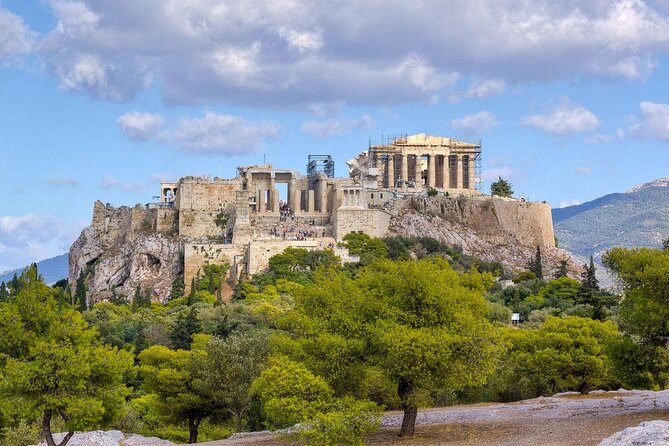
- Late afternoon helps with heat: The 5 PM departure is cooler than midday and can offer fine sunset light, though the Acropolis may still be crowded.
- Five major sites in two hours: The route includes the Theater of Dionysus, Temple of Athena Nike, Erechtheion, Propylaea, and Parthenon.
- Small groups matter: The maximum is 15 people, with some departures forming groups of only 7 to 11.
- Entry costs extra: The €30 Acropolis ticket is separate from the tour price, though the operator can pre-purchase it for you.
- Expect a real uphill walk: Marble can be slick, slopes are steep, and sturdy shoes with good grip are a smart choice.
- Guides are the star: Guides including Maria, Michalis, Calliope, Christia, and Vicky are praised for clear storytelling, humor, and strong knowledge of ancient Athens.
Why the late afternoon works so well
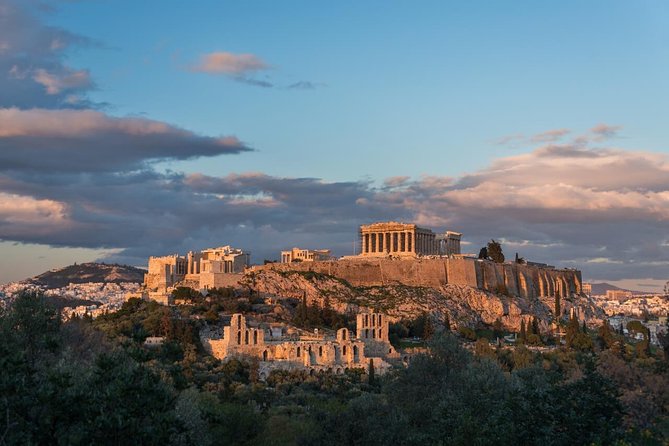
Athens can be punishing in summer. The Acropolis sits on an exposed rocky hill, with little shade once you reach the upper monuments. A late afternoon departure gives you a better chance of avoiding the fiercest heat, and the changing light makes the marble look far more dramatic than it does under a hard white sun.
The tour is commonly offered around 5 PM. That timing does not make the hill empty. You should still expect crowds at the top, especially in July, but the crush is often less severe than earlier in the day. The best departures can finish near sunset, with views across Athens toward the port of Piraeus.
There is one timing detail to watch closely. Some seasonal closing hours can limit how long you remain on the hill. One experience ended with a rushed final stretch because staff were preparing to close the site. Check the exact start time and closing hour for your date, and arrive ready to walk rather than spending too long at the meeting point.
More ways to see the Acropolis:
- Athens: Acropolis & up to 5 Archaeological Sites Combo Pass
★ 4.4 · 12,619 reviews - Athens: Acropolis Ticket with Optional Audio or Live Guide
★ 4.2 · 11,055 reviews - Athens: Acropolis, Parthenon & Acropolis Museum Guided Tour
★ 4.8 · 9,316 reviews
Starting at Hadrian’s Arch
The meeting point is the Arch of Hadrian on Leoforos Vasilisis Amalias 50. This is a useful place to begin because the arch itself introduces the layered story of Athens. It marked a boundary between the old Greek city and the Roman expansion associated with Hadrian.
You meet the guide here before heading toward the Acropolis. The tour ends at the Acropolis, not back at the arch, so plan your evening from the upper hill. That is convenient if you want to continue into Plaka or find dinner nearby, but less convenient if you need to return to a hotel in another part of Athens.
Public transportation runs near the meeting point. You do not get hotel pickup, food, drinks, or transportation as part of the experience. Bring water before you start, since the tour is on foot and the upper Acropolis offers limited relief from the sun.
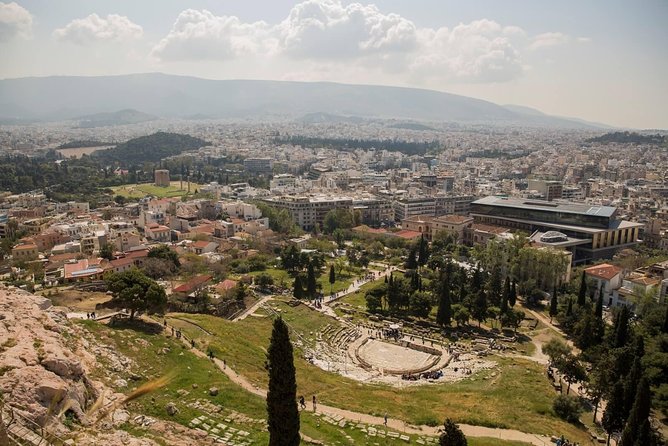
The Theater of Dionysus, where Greek drama began

The first stop is the Theater of Dionysus Eleuthereus, usually a 15-minute introduction to one of Athens’ most important cultural sites. Dionysus was linked with wine and the grape harvest, but his theater became famous for something even more lasting: the first performances of works by Aeschylus, Sophocles, Euripides, and Aristophanes.
This stop gives your guide a chance to explain how drama, religion, and civic life fit together in ancient Athens. You are not just looking at rows of stone seats. You are standing where some of the foundational plays of Western theater were first performed.
The short stop works well for orientation, although anyone fascinated by classical drama may want more time here. The tour has a full upper Acropolis route to cover, so the guide keeps the visit focused.
The Temple of Athena Nike and the climb upward
The Temple of Athena Nike is small compared with the Parthenon, but its position near the entrance makes it one of the first monuments to catch your eye. Athena Nike joined Athena, the city’s protector, with Nike, the goddess of victory.
Your guide will likely explain the old idea that the cult statue had no wings so victory would never fly away from Athens. It is a compact story, but it shows how myth and civic pride were built into the Acropolis.
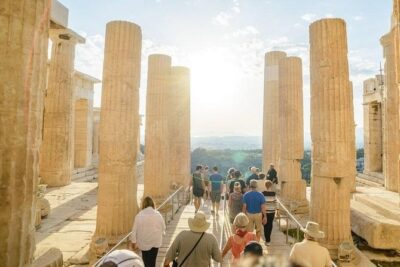
The climb becomes more noticeable around this part of the route. This is not a flat museum visit. You walk uphill over ancient surfaces and modern paths, and the final approach can feel strenuous in hot weather. The pace is generally described as manageable, but you should be comfortable walking for two hours with repeated stops.
A different kind of day out from Athens:
- Athens: Cape Sounion & Poseidon Temple Sunset Half-Day Trip
★ 4.8 · 8,241 reviews - Athens: Acropolis and Parthenon Guided Walking Tour
★ 4.6 · 5,882 reviews - All Day Cruise -3 Islands to Agistri,Moni, Aegina with lunch and drinks included
★ 5.0 · 4,958 reviews - Athens, Piraeus, and Coastline: Blue Hop-On Hop-Off Bus
★ 3.9 · 4,849 reviews
The Erechtheion and its famous porch
The Erechtheion is one of the most memorable buildings on the Acropolis because it is less rigid than the Parthenon. Its irregular shape reflects the complicated sacred traditions attached to the rock. The temple housed an ancient wooden cult image of Athena and helped honor the city during Athens’ period of power.
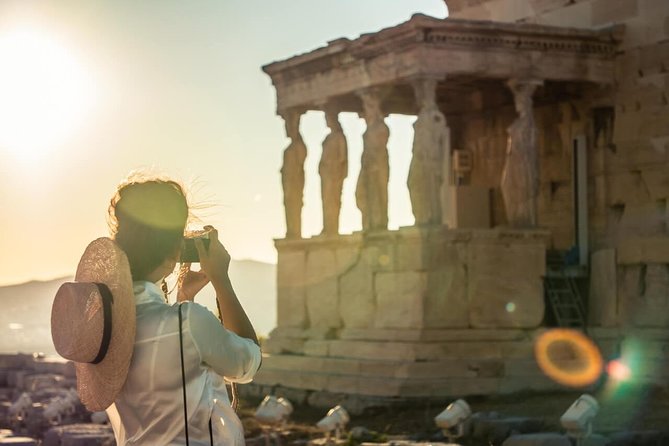
The porch with the Caryatid figures is the detail most people remember. Your guide can help you understand why the building looks so different from the clean, symmetrical Parthenon. This is one of the places where a live guide adds real value, since the site’s meaning is not obvious from the stones alone.
You will spend about 15 minutes here. The stop is short, but the guide’s explanation can make the difference between seeing a striking porch and understanding why the building was designed in such an unusual way.
The Propylaea, a grand entrance with little room to linger
The Propylaea served as the monumental entrance to the Acropolis. It was meant to shape the first impression of the sacred hill, and its scale still helps you feel the shift from ordinary Athens to the ceremonial world above.
This stop is listed at about 15 minutes. The space can be crowded, and you may need to stay close to the guide while other groups pass through. The wireless headset is intended to make that easier. Since one account found a soft-spoken guide hard to hear in the crowd, stay alert for instructions and tell the guide promptly if the sound is not clear.
The group limit helps here. A party of 7 to 11 is much easier to keep together than a large coach group, and it is simpler to ask a question without holding up dozens of people.
The Parthenon takes the final hour
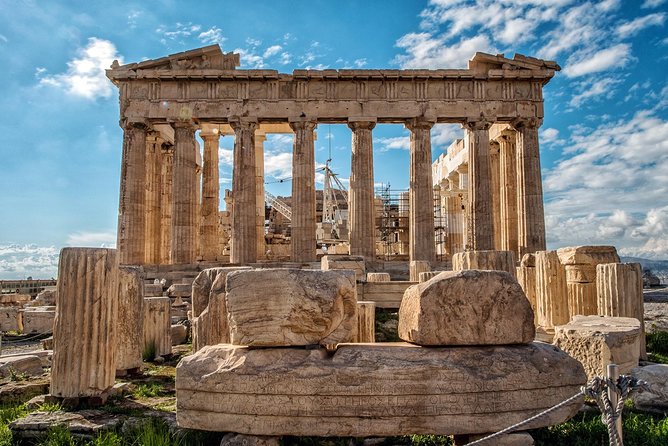
The Parthenon receives about an hour, and rightly so. Built in the mid-5th century BCE for Athena Parthenos, it is the monument that dominates the Acropolis and the image most closely tied to Athens.
A good guide can turn the familiar columns into a lesson in design, power, and religious purpose. Guides such as Maria and Vicky have been praised for making complex material clear, while Michalis is noted for using humor and energy to keep the walk lively. Another guide, Maria, is described as an archaeologist who explained construction methods and showed how the buildings may have looked in their original setting.
That extra context matters because the Parthenon is not preserved as a complete temple. You see surviving columns, sculptures, repairs, and open sky where ancient decoration once stood. A guide helps you picture the building as a working sanctuary rather than a stripped ruin.
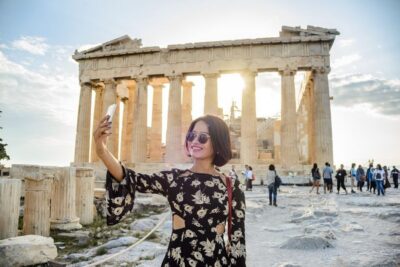
The final hour is not necessarily one continuous lecture. Expect pauses for explanations, views, questions, and photographs. Several guides are happy to take photos, which is useful at sunset when the light is best but the group is still moving on a schedule.
How the small group changes the experience
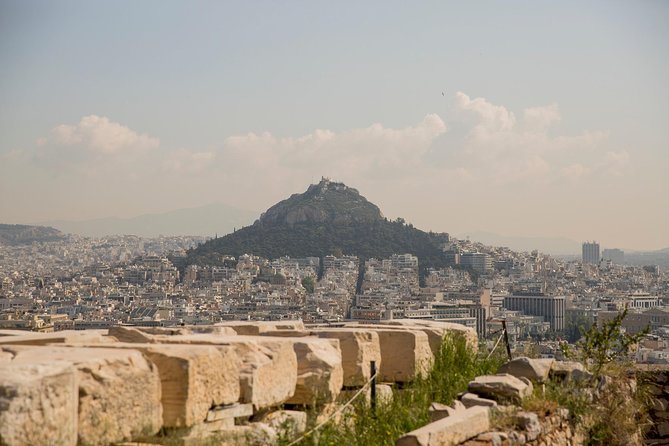
A maximum of 15 people is a practical size for the Acropolis. You can hear more easily, keep up on the slopes, and ask questions without shouting across a crowd. The guide can also watch the pace more closely, which helps families and anyone who wants a little more personal attention.
The small format does not erase the crowds. The Acropolis is one of Europe’s busiest ancient sites, and the upper hill can still feel packed at 5 PM. What it changes is how you handle those crowds. A compact group can move through openings, gather around a single explanation, and avoid the lost feeling that often comes with a large tour.
The listed wireless headsets should help you follow the guide while standing a little away from the main cluster. Still, sound depends on the guide, the device, and the noise around you. If hearing clearly is a priority, stay near the guide and confirm that your headset works before the route gets busy.
What the $54.44 price really covers
At $54.44 per person, you are paying for the English-speaking licensed guide, the small-group format, the two-hour route, and the included map of ancient Athens. The value is strongest if this is your first Acropolis visit or if you want the monuments explained instead of simply photographed.
The total cost is higher than the headline price because the Acropolis entry ticket is separate. Admission is listed at €30 per person, and the operator can pre-purchase it if you ask. That arrangement may be worth using because arriving without a ticket can cause serious trouble.
You need to understand this point before booking. One party arrived without tickets, found a long queue, and could not buy admission within the short waiting window before the group left. The operator says the ticket requirement is explained and reminders are sent, but the practical lesson is simple: arrange the €30 ticket in advance and do not count on buying it at the last minute.
People under 25 should carry an ID card or passport in case a discount applies. Entry fees are non-refundable and non-exchangeable, so check the details carefully before you finalize the purchase.
The walking conditions you should expect
The Acropolis route includes hills, uneven ground, steps, and polished marble. Some terrace areas can be slippery, especially in smooth-soled shoes. Wear walking shoes with a strong grip, and leave large backpacks and bags behind because they are not allowed on the Acropolis.
Most people can take part, but this is still a hilltop walking tour rather than an easy stroll. Heat, steep sections, and standing in the sun can wear you down. Children can enjoy it, especially when the guide uses myths and questions to keep them involved, but the amount of historical explanation may suit adults and older children better.
Strollers and big bags are not allowed. Service animals are allowed. You should also carry water and protect yourself from the sun, since the experience does not include drinks or refreshments.
Who should book this Acropolis tour
I would choose this tour if you want a clear first visit with the major monuments in one focused walk. It is especially useful for people who want the stories behind the Theater of Dionysus, Erechtheion, and Parthenon, not just time to wander among the stones.
It also suits families with older children and teenagers when the guide is lively. Several guides have been praised for keeping younger people engaged, and the two-hour length is easier to manage than a long full-day archaeological tour.
Photographers should consider the late slot for the warm light and sunset views. Just remember that the best light may arrive near closing time, so you might have little free time after the guide’s explanations.
I would skip it if you want a completely independent visit, a slow pace, or a long period inside each monument. I would also avoid booking until your ticket is settled. The tour itself may be well organized, but the separate admission requirement is the one detail most likely to spoil the day if overlooked.
Cancellation and final booking advice
You can cancel up to 24 hours before the start for a full refund. Changes made within 24 hours are not accepted, and cancellations inside that window are not refunded. Poor weather or failure to reach the minimum group size can lead to a different date, another experience, or a full refund.
My advice is to book this tour if you want a compact, well-explained Acropolis visit and can handle the uphill walk. Choose the late afternoon for cooler temperatures and better light, confirm the exact closing time, wear shoes with grip, and arrange the €30 entry ticket well before meeting at Hadrian’s Arch.
FAQ
Are Acropolis entry tickets included?
No. The €30 Acropolis entry fee is separate from the $54.44 tour price. The operator can pre-purchase the ticket if you request it.
Where does the tour start and finish?
The tour starts at Hadrian’s Arch, at Leoforos Vasilisis Amalias 50 in Athens. It ends at the Acropolis of Athens.
How long is the tour?
The planned duration is about two hours. One departure ran about two hours and 15 minutes, so allow a little extra time.
How many people can join the group?
The maximum group size is 15 people. Some departures have had groups of 7 to 11.
What should I wear or bring?
Wear sturdy walking shoes with good grip because the route includes steep sections and slippery marble. Do not bring a stroller, backpack, or large bag, since these are not allowed at the Acropolis. People under 25 should carry an ID card or passport for possible discounts.
Can I cancel for a full refund?
Yes, if you cancel at least 24 hours before the experience begins. Cancellations within 24 hours are not refunded. If poor weather or an insufficient minimum group causes the operator to cancel, you will be offered another date or experience, or a full refund.
Newly reviewed around Athens
- Feel Ancient thermal Spa Visit Delphi, Leonidas ℨoo Spaʀtan★ 5.0 · 4 reviews
- Food Tour★ 5.0 · 3 reviews
- Explore the Hidden Food Gems of Athens★ 5.0 · 57 reviews
- Food Experience in Athens including Unlimited Lunch★ 5.0 · 3 reviews
- Eat Your Way Through Athens: A Local Food Walk★ 4.9 · 97 reviews
- From Athens: Delphi Private Tour with Lunch Time★ 4.0 · 3 reviews
- Delphi: Spanish guided one day tour★ 4.6 · 55 reviews
- Early Entry Acropolis & Museum. Beat the Crowds & the heat★ 5.0 · 3 reviews
Athens Acropolis Tours, compared.
Acropolis & up to 5 Archaeological Sites Combo Pass
Read our review →
Acropolis, Parthenon & Acropolis Museum Guided Tour
Read our review →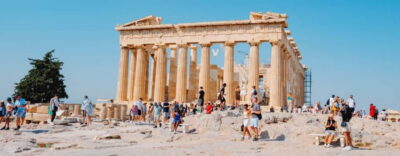
Acropolis, Parthenon & Acropolis Museum Guided Tour
Read our review →
Acropolis monuments & Parthenon Walking Tour with Optional Acropolis Museum
Read our review →Browse the lists this tour appears in