

Reviewed · CITY TOURS
Athens City of Rebellion Small-Group Walk
Athens’ ancient monuments are only half the story. This walk follows the city’s long fight for freedom, from the Ottoman period and Greek independence to Nazi occupation, student protest, and today’s activism in Exarchia. Guide Maelle brings a clear, personal voice to a subject many standard Athens tours skip.
I like the route for two reasons: it connects famous places such as Monastiraki and Syntagma Square to events you might otherwise miss, and it ends in Exarchia, a neighborhood where politics, art, community projects, and conflict still meet. The small group, capped at six, also leaves room for questions and conversation.
The main drawback is the walking. You cover city streets for about two and a half hours, with little emphasis on ancient Athens or museum interiors. If steep walking or long periods on your feet are difficult, this is not the best fit.
Key points
- A six-person maximum keeps the walk personal and makes it easier to ask questions.
- The route links Ottoman rule, Nazi occupation, student protest, and present-day activism.
- Syntagma Square provides the tour’s clearest look at Athens as a place of public resistance.
- Exarchia is the finale, with street art, citizen-led projects, and debates over policing and gentrification.
- Maelle’s storytelling gives the walk a human focus, including individual acts of courage and larger popular movements.
- The $46.29 price is reasonable if you want context about modern Greece rather than another pass by ancient ruins.
Why this Athens walk tells a different story
This is not a greatest-hits tour of classical Athens. You will not spend the morning moving from the Acropolis to the Agora, ticking off marble temples. Instead, the walk asks a more modern question: how did Athens become a city where public squares, universities, walls, and neighborhoods carry the memory of resistance?
That approach fills an important gap. Many first-time visitors understand Athens through antiquity, then find the path from classical Greece to the modern state less clear. This walk helps connect the Ottoman era, the Greek revolution, the creation of the modern kingdom, the Second World War, student movements, and the social tensions of present-day Athens.
I especially like the way the route moves through ordinary city spaces. A square, a small church, a former government building, and a neighborhood park become evidence in a much larger story. The experience works best if you want to understand what you are seeing on the street, not just collect photographs of famous buildings.
More walking tours in Athens:
- Athens: Acropolis and Parthenon Guided Walking Tour
★ 4.6 · 5,882 reviews - Greek Food Walking Tour in Athens
★ 5.0 · 4,740 reviews - Acropolis: Acropolis and Parthenon Guided Walking Tour
★ 4.7 · 3,442 reviews
Starting at Monastiraki and the Ottoman past

The meeting point is Pl. Monastirakiou 2, at Monastiraki Square. Your guide welcomes you here before the group begins moving through central Athens. The square is an effective starting point because it is familiar, easy to reach by public transport, and tied to several layers of the city’s past.
The first stop is the Tzisdarakis Mosque. You will look at Athens under Ottoman rule and consider a city that once had a minaret rising near the Acropolis. The guide also explains how resistance to Ottoman control helped lead to the Greek revolution.
This section gives needed context without treating independence as a simple story of heroes and villains. You begin to see how religious buildings, political power, and national identity overlapped in Athens. The mosque stop is brief, about 10 minutes, so expect a focused explanation rather than a long architectural visit.
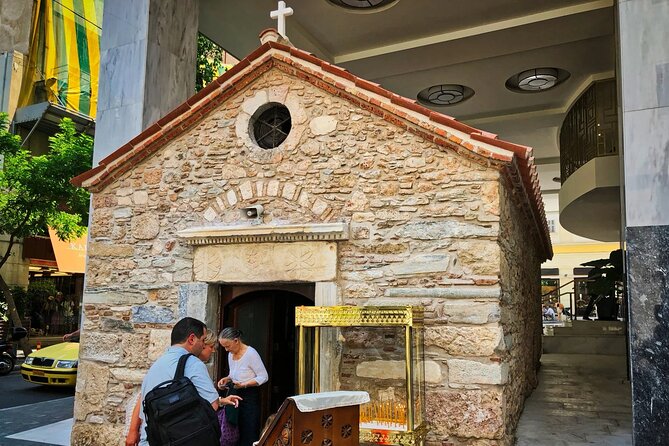
The route then reaches the Holy Church of the Sacred Power, also called Ayìa Dynami. This small church is linked to Greek resistance during Ottoman occupation. Its importance lies less in grand design than in the way a modest religious site could serve people involved in resistance.
That contrast is one of the walk’s strengths. Athens’ story is not told only through palaces and monuments. It also survives in small places that are easy to pass without knowing what happened there.
Syntagma Square and the city’s public memory
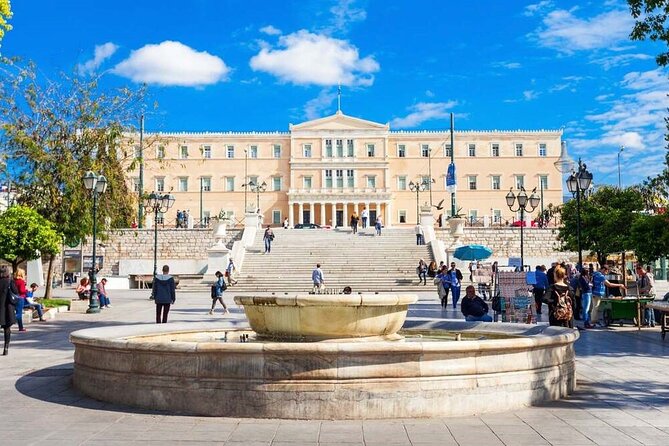
Syntagma Square is the route’s central stop, and you spend about 15 minutes here. This is the symbolic heart of political life in Athens, a place tied to royal rule, military power, occupation, protest, and public demands for change.
You will hear about the Old Palace, built for the first king of modern Athens after the Greek revolution. Today it serves as the Greek Parliament, but the walk focuses on the building’s earlier role and the political story around it. The setting helps you picture the young Greek state trying to define itself after independence.
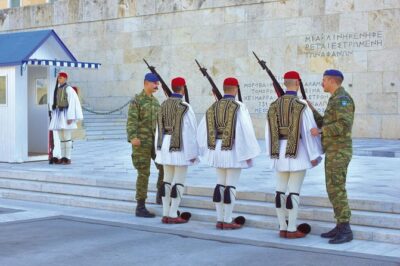
The square also holds the Tomb of the Unknown Soldier. You will see the Evzones, the ceremonial soldiers who guard it, and learn about their distinctive uniforms. The stop is short, about five minutes, but it gives you time to notice the formal ceremony and understand why this site carries such strong national meaning.
The route also points out a building now used as a luxury hotel. Its polished present hides a darker past connected with the Nazi occupation of Athens. That shift from elegant hotel to wartime headquarters is a useful reminder that the city’s recent past is close at hand, even when modern uses make it easy to overlook.
Syntagma works well on this walk because it brings several kinds of power into one place: monarchy, parliament, foreign occupation, military ceremony, and mass protest. You are not simply looking at a square. You are reading the political life of Athens through one urban stage.
The university and the fight for civil liberties
From Syntagma, the walk continues to the National and Kapodistrian University of Athens. Here, the focus turns to students and universities as forces in the struggle for civil liberties.
This stop adds an important social dimension. Resistance was not only the work of famous leaders or armed groups. Students, teachers, and ordinary citizens also shaped political change. The university helps show how education can become a meeting place for dissent and public action.
The time at this stop is about 10 minutes. That is enough for a clear explanation, but not enough for a full account of every student movement or political crisis in Greece. If modern Greek politics is your main interest, you may want to ask questions while the group is small.
That small-group format matters here. With no more than six people, you are less likely to lose the guide’s thread in central Athens crowds. Maelle’s approach, based on the information available about the walk, gives particular attention to how individuals and collective movements shaped the city. The result is more discussion-based than a large group lecture.
More city tours in Athens:
- Athens: City Sightseeing Hop-On Hop-Off Bus Tour
★ 4.3 · 4,520 reviews - City Sightseeing Athens, Piraeus & Beach Riviera Hop-On Hop-Off Bus Tours
★ 4.0 · 1,887 reviews - Athens:City Pass with Acropolis, Museums, Hop-On Hop-Off Bus
★ 3.9 · 586 reviews - Athens: City Highlights Bike tour
★ 4.9 · 453 reviews
Navarinou Park and citizen action in Exarchia
The walk then heads toward Navarinou, a park with an unusual origin. It reflects a citizen-led initiative in the heart of Exarchia, where local action changed the use and meaning of an urban space.
This is a valuable stop because it widens the idea of rebellion. Resistance does not always mean a dramatic uprising. It can also mean residents taking responsibility for a neglected place and arguing over who has the right to shape a neighborhood.
Navarinou introduces the character of Exarchia before you reach the neighborhood’s busier political subjects. You begin to see why this part of Athens attracts anarchists, refugees, queer communities, artists, and people involved in social justice causes. It is not presented as a simple tourist attraction. The point is to understand the forces that have made the district politically important.
The stop lasts about 10 minutes. Do not expect a park visit with time to linger on your own. The guide uses it as a piece of the larger story, connecting local action to questions about public space, community control, and urban change.
Exarchia, Athens’ center of present-day dissent
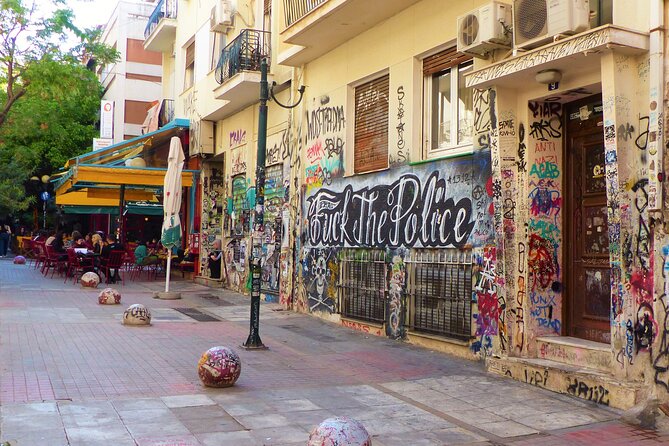
The final section takes place around Exarchia, ending at Themistokleous 68 near Exarchia Square. You spend about 20 minutes at several stops in the neighborhood, looking at street art, citizen initiatives, and the issues that have shaped Exarchia in recent years.
The subjects include Greece’s economic crisis, police violence, gentrification, and ongoing activism. These are not abstract themes here. They are tied to the streets, walls, gathering places, and community projects you encounter along the way.
Exarchia can feel politically charged, and that is precisely why it belongs on a walk about Athens’ rebellious spirit. You will see expressive street art and signs of competing visions for the district. One side may stress community autonomy and social justice. Another may focus on safety, policing, property, and redevelopment. A good guide should help you notice these tensions without reducing the neighborhood to a slogan.
I would not choose this tour if you want a polished, neutralized version of Athens. Exarchia is included because it can be complicated and uncomfortable. Its presence gives the walk more value, but it also means the experience is less conventional than a standard central Athens tour.
The neighborhood is also the place where the tour’s earlier stories come together. The Ottoman-era struggle, wartime resistance, student activism, and modern disputes over power all point toward the same question: who gets to shape the city?
What Maelle adds to the experience

The guide’s role is especially important on this walk. The route contains many short stops, and some buildings are easy to miss without explanation. A guide who can connect a small church, a royal palace, a university, and a painted wall gives the route its meaning.
Maelle is identified as the guide for this experience, and her style has been described as organized, passionate, and refreshing. The strongest part of her role is not simply knowing dates. It is helping you connect political events with people and places.
That human focus matters. You hear about individuals who became symbols, as well as large public movements by Athenians facing fascism, violence, occupation, and government pressure. The balance between personal courage and collective action keeps the walk from becoming a dry political lecture.
You should also expect a tour that leaves room for curiosity. The maximum of six participants is a real advantage for a subject that can raise questions about ideology, policing, national identity, and social change. In a group this small, you can ask for clarification instead of waiting for a crowded group to move on.
How much value do you get for $46.29?
At $46.29 per person, this is not the cheapest way to spend two and a half hours in Athens. You are paying for a guided interpretation of the city, not admission to a major archaeological site. All listed stops are free, so the value depends almost entirely on the quality of the storytelling and the route.
For me, the price makes sense if you have already seen, or plan to see, the Acropolis and ancient sites separately. This walk covers material those visits do not usually explain in detail. It can also be a strong early activity because it gives you social and political context for the streets you will continue exploring on your own.
The price is less convincing if your main goal is famous architecture, indoor attractions, or ancient Greek history. You might prefer to spend the money on an archaeological guide or museum ticket instead.
Group discounts are available, which may improve the cost for people booking together. The tour is usually reserved about 15 days ahead, so it is sensible to plan early if your dates are fixed, especially since the group limit is six.
Timing, walking, and practical details
The experience lasts about two hours and 30 minutes. The listed stop times total roughly 90 minutes, leaving the rest for walking between Monastiraki, Syntagma, the university area, Navarinou, and Exarchia.
Wear comfortable shoes and expect a steady urban walk. The experience is not recommended if you have walking difficulties. Most people can participate, service animals are allowed, and the route is near public transportation.
You receive confirmation when booking, and a mobile ticket is available. The walk requires good weather. If poor weather causes cancellation, you are offered another date or a full refund. You can cancel for a full refund up to 24 hours before the start time, but late cancellations and changes are not accepted.
The starting point is Pl. Monastirakiou 2. The walk ends at Themistokleous 68 near Exarchia Square, so you do not finish where you began. That is useful to know when planning dinner, public transport, or your next sight.
Who should book this walk?
I would choose this experience if you want to understand modern Athens beyond the ancient monuments. It suits visitors interested in political history, social movements, occupation, civil liberties, street art, and the way a neighborhood can become a symbol.
It is also a good match if you enjoy asking questions and prefer a small group. The maximum of six makes the format more personal than a large city walk, and Maelle’s role gives the route a clear human thread.
I would skip it if you want a relaxed stroll with little political discussion, or if you have limited mobility. The route is also not ideal as your only Athens tour because it leaves out the Acropolis, ancient ruins, and major museums.
Should you book the Athens City of Rebellion walk?
Book it if you want the Athens that exists between the postcard views: the city of occupation, protest, student action, local organizing, and arguments over its future. The route is strongest when you want context and conversation, not a checklist of sights.
At $46.29, it offers fair value for a small group and a subject that is hard to grasp on your own. The best reason to go is the progression from Monastiraki to Syntagma, the university district, Navarinou, and Exarchia. You finish with a clearer sense of how Athens’ past resistance continues to shape its streets today.
FAQ
How long does the Athens City of Rebellion walk last?
The tour lasts approximately two hours and 30 minutes.
How large is the tour group?
The experience has a maximum of six participants.
Where does the walking tour begin?
It begins at Pl. Monastirakiou 2 in Athens, near Monastiraki Square.
Where does the tour end?
The walk ends at Themistokleous 68, near Exarchia Square.
What places are included on the route?
The route includes Monastiraki, Tzisdarakis Mosque, the Holy Church of the Sacred Power, Syntagma Square, the Monument to the Unknown Soldier, the National and Kapodistrian University of Athens, Navarinou, and Exarchia.
Is the walk suitable for people with walking difficulties?
The experience is not recommended for people with walking difficulties. Most participants can take part, and service animals are allowed.
Can I cancel for a full refund?
Yes. You can cancel at least 24 hours before the start time for a full refund. If poor weather causes the tour to be canceled, you are offered another date or a full refund.
Newly reviewed around Athens
- Athens: workshop for painting landscape with local artist★ 4.6 · 3 reviews
- Athens: Greek Wine & Olive Oil Tasting at Brettos Plaka★ 4.5 · 3 reviews
- Outdoor Yoga and Pilates with Akropolis view★ 4.0 · 5 reviews
- Acropolis of Athens: 60′ Tour in a Vintage Motorcycle★ 5.0 · 4 reviews
- Ultimate Tasting of the Volcanic Wines of Greece★ 5.0 · 3 reviews
- workshop for painting acropolis/landscape with local artist★ 5.0 · 3 reviews
- Athens at Twilight Night Tour with Drinks and Meze Dishes★ 4.8 · 4 reviews
- Breakfast in the markets with olive oil and honey tasting★ 4.8 · 8 reviews
City Tours, compared.
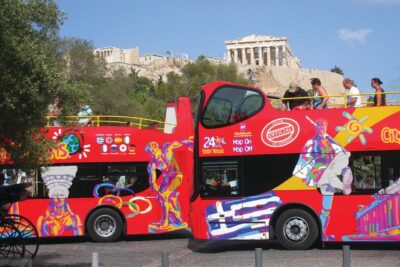
City Sightseeing Athens, Piraeus & Beach Riviera Hop-On Hop-Off Bus Tours
Read our review →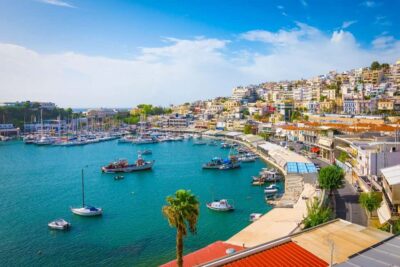
City Pass with Acropolis, Museums, Hop-On Hop-Off Bus
Read our review →
The Acropolis, Athens Walking City Tour and Acropolis Museum
Read our review →

Acropolis Walking Tour, Including Syntagma Square & City Center
Read our review →
Athens Off the Beaten Track Private City Walking Tour
Read our review →Browse the lists this tour appears in