
Reviewed · ATHENS ACROPOLIS TOURS
Athens: Acropolis, Parthenon and Acropolis Museum Guided Tour
The best thing about this half-day tour is the way it connects the stones on the Acropolis hill with the original art kept below in the museum. You see the Parthenon and its neighbors first-hand, then stand close to archaic statues, Caryatids, and sections of the original Parthenon frieze. The museum gives the hill a human face.
I like the clear central meeting point near the Acropolis Metro station, and I like the guides’ mix of facts, mythology, humor, and time for questions. Guides including Angel, Maria, Natasha, Simon, Chrysa, and Bernie have earned praise for making complicated history easy to follow. The main drawback is pace: the museum portion can feel short if you want to study every display on your own.
Key points to know before booking
- Two major sights in one half-day: You visit the Acropolis hill and Acropolis Museum in about 3 to 4 hours.
- A steep, active walk: The Acropolis paths can be slippery when wet, and there is no group-tour elevator access.
- Tickets require close attention: The advertised base price is $41.12, but admission costs extra unless you choose the ticket option.
- A strong guide-led experience: Expect stories about mythology, religion, politics, daily life, and the many eras of the Acropolis.
- A practical meeting point: Check in at the Athenian Tours office on Mitseon 2, a short walk from Acropolis Metro station.
- A group of up to 24: This is not a private visit, but the group size is still manageable for a major Athens attraction.
Why this Acropolis tour works well
The Acropolis is easy to recognize and surprisingly hard to understand on your own. You can walk up, take photographs, and admire the Parthenon, but a guide helps you see how the monuments fit together and why the hill mattered so much to ancient Athens.
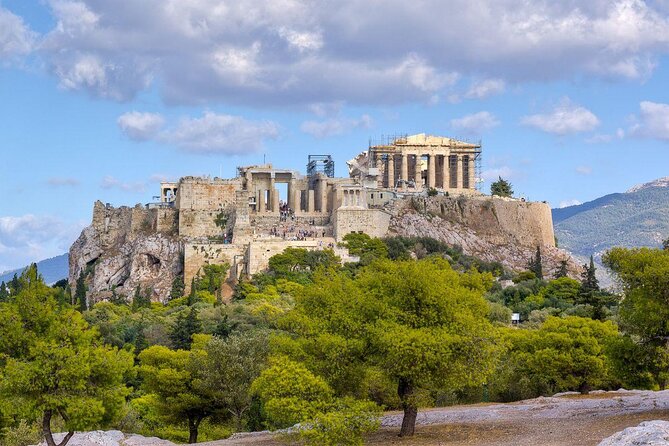
This tour also avoids treating the Parthenon as an isolated building. You see the theater where ancient drama took shape, the Roman Odeon of Herodes Atticus, the sanctuary of Asclepius, the Propylaea entrance, the Temple of Athena Nike, and the unusual Erechtheion. Each stop adds another piece to the story.
The museum then supplies the details that the open-air site cannot. Original statues, architectural fragments, household objects, religious items, and the Parthenon frieze help you understand what the Acropolis looked like and how people used it.
At $41.12 per person, the base price can be good value for an English-speaking licensed guide and a structured visit. But read the ticket choice carefully. The Acropolis ticket is listed at €30 and the museum ticket at €20 when purchased separately through the tour provider, unless admission is included in your selected option. The final price depends on the booking choice and the date.
More ways to see the Acropolis:
- Athens: Acropolis & up to 5 Archaeological Sites Combo Pass
★ 4.4 · 12,619 reviews - Athens: Acropolis Ticket with Optional Audio or Live Guide
★ 4.2 · 11,055 reviews - Athens: Acropolis, Parthenon & Acropolis Museum Guided Tour
★ 4.8 · 9,316 reviews
Meeting at Mitseon 2 near the Acropolis Metro
You meet at the Athenian Tours office at Mitseon 2, Athens 11742. It is close to the Acropolis Metro station and should be easy to reach from central Athens by public transport.
Arrive at least 15 minutes before the start. Acropolis entry times are strict, so this is not the place for a last-minute sprint from a café. If you are coming from the port of Piraeus, allow 30 to 40 minutes by taxi, and longer during morning traffic.
The tour ends at the Acropolis Museum on Dionysiou Areopagitou 15. That is useful because you can continue exploring the museum afterward if your ticket permits and you still have energy. You are not returned to your hotel, so plan your next stop from the museum area.
The maximum group size is 24 people. That is large enough to feel like a group walk, but small enough for a guide to answer questions and keep the group together. The audio quality can occasionally suffer when nearby groups are using their own equipment, so stay close when the guide is speaking.
Climbing through the Theater of Dionysus
The route begins on the Acropolis hill, with the climb passing the Theater of Dionysus. This is one of the most meaningful early stops because it connects the Acropolis with the birth of Western theater.
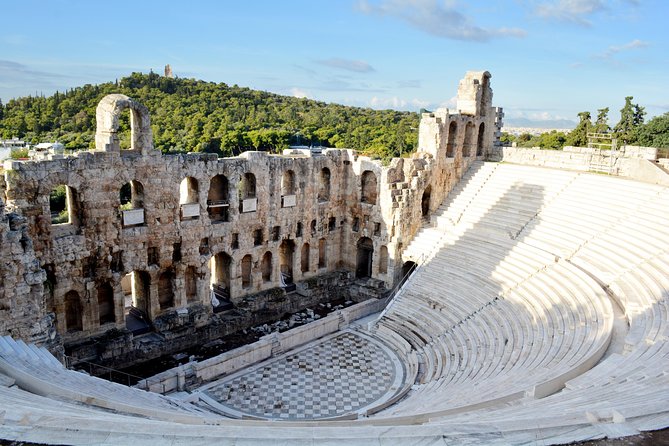
The theater is where famous ancient dramas and tragedies were first performed. Your guide can give the ruins a sense of purpose, explaining that this was not simply a pile of old seats but a working civic and religious space tied to festivals for Dionysus.
This section also sets the walking rhythm. The route is uphill, with stops for explanations and photographs. Several people have found the breaks helpful, since the climb is steady rather than flat and easy.
Use the bathroom before heading higher if you need to. There is a short break before the museum, but facilities on the Acropolis itself are limited. Bring water, since there are no cafés on the site, only a water fountain.
Herodes Atticus and the sanctuary of Asclepius
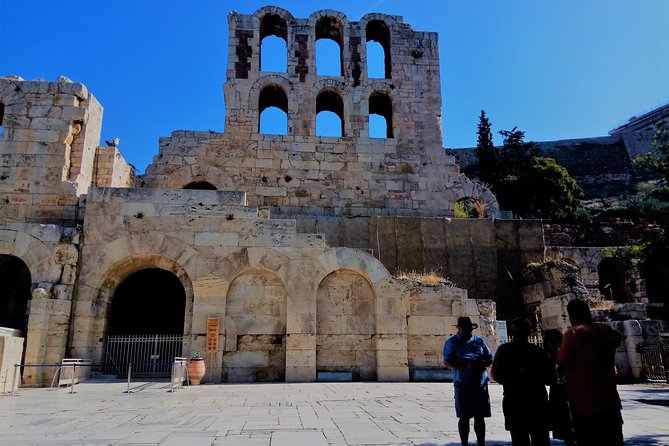
The route continues past the Odeon of Herodes Atticus, a Roman-era theater built in memory of the wife of Herodes Atticus. Its curved structure is one of the most striking sights below the summit, even when you cannot enter it.
You also see the sanctuary of Asclepius, associated with healing. This stop helps broaden the visit beyond temples and military power. The Acropolis was tied to worship, performance, health, civic identity, and public memory.
I like this part of the tour because it makes the hill feel like a whole complex rather than one famous monument. Your guide may adjust the order of the stops to make the walk more comfortable, especially when conditions or crowd flow change.
The ground can be uneven, and the hill is not suitable for people with mobility impairments. Group tours cannot use the elevator, and the tour operator says elevator access is not permitted for this experience. You should be comfortable walking uphill and standing for extended periods.
More museums and ancient sites in Athens:
- Athens: Acropolis, Parthenon & Acropolis Museum Guided Tour
★ 4.8 · 3,579 reviews - Acropolis monuments & Parthenon Walking Tour with Optional Acropolis Museum
★ 5.0 · 2,678 reviews - Athens: Acropolis Museum Ticket with optional Audio Guide
★ 4.4 · 2,652 reviews - Parthenon & Acropolis Museum with Audio or Live Tour Option
★ 4.1 · 2,446 reviews
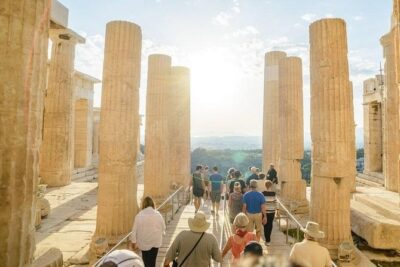
Entering the Acropolis through the Propylaea

At the top, you approach the Propylaea, the monumental gateway to the Acropolis. It was designed to create a grand entrance, and even its unfinished elements help show the scale of the building program during the fifth century BC.
The Propylaea is also where ticket and crowd arrangements matter. If you select the ticket-included option, your guide hands over the tickets at the meeting point. If you book without tickets, you need to arrange them in advance or notify the provider at least 24 hours before the tour so tickets can be secured.
Be careful with the phrase skip the line. The tour can save you time at ticket offices when that option is selected, and it uses a separate entrance at the museum. No one can skip all lines at the Acropolis itself. Entry is controlled by timed access, and late arrivals cannot be accommodated or refunded.
From the Propylaea, you see the Temple of Athena Nike. Small compared with the Parthenon, it has an important position at the entrance and honors Athena in her role as bringer of victory. A guide helps you notice these smaller structures instead of rushing straight toward the most famous building.
The Parthenon and the view from the summit
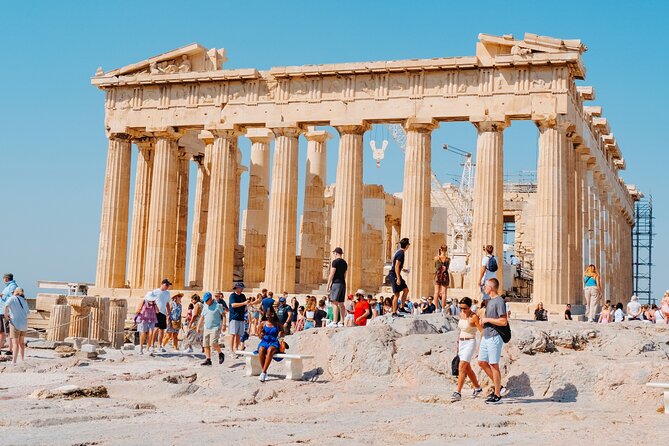
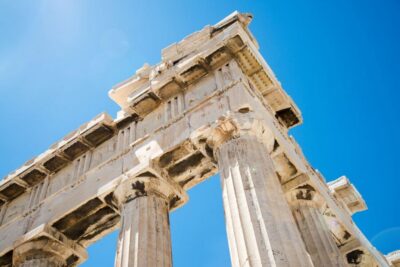
The Parthenon was dedicated to Athena, the city’s patron goddess. Built in the fifth century BC, it is the great expression of Doric architecture and the centerpiece of the Acropolis visit.
Your guide will likely explain more than dates and architectural labels. The monument has served different purposes across the centuries, and its meaning has changed with Athens itself. The information can make a familiar image feel less flat and more connected to people, belief, power, and later history.
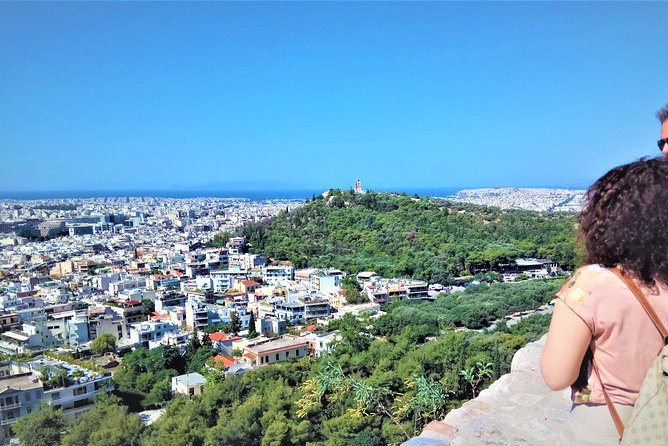
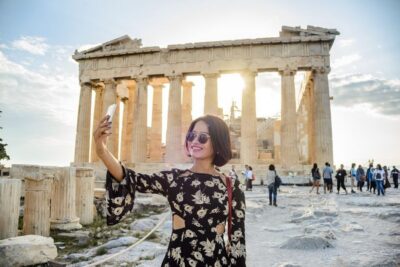
The Parthenon area can be crowded. You should expect other groups, restricted areas, and a need to pause at the right spots rather than wander freely wherever you like. Still, the views from the summit are a major reward for the climb, especially when the air is clear.
The pace is generally broken into stops, explanations, and photo opportunities. Several praised guides, including Chrysa and Jon, have been noted for keeping a comfortable rhythm while covering a great deal of material. That matters here because a nonstop lecture on an exposed hill can wear you down.
In winter, take warm layers. The top can be windy and cold even when Athens feels mild at street level. In summer or bright weather, wear a hat and sunglasses, and carry water.
The Erechtheion and its famous Caryatids
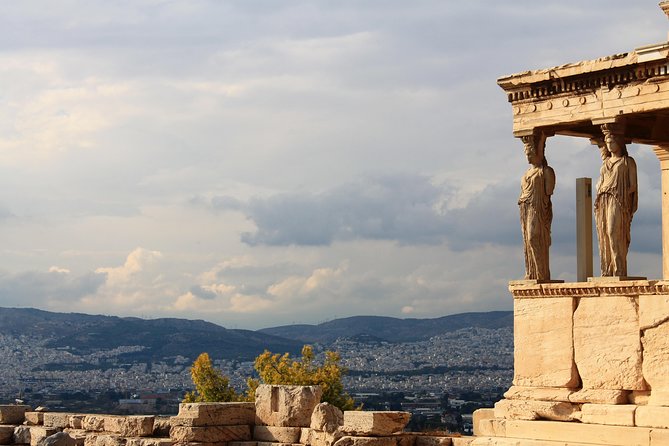
The Erechtheion is one of the most distinctive buildings on the Acropolis. Its asymmetrical design differs sharply from the orderly form of the Parthenon, and that difference is part of its appeal.
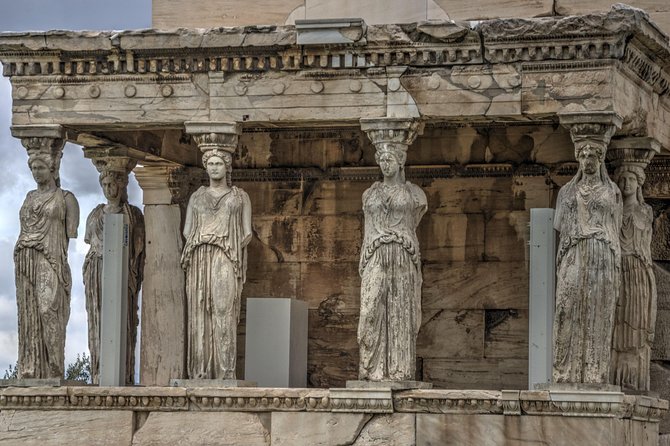
The porch supported by six sculpted female figures, the Caryatids, is the feature most people remember. The figures you see on the hill are copies, while original pieces are protected in the Acropolis Museum, with one Caryatid held elsewhere. Seeing the originals below gives the museum visit a clear purpose.
This is a good place to ask questions. The guides praised for this tour tend to handle mythology, religion, and architectural details with energy rather than treating them as a list to memorize. Natasha, Angel, and Maria are among the guides specifically appreciated for answering questions and using stories to make the ancient world easier to picture.
You spend about 20 minutes at the Erechtheion, but the guide controls the exact timing. If you want long periods for silent photography or close inspection, a self-guided visit may suit you better.
The Acropolis Museum brings the site into focus
After the hill, there is a short break before walking a few minutes to the Acropolis Museum. The museum portion is scheduled for about two hours, although the tour experience is still guided and structured rather than an entire afternoon of independent museum time.
On the ground floor, displays cover ordinary Athenian life. You see objects connected with weddings, children’s toys, healing, and religious practice. These details are valuable because they shift your attention away from marble monuments and toward the people who lived around them.
The first floor brings you close to archaic statues from the sixth century BC. You also see the original Caryatids and large pieces connected with the entrance to the Acropolis. After seeing the copies on the hill, the originals are easier to appreciate.
The top floor is the museum’s grand finale. It gives you a close look at the original Parthenon frieze while framing the Acropolis through the windows. That pairing is one of the tour’s strongest ideas: you look out at the monument while studying the art made for it.
The museum can feel rushed if you want to read every label or examine every case. One practical advantage is that you can often remain longer after the guided portion, so check the precise ticket conditions when booking. If the museum is your main reason for coming, allow extra time beyond the advertised 3 to 4 hours.
What the guides add to the experience
The quality of this tour depends heavily on the individual guide, but the repeated pattern is clear: the strongest guides combine command of the subject with a lively delivery.
Angel is praised for mixing realism, humor, and facts. Natasha is noted for mythology and religion, while Maria is remembered for staying with the museum portion and answering questions. Simon is described as funny, well prepared, and able to respond to questions. Bernie is especially effective at turning archaeology and history into a human story.
You should not book expecting one named guide, since assignments can change. But the tour’s format gives a good guide plenty of room to help. There is enough time for questions, and the group moves from one clear point to the next rather than leaving you to decode the site alone.
The guide’s value is greatest if you have not studied Greek history beforehand. You can simply listen and build a framework as you go. If you already know the basics, ask about the layers of later history, the role of mythology, the original sculptures, or how the Acropolis changed across different eras.
Tickets, timing, and the real cost
The listed starting price is $41.12 per person. That price should not be treated as the full cost until you confirm whether your selection includes admission.
The ticket-free option requires you to handle entry tickets separately. The stated adult prices are €30 for the Acropolis and €20 for the museum, or €50 total, unless a different arrangement applies to your booking. You may buy through the provider if you notify them at least 24 hours ahead, or follow their instructions for official online tickets.
The ticket-included option costs more but is simpler. Your guide gives you the tickets at the meeting point, and the provider can reserve the correct time slot. This is worth considering because a mistake with the time slot can spoil the morning.
The tour offers free cancellation up to 24 hours before the start time. Changes or cancellations inside that window are not refunded. Private tours are available for a more flexible starting time, while the regular option is the better match if you want the lower group rate.
Who should book this tour
I would choose this tour for a first visit to Athens, especially if you want the major Acropolis sights explained in plain language. It also suits you if mythology, ancient religion, sculpture, and architecture interest you more than wandering without a plan.
The tour is a good fit for independent visitors who want structure for one important half-day, then prefer to explore elsewhere on their own. The end at the museum leaves you well placed to continue nearby.
I would think twice if you have limited walking ability, dislike uphill paths, or want several quiet hours inside the museum. The group cannot use the hill elevator, and the museum section may feel too tightly timed for a serious art-focused visit.
Children under six are not permitted. Older children who can manage the climb may enjoy the stories, but the 3 to 4-hour length and exposed hill require patience.
Should you book the Acropolis and Museum tour?
Book it if you want the Acropolis to make sense, not just look impressive. The combination of the hill and museum is carefully chosen, and the guides add the context that signs and photographs cannot provide.
Before paying, confirm the ticket option, check the weather, and arrive early at Mitseon 2. Wear comfortable shoes, bring water and sun protection, and leave extra time if you want to continue through the museum after the guided visit.
For most first-time visitors, this is a strong-value introduction to Athens. It gives you the essential monuments, the original art, a clear route, and a guide-led explanation in one manageable half-day. If you prefer complete freedom or a slow museum study, book the sights separately instead.
FAQ
How long does the Acropolis and Museum tour last?
The experience lasts approximately 3 to 4 hours, including the Acropolis hill and the Acropolis Museum.
What is the tour price?
The listed starting price is $41.12 per person. Admission may cost extra unless you choose an option that includes tickets.
How much are the admission tickets if they are not included?
The stated adult prices are €30 per person for the Acropolis and €20 per person for the Acropolis Museum.
Where does the tour begin?
The meeting point is the Athenian Tours office at Mitseon 2, Athens 11742, near the Acropolis Metro station.
Where does the tour finish?
The tour ends at the Acropolis Museum at Dionysiou Areopagitou 15, Athens 11742.
Is the tour offered in English?
Yes. The experience is offered in English with an English-speaking licensed guide.
Can I use an elevator to reach the Acropolis?
Elevator use is not permitted on this group tour. The Acropolis is reached by walking up a steep hill.
Is the tour suitable for people with mobility impairments?
No. The tour is not suitable for people with mobility impairments because of the steep hill and walking conditions.
What happens if I arrive late?
Punctuality is essential because Acropolis entry times are strict. Late arrivals cannot be accommodated, and no refund is available for missing the scheduled entry.
Newly reviewed around Athens
- Feel Ancient thermal Spa Visit Delphi, Leonidas ℨoo Spaʀtan★ 5.0 · 4 reviews
- Food Tour★ 5.0 · 3 reviews
- Explore the Hidden Food Gems of Athens★ 5.0 · 57 reviews
- Food Experience in Athens including Unlimited Lunch★ 5.0 · 3 reviews
- Eat Your Way Through Athens: A Local Food Walk★ 4.9 · 97 reviews
- From Athens: Delphi Private Tour with Lunch Time★ 4.0 · 3 reviews
- Delphi: Spanish guided one day tour★ 4.6 · 55 reviews
- Early Entry Acropolis & Museum. Beat the Crowds & the heat★ 5.0 · 3 reviews
Athens Acropolis Tours, compared.
Acropolis & up to 5 Archaeological Sites Combo Pass
Read our review →
Acropolis, Parthenon & Acropolis Museum Guided Tour
Read our review →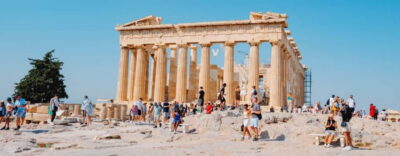
Acropolis, Parthenon & Acropolis Museum Guided Tour
Read our review →
Acropolis monuments & Parthenon Walking Tour with Optional Acropolis Museum
Read our review →Browse the lists this tour appears in