
Reviewed · NAFPLIO TOURS FROM ATHENS
Ancient Sparta Ancient Corinth Private Tour from Athens/ Nafplio
Sparta is the reason to book this long day. You will cross the Peloponnese, visit the remains of the ancient city, see the Leonidas Monument, and continue to Ancient Corinth before returning to Athens. I like the private vehicle and flexible pace, and I like that your driver can suggest lunch stops, photo points, and small changes when time allows. The trip is a big undertaking, though: about 10 hours on the road, with only a short visit at some sites.
I also like the Corinth Canal stop, which breaks up the drive with a quick walk and striking views from a pedestrian bridge. The main caution is simple: Sparta is not another Acropolis. Its remains are modest, so you should come for the story, setting, and historical meaning rather than grand ruins.
Key points to know before booking

- The route covers three major Peloponnese sights: the Corinth Canal, ancient Sparta, and Ancient Corinth in one demanding day.
- Your driver is not an archaeological guide: you receive historical information during the drive, plus books and an audio documentary, but site tours require a separate licensed guide.
- The private format gives you room to adjust: stops, lunch, photo breaks, and timing can be discussed with the driver.
- Ancient Corinth deserves careful planning: the site and museum receive about 1 hour 40 minutes together, which can feel short.
- Museum days matter: the Sparta Archaeological Museum and olive oil museum are closed on Tuesdays, while the Corinth museum closes on Tuesdays in winter.
- The best driver experience is highly personal: Christos, Nikolaos, Takis, Makis, and Philippe are named in customer accounts as friendly, careful, and generous with local information.
A long day that links two very different Greek cities
This private tour is built around distance. Athens to Sparta is not a quick hop, and adding Corinth creates a full day of driving, sightseeing, and short walks. You are not simply ticking off nearby ruins. You are crossing the Peloponnese to see places that tell very different stories about ancient Greece.
The advertised price is $265.50 per person, but the actual value depends on your group size and vehicle. The tour can use a sedan for up to three adults, a minivan for up to seven people, or a minibus for up to fourteen. Families should note that up to two children aged 12 or younger can travel free under the stated vehicle arrangements, though the total price varies by group and vehicle type.
The price includes private transport, fuel, toll roads, parking, hotel pickup and drop-off in central Athens, and an English-speaking driver. That matters on a route this long. You are not piecing together buses, trains, taxis, and site transfers, and you can keep your own group together all day.
Admission charges are extra. Plan for the Sparta Archaeological Museum at €5 in winter or €10 in summer, Ancient Corinth at €8 in winter or €15 in summer, and the olive oil museum at €5. The tour information also lists a €1 gratuity, although you should confirm the final payment details when booking.
More Ancient Corinth and canal trips:
- From Athens: Ancient Corinth Day Trip with Canal & VR Guide
★ 4.6 · 1,073 reviews - Private Biblical Tour Ancient Corinth & Isthmus Canal from Athens
★ 5.0 · 762 reviews - Athens: Ancient Corinth & Nafplio Full Day Trip with Swim
★ 4.8 · 523 reviews
Crossing the Corinth Canal
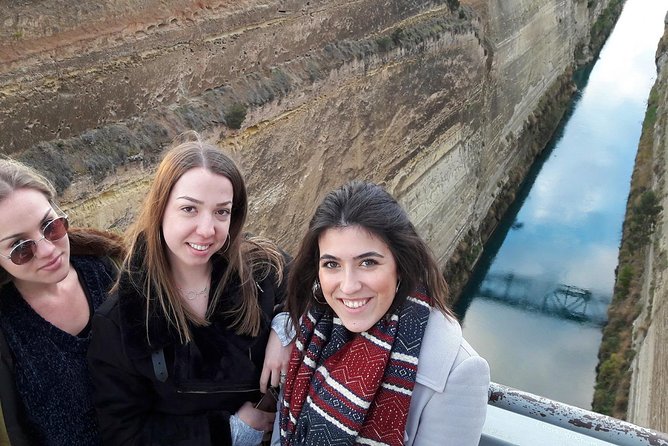
The first stop is the Corinth Canal, about 6.4 kilometers long and cut between 1881 and 1893. More than 2,500 workers spent twelve years creating this waterway between the Aegean and Ionian seas, separating the Peloponnese from mainland Greece.
You get about 15 minutes here. That is enough for photographs, a walk across the pedestrian bridge, and a look down into the canal from roughly 80 meters above the water. The stop is brief, but it is well placed at the start of the trip. It gives you a dramatic view without requiring a long detour.
Do not expect a full canal visit or a boat ride. This is a viewpoint stop. If you like engineering, big-scale construction, and quick photo opportunities, it earns its place. If you prefer more time at ancient sites, you may wish the stop were shorter, but the allotted time is already compact.
Reaching Sparta after the mountain drive
The drive to Sparta is the heart of the day. The route crosses the Peloponnese, and several people have specifically praised the scenery and the comfort of the newer road. You should still expect a substantial period in the vehicle, so this tour works best if you are comfortable with long drives.
This is where the private format earns its keep. The driver can explain the places you pass, answer questions, and make practical stops. The supplied material includes informative books and an audio documentary with historical details. Some drivers also offer a personal running commentary about Greek culture, politics, the countryside, and daily life.
The quality of that road conversation can shape the entire experience. Christos is described as making the drive educational and easy, while Nikolaos is praised for safe driving, good photo stops, and a well-chosen gyro lunch. Takis is remembered for discussing not just ancient monuments but also the land and people of Greece. Makis is noted for clear English and conversation that made the long ride feel less empty.
Your driver will not necessarily provide a formal lecture at every ruin. That distinction matters. The driver can orient you and share background, but you walk through the sites independently unless you arrange a licensed archaeologist guide in advance.
Ancient Sparta: atmosphere over monumental ruins
Sparta carries enormous weight in the popular imagination. The city was organized around military training and physical development, with society divided into groups including full Spartan citizens, free residents, and the enslaved helot population. The ancient system was disciplined, severe, and far more complex than the familiar story of heroic warriors.
The modern archaeological remains are not extensive. You will not find a single grand monument that defines the visit in the way the Parthenon defines Athens. Instead, the site gives you fragments, ground plans, the ancient theater, and a sense of how a famous city can leave a quieter physical trace.
That modest scale is the main issue to understand before you go. Some people will find Sparta underwhelming after the long drive. I would still recommend it if you care about ancient political systems, military culture, and the contrast between fame and surviving stone. Just set your expectations correctly.
The scheduled visit to Sparta itself is about 30 minutes, followed by the museum and the acropolis area. That can feel rushed if you want to read every panel or linger over each ruin. Tell your driver early if you care more about the site than an optional museum, lunch, or extra stop.
More Nafplio trips from Athens:
- From Athens: Mycenae, Epidaurus & Nafplio Full Day Trip
★ 4.8 · 2,438 reviews - From Athens: Mycenae, Epidaurus & Nafplio Full-Day Tour
★ 4.5 · 1,580 reviews - Mycenae and Nafplion Day Trip from Athens with Official guide
★ 4.5 · 501 reviews - Argolis: Full-Day Tour in Mycenae & Nafplio
★ 4.2 · 350 reviews
The Archaeological Museum of Sparta
The Archaeological Museum of Sparta occupies a neoclassical building constructed between 1874 and 1876. It is described as the oldest provincial archaeological museum in Greece, and the building itself has protected architectural and historical status.
You receive about 30 minutes inside. That is enough for a focused look, not a slow museum visit. The museum can help fill in what the open-air ruins do not show, especially if you want objects and displays to give shape to ancient Spartan life.
The museum is closed every Tuesday. This is one of the most important planning details in the entire tour. If your day falls on Tuesday, you need to know that this stop will not be available. The admission fee is separate, with the stated price changing between winter and summer.
The ancient theater and acropolis
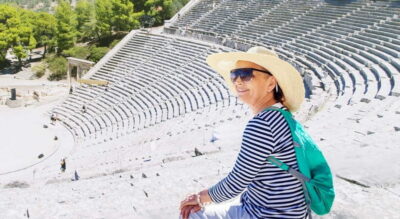
The acropolis and ancient theater give you the clearest physical sense of Sparta. The late first-century BC theater was built from local white marble during the Roman period and may once have held about 16,000 people. Its mobile stage was an unusual feature, and the theater was already a destination for visitors in antiquity.
Today, much of the seating was lost during the Byzantine period, and the remaining marble and limestone have weathered. You will spend about an hour in this area, walking among the surviving remains rather than touring a perfectly preserved monument.
I like this stop because it asks you to use your imagination. The theater’s scale becomes clearer when you consider the crowds it once held, even though the ruins are incomplete. Wear sensible shoes and take your time on uneven ground. The tour involves walking, but the information provided does not describe a special accessibility arrangement, so ask before booking if your group has mobility needs.
Meeting Leonidas at his monument
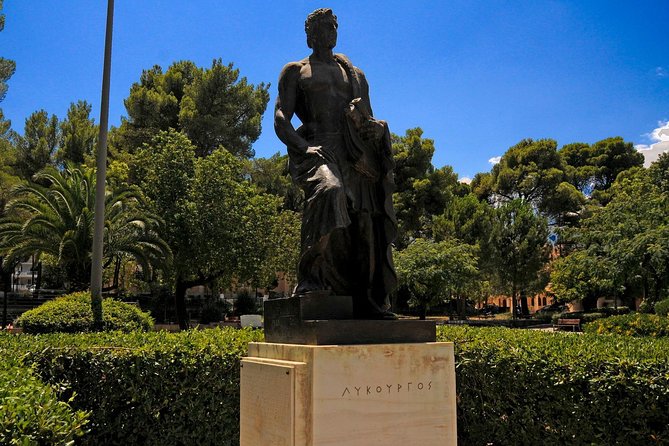
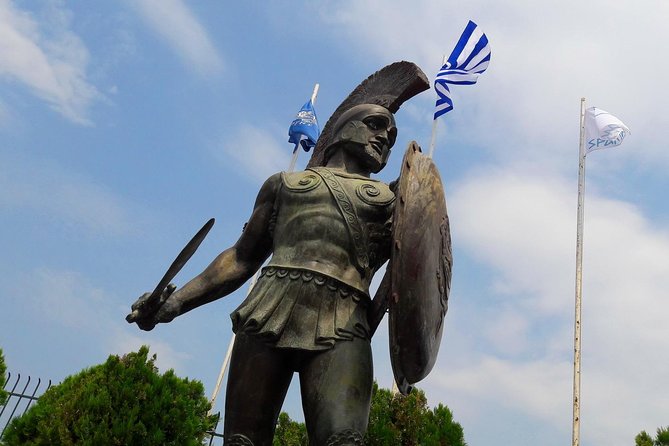
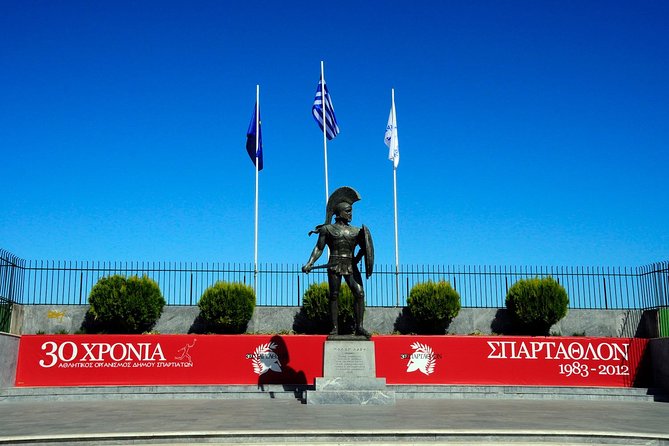
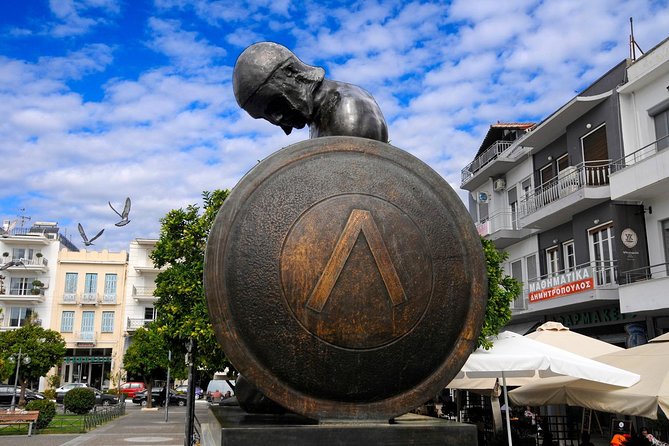
The Leonidas Monument is a short 15-minute stop. The statue faces a stadium, recalling the Spartan king’s role at Thermopylae and the famous defiant answer associated with him: Molon labe, meaning come and take them.
Nearby is a fifth-century BC limestone structure believed by some archaeologists to be the tomb of Leonidas. Its original purpose is not fully verified, but it is the only preserved monument of the ancient agora. That uncertainty is worth keeping in mind. You are seeing a place tied to an enduring tradition, not a conclusively labeled tomb with every question settled.
This stop is especially worthwhile if the Thermopylae story is what brought you to Sparta. It is quick, easy to photograph, and gives the day a strong human figure after the broader discussion of Spartan society.
The optional olive oil museum

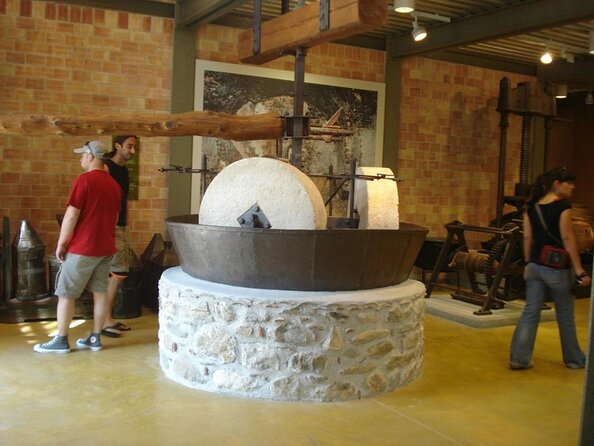
The Museum of the Olive and Greek Olive Oil is optional and depends on the day’s timing. You receive about 20 minutes, which is brief but enough for a compact introduction to olive cultivation and oil production in Greece.
The displays cover the olive’s role in the economy, food, religion, art, and technology from prehistoric times through the early twentieth century. Particularly unusual items include fossilized olive leaves from Santorini dating to roughly 50,000 to 60,000 years ago and replicas of Linear B tablets from the fourteenth century BC.
The museum costs €5 and is closed Tuesdays. It can be a pleasant addition, especially if you want cultural context beyond temples and theaters. But it should not come at the expense of Ancient Corinth if your interests are mainly archaeological. Timing has caused confusion for some groups, so confirm the museum’s opening status and your preferred order of stops at the start of the day.
Ancient Corinth deserves more than a quick glance
Ancient Corinth is often the surprise of the tour. The remains are more substantial and easier to read as a city than the ruins at Sparta. You can walk through the old urban center, then visit the archaeological museum, which is included with the combined site ticket.
Corinth also has strong Christian associations. Saint Paul’s letters to the Corinthians are part of the New Testament, and the city appears in the Acts of the Apostles during his missionary travels. That gives the site another layer, particularly if you are interested in early Christianity as well as classical Greece.
The scheduled time is about 1 hour 10 minutes at Ancient Corinth, followed by 30 minutes in the museum. The combined ticket costs €15 in summer or €8 in winter. I would protect this time carefully. The site has enough to reward a slower walk, and a short lunch overlooking the Temple of Apollo has been a memorable choice for some groups.
If you must trade one stop for another, Corinth is the stop I would not cut casually. Ask your driver how much time remains before agreeing to an extra detour or a longer lunch.
What the private driver adds, and what is missing
The strongest part of this experience is the human element in the vehicle. Drivers named Christos, Nikolaos, Takis, Makis, and Philippe have been praised for punctuality, safe driving, friendly conversation, and the ability to adjust the day. One driver even stopped at a small roadside fruit stand for fresh cherries, while another helped arrange a local lunch.
That does not make every driver an official guide. The written terms are clear: the driver is not an archaeologist, and a licensed guide must be booked separately, for an added charge and subject to availability. If you want detailed explanations inside each museum and site, arrange that before the day rather than hoping someone will be free at the entrance.
The private setup does let you ask for a slower meal, a restroom stop, or a photo break. The listed extension fee is €30 per hour for a sedan, €45 for a minivan, and €60 for a minibus. Agree on any extra time before it begins.
Starting in Athens or Nafplio
Pickup is offered from hotels and apartments in central Athens, generally within 7 kilometers, with the departure time arranged in advance. An 8:00 a.m. start or earlier is recommended in winter. Earlier is sensible in any season if you want to protect your time at Corinth and Sparta.
Pickup from Piraeus costs an additional €15 per direction under the stated terms. Airport and Lavrio Port transfers require prior agreement and are not covered by that port surcharge. Pickup from Nafplio is also available, with a different and lower price because the route is shorter from there.
Free cancellation is available up to 24 hours before the start time. Changes or cancellations inside that window are not accepted for a refund.
Who should book this day
I would choose this tour if you want to see Sparta but do not want to rent a car or manage a long Peloponnese drive yourself. It suits couples, families, and small groups who value a private vehicle and are willing to trade depth at each site for geographic reach.
It is less suitable if you want a relaxed archaeological day. The schedule is full, the drive is long, and several visits are measured in minutes. If Sparta is your only priority, a shorter arrangement with more time on site may suit you better. If you mainly want major monuments in perfect condition, Ancient Corinth will likely satisfy you more than Sparta.
Families can benefit from the private format, especially when a child needs a break, a snack, or a restroom stop. The option of a sedan, minivan, or minibus also makes the day workable for different group sizes.
Should you book the Ancient Sparta and Corinth tour?
Book it if you value the journey as much as the ruins. You will see the Corinth Canal, cross the Peloponnese, stand before Leonidas, walk through Sparta’s theater, and finish among the more substantial remains of Ancient Corinth. The driver can make the long route comfortable and personal.
Do not book it expecting an archaeologist-led tour or a spectacular set of Spartan ruins. Confirm museum closing days, arrange a licensed guide if detailed site interpretation matters to you, and protect enough time for Corinth. With those expectations in place, this is a strong private day for anyone who wants to connect the famous Spartan story with the real, quieter remains left behind.
FAQ
How long does the private Sparta and Corinth tour last?
The tour lasts approximately 10 hours, including transportation from Athens and the listed sightseeing stops.
What is included in the tour price?
The price includes an air-conditioned sedan, minivan, or minibus, private transport, fuel, toll roads, parking, pickup and drop-off, and an English-speaking driver. The driver also provides informative books and an audio documentary with historical details.
Are admission tickets included?
No. Admission is separate for the Sparta Archaeological Museum, Ancient Corinth, and the Museum of the Olive and Greek Olive Oil. Ancient Corinth admission includes its archaeological museum.
Is the tour available from Nafplio?
Yes. Pickup and drop-off can be arranged from a hotel, apartment, or port in Nafplio. The price changes because Sparta, the acropolis, and Corinth are closer to Nafplio.
Is an archaeologist guide included?
No. The driver provides information during the journey but does not accompany you as an archaeologist at the sites or museums. A licensed archaeological guide can be hired separately in advance, subject to availability.
Are the museums open every day?
The Archaeological Museum of Sparta and the Museum of the Olive and Greek Olive Oil are closed every Tuesday. The Archaeological Museum of Corinth is closed on Tuesdays during winter.
Can the itinerary or timing be changed?
The tour is private and flexible, so you can discuss the pace, lunch, photo stops, and possible itinerary changes with the driver. Extending the day costs €30 per hour for a sedan, €45 for a minivan, or €60 for a minibus.
More Peloponnese trips from Athens
- Athens: Peloponnese Highlights Day Trip and V.R. Audio Guide
★ 4.5 · 1,425 reviews - PELOPONNESE HIGHLIGHTS PRIVATE: Corinth Mycenae Nafplio Epidaurus
★ 5.0 · 103 reviews - From Athens: Ancient Sparta and Mystras Private Day Trip
★ 4.8 · 18 reviews - Corinth Canal, Corinth, Mycenae & Nafplion Argolis Tour
★ 5.0 · 12 reviews
Newly reviewed around Athens
- Feel Ancient thermal Spa Visit Delphi, Leonidas ℨoo Spaʀtan★ 5.0 · 4 reviews
- Food Tour★ 5.0 · 3 reviews
- Eat Your Way Through Athens: A Local Food Walk★ 4.9 · 97 reviews
- Explore the Hidden Food Gems of Athens★ 5.0 · 57 reviews
- Food Experience in Athens including Unlimited Lunch★ 5.0 · 3 reviews
- From Athens: Delphi Private Tour with Lunch Time★ 4.0 · 3 reviews
- Delphi: Spanish guided one day tour★ 4.6 · 55 reviews
- Early Entry Acropolis & Museum. Beat the Crowds & the heat★ 5.0 · 3 reviews
Nafplio Tours from Athens, compared.
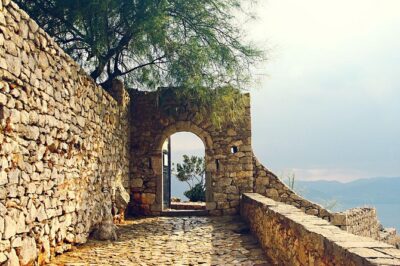
Ancient Corinth & Nafplio Full Day Trip with Swim
Read our review →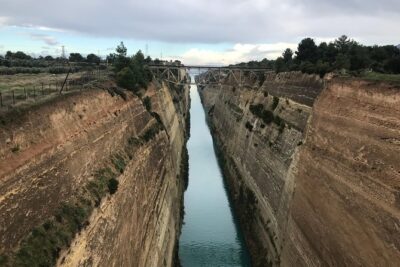
Mycenae and Nafplion Day Trip from Athens with Official guide
Read our review →
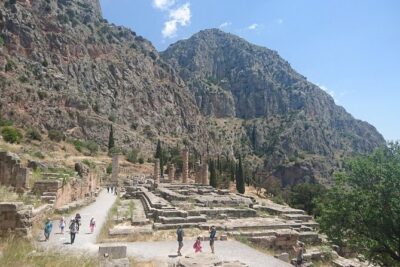
3-Day Classical Greece Tour: Epidaurus, Mycenae, Nafplion, Olympia, Delphi
Read our review →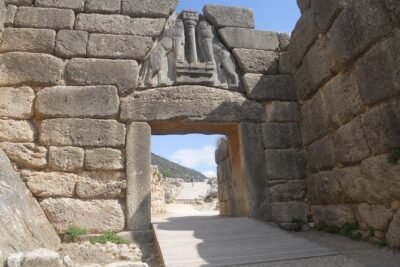
Mycenae, Epidaurus, Nafplio Full Day Private Tour from Athens
Read our review →
Mycenae, Epidaurus & Nafplio Full-Day V.R audio guided Tour
Read our review →Browse the lists this tour appears in