
Reviewed · ATHENS WALKING TOURS
Small-Group Women History in Ancient Greece Walking Tour
Ancient Athens is often told through male politicians, generals, and philosophers. This two-hour women’s history walk shifts the focus to the women who lived around them, including Athena, Penelope, Pandora, Sappho, Aspasia, and Agnodice. Guide Maelle connects their stories to the streets, ruins, and meeting places of central Athens.
I like the small group of no more than 12 people, which gives you room to ask questions, and I like the route’s mix of real women, mythological figures, marriage customs, education, politics, and daily work. The chief drawback is the walk itself: it finishes uphill at Philopappos Hill, and it is not recommended if you have mobility problems.
Key points to know before you book

- A rare women-centered view of Athens: The tour fills a gap left by standard ancient-site walks, with attention to women’s daily lives and public roles.
- Maelle leads a lively history lesson: Her presentation is described as kind, funny, inclusive, and well prepared, with plenty of room for questions.
- Nine stops give the stories a physical setting: You move from Monastiraki and Hadrian’s Library toward the Agora, Areopagus, Pnyx, and Philopappos Hill.
- The tour stays outside the major archaeological sites: You see the Ancient Agora from outside, and the price does not include entry to attractions.
- The final view is a real reward: Philopappos Hill gives you an excellent look toward the Acropolis.
- Plan for a two-hour walk: Wear comfortable shoes, expect uneven or uphill ground, and bring water, especially in warm weather.
Why this Athens walk feels different
This is not a standard parade of famous buildings. It is a social history walk, using familiar parts of Athens to ask who was allowed to learn, marry, work, vote, worship, and speak in public.
That shift matters. You may already know that Athens developed democracy, but this tour makes you confront the limits of that idea. The voting citizens were men. Many women could not take part in public political life, and wives faced strict limits on where they could go and what they could do.
The stories also move beyond the narrow image of women as wives or figures in myth. You hear about Sappho as a poet, Aspasia as an influential intellectual linked to Pericles, and Agnodice as a woman who challenged the rules of medicine. These examples help you see both the restrictions and the ways some women worked around them.
The tone appears serious but not grim. Maelle’s approach combines facts with stories, humor, and questions that connect ancient customs to themes still recognizable today. That makes the tour suitable for adults who want more than dates and building names, and for older children or teenagers with an interest in social history. One 15-year-old participant was especially engaged by the feminist angle.
More walking tours in Athens:
- Athens: Acropolis and Parthenon Guided Walking Tour
★ 4.6 · 5,882 reviews - Greek Food Walking Tour in Athens
★ 5.0 · 4,740 reviews - Acropolis: Acropolis and Parthenon Guided Walking Tour
★ 4.7 · 3,442 reviews
Starting at Monastiraki Square
You meet at Pl. Monastirakiou 2, in the center of Monastiraki Square. This is a practical starting point because the area is easy to reach by public transportation and is one of the most recognizable places in central Athens.
The opening stop takes about 10 minutes and costs nothing to enter. The square gives Maelle a useful place to set the scene before the route moves toward ancient Athens. You begin with the idea that the city you see today is layered over the city of myths, markets, civic buildings, and religious spaces.
This is also a good point to arrive a little early. Monastiraki is busy, and finding a guide in a crowded square can take a moment. Your confirmation is provided when you book, so keep the meeting details accessible on your phone.
Education at Hadrian’s Library
The next stop is Hadrian’s Library, where you spend about 10 minutes discussing education for girls and women in ancient Athens.
The site is a useful backdrop because the name immediately brings learning and books to mind. The discussion gives you a chance to consider who had access to education, which subjects were valued, and how much a person’s gender and social position shaped their opportunities.
This section helps prevent the tour from treating ancient women as one single group. The life of a citizen’s wife differed from that of an enslaved woman, a courtesan, or a woman from another Greek city. Athens and Sparta also had different expectations, and those contrasts become important later in the walk.
You do not need to enter the library for this stop, and admission is listed as free. The value is in the guide’s explanation rather than a long visit inside a monument.
Marriage, Eros, and the church near the old city
At the Holy Church of the All-Great Taxiarchs and the Virgin Mary Gregorousa, the group pauses for about 15 minutes. Here, the subject turns to marriage in Athens and Sparta, along with Eros and passionate love.
This is one of the more useful parts of the route because marriage in ancient Greece was not simply a private romance. It affected family alliances, household duties, inheritance, and a woman’s place in society. The comparison with Sparta gives you a clearer picture of how customs could differ across Greek communities.
The discussion of Eros adds another layer. Ancient stories often present love as powerful, risky, and disruptive, while social arrangements placed marriage within family and civic expectations. Holding those ideas side by side makes the myths feel less like isolated tales and more like reflections of real anxieties.
Expect the guide to draw links between famous stories and ordinary social rules. The point is not to claim that myth gives a literal record of daily life, but to show how ancient Greeks imagined desire, marriage, and women’s choices.
More ancient sites near Athens:
- Historical Delphi One Day Tour with Arachova Stop & Expert Guide
★ 4.5 · 1,247 reviews - Historic Athens: Small Group Electric Bike Tour
★ 4.9 · 740 reviews - The History of Athens: Greek Mythology Private Tour
★ 5.0 · 138 reviews - Athens Highlights by E-Bike: Small-Group Historic Tour
★ 5.0 · 131 reviews
Athena and married life at the Gate of Athena Archegetis
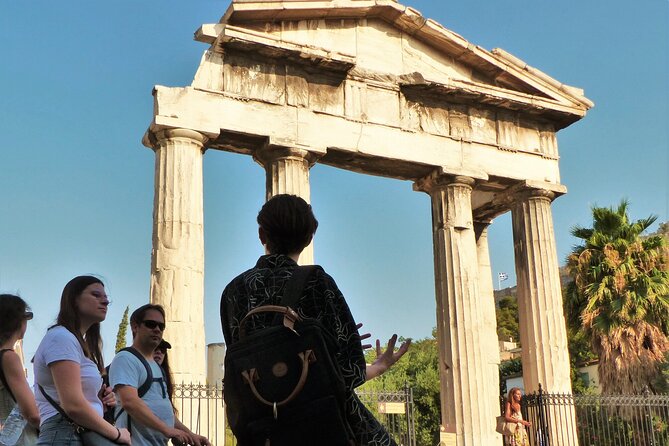
The Gate of Athena Archegetis is the setting for another 15-minute stop. The focus returns to married life for women in Athens and Sparta, then moves into the myths of Athena.
Athena is an especially fitting figure for this discussion. She is a powerful goddess associated with wisdom, strategy, and the protection of Athens, yet her position does not translate neatly into freedom for ordinary women. That contrast gives the tour one of its strongest themes: a society can honor a female deity while restricting real women.
The gate also adds a physical reminder that public monuments and civic identity were closely linked. You are not only hearing about a goddess in the abstract. You are looking at a place connected to the city’s public image and asking where actual women fit within that image.
I appreciate this sort of contrast because it keeps the tour from becoming a simple celebration of famous female figures. Athena is inspiring, but she also reveals the distance between mythology and social reality.
A women-only festival at Dioskouron
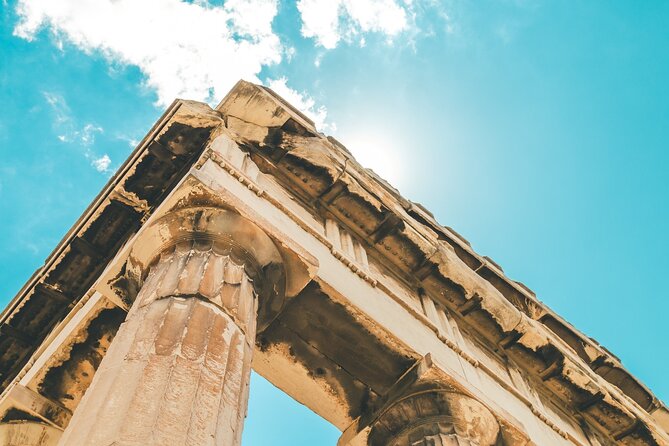
At Dioskouron, the tour spends about 10 minutes on a mysterious ancient festival dedicated exclusively to women.
This is a welcome change from discussions centered on the household or the political assembly. Festivals could create spaces where women gathered, worshipped, performed rituals, and took part in community life outside the usual male civic institutions.
The stop also reminds you that women were not absent from ancient public culture. Their participation often took religious or domestic forms rather than the voting, debating, and military roles celebrated in conventional accounts of Athens.
The details here are likely to prompt questions, which is one reason the small group matters. With a maximum of 12 people, you can pause over unfamiliar customs rather than simply move on to the next monument.
The Ancient Agora and lives outside the civic ideal
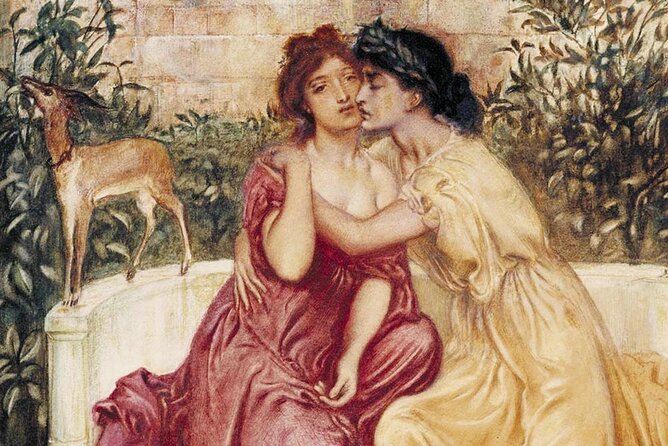
The Ancient Agora takes about 15 minutes. You see the archaeological area from outside rather than entering it, and the conversation turns to women in public space, female slaves, and courtesans.
This may be the most direct reality check on the image of classical Athens. The Agora was the center of public life, but access to that public life was unequal. Citizen men gathered, traded, debated, and took part in civic affairs, while many women’s lives were tied to the household or shaped by someone else’s legal and economic power.
The inclusion of enslaved women and courtesans is important. Ancient society did not divide neatly into men with power and women without it. Class, legal status, occupation, and family position all mattered. A courtesan might have more public visibility and conversation with elite men than a respectable citizen wife, while an enslaved woman had far fewer choices.
Because you do not enter the Agora, you should not book this walk as a substitute for a full archaeological visit. If you want to examine the ruins in detail, plan a separate visit. Here, the exterior view works as a prompt for the social story.
Areopagus and Agnodice’s challenge
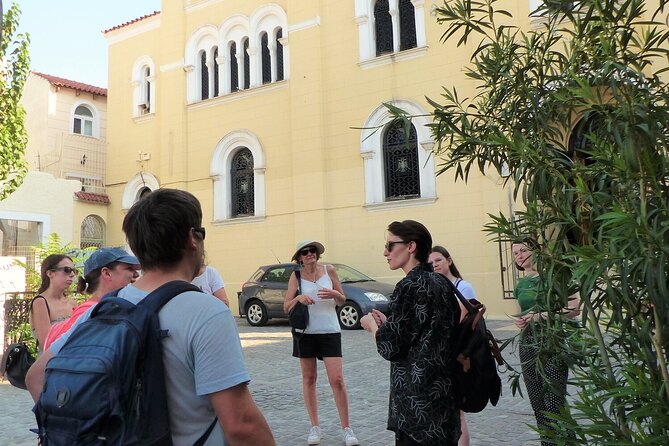
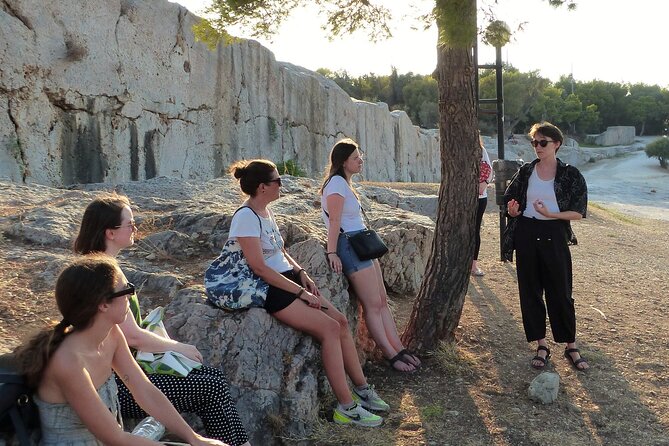
At Areopagus, the group pauses for about 10 minutes. This rocky setting is linked to ancient trials, including cases involving serious wrongdoing, and it introduces the story of a woman who risked a death sentence to change women’s rights.
The location adds drama without needing theatrical presentation. You are standing near a place associated with judgment while hearing about a woman who challenged the rules placed on her. Agnodice is one of the names that can easily disappear from a conventional tour, yet her story gives the discussion a clear human focus.
This is also a good example of the tour’s method. It does not only ask what women were forbidden to do. It asks how a woman responded when the rules blocked her from helping others, and what personal cost she faced.
The ground around Areopagus can be uneven, so take care as you move and listen. The walk is not presented as suitable for people with mobility issues, and this section helps explain why.
Pnyx and the limits of democracy
The route continues to Pnyx for about 15 minutes. This is the place associated with the beginnings of Athenian democracy, but only male citizens were allowed to vote.
That contradiction is central to the whole experience. Democracy was a major political development, yet it rested on a narrow definition of citizenship. Women were part of the city’s families, religious life, and economy, but they were excluded from the formal vote.
Here, the story of Aspasia brings the political discussion to life. She was connected to Pericles and is remembered as an intellectual figure who influenced political conversation during Athens’ Golden Age. Her presence in the story shows that formal exclusion did not mean women had no influence. It means influence often worked through relationships, reputation, conversation, and access rather than a ballot.
I like this stop because it gives you more than the familiar phrase democracy began here. You leave with a sharper question: who was included in that beginning, and who was left outside it?
Philopappos Hill and the Acropolis view
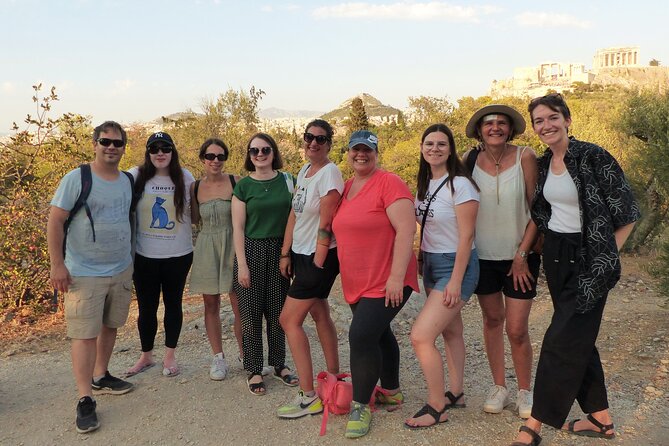
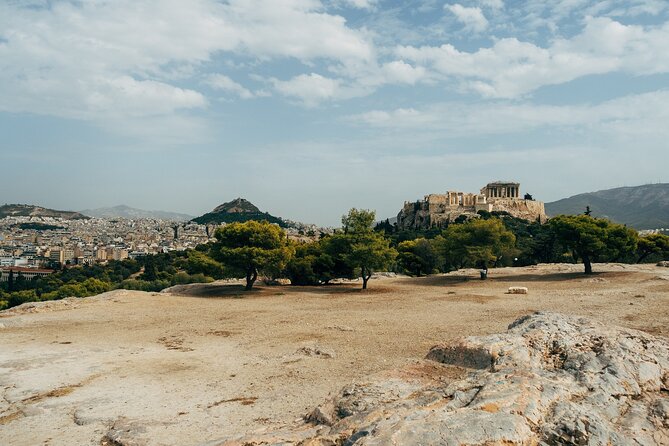
The final stop is Philopappos Hill, also called the Hill of the Muses, where you spend about 10 minutes. The tour ends with a view toward the Acropolis and easy access on foot to the city center or the metro if you need it.
This is a smart finish. After two hours of discussing restrictions, myths, work, and civic life, you get time beneath the trees with one of Athens’ best viewpoints. The setting gives the tour a calmer ending and a chance to think about how many different lives existed beneath the grand monuments.
The hill is also the main practical concern. The route ends uphill, and the full walk may be tiring in hot weather. Comfortable shoes are essential, and you should be realistic about your walking ability before booking.
What the $44.71 price gets you
At $44.71 per person, this is not an entry-ticket tour. The listed stops are free, and the Ancient Agora is viewed from outside. You are paying for Maelle’s research, storytelling, route planning, and the chance to explore a focused subject that is rarely given its own walking tour.
I consider that good value if you have already seen the Acropolis or intend to visit the major monuments separately. The tour adds context rather than repeating the standard story of temples and battles. It can also be a smart first Athens activity because it introduces the city through everyday life, then ends with a strong Acropolis view.
The small group improves the value. A maximum of 12 people is intimate enough for questions and discussion, while still keeping the cost below that of a private tour. Group discounts may be available, which could make it appealing for families or friends booking together.
The tour is commonly booked well ahead, with an average booking time of 37 days. That does not mean you must plan every Athens detail far in advance, but it does suggest reserving early if your dates are fixed.
Who will enjoy this walk most
I would choose this tour for you if you want:
- A social history angle instead of another monument checklist
- More attention to women’s daily lives and legal limits
- Mythology linked to real places in Athens
- A small group and an interactive guide
- A route that adds meaning to the Agora, Pnyx, Areopagus, and Acropolis view
- A thoughtful activity for a parent and history-minded teenager
You may want to skip it if your priority is entering archaeological sites or covering the greatest number of monuments. It is also a poor match if hills, uneven surfaces, or two hours of walking are difficult for you.
The activity allows service animals and is near public transportation. Most people can participate, but the provider specifically does not recommend it for people with mobility issues. Good weather is required. If conditions force cancellation, you can receive a full refund or choose another date.
Should you book the Women History in Ancient Greece Walking Tour?
Book it if you want Athens to make more sense beyond its famous stones. The strongest parts are the focus on education, marriage, slavery, religion, and politics, plus the stories of Sappho, Aspasia, Agnodice, Athena, Penelope, and Pandora. Maelle’s presentation gives the walk a clear human center, and the ending at Philopappos Hill is a fine bonus.
I would place it early in an Athens visit, especially if you plan to see the Acropolis and Agora afterward. You will look at those places differently once you understand who could enter public life, who could not, and how women found other ways to shape the city.
FAQ
How long is the Women History in Ancient Greece Walking Tour?
The tour lasts approximately two hours.
Where does the tour begin?
It begins at Pl. Monastirakiou 2 in Monastiraki Square, Athens.
Where does the tour end?
It ends at Philopappos Hill, with a view of the Acropolis and access to the city center by foot or to the metro if needed.
How many people can join the tour?
The group has a maximum of 12 participants.
Does the tour enter the Ancient Agora?
No. The Ancient Agora is viewed from outside, and the tour does not include entry to the archaeological site.
Can I cancel for a full refund?
Yes. You can cancel at least 24 hours before the local start time for a full refund. Cancellations or changes made less than 24 hours before the start are not refunded, and poor weather may lead to a different date or a full refund.
Newly reviewed around Athens
- Athens: workshop for painting landscape with local artist★ 4.6 · 3 reviews
- Athens: Greek Wine & Olive Oil Tasting at Brettos Plaka★ 4.5 · 3 reviews
- Ultimate Tasting of the Volcanic Wines of Greece★ 5.0 · 3 reviews
- Outdoor Yoga and Pilates with Akropolis view★ 4.0 · 5 reviews
- Acropolis of Athens: 60′ Tour in a Vintage Motorcycle★ 5.0 · 4 reviews
- workshop for painting acropolis/landscape with local artist★ 5.0 · 3 reviews
- Athens at Twilight Night Tour with Drinks and Meze Dishes★ 4.8 · 4 reviews
- Breakfast in the markets with olive oil and honey tasting★ 4.8 · 8 reviews
Athens Walking Tours, compared.

Acropolis monuments & Parthenon Walking Tour with Optional Acropolis Museum
Read our review →

Athens Authentic Greek Food Walking Tour (Small Group)
Read our review →
Early Morning Acropolis & Old Athens Guided Walking Tour
Read our review →
Browse the lists this tour appears in