Reviewed · TOURS
Philosophical Tour in Athens
Athens is easier to understand when you stop treating its monuments as isolated ruins. This private philosophy walk with Lampros links theaters, meeting places, hilltop views, and quiet lanes to questions about happiness, democracy, identity, and the way we think. You do not simply look at ancient stones. You ask what they were for, and why those ideas still matter.
I like the small format, since a private group of up to six can ask questions and set the pace. I also like the use of short videos and multimedia presentations, especially for difficult subjects such as Plato’s cave, Jung’s psychology, and the difference between Stoic and Epicurean happiness.
The main consideration is pace. The tour covers many locations in roughly two and a half hours, with some walking and uphill sections. Philosophy is the main event, so this is not the right pick if you want a standard sightseeing tour with long visits inside major monuments.
Key points at a glance
- A private Athens walk for up to six people: You receive Lampros’s full attention rather than joining a large group.
- Philosophy tied to real places: The Theater of Dionysus, Socrates’ prison, Pnyx, Keramikos, and Anafiotika each frame a different idea.
- Short videos support the storytelling: Multimedia helps turn abstract concepts into something easier to follow.
- A strong focus on happiness: Socrates, Plato, Aristotle, Epicurus, and the Stoics offer competing answers to a question every visitor understands.
- Good views along the way: Philopappos Monument and Pnyx provide memorable perspectives across Athens and toward the Acropolis.
- A thoughtful first-day activity: The walk gives you useful context for seeing Athens beyond its famous photographs.
Why this Athens philosophy walk feels different

Most city walks move from monument to monument. This one moves from question to question. At one stop you consider why ancient Athenians believed tragedy could correct shallow judgment. At another, you discuss democracy, personal identity, or the meaning of a good life.
Lampros, the guide, brings philosophy together with psychology. His explanations include Jung’s ideas about persona, animus, and anima, as well as connections to Buddhism, evolutionary psychology, Stoicism, and modern discussions about artificial intelligence. That range gives the tour a modern edge without losing its ancient setting.
You should not expect a university lecture. The format is conversational, and your own questions matter. You may discuss AI and human reasoning, or move from Plato’s cave to practical questions about self-awareness. The strongest part of the experience is the link between the place beneath your feet and the idea being discussed.
The tour is offered in English and starts at 11:00 a.m. at AcropoliAthens, near the Acropolis. It ends back at the meeting point. Since the walk is private, Lampros can adjust explanations to your group’s interest, though the amount covered means you should arrive ready to keep moving.
Other Athens days people book alongside this one:
- Athens: Acropolis & up to 5 Archaeological Sites Combo Pass
★ 4.4 · 12,619 reviews - Athens: Acropolis Ticket with Optional Audio or Live Guide
★ 4.2 · 11,055 reviews - Athens: Acropolis, Parthenon & Acropolis Museum Guided Tour
★ 4.8 · 9,316 reviews
The Theater of Dionysus and the purpose of tragedy
The first stop is outside the Theater of Dionysus Eleuthereus, often connected with the birth of Greek tragedy. The discussion asks why ancient Athenians were expected to watch tragic plays, and how tragedy might act as a cure for quick judgment.
This is a smart opening because the theater was not only a place for entertainment. It becomes a setting for thinking about fear, suffering, pride, and moral choice. The conversation also brings in Carl Jung and the idea that facing difficult parts of ourselves can help us become more complete people.
The stop lasts about 15 minutes and does not include an admission ticket. You will mainly be listening and discussing outside the theater, so do not book this expecting an extended interior visit.
Herod Atticus Odeon and the masks we wear
The short stop at the Herod Atticus Odeon shifts the focus to personality. The theater is used to explore persona, animus, and anima, terms associated with Jungian psychology and the parts we present, hide, or develop within ourselves.
At only about 10 minutes, this is more of a focused pause than a full site visit. Its value comes from the connection between a performance space and the roles people play in daily life. The open-air setting also helps keep the discussion rooted in the physical character of Athens.
Socrates’ prison and Plato’s cave
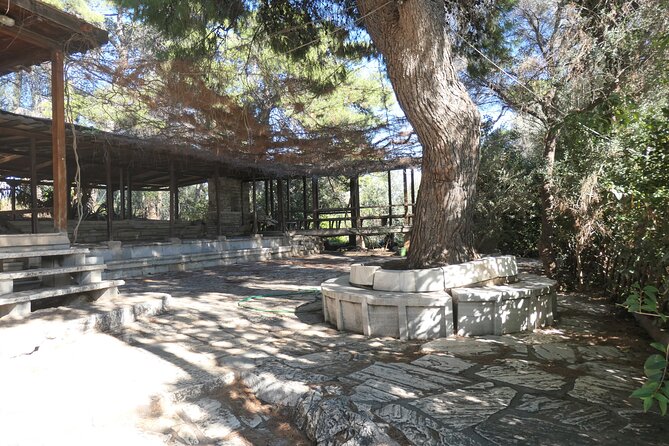
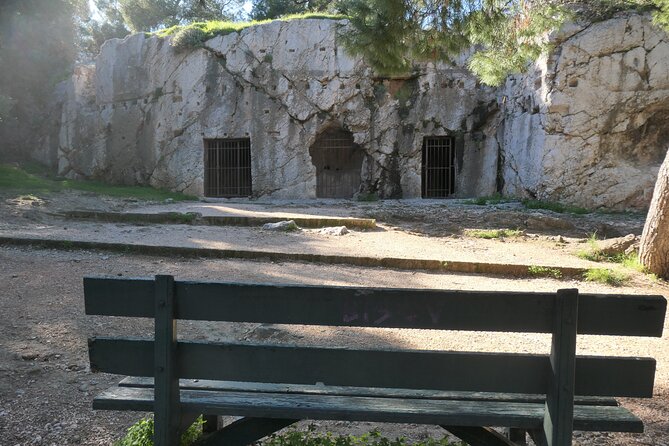
At the Prison of Socrates, the subject turns to Plato’s philosophy and the famous allegory of the cave. This is one of the tour’s clearest links between a physical location and a philosophical story.
Plato’s cave asks how you know what is real, how habit shapes your beliefs, and what happens when someone tries to leave familiar assumptions behind. At the prison, those questions feel less like classroom material and more like a discussion about courage, pressure, and independent thought.
The stop lasts around 20 minutes. It is likely to be one of the more discussion-heavy sections, so this is a place where your group’s interests can shape the experience. If philosophy is new to you, the videos and examples should help make the main point easier to grasp.
A different kind of day out from Athens:
- Athens: Cape Sounion & Poseidon Temple Sunset Half-Day Trip
★ 4.8 · 8,241 reviews - Athens: Acropolis and Parthenon Guided Walking Tour
★ 4.6 · 5,882 reviews - All Day Cruise -3 Islands to Agistri,Moni, Aegina with lunch and drinks included
★ 5.0 · 4,958 reviews - Athens, Piraeus, and Coastline: Blue Hop-On Hop-Off Bus
★ 3.9 · 4,849 reviews
Democracy at Agios Dimitrios Loumbardiaris
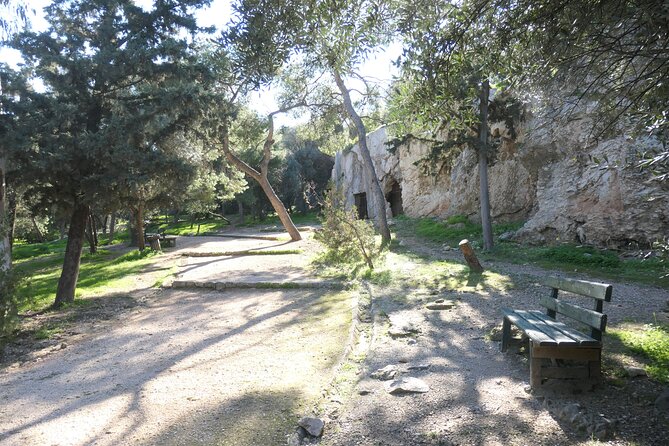
The walk continues to the church of Agios Dimitrios Loumbardiaris, where the subject becomes the birth of democracy. This portion helps place Athenian political ideas in a real local setting rather than presenting democracy as an abstract modern concept.
You will consider how citizens gathered, spoke, and took part in public decisions. The stop lasts about 20 minutes and adds an important civic layer to the tour. Athens is often sold through its temples and statues, but the idea of citizens shaping public life is just as important to the city’s legacy.
Philopappos Monument and the recipe for happiness
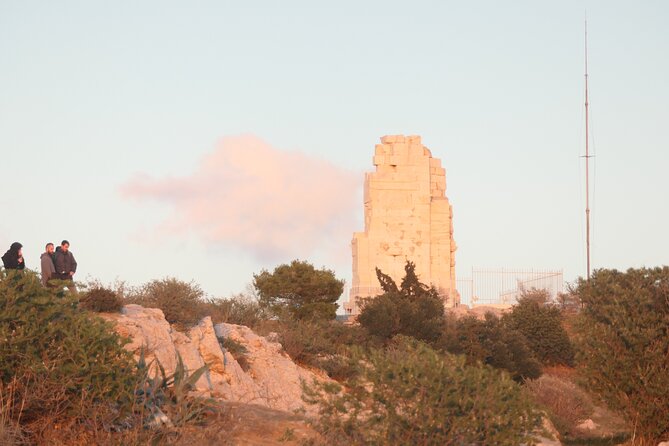
At the Philopappos Monument, the reward is both visual and philosophical. The site offers one of the best views toward the Acropolis and Parthenon, and it is described as one of the most energetic points in Athens.
The discussion centers on happiness according to Plato and Socrates. That makes good use of the setting. You can look over a city that has spent centuries asking what makes a life worthwhile, while considering whether happiness comes from pleasure, virtue, knowledge, or a disciplined mind.
This stop takes about 15 minutes. Bring water and sensible walking shoes, especially in warm weather. A past group found that Lampros chose shady places for explanations and adjusted the pace to keep people comfortable. That practical care matters in Athens, where a short hill can feel quite different at midday.
Pnyx, public life, and Aristotle’s eudaimonia
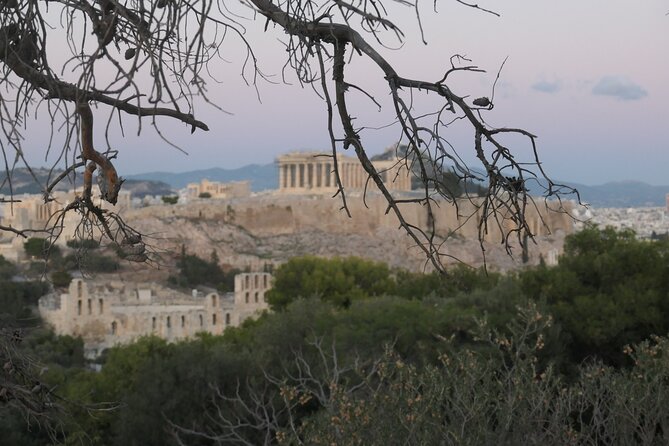
Pnyx is one of the most important stops on the route. It was an assembly area for Athenian citizens, and the views across Athens are a major part of the appeal. The site also connects directly with the idea of public participation.
Here, the discussion turns to Aristotle’s concept of eudaimonia, often translated as flourishing or blissful living. The idea is more demanding than simple pleasure. It asks how your habits, choices, relationships, and character shape a good life over time.
The stop is scheduled for about 15 minutes, with admission included. It is also linked with the secret place of Socrates, adding another layer to the setting. Because Pnyx combines a strong view with political and philosophical meaning, it may be the point where the whole tour’s method becomes clearest.
Keramikos and Epicurus’ garden
Keramikos is the ancient cemetery of Athens, and the tour uses this quieter setting to discuss Epicurean happiness. Epicurus is often reduced to a teacher of luxury, but the central idea is closer to a calm life built around friendship, modest pleasure, and freedom from needless fear.
The connection between a cemetery and happiness is useful. It encourages you to think about mortality without turning the discussion gloomy. The tour presents Epicurus’ garden as a recipe for living well, not as an excuse for excess.
The stop lasts about 15 minutes and does not include an admission ticket. The schedule also mentions the place where Stoicism was born and taught as a philosophy of life. These references give you a wider view of ancient schools, each offering a different answer to the same basic question: how should I live?
From the Ancient Agora area to Mnisikleous Stair
Several shorter points fill out the route. You pass the most beautiful street in Athens, see the first meteorological station in the world, and visit the discussion point of philosophers around Mnisikleous Stair.
The stairway area is also described as a good place for lunch. That is useful information at the end of a philosophy walk, since you may want to continue the conversation over a meal rather than rush straight to another monument. A local lunch suggestion from Lampros can also help you turn the tour into a longer neighborhood visit.
These smaller stops are not given the same time as the main sites. Think of them as connecting pieces that make the walk feel like a route through living Athens rather than a string of formal attractions.
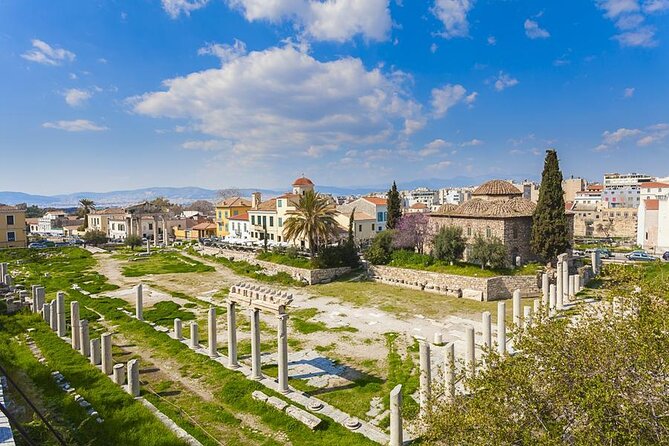
Roman Agora and Stoic ideas for daily life
At the Roman Agora, the focus returns to Stoicism. The site is presented as a place where Stoicism was taught as a philosophy of life, which fits the practical nature of the school.
Stoicism asks you to separate what you can control from what you cannot, and to build a steady response to setbacks. The Roman Agora provides an appropriate setting for discussing philosophy as a daily practice rather than a set of old names and quotations.
The stop lasts about 15 minutes and does not include an admission ticket. The route then continues through central Athens, adding the first meteorological station in the world as another point of interest.
Lysikratous Square and Nietzsche’s two sides of Athens
At Lysikratous Square, the discussion turns to Nietzsche and the Apollonian and Dionysian sides of Athens. In simple terms, the contrast considers order, reason, and form alongside instinct, emotion, music, and release.
The square gives the idea a strong urban setting. Athens can feel carefully structured in one moment and intensely expressive in the next. The stop lasts about 15 minutes and helps connect classical culture with a later philosopher’s reading of its spirit.
This is another place where a private format helps. If your group already knows some Nietzsche, you can ask for more detail. If the idea is new, Lampros can keep it practical and tied to what you are seeing.
Anafiotika and the final change of mood
The final stop is Anafiotika, a small area beneath the Acropolis that feels like a Cycladic island. The tour calls it the second most energetic point in Athens, and the contrast with the formal archaeological sites is part of the charm.
After theaters, cemeteries, political meeting grounds, and philosophical schools, Anafiotika gives the walk a more personal finish. Its narrow lanes and island-like character offer a reminder that Athens is not only an ancient capital. It is also a city of neighborhoods, daily life, and unexpected changes in mood.
The stop lasts about 10 minutes. You return to the starting meeting point afterward.
What the $90.11 price really buys you
The listed price is $90.11 per person, and the experience is private for a group of up to six. That makes the value depend heavily on how many people are in your party. For one person, it is a substantial price for a two-and-a-half-hour walk. For a full group, the cost is easier to justify because you are paying for a private guide rather than a standard large-group outing.
The real product is not admission access. Most stops are viewed from outside, and many have no ticket charge. You are paying for Lampros’s time, preparation, discussion, route planning, multimedia material, and ability to connect ancient philosophy with psychology and modern topics such as AI.
I would choose it for a family, couple, or small group that wants a focused conversation and personal attention. I would skip it if your main goal is entering every major archaeological site or covering Athens at a fast sightseeing pace.
Who should book this experience
This tour suits you if you enjoy asking why, not just when. It is especially good for people interested in philosophy, psychology, history, education, politics, or personal reflection.
Families can also make good use of it. One group included a 17-year-old, two adults, and found that the discussion worked across different levels of prior knowledge. Another group included children using wheelchairs, and Lampros helped them along the route. Still, the supplied details do not promise a fully step-free path, so you should discuss mobility needs before booking.
The tour also works well early in your Athens stay. It gives you a framework for understanding later visits to the Acropolis and other ancient sites. If you schedule it on your final day, you may not have enough time afterward to use Lampros’s suggestions for food, rooftop bars, open-air cinema, and other local activities.
Practical details before you reserve
The walk begins at 11:00 a.m. at AcropoliAthens, 117 42 Athens, and returns to that meeting point. It lasts about 2 hours and 30 minutes and is offered in English.
Wear comfortable shoes and bring water. The route includes outdoor stops, views, and some walking in the Athens heat. The guide has used shady places and regular pauses for discussion, but you should still plan for sun and warm conditions.
Mobile tickets are available, group discounts are listed, and confirmation arrives at booking. Service animals are allowed, and the meeting area is near public transportation. Most people can participate, but the route is not described as fully accessible.
Free cancellation is available up to 24 hours before the start time. Changes or cancellations inside that window are not refunded, and poor weather can lead to a different date or a full refund.
Should you book the philosophical tour in Athens?
Book this if you want Athens to challenge your thinking as much as it fills your camera. Lampros’s strongest qualities are his warmth, clear storytelling, care with the pace, and ability to meet both beginners and people who already know some philosophy.
The best reason to go is the setting. Discussing Plato at Socrates’ prison, democracy at Pnyx, happiness above the Acropolis, and Epicurus beside an ancient cemetery gives familiar ideas a physical anchor.
Skip it if you want a conventional archaeological tour, long indoor visits, or a route built mainly around ticketed attractions. For a curious small group, though, this is a personal and unusually thoughtful way to get acquainted with what Athens has contributed to the world.
FAQ
How long does the philosophical tour in Athens last?
The tour lasts approximately 2 hours and 30 minutes.
What time does the tour start?
It starts at 11:00 a.m.
Where does the tour begin?
The meeting point is AcropoliAthens, 117 42 Athens, Greece.
Where does the tour end?
The activity ends back at the meeting point.
Is this a private tour?
Yes. Only your group participates, with a maximum group size of up to six people.
What language is the tour offered in?
The tour is offered in English.
How much does the tour cost?
The listed price is $90.11 per person. Group discounts are also listed.
Are admission tickets included?
Admission is listed as free at most stops. Pnyx shows admission included. The tour is primarily a walking and discussion experience rather than a series of long interior visits.
Is the tour suitable for people with mobility needs?
Most people can participate, and service animals are allowed. The supplied details do not confirm that the entire route is step-free. One group received help with children in wheelchairs, so you should discuss your specific needs before booking.
Can I cancel for a full refund?
Yes, if you cancel at least 24 hours before the experience starts. Cancellations or changes made less than 24 hours before the start time are not refunded. If poor weather causes the tour to be canceled, you can receive a different date or a full refund.
Newly reviewed around Athens
- Athens: workshop for painting landscape with local artist★ 4.6 · 3 reviews
- Athens: Greek Wine & Olive Oil Tasting at Brettos Plaka★ 4.5 · 3 reviews
- Outdoor Yoga and Pilates with Akropolis view★ 4.0 · 5 reviews
- Acropolis of Athens: 60′ Tour in a Vintage Motorcycle★ 5.0 · 4 reviews
- Ultimate Tasting of the Volcanic Wines of Greece★ 5.0 · 3 reviews
- workshop for painting acropolis/landscape with local artist★ 5.0 · 3 reviews
- Athens at Twilight Night Tour with Drinks and Meze Dishes★ 4.8 · 4 reviews
- Breakfast in the markets with olive oil and honey tasting★ 4.8 · 8 reviews
Tours, compared.
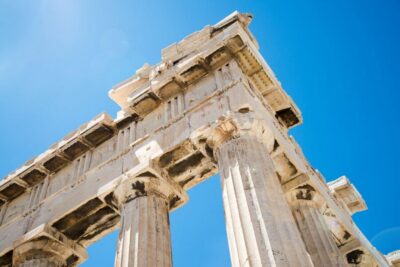
Acropolis, Parthenon & Acropolis Museum Guided Tour
Read our review →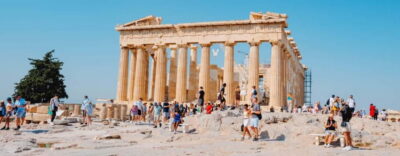

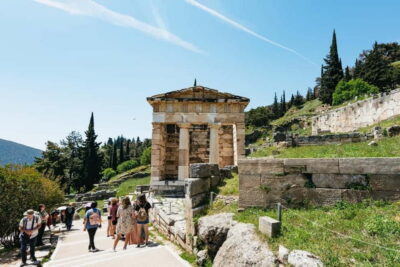
Mythology of Delphi, Museum and Arachova Guided Tour
Read our review →
Acropolis, Parthenon & Acropolis Museum Guided Tour
Read our review →