
Reviewed · ATHENS ACROPOLIS TOURS
Acropolis monuments, Parthenon and Plaka, Monastiraki walking tour
The best part of this Athens walking tour is the way it links the Acropolis with the neighborhoods below it. You see the Parthenon and Temple of Athena Nike, then walk into Plaka and Monastiraki, where ancient stones give way to pastry shops, tavernas, churches, and market lanes.
I like the skip-the-line Acropolis entry, which matters greatly on a busy morning. I also like the small food stop, with spanakopita and sweet semolina custard, because it gives the history a local, edible footnote. The main drawback is physical: the Acropolis involves uphill walking, uneven ground, and slippery sections, so comfortable shoes and a moderate fitness level are needed.
Key points at a glance
- Skip the main Acropolis ticket queue: Spend more of your 3.5-hour tour seeing the site rather than waiting outside.
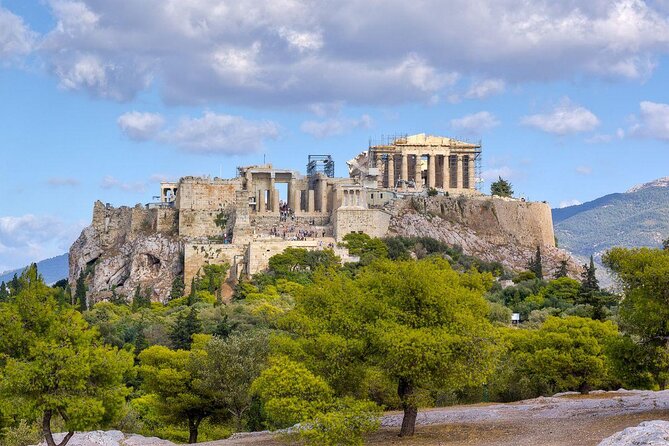
- See more than the Parthenon: The route includes the Temple of Athena Nike, Roman Agora, Tower of the Winds, Plaka, and Monastiraki.
- Hear the stories clearly: Guides such as Sophia, Demos, Anna, Artemis, Eleni, and Lisa have been praised for clear explanations, humor, and good pacing.
- Finish with Greek snacks: Try traditional spanakopita and sweet semolina custard during the walk.
- End in Monastiraki: You finish in one of central Athens’ most useful areas for food, shopping, and further exploring.
- Plan for a 9 a.m. start: The early time helps you tackle the Acropolis before the strongest heat and thickest crowds.
Why this 3.5-hour route works for a first day in Athens
At $105.26 per person, this is not the cheapest way to look at the Acropolis. It is a guided experience with admission included, though, and the value comes from combining several major sights in one well-planned walk.
You begin at 9 a.m. in central Athens, close to the Acropolis, and finish in Monastiraki. That point-to-point design is useful. You do not spend time returning to the starting area, and you finish near restaurants, shops, public transportation, and more streets worth exploring on foot.
The tour is offered in English and is limited to a maximum of 20 people. That is large enough to provide a social group but small enough for a guide to keep the route together. Some guides use a headset system, which is particularly helpful around the Acropolis, where you may want to step aside for photographs without losing the explanation.
The route is also a good introduction to Athens because it does not treat the Acropolis as an isolated monument. You get the famous ancient buildings first, then see how the modern city grew around them.
More ways to see the Acropolis:
- Athens: Acropolis & up to 5 Archaeological Sites Combo Pass
★ 4.4 · 12,619 reviews - Athens: Acropolis Ticket with Optional Audio or Live Guide
★ 4.2 · 11,055 reviews - Athens: Acropolis, Parthenon & Acropolis Museum Guided Tour
★ 4.8 · 9,316 reviews
Entering the Acropolis before the biggest crowds
The Acropolis is the centerpiece, and the skip-the-line ticket is the practical reason to book this tour rather than simply arriving alone. Lines and crowds can eat into a short Athens visit. Here, your guide handles the included entrance and leads you toward the monuments without making you work out the ticket process yourself.
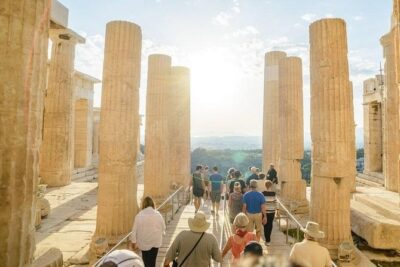
The climb is part of the experience. Expect an uphill approach over ancient and modern paths, with some uneven surfaces. It is not an extreme hike, but it is not a flat sightseeing stroll either. Bring water, use sun protection, and keep your walking shoes on.
Your guide gives the site shape and purpose. Without help, it is easy to look at a marble column and move on. With a good explanation, you begin to understand how the Acropolis functioned as a sacred center and why its buildings were placed where they were.
The tour has received a 4.9 rating from 182 reviews, with 98 percent of customers recommending it. The most consistent praise goes to the guides, not just the monuments. Sophia has been praised for making the route easy to follow, while Demos has been singled out for connecting ancient events with everyday life and adding humor. That matters because the Acropolis can become a blur of dates and names without a clear storyteller.
The Parthenon: the main event, with time to look closely
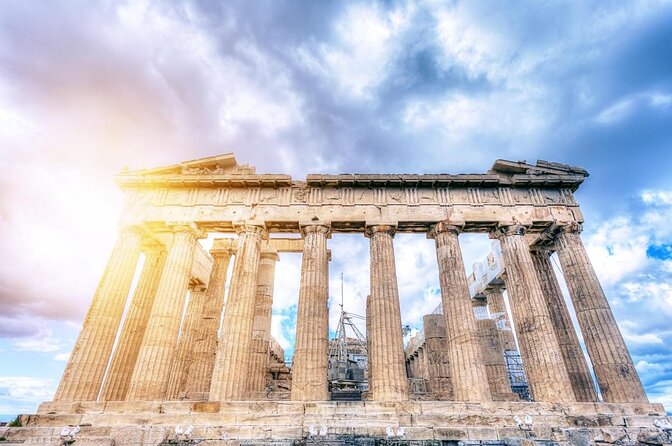
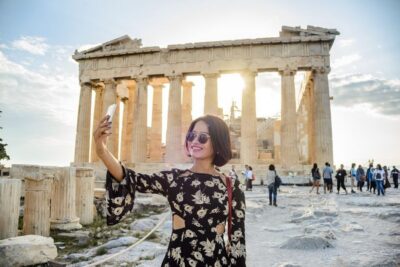
You spend about 30 minutes at the Parthenon, the former temple dedicated to Athena, the city’s patron goddess. Construction began in 447 BC, when Athens was at the height of its influence through the Delian League.
Thirty minutes is enough for a useful guided visit, but not enough for every detail. Your guide can point out the building’s design, purpose, and place within the Acropolis complex while you take in the scale. Allow yourself a few quiet moments to look beyond the explanations. The columns, surviving sculpture, and broad views over Athens are the reason this stop remains so powerful.
This is also the busiest part of the tour. You may need to share the best viewpoints with other groups, and your guide may pause in the shade when possible. The early start helps, but it does not turn the Parthenon into a private monument.
If you want a slow architectural study or extensive photography time, you may prefer to return on your own. For a first visit, though, the guided half hour gives you the essential context without letting one monument consume the entire morning.
The Temple of Athena Nike and the smaller Acropolis details
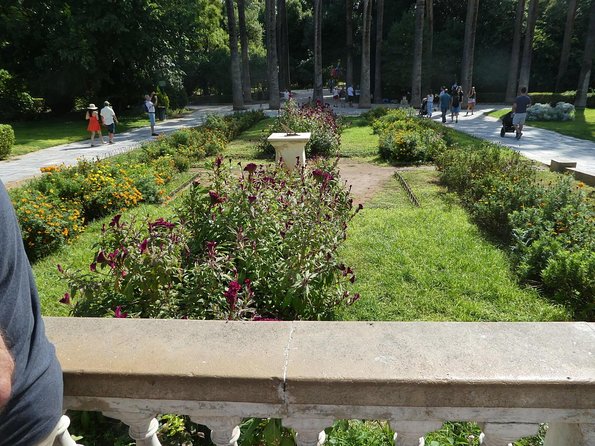
The Temple of Athena Nike gets about five minutes. That sounds brief, but the temple is small, and a short stop can still help you notice an important detail: it is the earliest fully Ionic temple on the Acropolis, built around 420 BC and dedicated to Athena Nike.
A guide is especially helpful here because the temple can be overshadowed by the Parthenon. You learn why it mattered and how it fit into the religious plan of the hill. Do not expect a separate, extended visit. Think of it as a focused stop along the Acropolis route.
The tour’s strength is this coverage of lesser-known monuments. You check off the famous building but also leave knowing the names and roles of sites that independent visitors often pass without a second glance.
More walks around Plaka and Monastiraki:
- Culinary Backstreets of Plaka – Athens Food Tour
★ 5.0 · 182 reviews - Traditional Greek Show in Plaka with Dinner
★ 3.6 · 178 reviews - VIP Private Guided Tour of Athens Acropolis & Plaka in a Sidecar
★ 5.0 · 108 reviews - Athens: Evening Guided Walking Tour with Plaka & Dinner
★ 4.7 · 70 reviews
The Roman Agora and Tower of the Winds
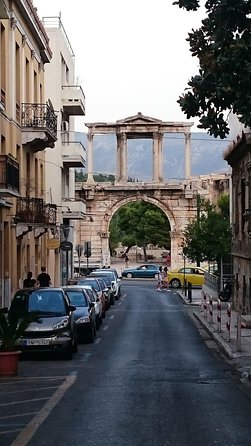
After the Acropolis, the route moves down into central Athens and toward the Roman Agora. The Roman Agora was built between 27 and 17 BC, using funds connected with Augustus and a promise originally made by Julius Caesar. In its ancient form, it was an open space surrounded by a colonnade, with shops, entrances, a fountain, and public facilities.
The Tower of the Winds is the visual prize here. This octagonal Pentelic marble structure functioned as a timepiece, combining sundials, a water clock, and a wind vane. It is often described as the world’s first meteorological station, which gives you a fun reminder that ancient engineering was practical as well as beautiful.
You spend about ten minutes at the tower, and admission is not included. The tour views it from the outside rather than adding another paid entrance. That keeps the route moving and avoids piling extra costs onto a three-hour experience, but it also means you should not book this tour expecting a full Roman Agora visit inside the archaeological area.
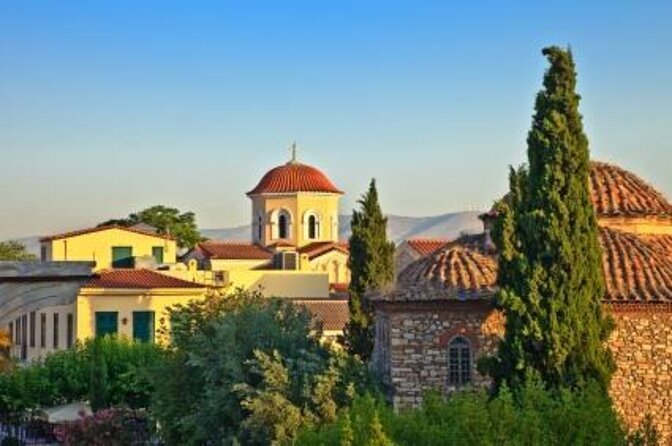
The Roman Agora also carries layers from later Athens. The Fethiye Mosque was built to the north during the Ottoman period, a useful reminder that this city’s story did not stop in classical Greece.
Plaka: the Acropolis neighborhood at street level
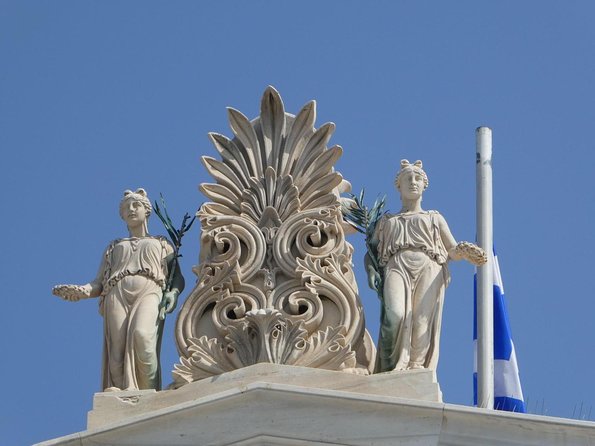
Plaka spreads across the slopes below the Acropolis. After the monumental scale of the hill, the neighborhood changes the mood completely. You walk narrow cobblestone lanes past neoclassical houses, Byzantine churches, small shops, sidewalk cafés, and family-run tavernas.
The Plaka portion lasts about 30 minutes, and admission is free. It is less about entering specific buildings and more about seeing how Athens feels at street level. Independent shops sell jewelry, clothing, and local ceramics. You may also pass lanes leading toward Anafiotika, a small area with whitewashed homes and a Greek-island feel.
I like this part because it gives the ancient sites a human setting. You are no longer looking only at temples and columns. You are seeing the neighborhood where people eat, shop, work, and meet beneath the same rocky hill.
There is a practical tradeoff. Some Plaka streets are heavily geared toward souvenirs, and the cobblestones can be awkward in thin-soled shoes. Still, the walk provides useful orientation, especially if Athens is new to you. Guides can point out places for later meals and shopping, as Anna did for one group, while keeping the walk connected to the city’s older layers.
Monastiraki and the final Greek pastry stop
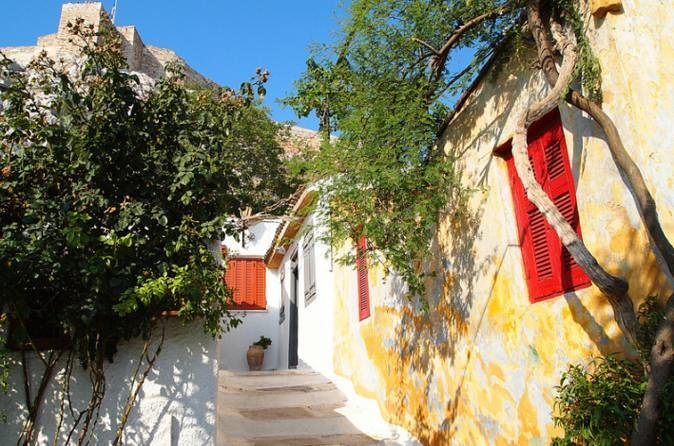
The tour ends in Monastiraki, one of the most central places in Athens. The square and its surrounding lanes are a natural handoff point for the rest of your day. From here, you can continue eating, shopping, visiting nearby sights, or simply watch the city move around you.
The food stop includes traditional spanakopita and a sweet semolina custard cream. These are samples, not a full lunch, so plan another meal afterward. The portions are best understood as a pleasant tasting break rather than a reason to skip breakfast or lunch.
The snacks add something important to the walk. Greek food is not presented as a separate cooking class or a formal meal. Instead, you get a quick taste while moving through the city, which suits the pace of the tour.
The reviews repeatedly praise the pastry stop, and one guide, Artemis, was especially appreciated for making the food part of an enjoyable day. If you have dietary restrictions, the supplied details do not promise substitutions, so ask before booking if that is important to you.
The guides make or break the experience
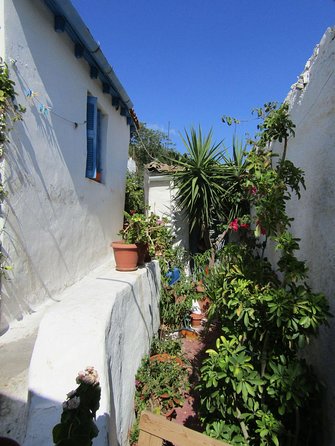
A historical walking tour depends heavily on the person holding the microphone. The guide names connected with this experience include Sophia, Eleni, Demos, Anna, Annie, Lisa, Sapfo, and Artemis. The guide assigned to your departure may differ, so you should not book on the expectation of one particular person.
The strongest guide qualities here are clear speaking, a relaxed pace, humor, and the ability to connect dates with ordinary life. Demos has been praised for making ancient facts relatable. Eleni was noted for giving rest breaks and keeping the group moving at a comfortable speed. Lisa was praised for organizing a large amount of information without making it feel rushed.
That range of feedback gives you a useful expectation. This is not simply a guide who points at buildings and recites labels. The better guides on this route explain why a site mattered and how it connects with what you are seeing now.
The group size can reach 20 people, so do not expect a private tour. A headset may be provided, and that helps you listen while taking photographs. Stay close enough to hear instructions, especially at busy crossings and around the Acropolis entrances.
Price, pace, and who gets the best value
At $105.26, the price makes the most sense for you if you want a guided introduction and value saved time. You receive the licensed guide, skip-the-line Acropolis entry, and Greek pastry tastings. You do not receive hotel pickup, hotel drop-off, or admission to the Tower of the Winds.
The experience lasts about three and a half hours, but the route covers a lot of ground. You visit the Acropolis, Parthenon, Temple of Athena Nike, Roman Agora area, Tower of the Winds, Plaka, and Monastiraki. That is good coverage for a first morning, but it also means each stop has a set limit.
I would book it early in an Athens stay. It gives you a map in your head, helps you understand the major ancient sites, and leaves you in Monastiraki with the rest of the day open. It is also useful if you prefer not to spend your first morning comparing ticket options and navigating the Acropolis alone.
I would look elsewhere if you want a private guide, a long museum visit, a leisurely food tour, or a route with very little walking. The pace is relaxed by walking-tour standards, but the terrain still asks something of your legs.
Practical advice before you go
Meet at Porinou 5 in Athens at 9 a.m. The tour does not include hotel pickup, so allow enough time to reach the meeting point. You can present either a paper or electronic voucher.
Wear sturdy, comfortable shoes. The Acropolis includes uphill walking, and the later neighborhoods bring cobblestones and uneven surfaces. One important accessibility detail is that visitors with mobility issues may be able to use the Acropolis elevator, but permission must be arranged when booking because last-minute access may not be possible.
The minimum age is 10. Service animals are allowed, and the meeting area is near public transportation. The tour requires a moderate fitness level and depends on good weather.
You can cancel for a full refund up to 24 hours before the local start time. Changes or cancellations inside that window are not accepted, and poor weather or an unmet minimum group size can lead to a new date, another experience, or a refund.
Should you book this Acropolis and Plaka walk?
Book it if you want the major Acropolis monuments explained by a local guide, then want an easy route into Plaka and Monastiraki. The skip-the-line entry, clear guide system, pastry tasting, and point-to-point finish give the tour real practical value.
Think twice if stairs, steep paths, hot sun, or uneven paving will cause trouble. Also remember that the Tower of the Winds is viewed without included admission, and the pastry tasting is not lunch.
For most first-time visitors with three and a half hours to spare, this is a smart way to meet Athens. You get the Parthenon, but you also get the streets, snacks, and neighborhoods that make the city more than an archaeological site.
FAQ
How long does the tour last?
The tour lasts approximately 3 hours and 30 minutes.
What time does the tour begin?
The tour begins at 9 a.m.
Where does the tour start and finish?
It starts at Porinou 5 in Athens and ends in Monastiraki.
Is Acropolis admission included?
Yes. Skip-the-line Acropolis entrance tickets are included. Admission to the Tower of the Winds is not included.
What food is included?
The tour includes a snack stop with sweet semolina custard cream and traditional spanakopita.
Is the tour suitable for children?
The minimum age is 10 years.
Is the tour physically demanding?
You should have a moderate fitness level and wear comfortable shoes. The route includes uphill walking at the Acropolis, cobblestones, and some potentially slippery sections.
More walking tours in Athens
- Athens: Acropolis and Parthenon Guided Walking Tour
★ 4.6 · 5,882 reviews - Greek Food Walking Tour in Athens
★ 5.0 · 4,740 reviews - Acropolis: Acropolis and Parthenon Guided Walking Tour
★ 4.7 · 3,442 reviews - Acropolis monuments & Parthenon Walking Tour with Optional Acropolis Museum
★ 5.0 · 2,678 reviews
Newly reviewed around Athens
- Feel Ancient thermal Spa Visit Delphi, Leonidas ℨoo Spaʀtan★ 5.0 · 4 reviews
- Food Tour★ 5.0 · 3 reviews
- Explore the Hidden Food Gems of Athens★ 5.0 · 57 reviews
- Food Experience in Athens including Unlimited Lunch★ 5.0 · 3 reviews
- Eat Your Way Through Athens: A Local Food Walk★ 4.9 · 97 reviews
- From Athens: Delphi Private Tour with Lunch Time★ 4.0 · 3 reviews
- Delphi: Spanish guided one day tour★ 4.6 · 55 reviews
- Early Entry Acropolis & Museum. Beat the Crowds & the heat★ 5.0 · 3 reviews
Athens Acropolis Tours, compared.
Acropolis & up to 5 Archaeological Sites Combo Pass
Read our review →
Acropolis, Parthenon & Acropolis Museum Guided Tour
Read our review →
Acropolis, Parthenon & Acropolis Museum Guided Tour
Read our review →
Acropolis monuments & Parthenon Walking Tour with Optional Acropolis Museum
Read our review →Browse the lists this tour appears in