
Reviewed · ATHENS CITY HIGHLIGHTS TOURS
Full Day Private Of Athens Highlights of Classical &Modern Athens
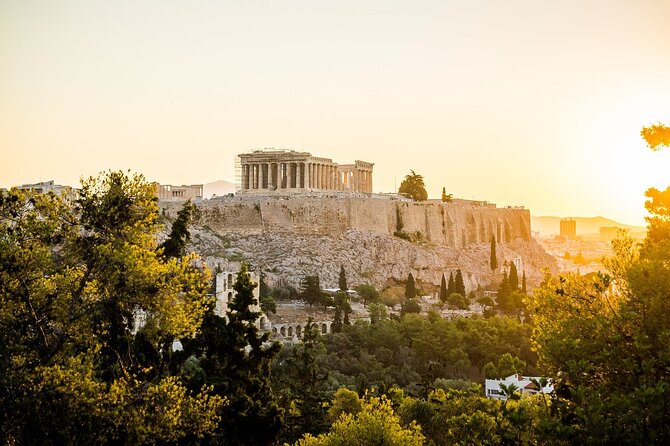
Athens makes a strong first impression from the top of the Acropolis. This private six-hour tour takes you from the Parthenon and Caryatids to the Panathenaic Stadium, Syntagma Square, Plaka, and the Athenian coast. You get a broad look at ancient and modern Athens without wrestling with city traffic or a large group.
I like the private vehicle and flexible plan, especially for cruise passengers on a tight clock. I also like the practical touches: hotel, apartment, or port pickup, cold bottled water, Wi-Fi, air conditioning, and an English-speaking driver. A possible drawback is that the driver does not enter the archaeological sites, and admission fees can add a fair amount to the $179.59 price.
Key details that shape the day
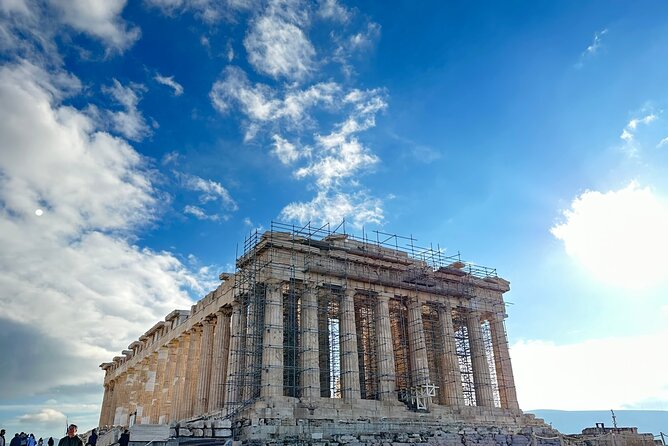
- The Acropolis is the main event: You see the Parthenon, Propylaea, Temple of Athena Nike, Erechtheion, Odeum of Herodes Atticus, Theatre of Dionysus, and Areopagus.
- A private car saves time: Pickup and return are offered from Athens hotels, residences, apartments, and Piraeus cruise port.
- The schedule can change: You may add or skip sites, which helps families, cruise passengers, and repeat visitors.
- Entry tickets are extra: Acropolis admission is listed at €30, the Acropolis Museum at €20, and Ancient Agora at €20 per person.
- The route reaches beyond central Athens: Depending on your wishes and available time, it can include Lycabettus, Lake Vouliagmeni, and Mikrolimano.
- You get a driver, not an official site guide: Your driver can explain the city in English but will not accompany you inside the monuments.
Starting above the city at the Acropolis
The day begins with pickup from your chosen location. For a hotel, the driver waits in the lobby. For an apartment, pickup is arranged at the building entrance. At Piraeus port, the driver waits by the gate with a sign, which is useful after a long morning at sea and a crowded disembarkation.
The first major stop is the Acropolis. This hill was the spiritual and civic center of ancient Athens, and the climb brings you into direct contact with the monuments that shaped Western art, politics, philosophy, and theater.
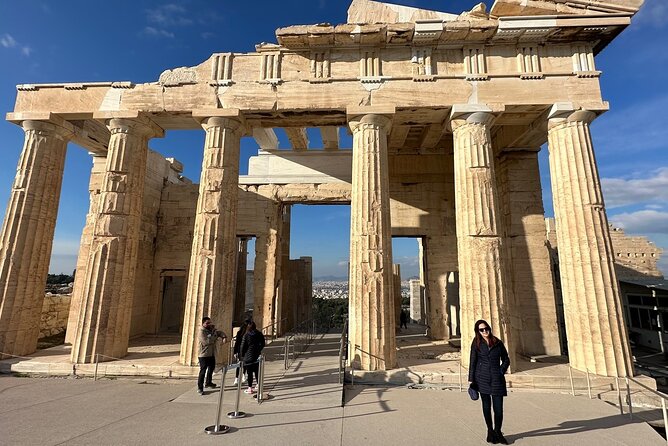
The Propylaea forms the grand entrance. Built as part of Pericles’ rebuilding program after the Persian Wars, it was meant to make arrival feel ceremonial. From there, you see the small Temple of Athena Nike on its raised bastion. Its Ionic design and location beside the entrance make it easy to miss if you are focused only on the Parthenon, so listen for the explanation.
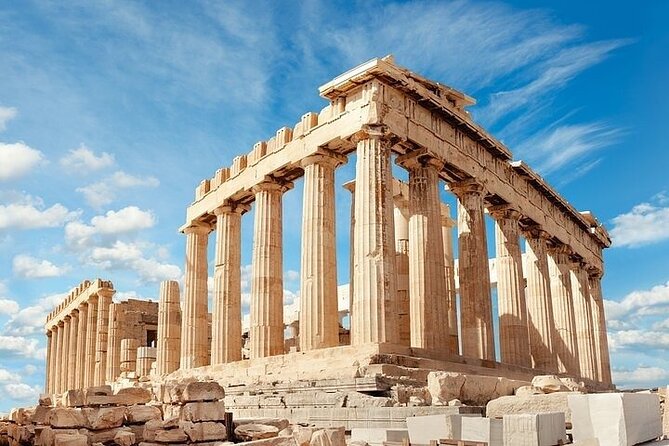
The Parthenon is the visual prize. Dedicated to Athena Parthenos, it was both a religious building and a statement of Athenian power. The marble is weathered, the sculpture is incomplete, and the building has suffered fire, explosions, looting, and pollution, yet its proportions still make the hill feel ordered and calm above the city.
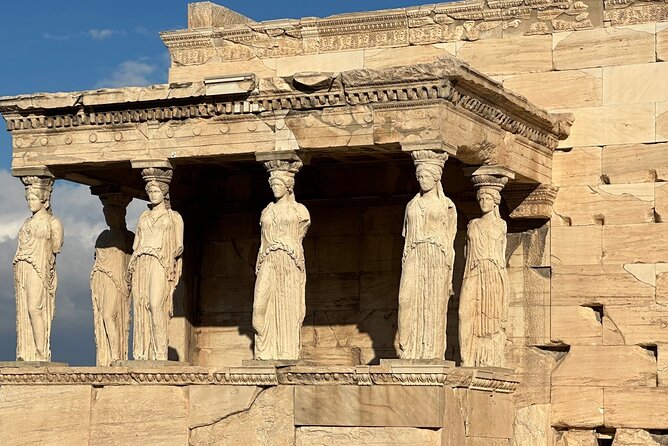
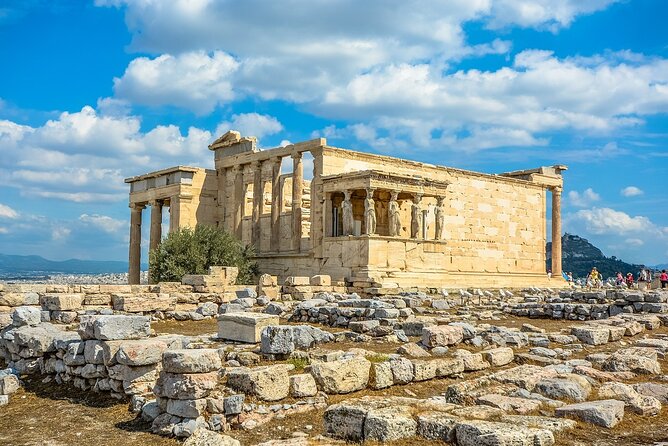
At the Erechtheion, look for the Caryatids, the sculpted maidens that serve as architectural supports on the Porch of the Maidens. The originals are protected in the Acropolis Museum, with one held by the British Museum, but the monument remains one of the most graceful sights on the hill.
The Acropolis portion is listed at roughly 45 to 55 minutes, depending on how the stops are arranged. That is enough for a focused visit, but not enough for a leisurely study of every monument. Wear firm shoes and bring water. One family completing a similar schedule logged more than 10,000 steps, and the dry Athenian sun can catch you off guard.
More city tours in Athens:
- Best of Athens Half Day Private Tour
★ 5.0 · 3,714 reviews - Athens Half-Day Sightseeing Tour with Tickets of Acropolis
★ 4.0 · 1,402 reviews - Highlights of Athens biketour
★ 5.0 · 840 reviews
Theater, democracy, and the south slope
The route also includes views of the Odeum of Herodes Atticus and the Theatre of Dionysus. The Odeum is the grand Roman-era theater still used for performances, while the Theatre of Dionysus began as a sanctuary venue and later became a large theater with room for as many as 17,000 people.
This is where the ancient city becomes more than a collection of marble ruins. The Theatre of Dionysus hosted the City Dionysia, the festival linked to the birth of Greek drama. The site connects the architecture under your feet with the plays, civic debates, and public rituals that shaped Athenian life.
You may also see the Areopagus, or Mars Hill, a rocky outcrop beside the Acropolis. It is a valuable viewpoint, though the stone can be slippery and uneven. Your driver can point out the site, but the visit itself is usually brief.
The important practical point is that the driver is not a licensed guide. You receive commentary in fluent English and can ask questions, but the driver does not go into the archaeological sites with you. If you want a full explanation beside each monument, an optional licensed guide is listed at €250 per person. That charge changes the value calculation sharply, especially for one or two people.
The Panathenaic Stadium and Olympic Athens
The Panathenaic Stadium, also called the Kallimarmaron, is a quick but worthwhile stop. It is built from Pentelic marble and occupies a natural hollow between the hills of Agra and Ardettos.
The site began as a stadium for the Great Panathenaia, a festival honoring Athena. Herodes Atticus restored it in the second century, and the modern stadium hosted the first Olympic Games of the modern era in 1896. It also connects to the Olympic flame ceremony and the 2004 Athens Games.
You can enter for an additional fee of €20, or simply stop for photographs if time and budget matter more. The outside view gives you a good sense of its horseshoe shape, but entry lets you see the marble seating and track from within.
I would make this a priority for families and anyone interested in the Olympics. It is an easy place to understand, even if you have limited interest in ancient architecture. The listed visit is about 20 minutes, so it does not consume much of the day.
The Acropolis Museum, where the fragments make sense
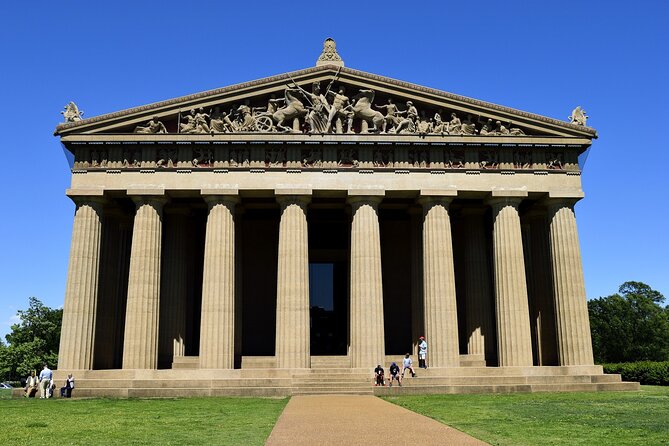
The Acropolis Museum sits below the sacred hill and houses sculpture and archaeological finds from the Acropolis. The glass building brings the old hill into view, while the galleries give context to the damaged and missing pieces you see above.
A short visit of about 35 minutes can cover the main highlights, including Parthenon marble and Caryatid sculpture. That is a sensible use of time if you want a clear connection between the ruins and the objects once placed there.
Admission is not included and is listed at €20 per person. If you are choosing between the museum and another paid site, I would usually favor the museum for a first visit. The Acropolis can feel abstract when seen only from the hill. Here, the fragments, sculptures, and architectural details help you understand what the buildings once looked like.
The timing is the limitation. Thirty-five minutes is enough for a brisk introduction, not a full museum visit. If art and archaeology are your main interests, ask to reduce the number of other stops.
More full days out from Athens:
- All Day Cruise -3 Islands to Agistri,Moni, Aegina with lunch and drinks included
★ 5.0 · 4,958 reviews - From Athens: Delphi Full Day V.R. Audio Guided Tour
★ 4.6 · 3,028 reviews - Athens Full Day Private Tour
★ 5.0 · 2,903 reviews - From Athens: Mycenae, Epidaurus & Nafplio Full Day Trip
★ 4.8 · 2,438 reviews
Syntagma Square and the Evzones
The tour then moves into modern Athens at Syntagma Square. The former royal palace now houses the Greek Parliament, facing the Tomb of the Unknown Soldier. The square is the center of national politics and one of the city’s key public spaces.
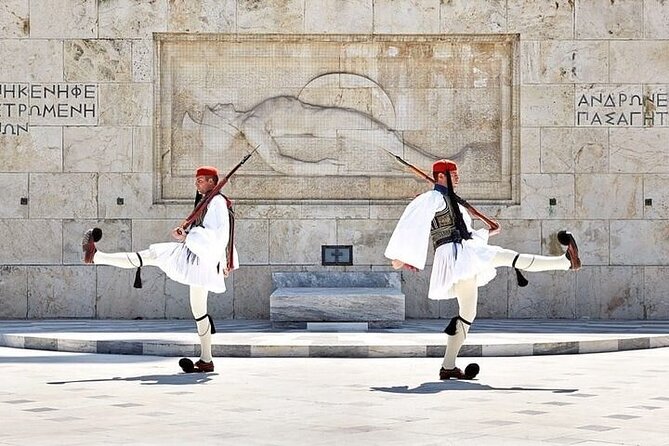
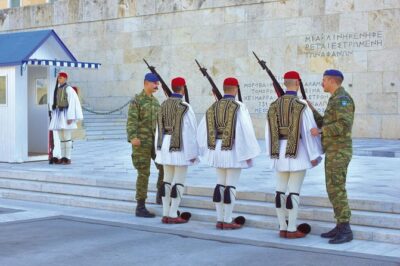
The presidential guards, known as the Evzones, protect the monument in traditional uniforms. Their hourly change of guard lasts about 15 minutes and uses slow, deliberate movements that make the ceremony memorable. Timing matters here. Ask your driver to plan the route around the ceremony if seeing it is important to you.
The tour also passes the Academy of Athens and the National Library along Panepistimiou Avenue. These neoclassical buildings form part of the city’s grand nineteenth-century civic center. You may also pass Omonoia Square, the Temple of Hephaestus, and other central landmarks during the drive.
These drive-by views are useful for orientation, but they are not full visits. You will not have time to study every facade or enter every building during a six-hour tour. The private format lets you choose where to linger, but you still need to protect time for the Acropolis.
Plaka, the Agora, and Monastiraki
Plaka spreads along the lower slopes of the Acropolis. Its narrow streets, small shops, neoclassical houses, and archaeological remains make it a pleasant place to walk after the larger monuments. The neighborhood is often called the Neighborhood of the Gods because of its location beneath the Acropolis.
The Ancient Agora is more than an old marketplace. It was a place for commerce, assemblies, public life, and debate. The site is closely tied to the development of democracy and free speech. The Temple of Hephaestus, one of the best-preserved Greek temples, rises on the Agora’s western side.
The Ancient Agora entry fee is listed at €20 per person. The Roman Agora is another possible stop, showing a later phase of the city’s public life. Both sites reward visitors who want ruins with a sense of civic purpose rather than only grand temples.
Monastiraki adds a more contemporary note. The flea market area is good for browsing souvenirs and handmade goods, and the surrounding streets offer Greek food. Lunch can be arranged, but the meal is not included. You can ask for a restaurant or taverna, or use the stop to choose your own meal.
The food portion is flexible, which I consider a plus. A fixed restaurant would make the day less personal, but a scheduled lunch can also eat into your already limited sightseeing time. Tell the driver early if food matters more to you than another monument.
Lycabettus and the view across Athens
Mount Lycabettus gives you the wide city view that the Acropolis cannot. From above, ancient sites, apartment blocks, central Athens, and the distant coast fit into one frame.
The listed stop is about 15 minutes and is reached by vehicle. That makes it a quick orientation stop rather than a long hill visit. It is especially useful early in your Athens visit because it helps you understand how the city is arranged.
I like this addition because it breaks up the steady sequence of ruins and museums. The only caution is time. If you are visiting the Acropolis Museum, Ancient Agora, and Panathenaic Stadium, Lycabettus may need to be a short photo stop.
Zeus, Vouliagmeni, and the Athenian coast
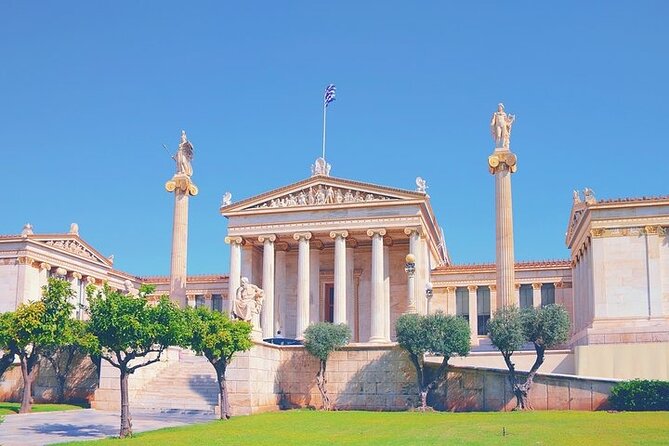
The Temple of Olympian Zeus brings you back to the scale of imperial Athens. Sixteen columns remain from a temple that once had enormous rows of supports and housed statues of Zeus and the emperor. The fee is listed at €20, although the tour can also stop for photographs without entering.
Hadrian’s Gate is nearby and shows the meeting of Greek and Roman Athens. It is a fast roadside-style sight, but it helps explain how the Roman emperor presented himself as a successor to the city’s ancient rulers.
For a longer day beyond the center, you may choose Lake Vouliagmeni. About 20 kilometers south of central Athens, the lake is fed by thermal springs and seawater. Its temperature is listed at roughly 22 to 29 degrees Celsius throughout the year, and swimming access, sun decks, and a lakeside café give the stop a different feel from the archaeological sites.
The lake’s Garra rufa fish provide natural exfoliation in the water. Swimming is not included in the tour price, and the lake has its own admission charge. At about 20 minutes, the scheduled stop is too short for a full spa afternoon, but it can provide a welcome change of pace if you have already seen Athens on an earlier visit.
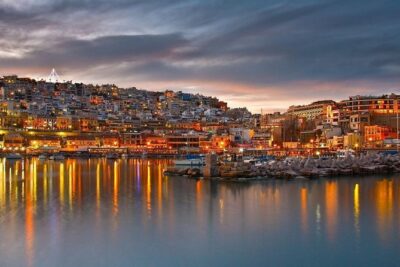
Mikrolimano in Piraeus offers another optional direction. This small horseshoe harbor has fishing boats, yachts, and seafood restaurants. It is a scenic place for a meal or a short waterfront look, though adding it to an already full central Athens route may require dropping other stops.
What the $179.59 price really covers
The $179.59 per-person rate pays for a private experience, vehicle, fuel, tolls, pickup, return, and an English-speaking driver. Groups of one to three use a sedan, while groups of four to seven use a minivan. Larger groups can be placed in a suitable vehicle.
For a family or small group, this can be good value. You avoid coordinating taxis, arranging port transport, and figuring out how to reach the Acropolis, stadium, museum, and coast in one day. Cold water, air conditioning, and Wi-Fi are small details that matter in Athens heat.
The total rises once you add admissions. A person visiting the Acropolis, Acropolis Museum, Ancient Agora, Panathenaic Stadium, and Temple of Olympian Zeus could add €100 in listed entry fees. Lunch and gratuity are also extra. The optional licensed guide is a separate €250 per person, a cost I would consider only if detailed site interpretation is central to your plans.
Airport pickup has an additional charge. The information gives two figures, €60 per person in the inclusions section and €45 in the additional information, so confirm the current airport fee before booking.
Who should book this private Athens tour?
I would consider this tour for a cruise passenger who wants a private car and a clear return plan to Piraeus. It is also a good fit for a family with children, since the route can be adjusted and the vehicle provides shade, water, and a place to rest between sites.
It works well for first-time visitors who want to see the major landmarks in one day. You get the Acropolis, Olympic stadium, museum, Parliament, Plaka, Agora, and several panoramic or coastal options.
I would choose another format if you want long museum visits, a slow food walk, or detailed commentary inside every archaeological site. The schedule covers a lot of ground, and the driver remains outside the monuments. This is a flexible sightseeing transfer with strong historical stops, not a traditional walking tour led inside each site.
Free cancellation is available up to 24 hours before the start time. The experience requires good weather, and poor weather may lead to a different date or a full refund.
My call: a strong overview with careful planning required
Book this tour if you value privacy, port pickup, and a wide range of sights more than extended time at each one. The best version of the day would focus on the Acropolis, Acropolis Museum, Panathenaic Stadium, Syntagma Square, and one neighborhood or Agora stop.
If you want Lake Vouliagmeni or Mikrolimano too, ask the operator to build the route around your priorities before departure. Trying to include every site listed could turn six hours into a hurried checklist.
The strongest practical tip is simple: bring water, sun protection, and comfortable shoes. A family day led by Nikos included cold water, a cool van, the guard ceremony, the Acropolis Museum, and more than 10,000 steps. That gives you a good sense of the pace. Athens rewards a full day, but this private format helps you spend that day on the sights you care about most.
FAQ
How long is the private Athens tour?
The tour lasts approximately six hours.
Where can pickup and return take place?
Pickup and return are available from Athens and Piraeus hotels, residences, apartments, and the Piraeus cruise port. The tour can also arrange airport pickup for an extra charge.
Is the tour suitable for cruise passengers?
Yes. The schedule is designed to cover major Athens sights while allowing pickup and return to Piraeus cruise port.
Is an official tour guide included?
No. An English-speaking driver provides commentary and answers questions, but drivers do not enter archaeological sites with you. An optional licensed guide is listed at €250 per person.
Are Acropolis tickets included?
No. Acropolis admission is listed at €30 per person.
What other admission fees are extra?
The Acropolis Museum is listed at €20, Ancient Agora at €20, Panathenaic Stadium at €20, Temple of Olympian Zeus at €20, and the National Archaeological Museum at €20 when selected.
Can the itinerary be changed?
Yes. This is a tailor-made private tour, so you can request that sites be added or skipped. Families can also ask for adjustments to suit children.
Is lunch included?
No. Lunch stops can be arranged, but meal costs are not included in the tour price.
Newly reviewed around Athens
- Athens: workshop for painting landscape with local artist★ 4.6 · 3 reviews
- Athens: Greek Wine & Olive Oil Tasting at Brettos Plaka★ 4.5 · 3 reviews
- Outdoor Yoga and Pilates with Akropolis view★ 4.0 · 5 reviews
- Acropolis of Athens: 60′ Tour in a Vintage Motorcycle★ 5.0 · 4 reviews
- Ultimate Tasting of the Volcanic Wines of Greece★ 5.0 · 3 reviews
- workshop for painting acropolis/landscape with local artist★ 5.0 · 3 reviews
- Athens at Twilight Night Tour with Drinks and Meze Dishes★ 4.8 · 4 reviews
- Breakfast in the markets with olive oil and honey tasting★ 4.8 · 8 reviews
Athens City Highlights Tours, compared.
Athens Half-Day Sightseeing Tour with Tickets of Acropolis
Read our review →

Essential Athens Highlights Plus Cape Sounion Skip-The-Line Tour
Read our review →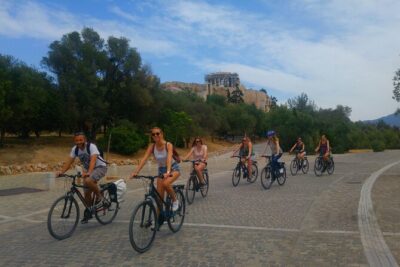
Acropolis & Parthenon Tour and Athens Highlights Bike tour
Read our review →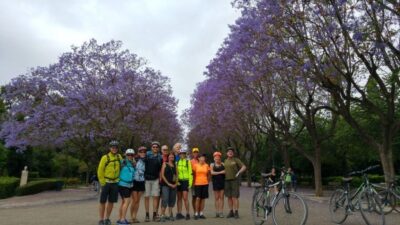
The Acropolis, Athens Walking City Tour and Acropolis Museum
Read our review →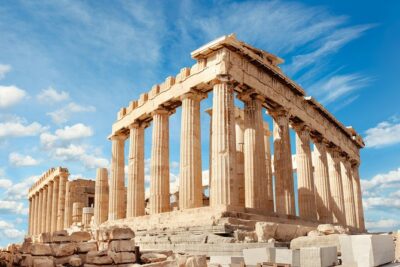
Browse the lists this tour appears in