

Reviewed · PRIVATE
Fast Private Athens Tour
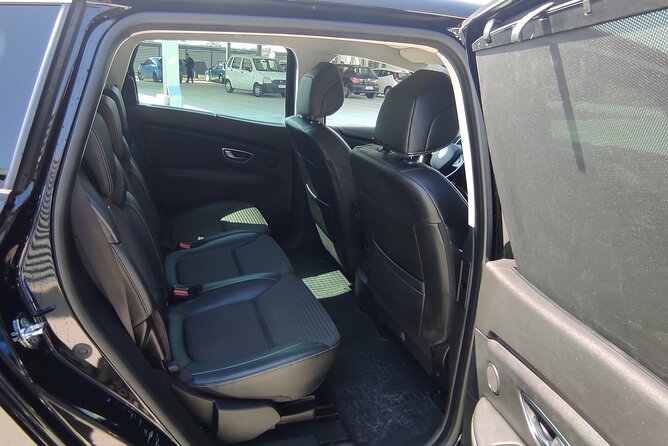
Athens packs more ancient monuments, modern politics, and daily city life into a small central area than most visitors expect. This private driving tour gives you a quick look at 14 landmarks, with an English-speaking driver handling the traffic and your group riding in comfort.
I like the small-group setup, which keeps the outing personal and lets you travel with only your own party of up to four. I also like the hotel or apartment pickup, especially for a short Athens visit or a shore excursion. The main drawback is time: 45 minutes to 1 hour 10 minutes is enough for quick stops and orientation, not full visits inside the monuments.
Key points at a glance
- Fourteen central Athens sights: Cover ancient ruins, grand neoclassical buildings, political squares, and modern city hubs in one short ride.
- Private transport for up to four people: The price is $118.35 per group, not per person.
- Useful for a tight schedule: Hotel and apartment pickup can save time when you have only part of a day in Athens.
- Mostly quick photo stops: Each listed stop is planned for about five minutes, so expect views and introductions rather than long explorations.
- Good for a shore excursion: The driver takes care of Athens traffic while you focus on the city outside the windows.
- Family-friendly arrangements: Infant seats are available if requested in advance.
A fast introduction to Athens by private car
This experience is best understood as a moving orientation tour. You are not settling in for long museum visits or guided walks. Instead, you move through the city with a private driver and pause briefly at key places, building a mental map of Athens in a short time.
The route links major sights around the Acropolis, central Athens, Syntagma Square, and Omonia Square. You get ancient temples, a Roman gateway, the birthplace of democracy, the Greek Parliament, the ceremonial Evzones, and the city’s grand academic buildings in one compact outing.
The strongest point is the driver. One direct recommendation praises the driver as very kind and very well informed, with special appreciation for the time spent showing Athens around. That matters here because the experience depends on clear explanations during a quick route. A good driver can turn a string of passing views into a useful introduction to the city.
The second strong point is convenience. Pickup from a hotel or apartment means you do not need to find a meeting point in an unfamiliar city. For a private group, that can be worth more than a cheaper shared bus, particularly when your time is limited.
A few more Athens tours worth putting side by side
- Best of Athens Half Day Private Tour
★ 5.0 · 3,714 reviews - Athens Full Day Private Tour
★ 5.0 · 2,903 reviews - Athens Airport Private Arrival Transfer with Meet & Greet
★ 4.5 · 1,495 reviews
What $118.35 means for a group of four
The price is $118.35 for up to four people. That works out to about $29.59 per person if your vehicle is full. For two people, the per-person cost is higher, but you still get private transport and a direct pickup rather than joining a larger group.
The value depends on what you want. If you want interior access to the Acropolis Museum, the Temple of Olympian Zeus, or the Panathenaic Stadium, this is not a substitute for buying admission and spending time at each site. If you want to cover many landmarks without arranging taxis between them, the price is easier to justify.
I see this as a city sampler and transport service, not a full sightseeing day. You pay for speed, privacy, and a driver who knows how to connect the sights. The free admission shown for the stops should not be read as a promise of extended entry. With only about five minutes planned at each place, some stops may be quick views from the vehicle or brief pauses nearby.
The Acropolis Museum and the Pnyx
The Acropolis Museum is the natural starting point for understanding Athens. It holds more than 4,250 objects connected with the Acropolis and the surrounding slopes, covering periods from the Greek Bronze Age through Roman and Byzantine Greece. The building also sits over remains from Roman and early Byzantine Athens.
A five-minute stop cannot do justice to the collections. Still, seeing the museum early in your Athens visit helps you decide if you want to return for a longer visit. The museum is one of the places where you will gain far more from an independent visit than from a quick pass.
The Pnyx offers a different kind of history. This hill, less than a kilometer west of the Acropolis, was where Athenians gathered for popular assemblies as early as 507 BC. It is closely tied to the early development of democracy.
The Pnyx is especially useful as a short stop because its importance is easy to miss among Athens’s famous monuments. You are not simply looking at old stones. You are seeing a place connected with public debate and civic decision-making. Allow more time here only if your schedule permits, since the brief tour stop is mainly an introduction.
Hadrian’s Gate and the Olympieion
Hadrian’s Gate marks the Roman side of Athens. Built around AD 131 or 132, the arch honored Emperor Hadrian and the nearby temple complex. Its inscriptions are tied not only to Hadrian as Roman emperor but also to his connection with Athens as a citizen.
The Arch of Hadrian is a good quick-photo stop. It is visible as a strong architectural marker between the ancient Greek and Roman parts of the city. You can understand its purpose quickly, which suits this fast itinerary.
Nearby, the Temple of Olympian Zeus gives you a sense of scale. Construction began in the sixth century BC and took roughly 638 years to finish. When completed under Hadrian, it had 104 massive columns and was regarded as the largest temple in Greece.
Only a few columns remain today, but they are enormous and easy to appreciate even during a short pause. The main limitation is obvious: five minutes gives you no time to explore the full site. Treat the stop as a preview, then return later if the temple interests you.
A different kind of day out from Athens:
- Athens: Acropolis & up to 5 Archaeological Sites Combo Pass
★ 4.4 · 12,619 reviews - Athens: Acropolis Ticket with Optional Audio or Live Guide
★ 4.2 · 11,055 reviews - Athens: Acropolis, Parthenon & Acropolis Museum Guided Tour
★ 4.8 · 9,316 reviews - Athens: Cape Sounion & Poseidon Temple Sunset Half-Day Trip
★ 4.8 · 8,241 reviews
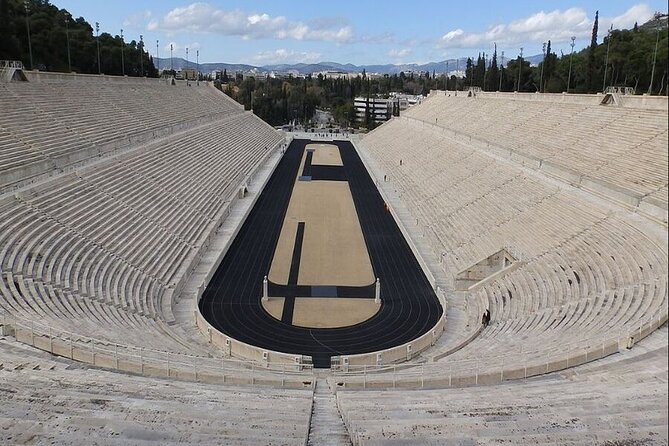
The marble Panathenaic Stadium
The Panathenaic Stadium, also called Kallimarmaro, is one of the most memorable stops on the route. It is built entirely of marble and occupies the site of an earlier racecourse used for the Panathenaic Games.
The stadium was rebuilt in marble by Herodes Atticus around AD 144 and once held about 50,000 people. After a long period of disuse, it hosted events connected with the first modern Olympics in 1896 and later played a role in the 2004 Olympic Games.
I like this stop because it connects ancient athletic festivals with the modern Olympic movement. The stadium’s shape is easy to understand from a short visit, and the white marble makes it visually distinct from the other monuments.
You will not have time to walk through the stadium at leisure during a five-minute stop. Still, it is one of the places where a quick view can feel satisfying, especially if you want a photograph or a clear sense of the site’s scale.
Parliament, the Evzones, and Syntagma Square
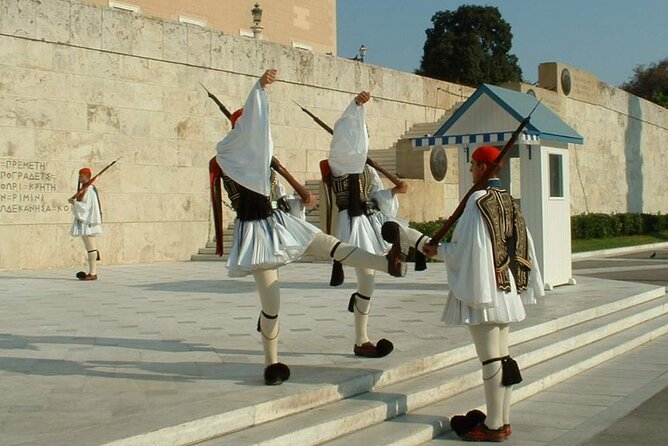
The Hellenic Parliament occupies the Old Royal Palace above Syntagma Square. The square takes its name from the constitution granted after the uprising of September 3, 1843. Today it is the center of Greek political life and one of Athens’s main transport hubs.
The nearby Evzones are members of the Presidential Guard. Their ceremonial uniform includes the fustanella, a pleated garment linked to clothing worn by fighters during the Ottoman period. They guard the Tomb of the Unknown Soldier and the Presidential Mansion.
A short stop here lets you connect modern Greece with its monarchy, constitution, military traditions, and elected government. If you are hoping to see a formal changing ceremony, do not assume it is included. The tour information promises a stop at the Parliament and Evzones area, not a scheduled ceremony.
Syntagma is also practical for orientation. Metro lines, buses, and the tram meet near the square, making it one of the easiest places to continue exploring after the tour. If you are staying nearby, you can ask to finish in this area, though the exact arrangement should be confirmed with the provider.
The neoclassical trio on Panepistimiou
The Academy of Athens, the National and Kapodistrian University of Athens, and the National Library form one of the city’s most impressive neoclassical stretches. They are close enough to appreciate as a group, and the private vehicle makes it easy to see all three without spending time finding each one.
The Academy of Athens is Greece’s national academy and its top research institution. Its founding idea reaches back to Plato’s ancient Academy, though the modern institution was established in 1926.
The University of Athens dates from 1837 and is the country’s oldest higher education institution. It has more than 40,000 undergraduate students and more than 2,000 teaching and research staff. That scale helps explain why the building is more than a pretty facade. It represents the continuing role of education in the Greek state.
The National Library of Greece was founded in 1832. Its work includes locating, organizing, describing, and preserving Greek cultural records and important works of human thought.
These stops are mainly exterior views. Five minutes at each is enough to see the buildings and hear why they matter, but not enough for an interior visit or close architectural study. I would pay attention to this section even if you came mainly for ancient Athens. It shows the 19th and 20th-century city that grew around the archaeological sites.
Omonia, Klafthmonos, and the Old Parliament

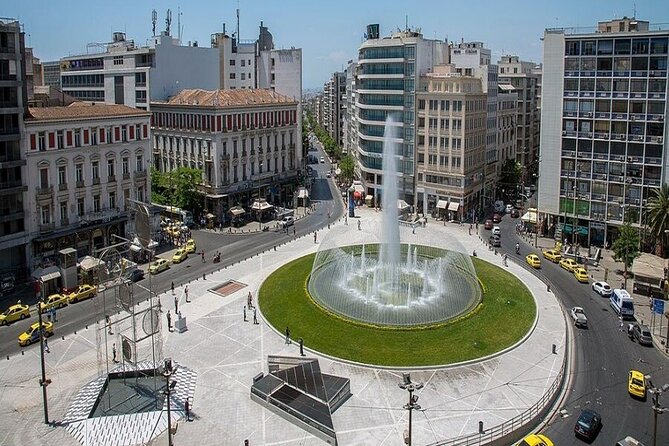
Omonia Square is one of Athens’s main traffic centers and one of its oldest squares. Six major streets meet here, and the square is linked to the Omonia metro station. It is more a working part of the city than a quiet monument, which makes it useful for seeing Athens beyond the ancient center.
Klafthmonos Square has a memorable name that means crying square. The name refers to dismissed civil servants who gathered there after elections, when a new government often removed officials appointed by the previous one.
This is a small but telling piece of political history. It shows how public spaces can preserve stories about government, employment, and protest that are less famous than those tied to kings and temples.
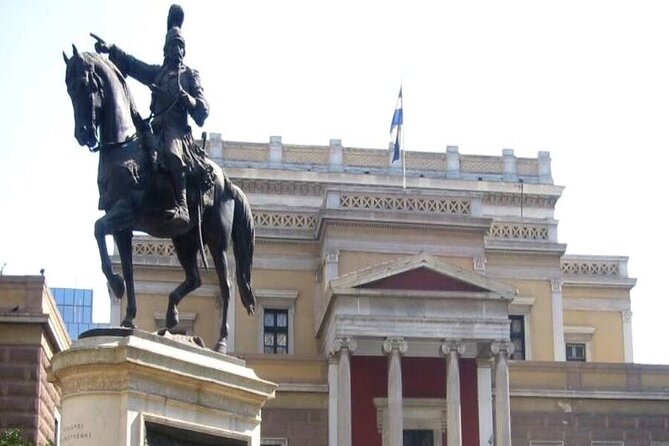
The Old Parliament building on Stadiou Street now houses the National Historical Museum. It served as the Greek Parliament from 1875 to 1935. The original house on the site was connected with King Otto, later burned in 1854, and was replaced by the current structure.
A short stop gives you the outside view and the building’s place in modern Greek political history. If museums are important to you, note that the National Historical Museum would need a separate visit. This tour does not provide enough time to explore its collections.
How the short format works in practice
The planned timing is the key issue. Fourteen stops at roughly five minutes each would already take about 70 minutes before allowing for traffic or driving between locations. That matches the upper end of the stated duration, but the route still depends on quick transitions and brief visits.
You should think in terms of snapshots rather than full stops. Some places may be viewed from the vehicle or from a nearby point, while others may allow a quick pause for photographs and a short explanation. The exact rhythm can change with Athens traffic and the pickup location.
That is not automatically a flaw. A short private circuit can be a smart first look at Athens, especially if you are deciding where to return later. It becomes a poor fit if you expect a guided museum tour, long walks, or relaxed time at the ruins.
The English-language format is useful for direct communication with the driver. Ask at the start which sites will receive a true stop and which will be viewed while driving. That simple question will help you set realistic expectations.
Who should book this Athens tour
This experience suits you best if you have a short window in Athens, want a private vehicle, or prefer not to manage city traffic yourself. It also fits families who need an infant seat, provided they request one in advance.
It is particularly useful for a shore excursion because the route covers a lot of central Athens without asking you to navigate buses, taxis, or unfamiliar streets. Pickup from a hotel or apartment adds the same benefit for visitors staying in the city.
You may want something else if your main goal is the Acropolis Museum, the Temple of Olympian Zeus, or the National Historical Museum. Those places reward time inside, and this itinerary does not provide it.
The tour operates Monday through Thursday from 8:00 AM to 6:00 PM during the stated operating period. Check the time carefully if you are planning around a ship schedule or a limited arrival window.
Cancellation and family details
Free cancellation is available up to 24 hours before the start time for a full refund. Changes or cancellations made less than 24 hours before the start are not accepted for a refund.
The experience depends on good weather. If poor weather causes cancellation, you are offered another date or a full refund. Most people can participate, and the tour is near public transportation, though the private pickup means you may not need to use it.
Should you book the Fast Private Athens Tour?
Book it if you want a quick, private introduction to Athens and value having a driver manage the traffic. For four people, the group price is reasonable for a compact city circuit, especially when hotel or apartment pickup saves you time.
Skip it if you want long visits at the museum, archaeological sites, or stadium. The best way to use this tour is as a first look: learn the city’s layout, note the places that catch your interest, then return to one or two of them with more time.
FAQ
How long does the Fast Private Athens Tour last?
The experience lasts approximately 45 minutes to 1 hour 10 minutes.
How many people can join the private tour?
The price covers one private group of up to four people.
What is the price?
The listed price is $118.35 per group of up to four people.
Is hotel pickup available?
Yes. Pickup is offered from hotels and apartments.
Is this tour suitable for an Athens shore excursion?
Yes. It is described as an ideal option for shore excursions because a private driver handles the city traffic while you see central Athens.
What language is the tour offered in?
The experience is offered in English.
Are infant seats available?
Yes. Infant seats are available on request.
Does the tour include admission tickets?
The stops are shown with free admission, but the short duration means the experience is focused on quick visits and views rather than extended time inside each attraction.
When does the tour operate?
It operates Monday through Thursday from 8:00 AM to 6:00 PM during the stated operating period, April 20, 2023, through March 16, 2027.
Newly reviewed around Athens
- Athens: workshop for painting landscape with local artist★ 4.6 · 3 reviews
- Athens: Greek Wine & Olive Oil Tasting at Brettos Plaka★ 4.5 · 3 reviews
- Outdoor Yoga and Pilates with Akropolis view★ 4.0 · 5 reviews
- Acropolis of Athens: 60′ Tour in a Vintage Motorcycle★ 5.0 · 4 reviews
- Ultimate Tasting of the Volcanic Wines of Greece★ 5.0 · 3 reviews
- Athens at Twilight Night Tour with Drinks and Meze Dishes★ 4.8 · 4 reviews
- Breakfast in the markets with olive oil and honey tasting★ 4.8 · 8 reviews
- workshop for painting acropolis/landscape with local artist★ 5.0 · 3 reviews
Private, compared.


Athens Airport Private Arrival Transfer with Meet & Greet
Read our review →
Athens Airport to Athens Hotels Private Arrival Transfer
Read our review →
Private Biblical Tour Ancient Corinth & Isthmus Canal from Athens
Read our review →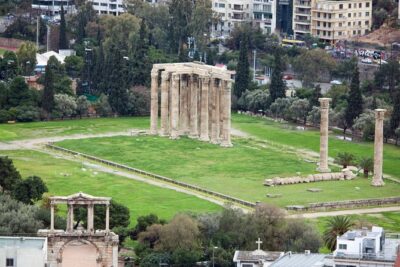
4 Hours – Athens & Acropolis Highlights Private Tour
Read our review →