
Reviewed · ATHENS
The Best Way to See and Learn about Athens in 6 hours
The smartest part of this Athens tour is its private car. You can move between the Acropolis, Ancient Agora, Olympic Stadium, Parliament, and old neighborhoods without losing time to maps, taxis, or the city’s busy streets. Guides such as Markos, John, Dem, and Makis also add history, mythology, and local food advice along the way.
I like the door-to-door pickup, especially if you arrive from a cruise ship at Piraeus or have only one day in town. I also like the chance to combine major ruins with everyday Athens, from Plaka and Monastiraki to the Central Market and a possible lunch in Petralona. The main catch is important: the driver can explain sites outside them, but only a licensed guide may guide you inside archaeological areas and museums, and that costs extra.
Key things to know before booking
- Private transport saves your legs and your clock: Pickup is offered from hotels, apartments, Piraeus, cruise ships, or a chosen city location.
- The Acropolis gets the prime slot: Plan on about 90 minutes for the Parthenon, Erechtheion, Propylaea, and Temple of Athena Nike.
- Admission is not included: Budget about 30 euros per person for entrance fees, with a licensed guide available at an additional cost.
- You see both ancient and modern Athens: The route links classical monuments with Syntagma, the Parliament, the Athenian Trilogy, Plaka, and Omonia.
- Food can be part of the day: Lunch in Petralona, coffee, pastries, or a local restaurant may be arranged, but meals and drinks are not included.
- An early start is wise: The Acropolis and central monuments are easier before the heat and largest crowds.
Why private transport works so well in Athens
Athens is not hard to explore, but its sights are spread across a busy central area. The Acropolis sits above the city, the Ancient Agora lies below it, the Panathenaic Stadium is farther east, and Syntagma and the Academy take you into the modern center. Add summer heat, uneven pavement, and a six-hour limit, and private transport starts to look less like a luxury and more like a practical tool.
The tour costs $505.23 for a group of up to three. Split three ways, that is about $168 per person before entrance fees, meals, and any licensed guide. For a couple, the per-person price is higher, but you gain a private vehicle, hotel or port pickup, parking fees, baggage charges, and a schedule shaped around your group.
The driver-guide remains with you between stops and can talk about Greek mythology, history, and modern life. Drivers are not allowed to guide inside the archaeological sites, so you should think of this as a private sightseeing service with historical commentary, not a full guided museum tour unless you add a licensed guide.
That difference matters most at the Acropolis and Ancient Agora. You will get more from the stones if someone can explain them beside you, rather than only at the car or outside the entrance.
Other Athens days people book alongside this one:
- Athens: Acropolis & up to 5 Archaeological Sites Combo Pass
★ 4.4 · 12,619 reviews - Athens: Acropolis Ticket with Optional Audio or Live Guide
★ 4.2 · 11,055 reviews - Athens: Acropolis, Parthenon & Acropolis Museum Guided Tour
★ 4.8 · 9,316 reviews
Starting above Athens at the Acropolis
The Acropolis is the heart of the experience, and the schedule allows about 90 minutes. That is enough to see the main monuments, but not enough for a slow, scholarly visit to every corner. Wear sensible shoes and expect uphill walking, exposed sun, and ancient surfaces that can be uneven.
The climb brings you through the Propylaea, the grand entrance to the sacred hill. From there, you encounter the Temple of Athena Nike, a small but finely placed building associated with victory. The Erechtheion is especially memorable for its Caryatids, the sculpted female figures that serve as columns. These are copies on the building, while the originals are protected in the Acropolis Museum.
Then comes the Parthenon, the monument most people picture when they think of Athens. From the hill, you can look down toward the Odeon of Herodes Atticus, the Theatre of Dionysus, and the Areopagus, also called Mars Hill. The view helps you understand how the Acropolis relates to the city below, something photographs rarely manage.
Your driver can give you useful background before you enter, but cannot accompany you inside as a guide. If ancient architecture and mythology are your main reason for booking, adding a licensed guide is worth considering. If you mainly want the classic sights and a clear overview, the driver’s explanations may be enough.
Seeing the Acropolis collection in one hour
The Acropolis Museum is scheduled for about an hour. Its displays focus on objects and sculpture from the Acropolis, so it works best after visiting the hill itself. You will recognize the buildings you have just seen, then gain a closer look at their decoration and religious setting.
An hour is a useful introduction, not a complete museum visit. If you read every label or want time with each gallery, you may feel hurried. The extra guide rule applies here too: a driver may provide information outside, but only a licensed guide can lead you through the museum as a professional guide.
Admission is not included. The supplied estimate is about 30 euros per person for entrance fees across the paid sites, though you should confirm the current amount when booking.
Zeus, the Stadium, and the changing of modern Athens
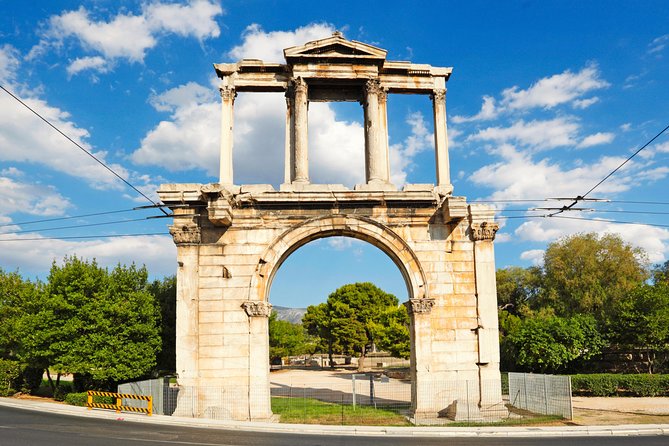
The Temple of Olympian Zeus gets about 20 minutes. This was the largest temple built in Athens, and even its surviving columns give you a sense of scale. The stop is brief and mostly outdoors, so it works well as a photo and orientation stop between longer visits.
The Panathenaic Stadium also receives about 20 minutes. Built in marble, it is tied to the first modern Olympic Games and to the older tradition of athletic contests. The itinerary also connects the site with Pheidippides and the announcement of victory over the Persians at Marathon.
The stadium stop is free according to the tour details. You may want more time if you enjoy sports history, but 20 minutes gives you a look inside and a chance to understand its shape.
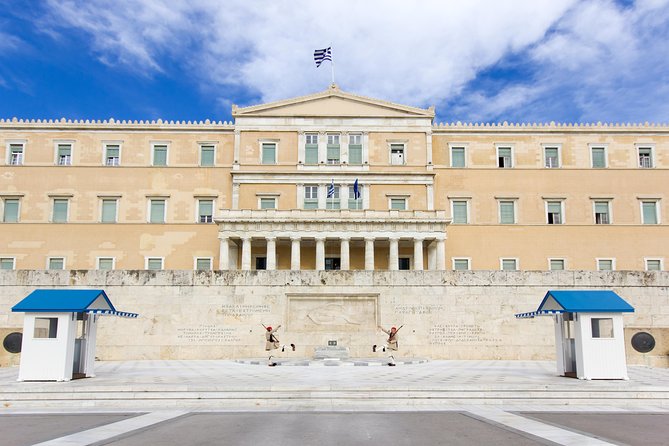
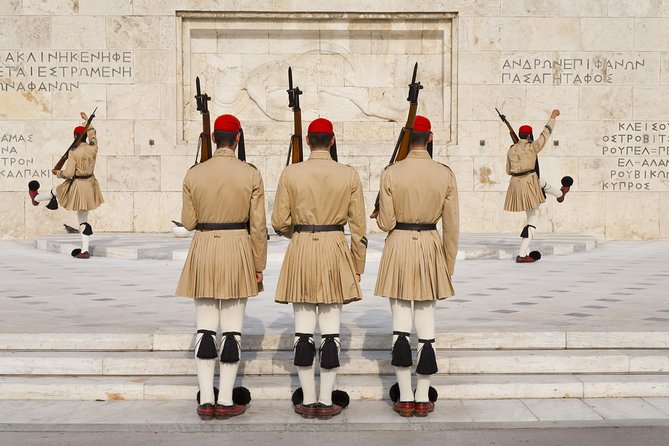
At Syntagma Square, the Parliament building and Tomb of the Unknown Soldier bring you into present-day civic Athens. The Evzones guard the tomb in traditional military dress associated with the 1821 independence era. One of the most useful moments here is the changing of the guard, if the timing matches your visit.
Because the schedule is tight, ask your driver in advance about the guard ceremony. It may not fit every departure time, but the area remains worth seeing even when no ceremony is underway.
A different kind of day out from Athens:
- Athens: Cape Sounion & Poseidon Temple Sunset Half-Day Trip
★ 4.8 · 8,241 reviews - Athens: Acropolis and Parthenon Guided Walking Tour
★ 4.6 · 5,882 reviews - All Day Cruise -3 Islands to Agistri,Moni, Aegina with lunch and drinks included
★ 5.0 · 4,958 reviews - Athens, Piraeus, and Coastline: Blue Hop-On Hop-Off Bus
★ 3.9 · 4,849 reviews
The Athenian Trilogy and central squares
The Academy of Athens, University, and National Library form the famous Athenian Trilogy along Panepistimiou Street. Their Neoclassical design offers a sharp contrast to the weathered stone of the Acropolis. The stop is short, about 10 minutes, so you will mainly view the facades and take photographs.
A newer National Library building is also included among the possible sights. This gives the route a useful time span, from ancient temples to modern cultural institutions.
The drive can also pass through Omonia, Syntagma, and Monastiraki, described together as Athens’ historic triangle. Omonia gives you a look at a major city square surrounded by Neoclassical buildings. Monastiraki is the center of the flea-market area, with shops, food places, and archaeological remains woven into the city fabric.
These drives matter because Athens is not only a collection of ruins. You see a working capital, with offices, markets, traffic, cafes, and old stone sites sharing the same few blocks.
Walking through the Ancient Agora
The Ancient Agora receives about 40 minutes, making it one of the more substantial stops after the Acropolis. This was the marketplace and civic center of ancient Athens, a place linked with public discussion and philosophy. It helps you picture how ordinary political and commercial life took place below the sacred hill.
The Temple of Hephaestus is the main prize here. It is described as the best-preserved temple in Athens, and its condition makes it easier to understand the form of a classical Greek temple than the more damaged Parthenon.
The Museum of the Ancient Agora is scheduled for another 20 minutes. It is located within the archaeological site and adds objects and context to the ruins outside. Again, the timing favors a useful introduction rather than an exhaustive museum visit.
The tour information lists the Temple of Hephaestus both as part of the Agora visit and as a separate short stop. In practice, expect these attractions to belong to the same archaeological area, with the exact order shaped by opening hours, traffic, and your interests.
Plaka, Monastiraki, and a taste of local Athens
Plaka gets about 30 minutes on foot. This is the oldest neighborhood in Athens, directly below the Acropolis, with older buildings, souvenir shops, and places to eat and drink. It is a good change of pace after ruins and museums.
I would use this time for a short wander rather than serious shopping. Thirty minutes passes quickly, and the neighborhood’s value is in seeing how daily life fits around the ancient hill. You may find the area more tourist-oriented than Petralona or the Central Market, but it remains an easy and attractive introduction to central Athens.
The Central Open Food Market is another possible sight. Athenians shop here for meat, fish, and other food at local prices. It offers a more ordinary side of the city than Plaka, though the supplied schedule does not give this stop a fixed duration. Ask whether it is included in your planned route, especially if markets interest you.
Petralona offers another optional addition, with a local taverna suggested for lunch. This can be a fine way to end the sightseeing day with Greek food away from the main tourist lanes. Lunch is not included, and the stop may affect how much time you have at the fixed monuments.
Several guides are noted for recommending food and coffee. Markos is praised for a local restaurant, while Makis is associated with coffee, pastries, and a family-run place near a hotel. Those details suggest the company can tailor food stops, but you should confirm what is possible during your six-hour schedule.
What the day feels like in practice
The strongest part of the experience is the balance between short drives and focused walks. You do not spend the whole day underground or figuring out transfers, and you do not need to return to the same neighborhood after every monument. A clean, air-conditioned Mercedes is mentioned in the tour information, though the exact vehicle can vary.
The day can also run longer than six hours if you add lunch or extra sights. Some past tours with the company lasted seven or eight hours and included places beyond this route, such as Cape Sounion or the Corinth Canal. Do not assume those destinations are part of this package. Confirm the route and finish time, especially if you have a flight or ship departure.
The six-hour version is best treated as a highlights tour. You can see the major monuments, but you will not have time to linger everywhere. The Acropolis and Ancient Agora deserve the most attention, while the Stadium, Trilogy, squares, and Zeus temple work as shorter stops.
Several guides receive particular praise for being friendly, punctual, flexible, and easy to talk with. Markos is noted for mythology and Greek life. John is associated with broad local knowledge and careful timing. Dem is praised for adapting the day to a couple’s interests, while Makis is described as caring and attentive with refreshments and local food suggestions.
That personal touch is valuable, but the quality of your day still depends on the assigned driver and the exact traffic conditions. Ask for an early start if you can. It gives you a better chance at cooler weather, clearer views, and a calmer Acropolis visit.
Who gets the best value from this tour
This private Athens tour suits you best if you have limited time, want hotel or port pickup, or prefer not to manage public transport between scattered sights. It is particularly useful for cruise ship passengers and people on a long layover, provided your timing leaves enough room for the six-hour experience and return transfer.
It also suits families or small groups who can share the $505.23 cost. You control the vehicle and can ask for more time at a favorite stop, though the total number of sights means every extra pause has a cost elsewhere.
You may want a different format if your main goal is intensive museum study, a slow Acropolis visit, or a low-cost walking tour. The entrance fees are extra, lunch is extra, and a licensed guide costs more. Those additions can push the final price well above the advertised group rate.
Free cancellation is available if you cancel at least 24 hours before the start time. Confirmation is sent within 48 hours of booking, subject to availability. Most people can participate, and the tour is near public transportation, but the main walking sites still involve hills, steps, and uneven ground.
Should you book it?
Book this tour if you want Athens’ major sights in one organized day and value a private car more than the lowest possible price. The combination of Acropolis, museum, Agora, Stadium, Syntagma, Plaka, and central Athens gives you a useful first look without forcing you to plan every transfer.
Before paying, ask three questions: Is a licensed guide included or added? Which entrance tickets will be purchased for you? Can the route include the guard ceremony, Central Market, or Petralona lunch?
For a first visit, cruise stop, or long layover, I think the private format is worth serious consideration. Just keep the expectations clear: this is a fast, well-covered introduction to Athens, not a slow archaeological seminar.
FAQ
How long does the Athens tour last?
The tour lasts approximately six hours.
How much does the private tour cost?
The listed price is $505.23 per group of up to three people.
Where can pickup take place?
Pickup is offered from any hotel, apartment, Piraeus port, a cruise ship, or a specific location in Athens.
Is the tour private?
Yes. Only your group participates in the activity.
Is transportation included?
Yes. The service includes a private driver-guide, parking fees, and baggage charges.
Are entrance fees included?
No. Entrance fees are extra and are estimated at approximately 30 euros per person.
Can the driver guide inside the archaeological sites?
No. Greek regulations do not permit drivers to provide guiding services inside archaeological sites or museums. A licensed guide can be added for an extra fee.
Is lunch included?
No. Meals and drinks are not included. An optional lunch at a local taverna in Petralona may be arranged.
Is the Acropolis Museum part of the route?
Yes. The planned visit to the Acropolis Museum lasts about one hour, with admission not included.
Can I cancel for a full refund?
Yes, if you cancel at least 24 hours before the experience start time. Cancellations or changes made less than 24 hours in advance are not accepted for a refund.
Newly reviewed around Athens
- Athens: workshop for painting landscape with local artist★ 4.6 · 3 reviews
- Athens: Greek Wine & Olive Oil Tasting at Brettos Plaka★ 4.5 · 3 reviews
- Outdoor Yoga and Pilates with Akropolis view★ 4.0 · 5 reviews
- Acropolis of Athens: 60′ Tour in a Vintage Motorcycle★ 5.0 · 4 reviews
- Ultimate Tasting of the Volcanic Wines of Greece★ 5.0 · 3 reviews
- workshop for painting acropolis/landscape with local artist★ 5.0 · 3 reviews
- Athens at Twilight Night Tour with Drinks and Meze Dishes★ 4.8 · 4 reviews
- Breakfast in the markets with olive oil and honey tasting★ 4.8 · 8 reviews