
Reviewed · ATHENS ACROPOLIS TOURS
Athens All Included: Acropolis and Museum Guided Tour with Ticket
The best thing about this Athens tour is the way it connects the Acropolis itself with the Acropolis Museum in one well-planned morning or afternoon. You see the stones on the hill, then the sculptures and fragments that explain what you were looking at. That makes ancient Athens easier to understand than a quick climb followed by a few photographs.
I like the pre-reserved tickets and the small-group format. You spend less time figuring out queues and more time listening, looking, and asking questions. I also like the headsets, especially when the Acropolis is crowded or windy. Guides such as Eva, Antigone, and Lisa have been singled out for clear explanations, good pacing, and a warm way with families.
The tradeoff is simple: this is a teaching tour, not a free-roaming visit. You may get only about 10 minutes to explore the Acropolis independently, so photographers and people who prefer to wander may want extra time afterward. At $165.67 per person, the price is fair only if you want the guide’s stories and historical context, not merely admission.
Key points to know before booking
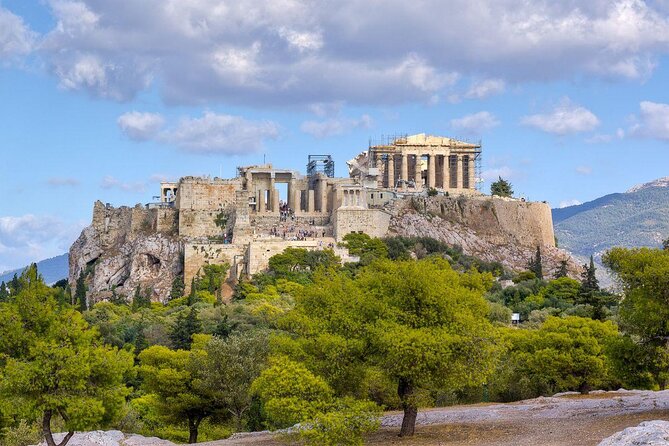
- Two major Athens sights in about three hours: Spend roughly two hours at the Acropolis, followed by about 45 minutes in the museum.
- Timed entry saves time, but not all waiting: High-season queues for pre-reserved ticket holders can still form.
- The route is active: Expect stairs, uneven ground, and a walk uphill. Proper walking shoes matter.
- The guide controls the pace: You get a structured explanation of the monuments, with limited independent time on the Acropolis.
- The museum visit is intentionally short: The guided portion covers the main works, then you can remain inside on your own.
- Strict departure rules apply: Arrive at least 10 minutes early, since late arrivals cannot join after the timed entry expires.
Why pairing the Acropolis with its museum works so well
The Acropolis can feel confusing if you visit without context. You see columns, marble blocks, battered statues, and grand views, but it takes a good guide to explain how these parts once worked together.
This experience gives you that missing thread. At the hilltop, your guide explains the buildings in their setting. At the museum, you see original sculpture and architectural pieces in a calmer indoor environment. The two visits reinforce each other, so the Parthenon is not just a famous building in a photograph. It becomes part of fifth-century Athens, with its religious purpose, civic pride, artistic goals, and political power.
I particularly like that the route includes more than the Parthenon. The Erechtheion, Temple of Athena Nike, Propylaea, Theatre of Dionysus, Altar of Asclepius, and temples on the north side all add texture to the visit. You get a fuller picture of the hill instead of spending the entire time staring at one monument.
The experience is offered in English and uses headsets. That small detail has real value. The Acropolis is open, exposed, and often noisy. A guide speaking through a headset is much easier to follow than someone trying to project across a crowd.
More ways to see the Acropolis:
- Athens: Acropolis & up to 5 Archaeological Sites Combo Pass
★ 4.4 · 12,619 reviews - Athens: Acropolis Ticket with Optional Audio or Live Guide
★ 4.2 · 11,055 reviews - Athens: Acropolis, Parthenon & Acropolis Museum Guided Tour
★ 4.8 · 9,316 reviews
Meeting at the Acropolis Metro Station
The meeting point is at Makrigianni 7, near the Acropolis metro station. This is a sensible place to begin because it puts you close to the archaeological site and is convenient for public transportation.
Arrive 10 minutes early. This is not a casual suggestion. The tickets are timed, and they can expire within five to ten minutes. The group departs on schedule, with only a short grace period, and there is no refund if you arrive too late to enter.
If you are coming from the port, allow extra time. The metro may be the practical choice, but you should not cut the connection close. Athens traffic and port transfers can be unpredictable, while a timed Acropolis entrance leaves little room for mistakes.
At the start, the licensed Greek guide outlines the route and introduces the group. The maximum group size is 20 people. That is not a private tour in the one-guide-for-one-family sense, but it is small enough for questions and easier movement than a large coach group.
Climbing the Acropolis and entering through the Propylaea
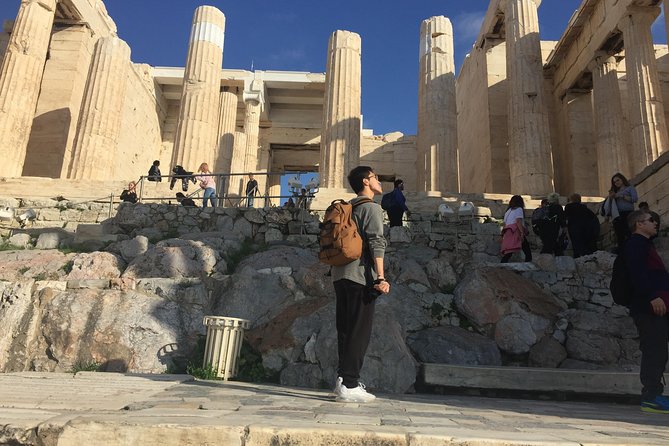
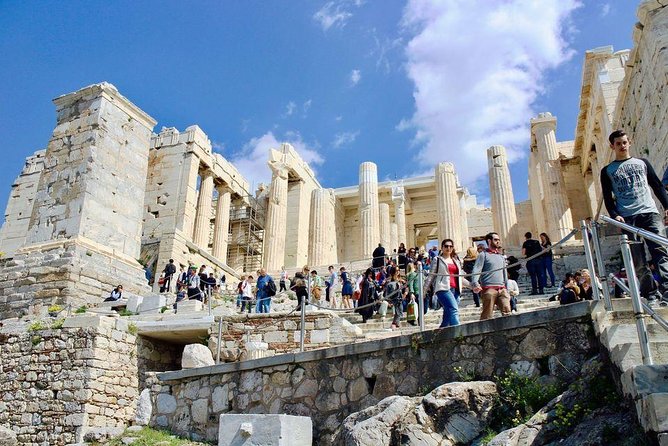
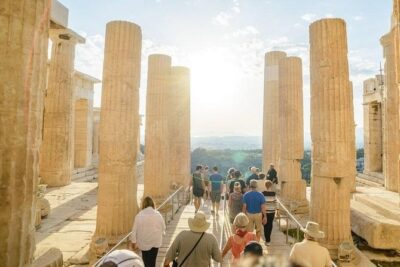
The first part is an active walking tour. You make your way toward the top of the Acropolis, passing through the Propylaea, the monumental gateway that once formed the ceremonial entrance.
This is a useful first lesson. The Propylaea was not simply a doorway. Its scale and marble architecture prepared worshippers and festival participants for the sacred buildings beyond. Your guide explains how the entrance reflected Athens at the height of its power and how architecture could direct the feelings of people approaching a holy place.
The ground is uneven, and there are stairs. You need a moderate level of fitness, and comfortable walking shoes are essential. Flip-flops, slippers, and loose sandals are poor choices here. The route is not suitable for anyone with major mobility restrictions, though the pace can accommodate some visitors who use a cane.
There is little shade on the hill, so conditions can feel different from those at street level. In winter, the top may be cold even when Athens feels mild below. In warm weather, sun exposure and stone surfaces can make the climb more tiring. Plan your clothing and water accordingly, although the tour information does not promise refreshments.
The Parthenon, Erechtheion, and Temple of Athena Nike
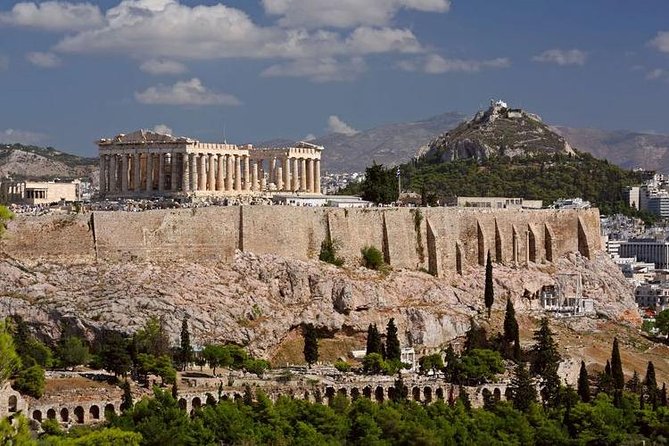
Once inside, the guide focuses on the Acropolis monuments and the ideas behind them. The Parthenon receives about 30 minutes of dedicated attention, while the wider Acropolis section lasts around two hours in total.
The Parthenon is the obvious star, but a good explanation helps you see beyond its damaged columns. The guide discusses its dedication to Athena, its design and construction, and the way it came to represent Athenian ambition, civic identity, democracy, and cultural achievement. You also learn how the building was used, rather than treating it as a simple shell left by time.
The Erechtheion offers a different kind of story. The complex arrangement of sacred spaces reflects older Athenian cults and traditions, and its famous sculpted female figures make it one of the hill’s most memorable stops. The Temple of Athena Nike is smaller, but its position and purpose help explain how victory and protection were linked to the city’s patron goddess.
The guide also helps you picture the Acropolis during the age of Pericles, when Athens had the wealth and confidence to build on this scale. This historical framing is one of the main reasons to choose a guided visit. Without it, you can admire the view and the marble, but miss the decisions and beliefs behind the structures.
More museums and ancient sites in Athens:
- Athens: Mythology of Delphi, Museum and Arachova Guided Tour
★ 4.6 · 4,008 reviews - Athens: Acropolis, Parthenon & Acropolis Museum Guided Tour
★ 4.8 · 3,579 reviews - Acropolis monuments & Parthenon Walking Tour with Optional Acropolis Museum
★ 5.0 · 2,678 reviews - Athens: Acropolis Museum Ticket with optional Audio Guide
★ 4.4 · 2,652 reviews
South-side views and the birthplace of theater
The route continues toward the south exit, where you can look across Athens and, when conditions allow, toward the Aegean Sea. The views are one of the tour’s easier pleasures. Your guide may also point out good photo positions and pause to take pictures for the group.
The south-side route brings in the Altar of Asclepius and the Theatre of Dionysus. The theater is especially important because it is linked to the beginnings of drama and theatrical performance. Seeing it after the temples gives you a broader sense of the Acropolis as a place of worship, ceremony, civic expression, and public culture.
This section also shows why the tour is more than a quick Parthenon visit. Athens is not represented by one building alone. The surrounding sanctuaries and performance spaces reveal how religion, art, politics, and daily life overlapped.
There is a practical downside. The guide may keep the group moving to maintain the timed schedule. If you want long stretches for photos or quiet observation, the organized route can feel restrictive. One useful approach is to take your main pictures as the guide pauses, then plan to return independently if you want more time on the hill.
A short break before the Acropolis Museum
After the Acropolis, there is a short break before entering the museum. This pause is welcome because the first section involves hills, stairs, sun, and constant attention.
The museum is close to the archaeological site, and the tour ends there at Dionysiou Areopagitou 15. Transportation between the two attractions is not included because the route is arranged as a walking experience. You should not expect a hotel pickup or a vehicle transfer.
The break also gives you a chance to reset before the indoor portion. The experience covers a great deal in a little more than three hours, and the transition keeps the museum visit from feeling like an afterthought.
The Acropolis Museum in 45 focused minutes
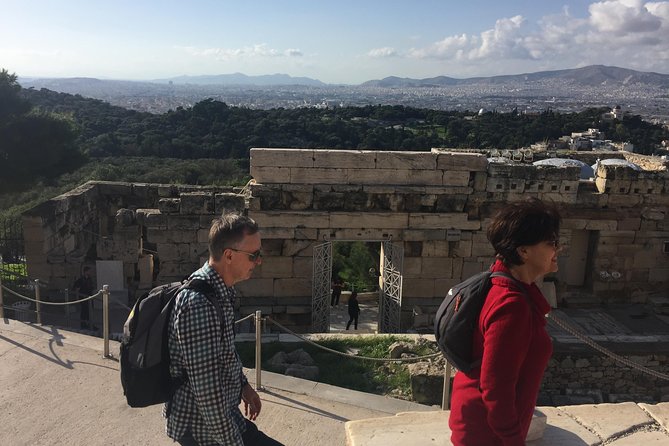
The guided museum visit lasts about 45 minutes. That is enough for an introduction to the major works, but not enough to cover every gallery in detail.
The building itself adds to the visit. Glass floors reveal archaeological remains below, giving you a direct reminder that modern Athens was built over layers of older settlement. Inside, you see original sculptures and architectural elements from the Acropolis temples, with the guide explaining where they belonged and what they meant.
The Parthenon Gallery is a key stop. Here the guide discusses the famous Elgin Marbles and their significance. This is a subject that benefits from context, since the gallery is not just a display of beautiful fragments. It raises questions about ownership, removal, preservation, and the relationship between the museum and the monument across the street.
The tour concludes in the Archaic Gallery, where statues from before the great fifth-century monuments show how Greek sculpture developed over time. That chronological connection is useful. You see that the Parthenon did not appear from nowhere. It followed earlier experiments in form, proportion, and representation.
The museum portion is also where this tour gives you flexibility. Once the guided visit ends, you may remain inside and continue at your own pace, or sit at the museum café. This is a meaningful benefit for anyone who wants more time with the collection. The guided portion is brief, but you are not forced to leave when it finishes.
How much value do you get for $165.67?
At $165.67 per person, this is a substantial purchase. You can visit major Athens sights independently for less, so the price needs to be judged by what the guide adds.
The cost makes more sense if you want:
- A licensed English-speaking guide to explain mythology, architecture, and history
- Pre-reserved admission for both the Acropolis and museum
- A small group rather than a large sightseeing crowd
- Headsets that make explanations easier to hear
- A planned route that covers the main monuments without requiring you to organize the timing
The value is weaker if you already know the site well, prefer reading on your own, or want long stretches without commentary. The tour spends most of its Acropolis time explaining what you see, and independent time there may be limited.
The strong rating of 4.7 from 2,673 reviews and a 94 percent recommendation rate support the idea that the guide service is the main strength. Still, those figures do not change the basic calculation: you are paying for structure, interpretation, and convenience, not just entrance tickets.
The pace, the group, and the guides
The guide quality matters more here than on a simple transfer. You are listening for several hours, walking across difficult surfaces, and moving through one of Europe’s most visited sites.
Guides named Eva, Antigone, and Lisa have received especially warm praise for making ancient subjects understandable, answering questions, taking photos, and adjusting the pace. The most useful pattern is not any one personality. It is the combination of historical clarity and attention to the group.
One guide may pause for photographs, point out a strong view, or make sure nobody is left behind. Another may give a more detailed lecture. The experience can therefore vary by departure, but the format is designed for explanation rather than a bare escort from one gate to another.
Families should note that children under six are not permitted. Older children can enjoy the tour if they can handle stairs and several hours of walking. One 12-year-old was specifically made to feel included, which suggests that a good guide can keep younger visitors engaged, but the subject matter remains demanding.
What to bring and how to prepare
Wear proper walking shoes. This is the single most important preparation point. The Acropolis includes steps and uneven ground, and poor footwear can turn an excellent visit into an uncomfortable one.
Arrive early, especially if you are coming from the port. Keep the meeting address handy and allow time to find the group near the metro station. Since tickets are timed and the tour cannot wait for late arrivals, punctuality is part of the booking.
Expect crowds during high season. Pre-reserved tickets help, but they do not guarantee an instant walk through the entrance. At busy times, people with reserved tickets may still wait in their own queue.
Bring a willingness to listen. If you prefer to stop at every column for as long as you like, you may feel hurried. If you want the site to make sense and appreciate a guide who keeps the route moving, the schedule should suit you.
Free cancellation is available up to 24 hours before the start time. Cancellations or changes inside that window are not refunded or accepted.
Should you book this Acropolis tour?
I would book it if this is your first visit to Athens and you want the Acropolis to mean more than a famous hilltop ruin. The combination of a licensed guide, timed admission, headsets, and the museum makes the day efficient and intellectually satisfying.
I would skip it if you want complete independence or are mainly chasing photographs. The $165.67 price is hard to justify when you do not care for guided commentary, and the Acropolis portion leaves limited time to wander alone.
For most first-time visitors who can manage stairs and uneven ground, this is a strong choice. Arrive early, wear real walking shoes, accept the structured pace, and stay in the museum afterward if you want a quieter look at the sculptures. That approach gives you the tour’s best benefits without feeling that the experience ended the moment the guide stopped speaking.
FAQ
How long does the Acropolis and museum tour last?
The experience lasts approximately three hours. About two hours are spent exploring the Acropolis, followed by a short break and roughly 45 minutes of guided time in the Acropolis Museum.
What language is the tour offered in?
The tour is offered in English.
Where does the tour begin?
The meeting point is at Makrigianni 7 in Athens, near the Acropolis metro station.
Where does the tour end?
The tour ends at the Acropolis Museum at Dionysiou Areopagitou 15.
Are admission tickets included?
Yes. Pre-reserved admission tickets for both the Acropolis and the Acropolis Museum are included.
Is transportation included?
No. Transportation to and from the attractions is not included. The tour is arranged as a walking experience between the Acropolis and museum.
How large is the group?
The maximum group size is 20 people.
Is the tour suitable for visitors with limited mobility?
The tour requires a moderate level of physical fitness, including stairs and uneven ground. Strollers are not allowed, and the experience is not suitable for people with significant mobility restrictions. Children under six are not permitted.
What happens if I arrive late?
You should arrive at least 10 minutes early. The tickets are timed and may expire within five to ten minutes, so late arrivals cannot join the tour and are not eligible for a refund.
Newly reviewed around Athens
- Feel Ancient thermal Spa Visit Delphi, Leonidas ℨoo Spaʀtan★ 5.0 · 4 reviews
- Food Tour★ 5.0 · 3 reviews
- Explore the Hidden Food Gems of Athens★ 5.0 · 57 reviews
- Food Experience in Athens including Unlimited Lunch★ 5.0 · 3 reviews
- Eat Your Way Through Athens: A Local Food Walk★ 4.9 · 97 reviews
- From Athens: Delphi Private Tour with Lunch Time★ 4.0 · 3 reviews
- Delphi: Spanish guided one day tour★ 4.6 · 55 reviews
- Early Entry Acropolis & Museum. Beat the Crowds & the heat★ 5.0 · 3 reviews
Athens Acropolis Tours, compared.
Acropolis & up to 5 Archaeological Sites Combo Pass
Read our review →
Acropolis, Parthenon & Acropolis Museum Guided Tour
Read our review →
Acropolis, Parthenon & Acropolis Museum Guided Tour
Read our review →

Acropolis monuments & Parthenon Walking Tour with Optional Acropolis Museum
Read our review →Browse the lists this tour appears in