
Reviewed · ATHENS ACROPOLIS TOURS
Athens: Acropolis Visit and City Night Tour
The best part of this five-hour outing is the change of mood. You begin among the sunlit stones of the Acropolis, then move through neoclassical Athens and ancient landmarks as the city lights come on. I like the south-east Acropolis entrance, which avoids the main gate, and I like having free time after the guided visit to look around at your own pace. The main catch is simple: your Acropolis ticket is not included, so you must buy the correct timed entry before meeting the guide.
I also like the route’s broad sweep. In one afternoon and evening, you see the Parthenon, the Theatre of Dionysus, the Panathenaiko Stadium, Syntagma Square, Hadrian’s Arch, the Temple of Zeus, and Monastiraki. The tour is conducted in Spanish only, so it suits Spanish-speaking visitors best. Be ready for a long walking day, uneven ancient ground, and a late finish in central Athens.
Key points at a glance
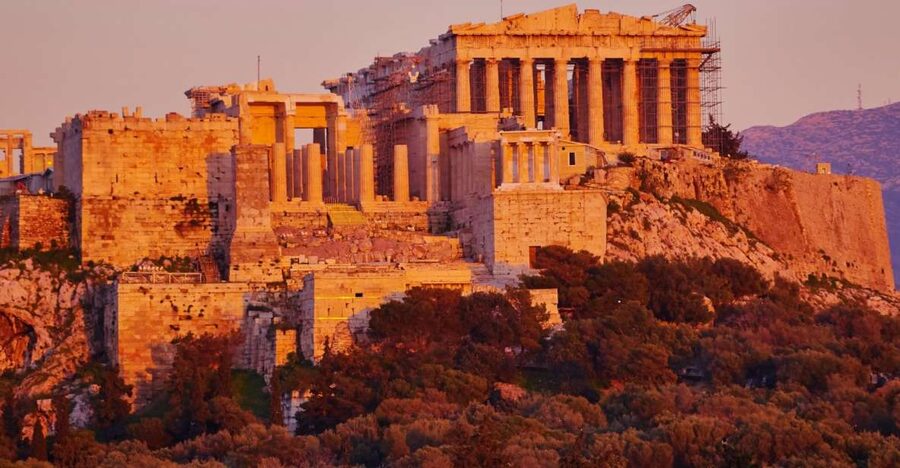
- Afternoon Acropolis entry from the south-east: You avoid the most crowded main entrance and begin near the archaeological site’s southern monuments.
- The Parthenon is only part of the visit: The route also covers the Propylaea, Erechtheion, Caryatids, Temple of Athena Nike, Theatre of Dionysus, and Odeon of Herodes Atticus.
- A useful visual aid from Barbara: One praised guide carried a folder with reconstructions that helped explain how the Acropolis may have looked in ancient times.
- Athens after dark: The evening route connects the National Library, University, Academy, Syntagma Square, Zappeion, Panathinaiko Stadium, and central Roman and Byzantine landmarks.
- Spanish guide throughout: Guides such as Barbara and Juan provide history, mythology, and city context in Spanish.
- Budget at $53, before admission: The price covers the guided experience, but you must add the Acropolis entrance ticket and arrange it for the right time slot.
Why this combination works for a first afternoon in Athens
Athens can feel scattered when you first arrive. Ancient temples sit beside neoclassical institutions, Roman ruins appear along busy streets, and a grand square can lead to a narrow old-town lane within minutes. This tour gives you a clear route through that mix.
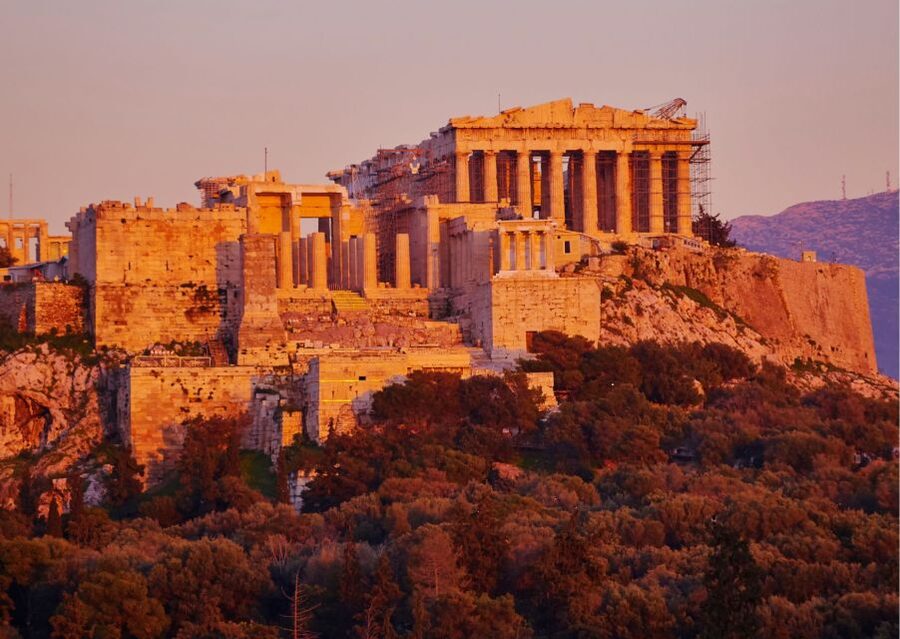
The Acropolis supplies the big visual moment in daylight. Later, the city tour puts the hill into context. From several points, you see the illuminated Acropolis above the streets, which helps connect the ancient citadel to modern Athens rather than treating it as an isolated monument.
I would choose this outing if you have limited time in the city and want both major sights and a guided introduction to central Athens. It is especially useful on a first visit, when knowing the names and locations of the main districts can save you time on later independent walks.
The pace is not designed for lingering over every stop. The full program lasts five hours and includes a substantial walking route. You will get a wide view of the capital, but not a slow museum-style experience. Think of it as a well-packed introduction.
More ways to see the Acropolis:
- Athens: Acropolis & up to 5 Archaeological Sites Combo Pass
★ 4.4 · 12,619 reviews - Athens: Acropolis Ticket with Optional Audio or Live Guide
★ 4.2 · 11,055 reviews - Athens: Acropolis, Parthenon & Acropolis Museum Guided Tour
★ 4.8 · 9,316 reviews
Starting at the Acropolis from the quieter side
The afternoon portion begins at Acropolis metro station, where you should meet the guide 10 minutes before the start. The group uses the south-east side rather than the main entrance, a practical choice because the main gate is usually the more crowded approach.
This meeting arrangement requires care. Your guide does not supply the archaeological ticket, and you cannot simply arrive without one and expect a smooth entry. Buy your ticket online before the tour and select the correct time slot.
For a 3 p.m. low-season tour, the required slot is 3 to 4 p.m. In high season, a 5 p.m. tour requires a 5 to 6 p.m. ticket. A 5:45 p.m. tour requires the 6 to 7 p.m. slot. Check the exact departure time before buying, since a ticket for the wrong hour can create a problem at the entrance.
If you have not bought a ticket in advance, allow about 30 extra minutes at the south entrance ticket office. After purchasing it, the meeting point is less than two minutes away. Still, online purchase is the safer plan, especially during high season.
The Parthenon, Propylaea, and the main Acropolis monuments
Once inside, the guide explains the Acropolis as a sacred site dedicated to Athena, the city’s patron goddess. The focus is not only on stone and dates. Greek myths, gods, demigods, and political meaning help make sense of why these buildings were placed here.
The Propylaea, the monumental gateway, gives you a strong opening view of the upper site. It was designed as a grand entrance, and its scale prepares you for the Parthenon beyond it.
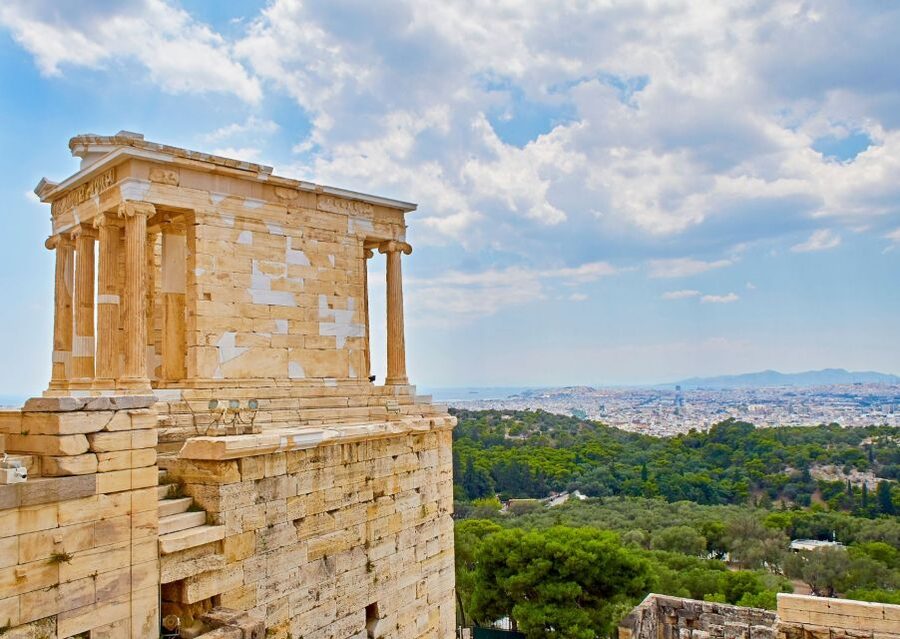
The Parthenon is the central sight, but do not let the famous name make you rush past the other buildings. The guide also points out the Erechtheion, named for the demigod Erechtheus, and the Temple of Athena Nike, the smallest temple on the Acropolis.
The Caryatids are among the most memorable details. These carved female figures take the place of columns at the Erechtheion. Their unusual form gives the building a human quality, and the guide’s explanation helps you see them as part of a carefully planned religious space rather than as decorative statues placed at random.
One particularly useful teaching method comes from Barbara, a guide praised for carrying a folder with visual reconstructions. Ancient sites can be hard to picture when you are looking at broken columns and partial walls. Images that show possible original forms give you a better sense of the Acropolis as a working complex of temples, gateways, and sacred monuments.
You also have free time after the guided visit. That matters because a guide-led explanation and personal looking are different activities. You can return to a detail, take in the views, or simply pause without needing to keep up with the commentary.
Theatre of Dionysus and the Odeon of Herodes Atticus
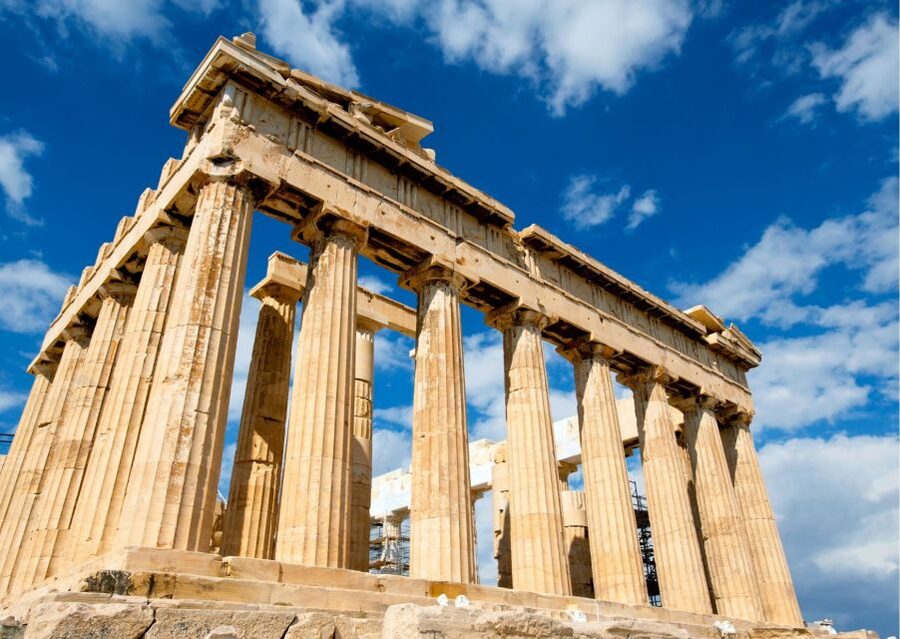
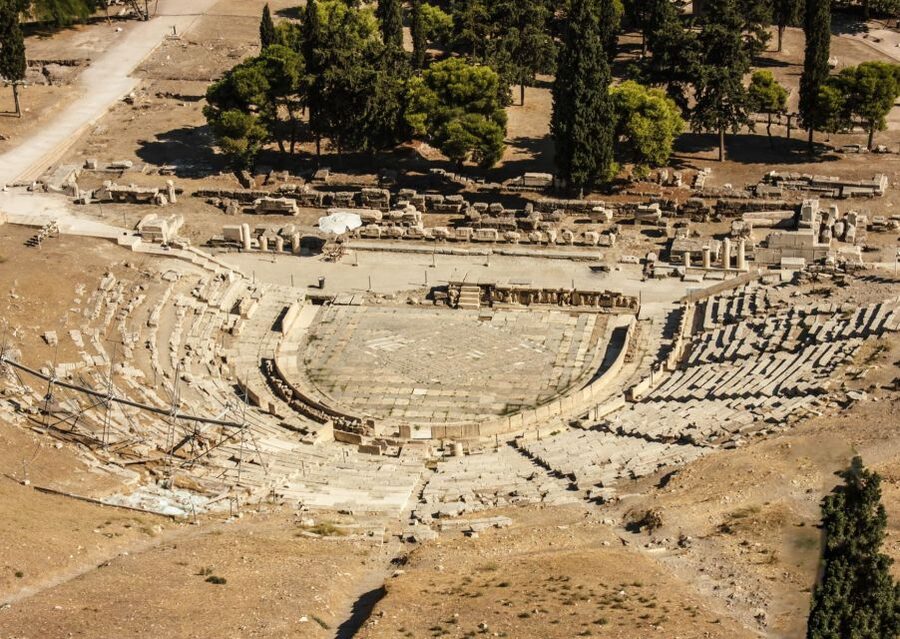
The Theatre of Dionysus lies on the southern slope of the Acropolis. It could seat around 17,000 spectators and was used for festivals connected with Dionysus, the Greek god of theatre and celebration.
For me, this stop adds an important side to the Acropolis story. The hill was not only a place of temples. Its slopes also connected religion, drama, music, and public life. The size of the theatre makes clear that performances were major civic events, not small private shows.
The Odeon of Herodes Atticus is another major structure on the southern side. Its name often appears in discussions of ancient Athens, but seeing it in relation to the hill makes the setting easier to understand. The route gives you both the religious monuments above and the performance spaces below.
The ground around the Acropolis is uneven and made for walking rather than rolling. Wear firm, comfortable shoes. High heels are not allowed, and this is no place for them in any case. The tour is not suitable for wheelchair users, and baby strollers or carriages are not allowed.
More evening and night tours in Athens:
- Electric Bike Tour of Athens by Night
★ 5.0 · 355 reviews - Athens Night Sightseeing Tour with Greek Dinner Show
★ 3.5 · 268 reviews - Athens By Night Private Tour
★ 5.0 · 203 reviews - Athens: Big Bus Panoramic Night Tour by Open-Top Bus
★ 3.7 · 166 reviews
From the National Library to Syntagma Square
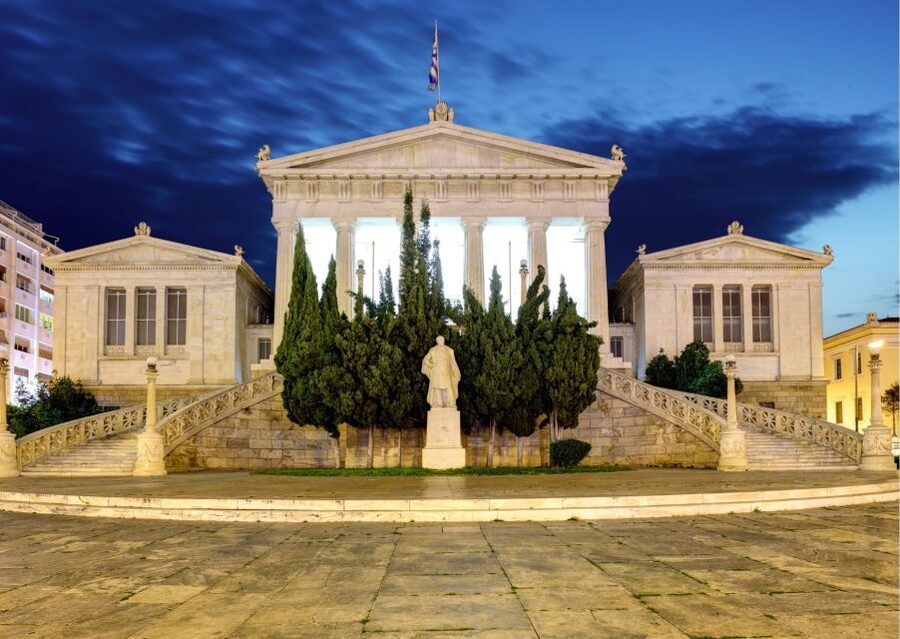
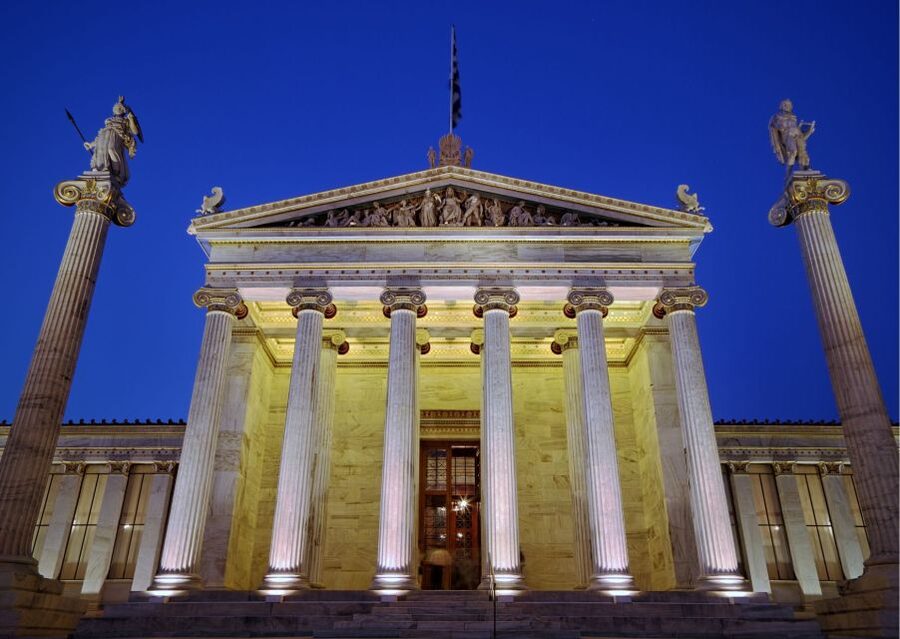
The evening tour begins at the National Library of Greece on Panepistimiou Street. This building forms one part of the city’s neoclassical trilogy, along with the University and the Academy of Athens.
This opening section shifts the story from Classical Greece to the Athens of the 19th century. The buildings show how modern Greece used grand European architectural forms to express its new national identity. After hours among ancient temples, the change is useful. You begin to see Athens as a city rebuilt and reimagined across several periods.
The next major stop is Syntagma Square, home to the Greek Parliament. Here you see the presidential guard, a familiar symbol of modern Greece. The square gives the guide a chance to explain the political heart of the capital while keeping the route tied to visible places rather than abstract history.
You should expect short stops and outdoor commentary. This is a city walking tour, not a visit inside each institution. The value comes from seeing how the buildings fit together and how the route links central Athens.
Zappeion, the Panathinaiko Stadium, and Olympic Athens

The route continues through the National Gardens toward Zappeion. The itinerary describes Zappeion as an ancient Olympic Village, giving this part of the walk a connection to the revival of Olympic ideals in modern Athens.
The Panathinaiko Stadium is the major stop in this section. Built in white marble, it is presented as the first Olympic stadium in modern history. Even without entering every building on the route, seeing the stadium helps tie ancient athletic traditions to the modern Olympic story.
This part of the tour is useful because it broadens the usual Athens checklist. Many short city tours rush from the Acropolis to the old town. Here, you get a look at the capital’s neoclassical and Olympic identity before returning to its ancient Roman monuments.
The stadium and gardens also break up the run of formal city buildings. You still walk a good distance, but the route changes setting often enough to keep the evening moving.
Hadrian’s Arch and the Temple of Zeus
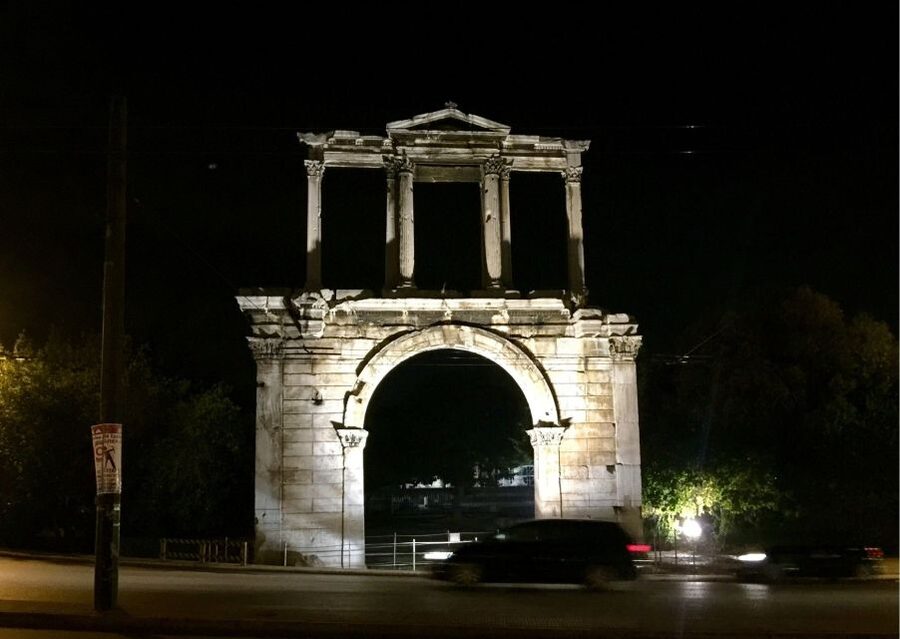
After the stadium, the tour turns back toward the ancient city. Hadrian’s Arch marks the boundary between the older Greek city and the area associated with Roman Athens under Emperor Hadrian.
The Temple of Olympian Zeus is nearby. Its surviving columns give you a clear sense of scale, even though the temple is incomplete. A guide can help explain how Roman patronage shaped Athens and how this enormous project related to the city’s older Greek identity.
This is one reason the combined format works better than an Acropolis visit alone. The Acropolis is the star, but the later stops show that Athens did not stop changing after the Classical period. Roman power, Christian worship, Ottoman rule, and the modern Greek state all left their mark, even if this tour focuses most closely on the ancient and 19th-century chapters.
The Metropolitan Cathedral and Little Mitropolis
The next section brings you to the Metropolitan Cathedral and the Little Mitropolis. These two churches sit close together but offer a different look at Athens from the temples and civic buildings earlier in the day.
The Little Mitropolis is especially easy to miss if you are walking alone. Its compact size and older appearance contrast with the larger cathedral beside it. The stop helps show that central Athens contains layers of religious architecture from different periods within a very small area.
The guide’s role is important here. Without explanation, a quick look at another church can blur into the rest of the city walk. With context, you can place these buildings within Athens’ Byzantine and modern religious life.
Ending in Monastiraki with the Acropolis above you
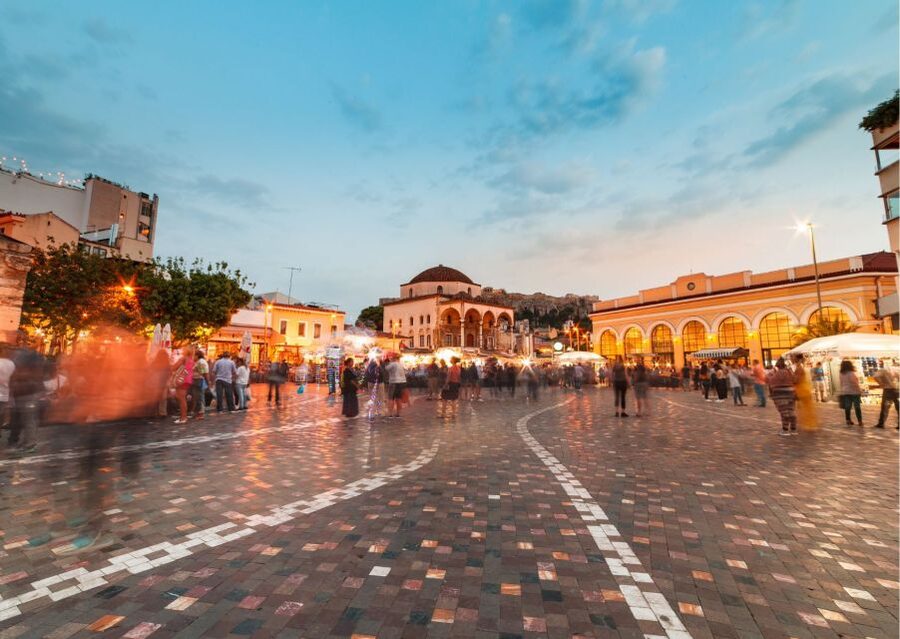
The tour finishes at Monastiraki Square and the Greek Agora, with views toward the Acropolis. Ending here makes sense. You finish in one of central Athens’ best-known meeting areas, with the illuminated hill providing a final visual link to the afternoon visit.
This is a good place to continue your evening independently because the tour ends in a central part of the city. The experience does not include a meal or a restaurant stop, so plan your food separately. Food and drinks are not allowed during the Acropolis portion.
The night view is less about entering monuments and more about seeing familiar landmarks in a new setting. The Parthenon that seemed distant or sunlit earlier now becomes a bright marker above the city. That change gives the day a natural finish.
Guide quality and the Spanish-language format
The tour includes a licensed Spanish-speaking guide. The strongest feature, based on the available guide feedback, is the quality of the historical explanation. Barbara is praised for professional, friendly delivery and for using visual reconstructions. Juan is praised for knowing both the history and the city and for shaping a well-organized route.
The guide commentary covers myths as well as dates and names. That can make a major difference at the Acropolis, where several temples share similar pale stone and partially ruined forms. Stories about Athena, Erechtheus, Dionysus, and other figures give each place a clearer identity.
One useful suggestion is to expect more ancient and architectural information than modern city statistics. The tour gives you a broad feel for Athens, but it does not promise detailed information about current population, salaries, or major industries. If those subjects matter to you, ask the guide directly when there is a natural opening.
Since the language is Spanish, this is not the right choice if you need English commentary. For Spanish speakers, though, a guide who can explain complicated myths and historical changes in your own language may make the Acropolis much easier to follow.
Is $53 a fair price?
At $53 per person, the cost is reasonable for a five-hour guided program that combines the Acropolis with a substantial central Athens route. The important qualification is that the Acropolis admission ticket costs extra.
That means you should compare the full cost, not just the advertised tour price. You are paying for a licensed guide, the organized route, the Spanish commentary, and the convenience of connecting major sites in one outing. You are not paying for the archaeological entrance itself.
The value is strongest if you want structure and context. If you already know Athens well, speak enough Greek or Spanish to follow independently, and prefer to set your own pace, you may find the fixed route less useful. If this is your first afternoon in Athens, the combination can save planning time and help you understand where the main sights are.
Free cancellation up to 24 hours before the activity and the option to reserve now and pay later add useful flexibility. Still, the ticket purchase remains your responsibility, so do not wait until the last moment to sort out the Acropolis entry.
Who should book this tour?
I would recommend it to Spanish-speaking first-time visitors, couples, families with older children, and anyone with only a short stay in Athens. It gives you the city’s most important ancient monument plus a useful orientation walk through central Athens.
It is also a good fit if you like history explained through stories and buildings rather than through a museum display. Barbara’s reconstruction images are a strong example of how the right guide can make damaged ruins easier to picture.
I would think twice if you use a wheelchair, need a stroller, dislike long walks, or want a relaxed visit with plenty of time at each stop. You also need to be comfortable arranging the Acropolis ticket yourself and following a Spanish-language program.
Should you book it?
Book this tour if you want one organized afternoon and evening that covers the Acropolis, modern Athens, Roman monuments, churches, Olympic sites, and a night view from Monastiraki. The route is wide-ranging, the price is fair once you account for the separate ticket, and the guide quality appears strongest in the historical storytelling.
Skip it if you want a short Acropolis visit only, an English guide, wheelchair access, or a flexible schedule. For the right person, this is a practical way to get your bearings fast while seeing Athens change from ancient sanctuary to modern capital after dark.
FAQ
How long does the Athens Acropolis and city night tour last?
The activity lasts five hours and includes both the afternoon Acropolis visit and the evening city tour.
What language is the tour conducted in?
The live tour guide speaks Spanish. The experience includes a licensed Spanish-speaking guide.
Is the Acropolis entrance ticket included?
No. You must buy your own ticket for the Acropolis archaeological site before the activity begins.
What Acropolis ticket time should I purchase?
For the 3 p.m. low-season tour, buy a ticket for the 3 to 4 p.m. slot. For a 5 p.m. high-season tour, use the 5 to 6 p.m. slot. For a 5:45 p.m. high-season tour, use the 6 to 7 p.m. slot.
Where does the Acropolis portion begin?
Meet at Acropolis metro station 10 minutes before the tour starts. The group enters from the south-east side rather than the main entrance.
Where does the evening city tour begin?
Meet at the National Library of Greece at Panepistimiou 32, Athens.
Can I cancel the activity?
Yes. You can cancel up to 24 hours before the activity for a full refund.
Is the tour suitable for wheelchair users or strollers?
No. The activity is not suitable for wheelchair users, and baby strollers or baby carriages are not allowed. High-heeled shoes, food, and drinks are also not allowed.
More city tours in Athens
- Athens: City Sightseeing Hop-On Hop-Off Bus Tour
★ 4.3 · 4,520 reviews - City Sightseeing Athens, Piraeus & Beach Riviera Hop-On Hop-Off Bus Tours
★ 4.0 · 1,887 reviews - Athens:City Pass with Acropolis, Museums, Hop-On Hop-Off Bus
★ 3.9 · 586 reviews - Athens: City Highlights Bike tour
★ 4.9 · 453 reviews
Newly reviewed around Athens
- Feel Ancient thermal Spa Visit Delphi, Leonidas ℨoo Spaʀtan★ 5.0 · 4 reviews
- Food Tour★ 5.0 · 3 reviews
- Explore the Hidden Food Gems of Athens★ 5.0 · 57 reviews
- Food Experience in Athens including Unlimited Lunch★ 5.0 · 3 reviews
- Eat Your Way Through Athens: A Local Food Walk★ 4.9 · 97 reviews
- From Athens: Delphi Private Tour with Lunch Time★ 4.0 · 3 reviews
- Delphi: Spanish guided one day tour★ 4.6 · 55 reviews
- Early Entry Acropolis & Museum. Beat the Crowds & the heat★ 5.0 · 3 reviews
Athens Acropolis Tours, compared.
Acropolis & up to 5 Archaeological Sites Combo Pass
Read our review →
Acropolis, Parthenon & Acropolis Museum Guided Tour
Read our review →
Acropolis, Parthenon & Acropolis Museum Guided Tour
Read our review →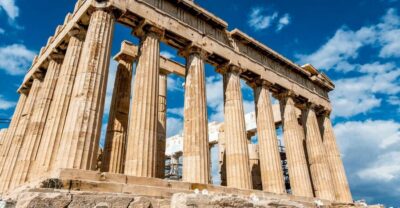
Acropolis monuments & Parthenon Walking Tour with Optional Acropolis Museum
Read our review →Browse the lists this tour appears in