
Reviewed · ATHENS ACROPOLIS TOURS
4 Hours – Athens & Acropolis Highlights Private Tour
The Acropolis visit is the heart of this four-hour Athens tour, but the real appeal is how much city you can cover around it. You see the Parthenon and ancient theaters, then switch from marble temples to the Panathenaic Stadium, Lycabettus Hill, the Parliament, and the changing of the guard. It is a quick, useful first look at Athens rather than a slow archaeological study.
I like the private vehicle and flexible pickup, especially for cruise passengers or anyone with only one day in town. I also like the local touch: guides such as Andreas, Panos, Manos, Tolis, and Pantelis have been praised for good stories, smart routes, photo stops, and restaurant suggestions. The main catch is important: your driver is not licensed to guide you inside the Acropolis, so a full licensed guide costs an additional €250.
Key points to know before booking

- The Acropolis gets about 90 minutes: You see the Propylaea, Temple of Athena Nike, Erechtheum, Parthenon, Odeon of Herodes Atticus, and Theatre of Dionysus.
- Skip-the-line Acropolis tickets are included: This saves useful time, though you still pass through normal security and site controls.
- You cover Athens by private vehicle: Hotel, Airbnb, and port pickup and drop-off are included for the private tour.
- The driver explains the city but cannot tour the monuments inside: Request the licensed guide option if detailed site commentary matters to you.
- Lycabettus Hill gives the broad city view: You can look from the Acropolis toward the Aegean Sea in one quick stop.
- The route is built for a short stay: It suits cruise passengers, first-time visitors, and anyone needing a fast orientation before exploring on foot.
The Acropolis comes first
The tour begins with Athens’s defining sight, the Acropolis. That order matters. You get the major ancient site before traffic, heat, tired legs, or a delayed cruise transfer can eat into your limited time.
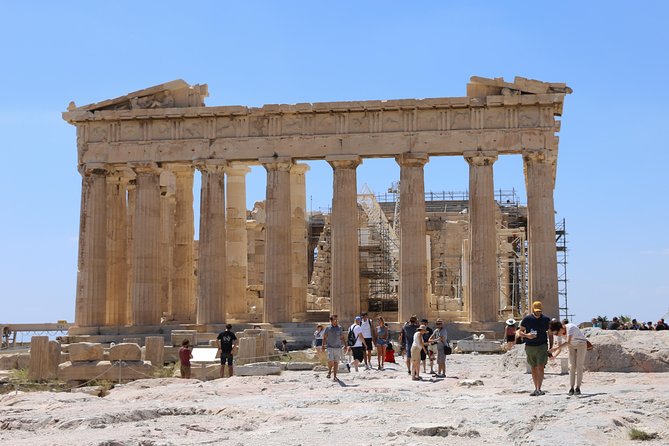
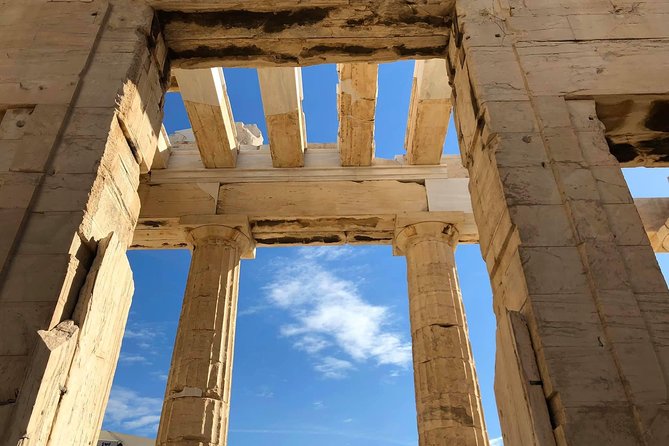
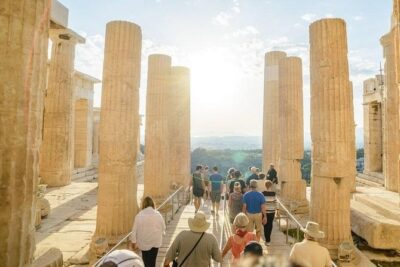
The Acropolis stop lasts about 1 hour and 30 minutes, with admission included. You enter through the monumental Propylaea, the grand gateway designed by Mnesicles in Pentelic marble. From there, the route brings you near the small Temple of Athena Nike, the Erechtheum with its famous Caryatid porch, and the Parthenon.
The Parthenon receives only about 10 minutes as a listed stop, but that should not be read as the total time available for the Acropolis. The broader hill visit gives you time to see the main buildings, take photographs, and look across central Athens. Still, this is not a detailed art-history walk. You are moving through several major areas on a tight clock.
Below the hill, you can see the Theatre of Dionysus, often linked with the beginnings of Western theater, and the Odeon of Herodes Atticus. The Odeon is a Roman theater completed in 161 AD and renovated in 1950. It remains an impressive stone bowl on the southwest slope, though your exact viewing position depends on site access and the day’s route.
The skip-the-line entry is one of the tour’s most useful features. It does not mean walking past every checkpoint, but it can reduce the time spent waiting to buy or validate admission. On a four-hour tour, every saved minute helps.
Bring sensible shoes. The Acropolis has uneven stone, slopes, and exposed walking areas. The supplied information does not promise shade, seating, or a specific route for mobility needs, so ask the provider about your situation before booking if you have walking concerns.
More ways to see the Acropolis:
- Athens: Acropolis & up to 5 Archaeological Sites Combo Pass
★ 4.4 · 12,619 reviews - Athens: Acropolis Ticket with Optional Audio or Live Guide
★ 4.2 · 11,055 reviews - Athens: Acropolis, Parthenon & Acropolis Museum Guided Tour
★ 4.8 · 9,316 reviews
Know what your driver can and cannot do
This is the point I would want made clear before paying. The included professional driver can explain Athens during the drives and take you to the key stops, but drivers are not licensed to accompany you inside the Acropolis or other archaeological sites and museums.
That arrangement works well if you are happy to explore the Acropolis independently after receiving an introduction. Several positive experiences describe exactly that format: the driver explains the site before you enter, helps with tickets or the entrance area, then waits while you look around.
If you want sustained commentary beside the Parthenon, Erechtheum, and Propylaea, request the licensed guide option. It costs an additional €250, subject to availability. That is a large supplement, so decide based on your interest in archaeology, not just on the promise of private transport.
The difference between a driver-guide and a licensed site guide can shape the entire experience. A driver such as Andreas, Panos, Manos, Nikos, Giannis, Tolis, or Pantelis may offer useful history, personal stories, route advice, and local recommendations, but that is not the same as a formal guided visit inside the monuments.
From Hadrian’s Arch to the Temple of Zeus
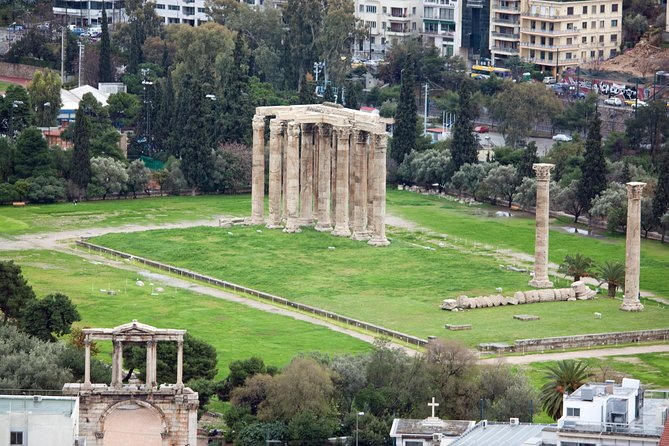
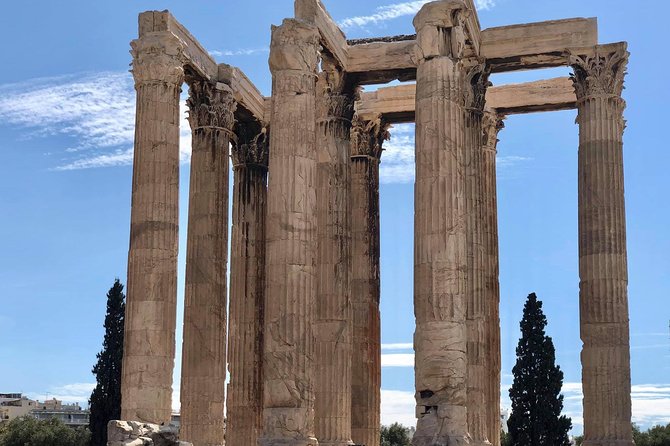
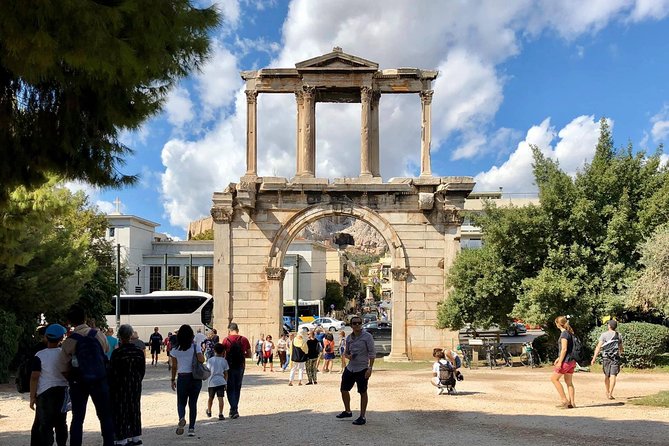
After the Acropolis, the vehicle heads toward the Temple of Olympian Zeus, once the largest temple in ancient Athens. Hadrian’s Arch is nearby and gives you a quick visual link between the ancient city and the Roman-era expansion associated with Emperor Hadrian.
The supplied route describes this as a drive-by or sightseeing portion rather than a long interior visit. That is sensible in a half-day tour. You get the scale and setting of the temple without spending another block of time on an archaeological site.
This part of the route also helps you understand Athens as more than the Acropolis. The city’s ancient core, Roman additions, neoclassical avenues, modern government buildings, and residential districts sit close together. A vehicle makes those connections quickly, though you will not get the same feel for street life as you would on a walking tour.
The Panathenaic Stadium adds a modern Olympic connection
The Panathenaic Stadium is a natural next stop. The white marble stadium hosted the first modern Olympic Games in 1896, and the tour allows about 20 minutes there. Admission is listed as free for this stop.
You can expect a brief visit and time for photographs, rather than a long stadium presentation. The structure is visually striking because it sits in the modern city while recalling the ancient athletic tradition that inspired the 1896 games.
I like this stop because it breaks up the ruins with a more recent piece of Greek history. If your group includes children or anyone who finds temple remains hard to picture, the stadium can be an easier place to grasp. The trade-off is that 20 minutes goes quickly, and the tour does not promise a full interior program or museum visit.
A few more Athens tours worth putting side by side
- Best of Athens Half Day Private Tour
★ 5.0 · 3,714 reviews - Athens Full Day Private Tour
★ 5.0 · 2,903 reviews - Athens Airport Private Arrival Transfer with Meet & Greet
★ 4.5 · 1,495 reviews - Athens Airport to Athens Hotels Private Arrival Transfer
★ 5.0 · 947 reviews
Lycabettus Hill delivers the big Athens view
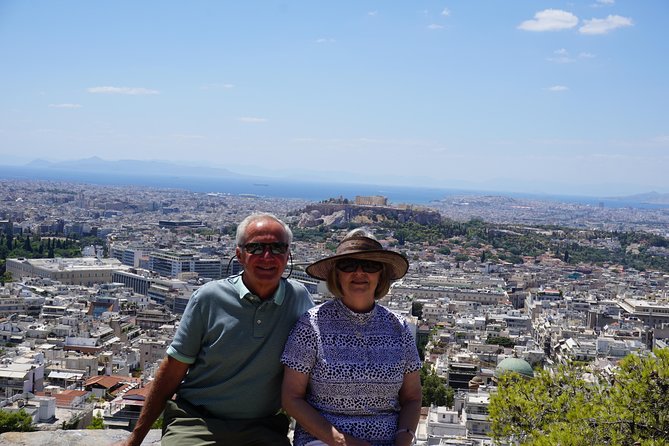
The drive up Lycabettus Hill takes about 15 minutes at the stop. From the highest hill in Athens, you can look toward the Acropolis and across the city toward the Aegean Sea.
This is one of the best uses of a vehicle. Reaching a high viewpoint on your own takes extra planning, while the tour gives you a quick panoramic pause without asking you to spend half the day climbing. It is also a useful counterpoint to the Acropolis itself. From the ancient hill, you study monuments. From Lycabettus, you see how those monuments fit into the present-day city.
The stop is short, so keep your camera ready and do not expect a long walk or extended time at the top. Weather also matters. One positive account describes enjoying the tour despite poor weather, but cloud or rain can reduce the payoff of any viewpoint.
Neoclassical Athens appears from the vehicle

The route passes the three major neoclassical buildings often called the architectural trilogy: the Academy, the National and Kapodistrian University of Athens, and the National Library of Greece.
The Academy was founded in 1926 as an institution for sciences, humanities, and fine arts. The University building was designed by Danish architect Christian Hansen and completed in 1864. The National Library, designed by Theophil Hansen, completes the group.
These are usually sightseeing views rather than long interior visits. That distinction matters. You can admire the facades, hear the basic story, and take photographs if the route allows, but do not book this tour expecting museum access or an architectural walking seminar.
Still, I would keep this portion. It shows the Athens built after independence, when the new Greek state used neoclassical design to connect itself with classical antiquity. That context makes the city feel less like a collection of isolated ruins.
The changing of the guard at Syntagma Square
The tour ends its central Athens circuit at the Monument to the Unknown Soldier, in front of the Hellenic Parliament at Syntagma Square. The visit includes the chance to see the Euzones, the ceremonial guards, and is listed as about 15 minutes.
Timing is the key issue here. The tour can aim for the changing of the guard, but the exact ceremony and viewing position depend on the schedule and traffic. Several accounts praise guides for finding a good spot in front of the Presidential Mansion or Parliament, sometimes away from the thickest crowd.
Syntagma Square also gives you a quick introduction to modern Greek politics. The square takes its name from the constitution granted after the uprising of September 3, 1843. The Parliament occupies the former Royal Palace, overlooking the square.
This stop works well at the end because it puts modern Greece beside ancient Greece. You have seen temples and theaters, then the institutions and ceremonies of the present state. It is a small detail, but it gives the tour a clear arc.
Why private transport is valuable in four hours
Athens is compact around its central sights, but traffic and road closures can disrupt a tightly timed visit. A private vehicle gives you a base between stops and lets the driver adjust the route. Pantelis, for example, was praised for finding alternate roads during a bike race, while another driver managed around marathon closures.
That local route knowledge matters most for port pickups. If you arrive from a cruise ship, a private pickup can save the trouble of finding the right taxi or carrying bags through a transit connection. The tour includes hotel, Airbnb, or port pickup and drop-off for private bookings, with the pickup time adjustable on request.
You should still allow a buffer around your cruise schedule. The experience lasts about four hours, but traffic can affect the drive between the port and central Athens. Tell the provider your ship’s departure time and keep your plans after the tour conservative.
The vehicle is described in the positive accounts as clean and comfortable, with bottled water supplied. Group size and vehicle type can vary, so ask for details if your party is large. The experience is advertised as private, with group discounts available, but confirm the exact booking option and capacity before paying.
What the price means at $181.39 per person
At $181.39 per person, this is not the cheapest way to see Athens. You are paying for private transport, pickup and drop-off on the private option, Acropolis admission, bottled water, and a driver who can shape the route around your timing and interests.
The value improves with a small group. Split among several people, a private vehicle can cost more than a public bus or self-guided day, but it gives you door-to-door movement and avoids losing time on route planning. It is especially practical for cruise passengers, families, older travelers, or anyone with only one free day.
The value drops if you mainly want a detailed Acropolis lesson. The included driver cannot guide inside the site, and the licensed guide supplement is €250. If that add-on pushes the total beyond your comfort level, you might prefer a separate licensed Acropolis tour and explore the rest of Athens on your own.
I also would not choose this format if you want long meals, neighborhood wandering, or museum time. Four hours is designed for breadth over depth. You see many headline sights, but most stops are short and some are viewed from the vehicle.
Guides who add local character
The strongest part of the experience is the human element, though the assigned driver can vary. Andreas is praised for answering questions, sharing his affection for Greece, and adding less familiar stops. Panos is noted for good English, punctual port pickup, photo stops, and a restaurant recommendation in Plaka.
Manos is described as lively and funny, with personal stories about Greek culture and a scenic proposal viewpoint outside the standard route. Tolis is praised for reaching the main sights before the crowds and explaining the city during the drive. Nikos, Giannis, Yiannis, Dimitris, Georgia, Yanos, and Pantelis also receive warm praise for clear explanations, flexibility, and careful handling of the day.
You cannot request a particular person with certainty from the supplied information, so treat those names as examples of the service style rather than a guarantee. If a certain guide matters to you, ask the provider before booking.
The best drivers seem to understand that a short tour needs choices. They help you decide where to stop, point out a strong photo position, and adjust when streets close. That flexibility is more useful than trying to force every listed sight into equal time.
Best seasons and best type of visitor
A winter visit may help with crowds, as one account specifically recommends doing the tour in winter. Summer brings longer daylight but can also mean heat, glare, and heavier demand at the Acropolis. An early start can help, though the exact pickup time is adjustable rather than fixed.
This tour is a strong fit for:
- First-time visitors who want a fast introduction to Athens
- Cruise passengers with a limited shore visit
- Families or small groups who value a private vehicle
- Visitors who want the Acropolis plus city viewpoints and modern landmarks
- People who prefer a driver to handle routes and parking
- Anyone who wants help finding a restaurant or extending the day in Plaka
It is less suitable for:
- Archaeology fans who want detailed commentary inside every monument
- Visitors seeking a relaxed walking tour
- People who want extended museum time
- Budget visitors who can comfortably use public transport
- Anyone unable to manage uneven Acropolis surfaces without confirming access arrangements first
The experience has a 4.9 rating from 681 ratings and is recommended by 98 percent of customers. Those numbers point to a consistently strong service record, but they do not change the practical limits: four hours is short, and the standard driver is not a licensed site guide.
Should you book the Athens and Acropolis Highlights tour?
I would book it if you have one day, a cruise stop, or a group that wants the Acropolis plus a broad look at Athens without handling transport. The combination of skip-the-line admission, port pickup, Lycabettus Hill, the Panathenaic Stadium, and the guard ceremony gives you a lot of useful orientation in one half-day.
Before booking, decide how much commentary you want inside the Acropolis. If you are content to explore after an introduction from the driver, the price can make sense. If you want a full archaeological explanation, budget for the €250 licensed guide supplement and confirm availability.
The free-cancellation policy allows cancellation up to 24 hours before the start time for a full refund. Changes or cancellations inside that window are not accepted for a refund. For the best experience, request an early pickup, tell the provider about your port schedule, and wear shoes suited to ancient stone.
FAQ
How long does the Athens and Acropolis tour last?
The tour lasts approximately four hours.
Is Acropolis admission included?
Yes. Skip-the-line Acropolis tickets are included for bookings made after November 17, 2023.
Does the tour include hotel or port pickup?
Hotel, Airbnb, and port pickup and drop-off are included for the private tour. Pickup time can be adjusted upon request.
Can the driver guide me inside the Acropolis?
No. The included drivers are not licensed to accompany you inside the Acropolis or other archaeological sites and museums.
Can I add a licensed tour guide?
Yes. A licensed guide can be requested, subject to availability, for an additional cost of €250.
What sights are included besides the Acropolis?
The route includes the Parthenon, Propylaea, Temple of Athena Nike, Erechtheum, Theatre of Dionysus, Odeon of Herodes Atticus, Temple of Olympian Zeus, Hadrian’s Arch, Panathenaic Stadium, Lycabettus Hill, the Academy, University, National Library, Parliament, Syntagma Square, and the Monument to the Unknown Soldier.
Is the Panathenaic Stadium admission included?
Yes. Admission to the Panathenaic Stadium is listed as free.
What is the cancellation policy?
You can cancel up to 24 hours before the experience start time for a full refund. Cancellations or changes made less than 24 hours before the start time are not accepted for a refund.
Newly reviewed around Athens
- Feel Ancient thermal Spa Visit Delphi, Leonidas ℨoo Spaʀtan★ 5.0 · 4 reviews
- Food Tour★ 5.0 · 3 reviews
- Explore the Hidden Food Gems of Athens★ 5.0 · 57 reviews
- Food Experience in Athens including Unlimited Lunch★ 5.0 · 3 reviews
- Eat Your Way Through Athens: A Local Food Walk★ 4.9 · 97 reviews
- From Athens: Delphi Private Tour with Lunch Time★ 4.0 · 3 reviews
- Delphi: Spanish guided one day tour★ 4.6 · 55 reviews
- Early Entry Acropolis & Museum. Beat the Crowds & the heat★ 5.0 · 3 reviews
Athens Acropolis Tours, compared.
Acropolis & up to 5 Archaeological Sites Combo Pass
Read our review →
Acropolis, Parthenon & Acropolis Museum Guided Tour
Read our review →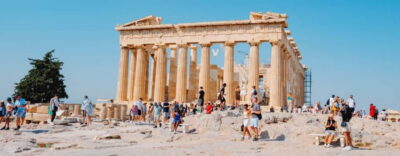
Acropolis, Parthenon & Acropolis Museum Guided Tour
Read our review →

Acropolis monuments & Parthenon Walking Tour with Optional Acropolis Museum
Read our review →Browse the lists this tour appears in