
Reviewed · ATHENS ACROPOLIS TOURS
Private Guided Tour: Athens, Acropolis and Acropolis Museum
The best thing about this private Athens walking tour is its sense of connection. You move from modern Syntagma Square through royal gardens, Roman ruins, ancient theaters, the Acropolis, and the museum with one guide tying it all together. You are not simply checking off the Parthenon. You are learning how Athens grew around it.
I like the private format for two reasons: your guide can answer your questions instead of following a fixed script, and the pace can fit your group. Guides such as Annie, Margarita, Tina, Vicky, and Panagiota have been praised for clear storytelling, warmth, and the ability to keep both adults and children interested. I also like the route through the Acropolis south slope, which includes the Theater of Dionysus and can help you avoid some of the main entrance crowds.
The catch is the walking. Five and a half hours can mean a very long day on uneven ground, steps, and exposed stone. Entrance tickets are not included, and strict Acropolis entry times mean late arrivals can lose the tour without a refund.
Key points to know before booking
- Private guide, private pace: Ask questions freely and adjust the emphasis toward art, mythology, archaeology, or modern Athens.
- A full city-to-Acropolis route: Syntagma Square, Parliament, the National Garden, Zappeion Hall, Hadrian’s Arch, the Temple of Olympian Zeus, the Acropolis, and the museum all fit into one morning or afternoon.
- The south-side Acropolis approach: You enter near the Theater of Dionysus rather than simply joining the main hilltop flow.
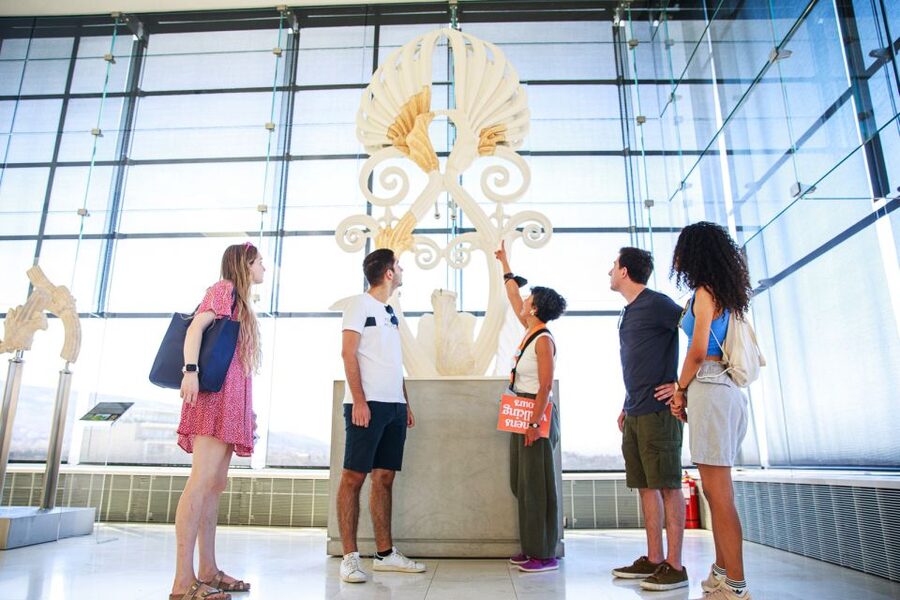
- Four thousand museum objects: The Acropolis Museum gives the monuments context with strong lighting, open views, and glass floors over excavations.
- Serious walking and summer heat: Wear shoes with a firm sole, bring a hat and water, and expect little shade on the Acropolis itself.
- Budget for tickets separately: The $318 price pays for the private licensed guide, while admission to the archaeological sites and museum is extra.
Starting beneath Syntagma Square
Your meeting point is inside Syntagma metro station, one level below street level, beside the ticket-validating machines under the large central clock. Look for the orange Athens Walking Tours sign. This is a practical meeting place in central Athens, but give yourself time to find the correct level of the station.
The tour begins with a small collection of archaeological finds from classical-era excavations around Syntagma. It is a modest opening, but it gives your guide a chance to set the scene. Athens is not only an ancient hill surrounded by a modern city. Ancient remains appear in ordinary places, sometimes beneath roads, stations, and public squares.
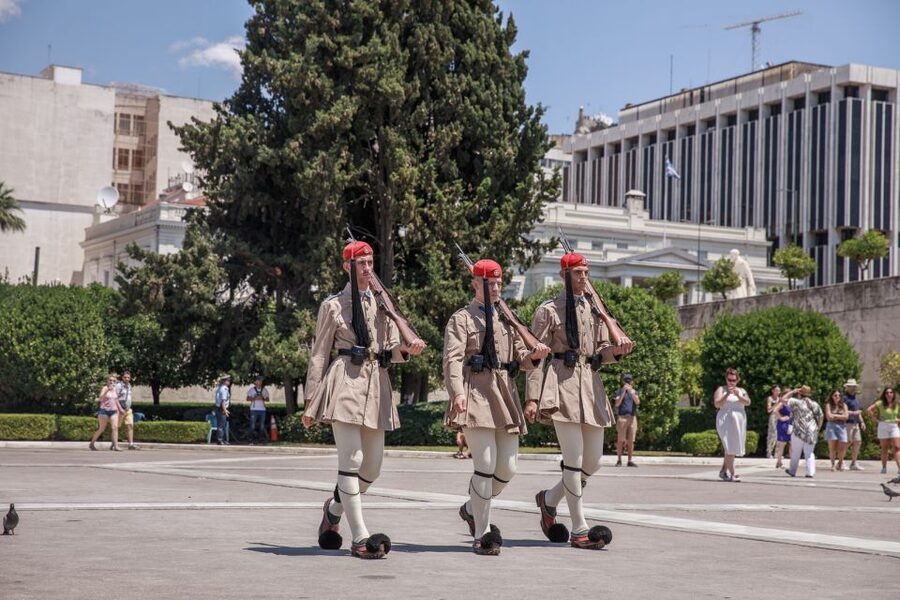
From there, you walk to the House of Parliament. In front of it, the Tomb of the Unknown Soldier is guarded by the Evzones, Greece’s ceremonial soldiers. If your timing lines up, you can watch the changing of the guards. This is one of those short stops that works best with a guide, who can explain what you are seeing instead of leaving you to photograph uniforms without context.
The pace here is easy, but the day soon becomes more active. This is a walking tour from the start, not a sightseeing trip with a vehicle waiting at each corner.
More ways to see the Acropolis:
- Athens: Acropolis & up to 5 Archaeological Sites Combo Pass
★ 4.4 · 12,619 reviews - Athens: Acropolis Ticket with Optional Audio or Live Guide
★ 4.2 · 11,055 reviews - Athens: Acropolis, Parthenon & Acropolis Museum Guided Tour
★ 4.8 · 9,316 reviews
The National Garden and Athens’s modern story
The route continues through the National Garden, once Queen Amalia’s private garden. The shade is welcome, especially in warmer months, and the garden gives you a break from the hard stone and traffic of central Athens.
Next comes Zappeion Hall, a neoclassical building linked to the first modern Olympic Games. Your guide also discusses important figures and events from more recent Athenian history. This part of the tour matters because the Acropolis can otherwise make Athens feel frozen in antiquity. The city is also a modern capital with royal, political, sporting, and civic stories.
I like this section as a transition. You are not rushed straight from the metro to the Parthenon. Instead, you see how Athens presents its past through parks, public buildings, monuments, and ceremonial spaces.
The main limitation is that the itinerary covers a lot of ground. Stops outside the Acropolis are mostly short, so this is not the tour for detailed interior visits to every building along the way. The payoff is breadth: you get a strong first look at the city before reaching its most famous site.
Roman Athens at Hadrian’s Arch and the Temple of Zeus
The city’s Roman chapter appears at Hadrian’s Arch and the Temple of Olympian Zeus. These monuments show that Athens did not end with the classical period. Roman emperors reshaped the city and added their own grand projects.
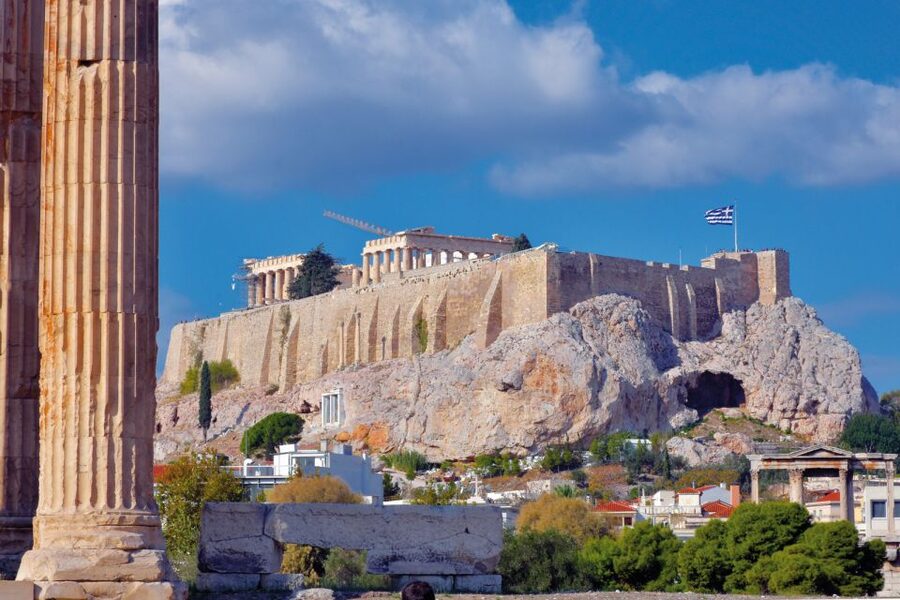
The Temple of Olympian Zeus was one of the largest temples in the ancient Greek world. Even in its ruined condition, the surviving columns make its scale easy to grasp. Hadrian’s Arch is smaller, but it is a useful marker of the boundary between old Athens and the Roman city associated with Emperor Hadrian.
A guide adds value here by linking the remains to the wider story of power, patronage, and urban growth. You can ask the questions that often get lost in a group setting: Why was the temple built? What did Roman Athens look like? How did later generations treat these ancient structures?
The tour does not include private transportation, so you walk between these sights. That is part of the experience, but it also explains why comfortable shoes and a reasonable level of stamina matter.
Walking the Dionysiou Areopagitou walkway
From the Roman monuments, you follow the Dionysiou Areopagitou pedestrian walkway toward the Acropolis. This is one of the most enjoyable stretches of the route. The traffic drops away, the Acropolis rises above you, and the ancient hill begins to feel like part of the city rather than a distant monument.
Along the way, you see the Philopappos Hill monument and the Odeon of Herodes Atticus. The Odeon is a Roman-era theater still associated with performances, while the Philopappos monument gives the surrounding hills another layer of history.
Your guide also points out the views toward Mars Hill, the Ancient Agora, and the Temple of Hephaestus. These views help you understand the Acropolis as the center of a larger urban and religious setting. The Parthenon is the star, but it did not sit alone.
This walk can be sunny and hot. There are shaded stretches earlier in the day, but the exposed stone around the Acropolis offers limited relief. One participant described completing roughly 12 miles during a similar day in Athens, so do not treat the five-and-a-half-hour duration as a gentle stroll.
More museums and ancient sites in Athens:
- Athens: Acropolis, Parthenon & Acropolis Museum Guided Tour
★ 4.8 · 3,579 reviews - Acropolis monuments & Parthenon Walking Tour with Optional Acropolis Museum
★ 5.0 · 2,678 reviews - Athens: Acropolis Museum Ticket with optional Audio Guide
★ 4.4 · 2,652 reviews - Parthenon & Acropolis Museum with Audio or Live Tour Option
★ 4.1 · 2,446 reviews
Entering the Acropolis by the south slope
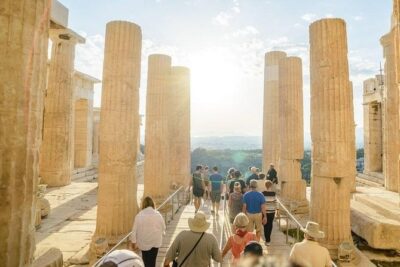
The Acropolis portion begins at the south entrance, where you visit the Theater of Dionysus before climbing toward the hilltop monuments. This route is a smart feature. It gives you an important site that many independent visitors hurry past, and it can reduce time spent in the main entrance crush.
The Theater of Dionysus is often called the first theater of antiquity. It sits on the southern slope beneath the Acropolis, where drama, religion, and civic life met. Your guide can explain how theater connected with worship of Dionysus and how performances fit into Athenian public life.
The climb from here is not trivial. The route includes uneven ancient surfaces and uphill sections. There is no need to race, but you should be comfortable walking on stone. A private guide can help set a sensible pace, find shaded pauses, and adjust the amount of commentary when the group needs a breather.
Past participants have specifically praised guides such as Nikoletta for knowing where the shade falls and guides such as Efie for keeping teenagers interested. That flexibility is one of the strongest reasons to choose a private tour rather than a large group.
The Parthenon, Propylaia, and Erechtheion

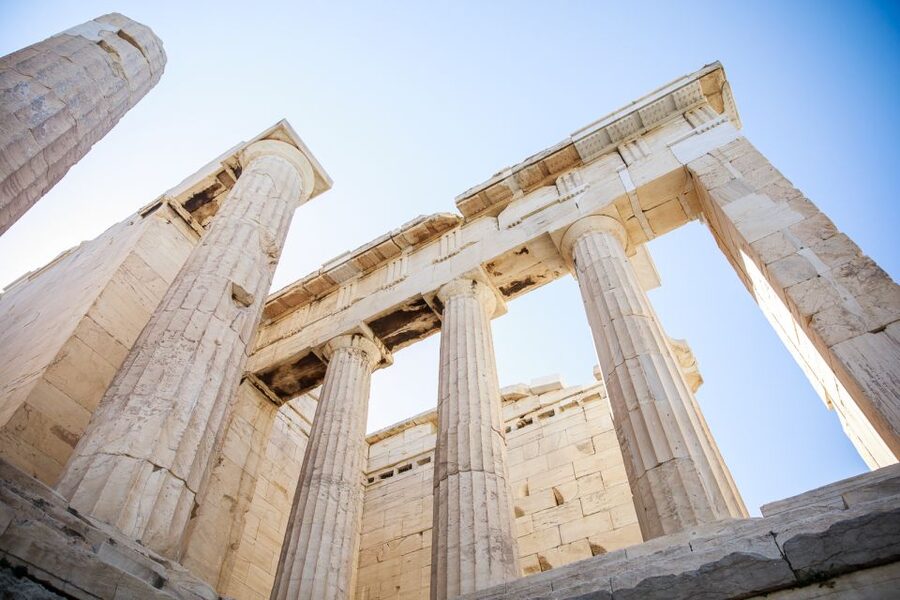
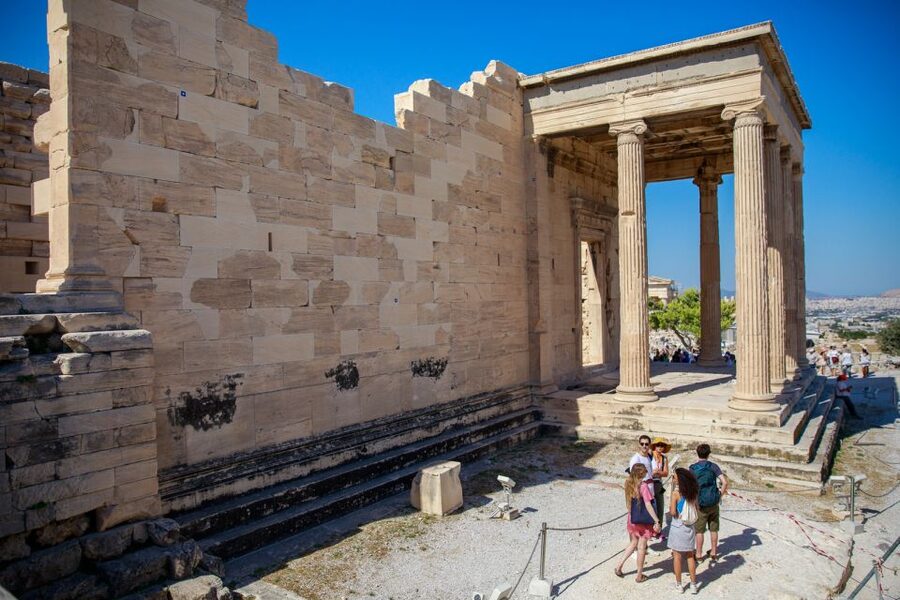
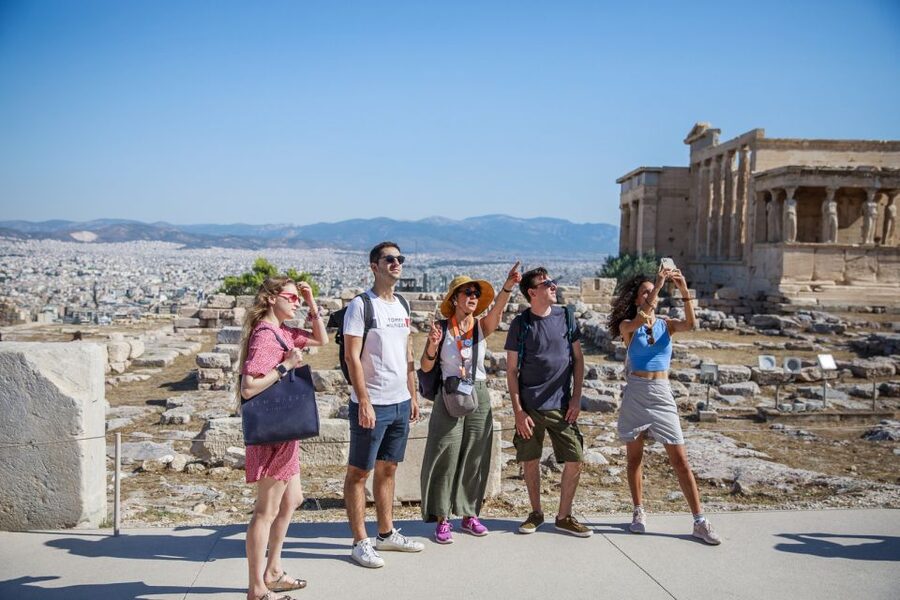
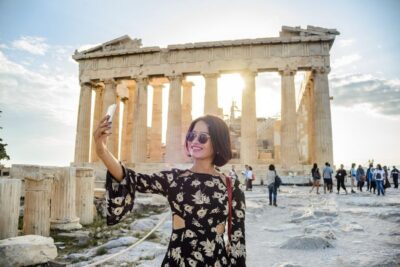
At the summit, the monuments arrive one after another. The Propylaia forms the monumental gateway. The Temple of Athena Nike sits near the approach. The Erechtheion is known for its unusual design and the famous Caryatid figures. Then comes the Parthenon, the building most people have come to Athens to see.
A good guide does more than name each structure. You learn why the buildings were placed as they were, how ancient builders handled proportion and stone, and how the Acropolis changed over time. You also hear the stories connected with Athena and the city that claimed her as its protector.
The Parthenon is impressive even when crowded, but the setting can be demanding. The stone is uneven, the sun can be strong, and security lines may add 30 minutes or more during peak season. Everyone passes through airport-style security, so leave large bags and luggage behind. Baby strollers and electric wheelchairs are not allowed, and the tour is not suitable for wheelchair users or people with mobility impairments.
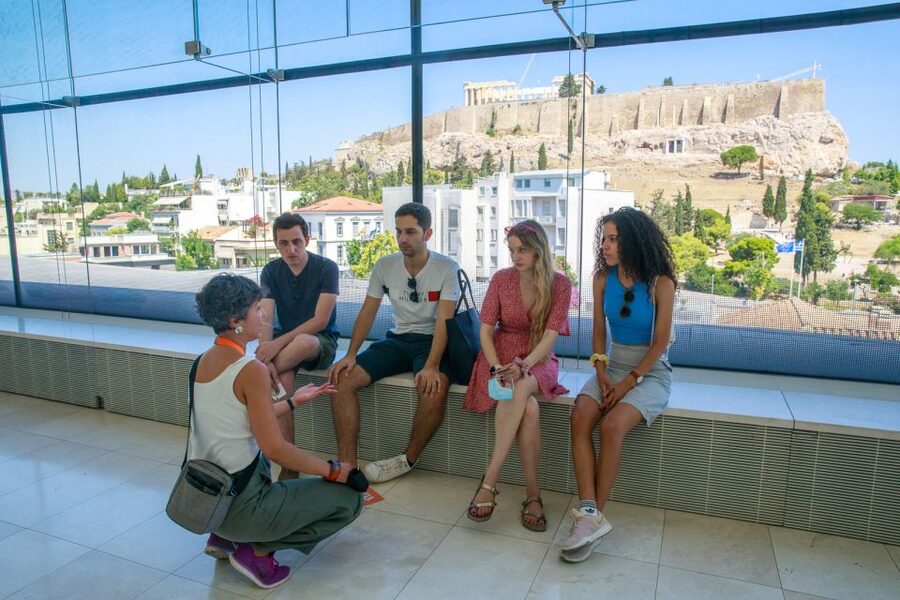
You get time after the guided Acropolis visit to take pictures and look around. That matters. A nonstop lecture can make the hill feel like an exam, while a quiet pause lets you take in the view toward Mars Hill, the Agora, and the surrounding city.
Why the Acropolis Museum completes the visit
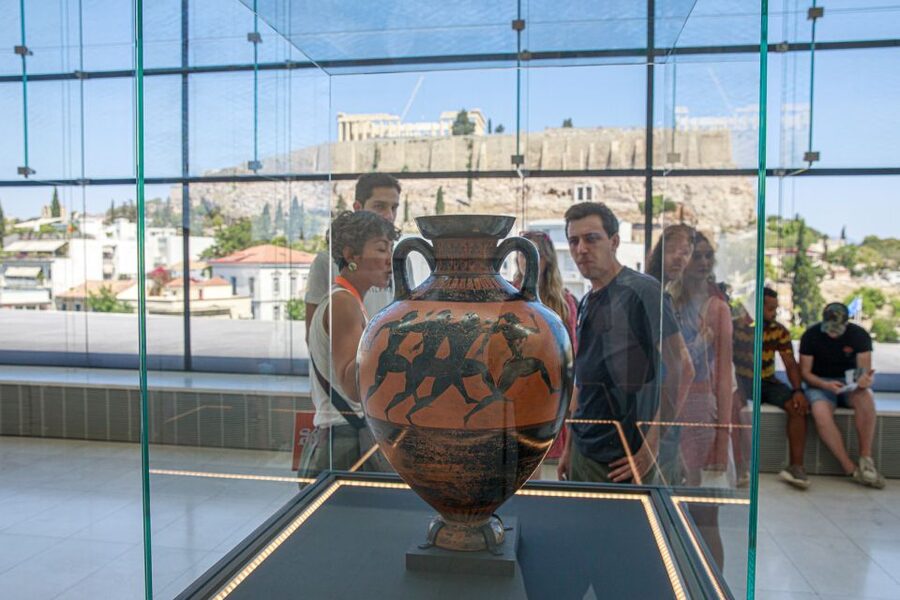
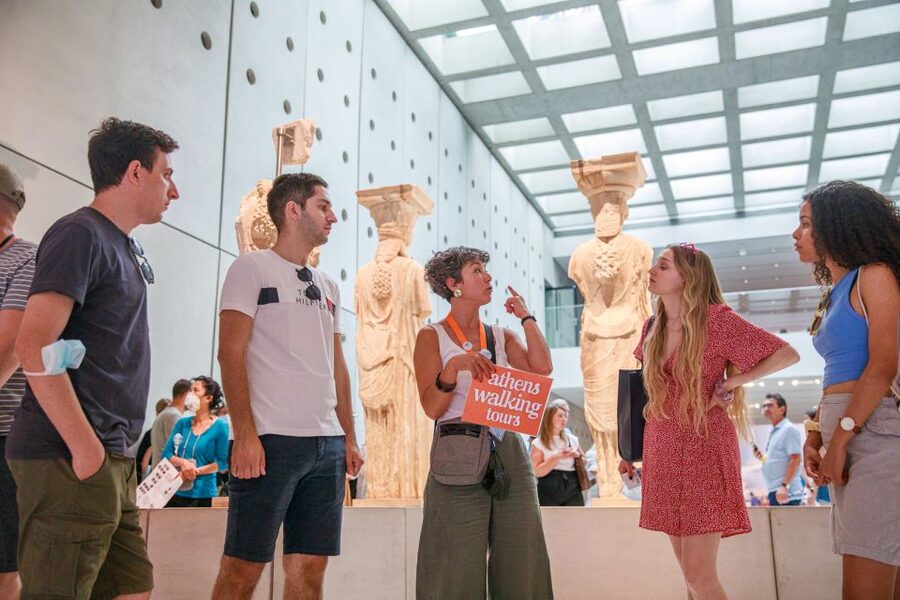
After a short break for a snack or drink, the tour continues to the Acropolis Museum. Food and beverages are not included, so this is a good point to carry your own water and plan for a quick purchase if needed.
The museum was designed by Bernard Tschumi with Greek architect Michalis Photiadis. Its glass floors reveal excavations below, making the building itself part of the archaeological story. Instead of viewing the Acropolis as an isolated hill, you see the material found there arranged in a clear museum setting.
About 4,000 artifacts are displayed. Natural light, open exhibition areas, and views back toward the Acropolis help connect the objects to their original setting. The museum is especially useful after the hilltop visit because you can look closely at sculpture and architectural details that are difficult to study outdoors.
I consider the museum essential rather than an optional add-on. The Acropolis shows you the buildings in place. The museum lets you examine the art, fragments, and surviving details at close range. If you have children or teenagers, the shift indoors can also provide a needed break after the uphill walk.
The private format is valuable here. You can stop longer at an object that catches your eye, ask about a particular myth, or move on when the group’s attention fades. Guides including Theodora, Anna, and Alex have been praised for discussing archaeology, philosophy, language, and Greek culture beyond the basic monument facts.
What $318 buys you
At $318 per person, this is an expensive Athens activity, particularly because admission tickets are extra. You are paying for a private English-speaking licensed guide, not for transportation, meals, or a bundled entry pass.
The value depends on your priorities. If you have only 36 hours in Athens, the tour can organize a large amount of sightseeing into one route and spare you the work of navigating between sites. If you are visiting the Acropolis for the first time, the guide’s explanations can turn familiar images into a more complete understanding of the city.
The price is harder to justify for a solo visitor or a couple mainly interested in seeing the Parthenon quickly. You could visit the monuments independently for less, though you would need to arrange tickets, plan your route, and supply your own context.
For families, older children, and groups with mixed interests, the private setup makes more sense. Guides have adjusted explanations for children, teenagers, experienced adults, and slower walkers. That kind of personal attention is difficult to get in a large group, especially on a crowded hill.
Timing, tickets, and practical preparation
The tour lasts 5.5 hours, with starting times based on availability. The Acropolis uses strict entry times, so arrive early at the Syntagma meeting point. The guide cannot wait for late arrivals, and the tour fee is not refunded if you miss the timed entry.
You must buy your entrance tickets separately through the designated Athens Walking Tours ticket link. Select the correct category, such as adult or student, and enter the booking reference number beginning with GYG. If you qualify for a reduced or free ticket, bring official documents and identification showing your age and nationality. Without the required proof, you may be denied entry or asked to pay the full price if tickets remain.
Bring:
- Comfortable shoes with good grip
- Water and some cash
- A hat and weather-appropriate clothing
- Identification if using a reduced or free ticket
The tour runs in rain or sunshine. It is not suitable for strollers, large luggage, wheelchair users, or people with mobility impairments. You can cancel up to three days in advance for a full refund, which gives you some protection when plans change.
Who should book this private Athens tour?
I would choose this tour for a first visit, a short stay, or a family group that wants one well-organized introduction to Athens. It is also a good fit if you care about archaeology and want to ask questions as you go.
You should be ready for a serious walking day. Heat, steps, uneven stone, security checks, and the extra ticket cost are not minor details. If those sound tiring rather than worthwhile, an Acropolis-only visit may suit you better.
The strongest part of this experience is the human guide. Names such as Annie, Tina, Margarita, Vicky, and Panagiota are associated with the friendly, adaptable style this format needs. A private guide can make the difference between seeing old stones and understanding why those stones changed the city.
FAQ
Where does the tour meet?
Meet your guide inside Syntagma metro station, one level down, beside the ticket-validating machines under the large central hanging clock. Look for the orange Athens Walking Tours sign.
How long does the tour last?
The tour lasts 5.5 hours. Starting times vary, so check availability when booking.
Are entrance tickets included?
No. You must purchase the Acropolis and Acropolis Museum entrance tickets separately through the designated ticket link.
Is the tour private?
Yes. It is a private-group tour with a professional licensed English-speaking guide.
Does the tour include hotel pickup?
No. Hotel pickup and drop-off are not included. You meet the guide at Syntagma metro station.
Is the tour suitable for wheelchair users or strollers?
No. The route involves extensive walking on uneven ground and is not suitable for wheelchair users, people with mobility impairments, or baby strollers.
What happens if I arrive late?
The Acropolis has strict entry times, so the guide cannot wait for latecomers. Missing the timed entry can mean losing the tour without a refund.
Should you book it?
Book this tour if you want the Acropolis explained in context, prefer a private pace, and can handle a long walking day. The route covers more than the Parthenon, and the museum gives the ancient site much greater meaning.
Skip it if you want a low-cost admission visit, need step-free access, or would rather explore slowly on your own. For most first-time visitors with limited time, though, the combination of a private guide, south-slope approach, city sights, Acropolis monuments, and museum makes this a strong, though pricey, introduction to Athens.
Newly reviewed around Athens
- Athens: workshop for painting landscape with local artist★ 4.6 · 3 reviews
- Athens: Greek Wine & Olive Oil Tasting at Brettos Plaka★ 4.5 · 3 reviews
- Acropolis of Athens: 60′ Tour in a Vintage Motorcycle★ 5.0 · 4 reviews
- Ultimate Tasting of the Volcanic Wines of Greece★ 5.0 · 3 reviews
- Outdoor Yoga and Pilates with Akropolis view★ 4.0 · 5 reviews
- workshop for painting acropolis/landscape with local artist★ 5.0 · 3 reviews
- Athens at Twilight Night Tour with Drinks and Meze Dishes★ 4.8 · 4 reviews
- Breakfast in the markets with olive oil and honey tasting★ 4.8 · 8 reviews
Athens Acropolis Tours, compared.
Acropolis & up to 5 Archaeological Sites Combo Pass
Read our review →
Acropolis, Parthenon & Acropolis Museum Guided Tour
Read our review →
Acropolis, Parthenon & Acropolis Museum Guided Tour
Read our review →
Acropolis monuments & Parthenon Walking Tour with Optional Acropolis Museum
Read our review →Browse the lists this tour appears in